
Within the order Phasmatodea (stick and leaf insects), the genus Carausius belongs to the tribe Lonchodini. Because every member in the genus resembles a twig, it is similar to the Phasmatodea in many aspects. They are parthenogenetic species.
The most popular stick insect kept in captivity is Carausius morosus.
Classification of Carausius (Stick Insect)
Phylum – Arthropoda (Jointed Appendages)
Class – Insecta (3 pairs of legs.)
Sub-class – Pterygota (Winged insects.)
Division – Exopterygota (Wings develop externally.)
Order – Orthoptera (Straight wings.)
Genus – Carausius (Stick Insect)
Habit and habitat
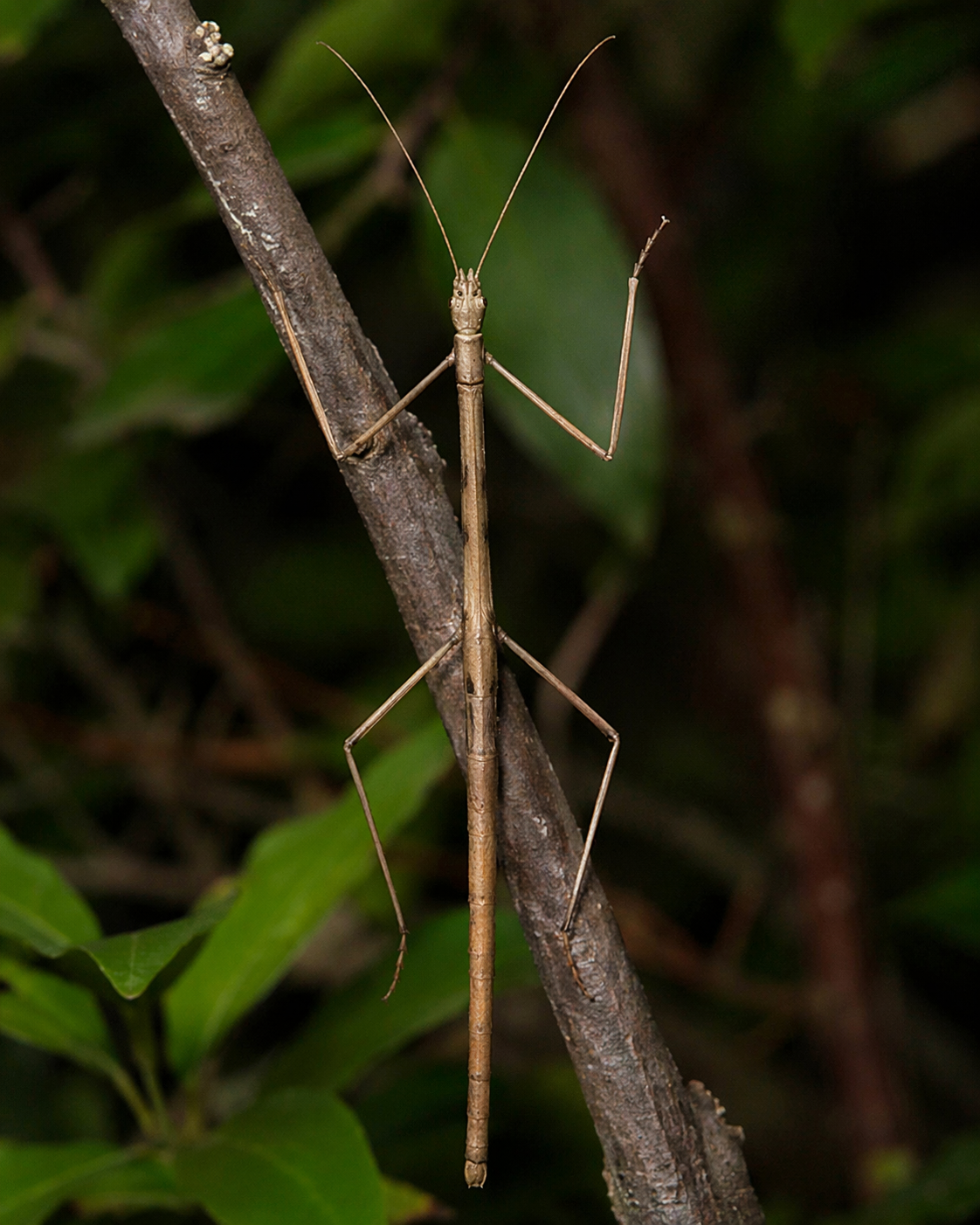
Carausius found in tropical forests and thick foreleg vegetation. All the species are vegetable feeders.
Distribution
It is found in India, Myanmar, Srilanka, other Asian countries and Europe.
Comments on Carausius (Stick Insect)
- Commonly called as stick insect.
- It is called as walking stick, because its slender body resembles a twig or stick and is a greatly modified orthopteran attaining 22.5 to 32.5 cm in length.
- This insect has great power of mimicry and shows changes in colour like its environment and jumps swiftly.
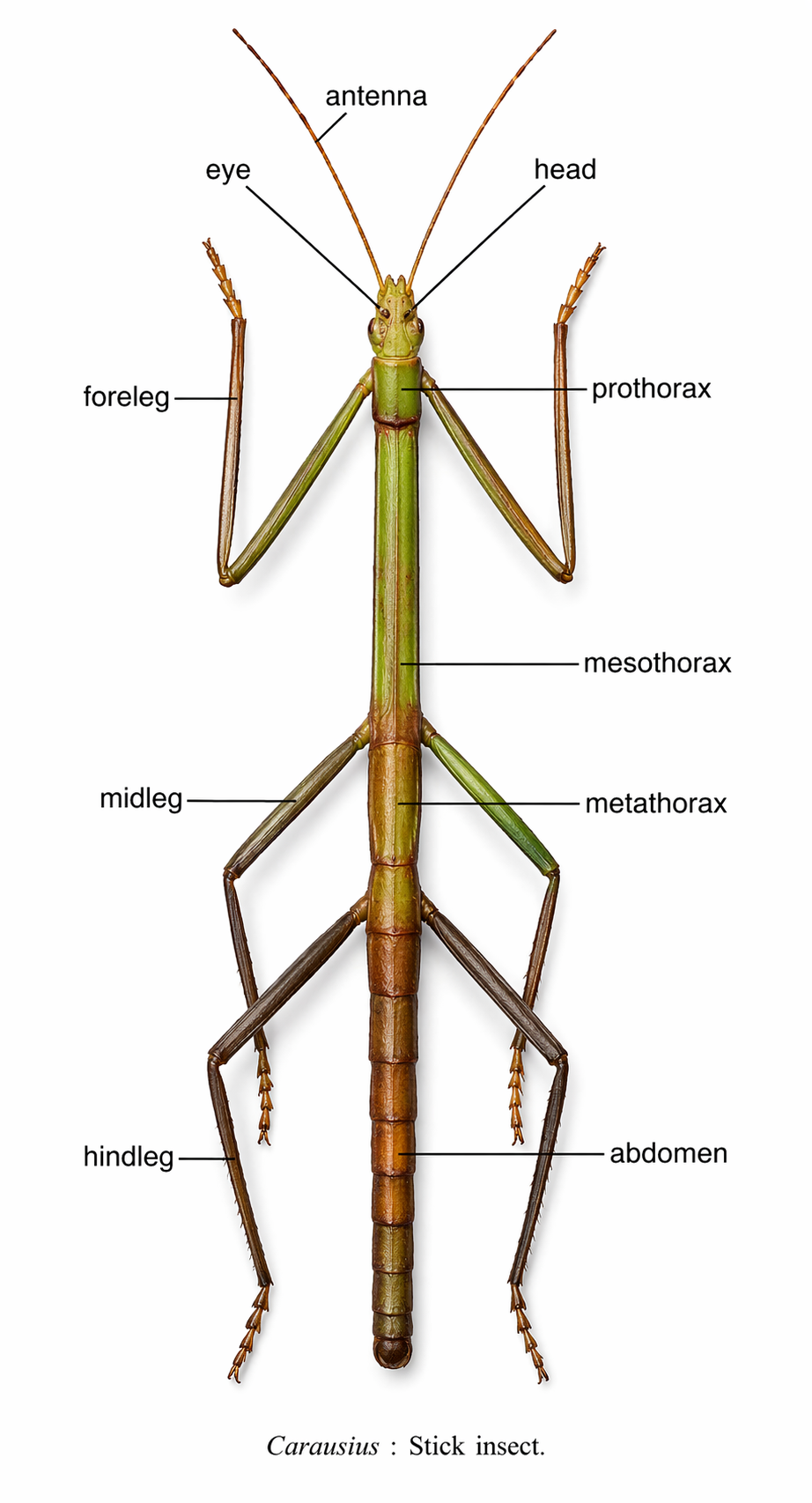
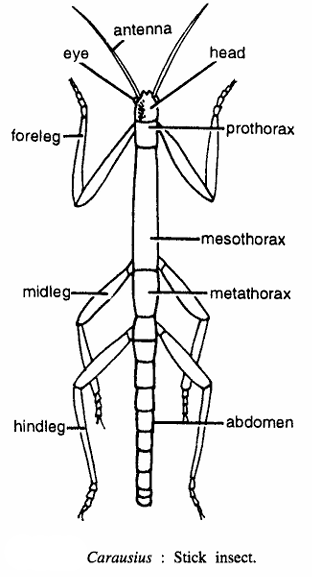
- Body is differentiated into head, thorax and abdomen.
- Head is small containing small antennae and a pair of hindleg compound eyes.
- Thorax has prothorax, mesothorax and metathorax. Thorax is small, containing 3 pairs of flattened leaf coloured legs.
- Anterior part of thorax is fused with head forming pro thorax. Pro thorax is short, while mesothorax and metathorax are elongated.
- Abdomen is also elongated and consists of 9 segments.
- Tegmina small or absent.
- Walking legs are three pairs, simple and adapted for walking.
- The tarsi are usually 5 jointed.
- Sexes are separate.
- The male is small, active and winged and the female is large, sluggish and apterous. Ovipositor rudimentary.
Special features
They are the leaf feeders of the trees. They sometimes are sufficiently abundant to defoliate large areas of woodland. Insects are never conspicuous. Their stick like appearance and green or brown colouring gives them almost perfect protection from observation without close scrutiny. They move very slowly and act as dead if disturbed.
Identification
Since the body is like stick with cylindrically elongated head, thorax, abdomen and all above features, hence it is stick insect.
See other posts also
- Schistocerca (Locust)
- Pinctada vulgaris
- ORGANIZATION OF COELOM
- Larval Forms in Echinodermata
- Larval Forms of Crustaceans
Discover more from Zoologyverse
Subscribe to get the latest posts sent to your email.