
Chiloscyllium, commonly known as True dogfish in traditional zoology practical studies, is a small, bottom-dwelling cartilaginous shark belonging to the family Hemiscylliidae. The family includes the bamboo sharks, which are generally slender and adapted to life near the sea floor.
The species Chiloscyllium indicum, commonly called the slender bambooshark, is an important representative of this group. It occurs mainly in shallow tropical coastal waters of the Indo-West Pacific region. It is generally found over sandy, muddy, rocky and coral-associated bottoms.
The animal has an elongated body, relatively long snout, small eyes, nasal barbels, five pairs of gill openings, two dorsal fins and a strongly asymmetrical caudal fin. Unlike Scoliodon, which is viviparous, Chiloscyllium indicum is oviparous and lays eggs enclosed in protective egg cases.
For zoology practical examinations, the specimen is particularly useful for studying the external features of an elasmobranch and for distinguishing an oviparous shark from viviparous forms.
For Practical Study
The following notes are arranged in a practical examination format for easy study and identification.
Classification of Chiloscyllium (True Dogfish)
| Rank | Classification | Characteristic |
|---|---|---|
| Kingdom | Animalia | Multicellular, heterotrophic organisms without a cell wall. |
| Phylum | Chordata | Dorsal nerve cord and other chordate features are present during development. |
| Subphylum | Vertebrata | Cranium and vertebral column are present. |
| Division | Gnathostomata* | Jaws and paired appendages are present. |
| Superclass | Pisces* | Traditional zoological grouping of aquatic vertebrates with fins and gills. |
| Class | Chondrichthyes | Endoskeleton is predominantly cartilaginous |
| Subclass | Elasmobranchii | Includes sharks and rays |
| Order | Orectolobiformes | Carpet sharks |
| Family | Hemiscylliidae | Small slender sharks |
| Genus | Chiloscyllium | Long slender body |
Note: Gnathostomata and Pisces are retained as traditional practical-zoology ranks. Modern taxonomy places Chiloscyllium indicum within Elasmobranchii → Orectolobiformes → Hemiscylliidae.
Geographical Distribution
Chiloscyllium indicum has an Indo-West Pacific distribution. It is recorded from the coastal waters of the Indian subcontinent and surrounding tropical regions, including India and Sri Lanka, with records extending into parts of Southeast Asia.
The species is primarily associated with tropical coastal waters. Because older records of Chiloscyllium from some regions have subsequently been reassigned to other species, historical distribution records should be interpreted carefully.
Habit and Habitat
The True dogfish is mainly a sluggish, demersal shark that remains close to the sea floor.
It is associated with:
- Shallow coastal waters
- Bays and inlets
- Sandy bottoms
- Muddy substrates
- Rocky areas
- Coral-associated habitats
Chiloscyllium indicum has been recorded from marine and brackish environments and may occur at considerable depths for a shallow-water shark. It generally spends much of its time near the bottom while resting or searching for food.
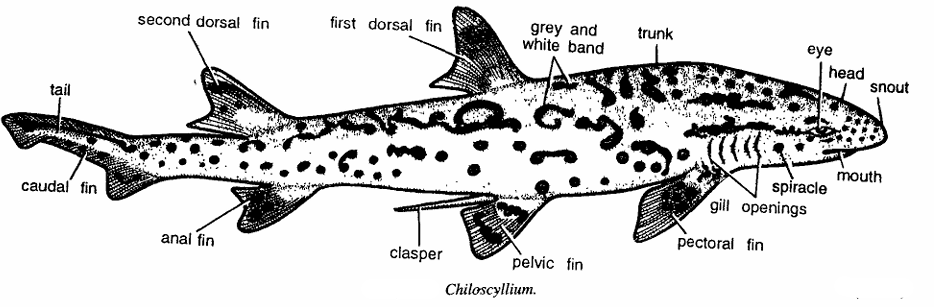
Characteristics Of Chiloscyllium (True Dogfish)
- Body elongated and slender.
- Head broad and flattened.
- Snout relatively long and rounded.
- Eyes small and dorsolateral.
- Spiracles present behind the eyes.
- Nasal barbels present.
- Mouth small and ventral.
- Five pairs of separate gill openings present.
- Skin covered with placoid denticles.
- Two dorsal fins present.
- One anal fin present.
- Paired pectoral and pelvic fins present supported by pectoral girdle and pelvic girdle.
- Caudal fin strongly asymmetrical.
- Body generally brownish above and pale below.
- Dark spots occur on the body and fins.
- Reproduction is oviparous.
Special Features
The important special features of Chiloscyllium indicum are:
- The body has characteristic dark spots.
- It possesses a cartilaginous endoskeleton.
- The body is elongated and slender.
- Nasal barbels are present.
- Five pairs of separate gill openings occur on each side.
- Placoid denticles cover the skin.
- Two dorsal fins are present.
- A single anal fin is present.
- The caudal fin is strongly asymmetrical.
- It is mainly a bottom-dwelling shark.
- It is oviparous.
- Eggs are enclosed in protective egg cases.
Identification
The specimen can be identified by the following combination of characters:
Elongated slender body, long rounded snout, nasal barbels, five pairs of gill openings, two dorsal fins, spotted body and strongly asymmetrical caudal fin.
The presence of nasal barbels, together with the elongated body and spotted colour pattern, is particularly useful for practical identification.
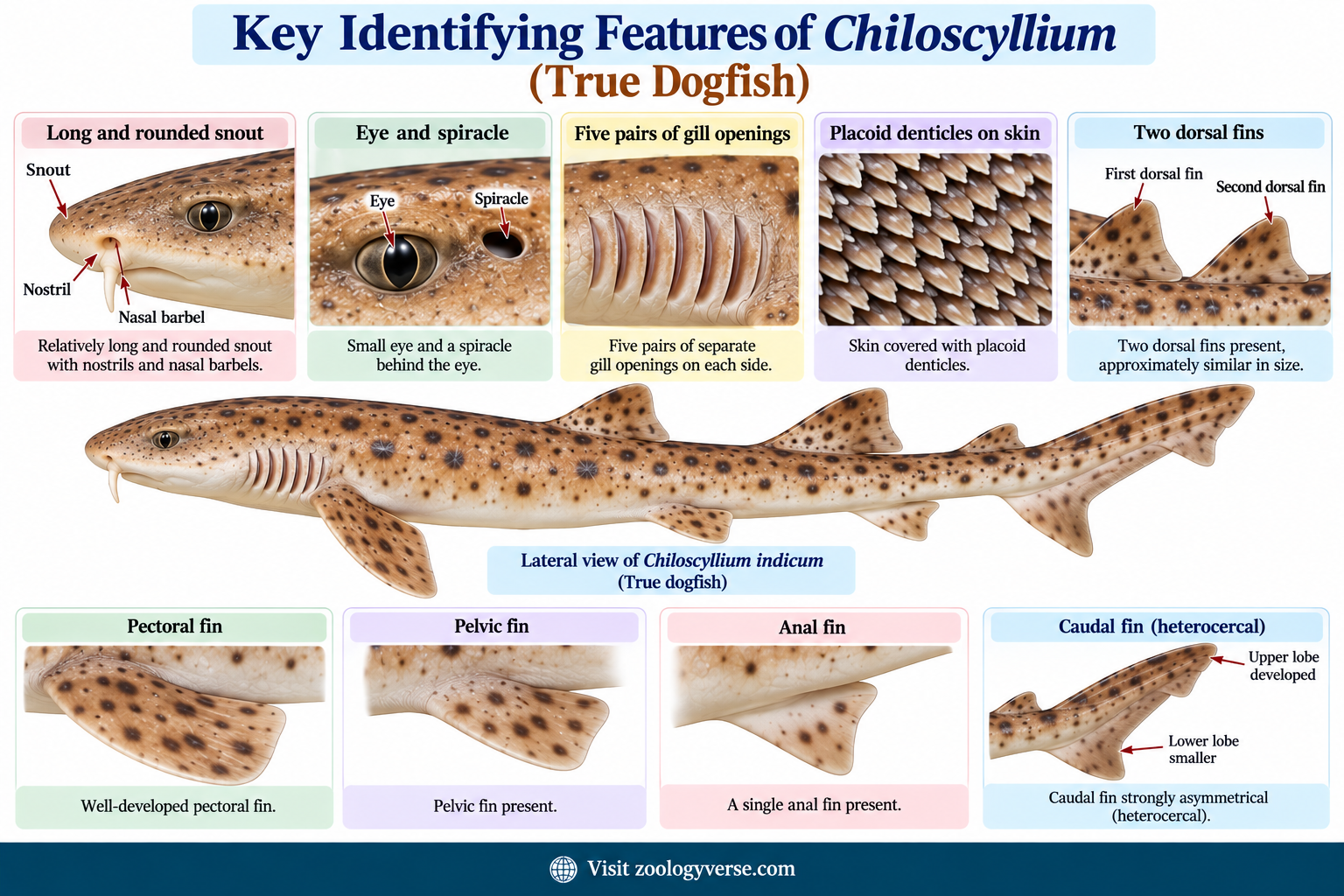
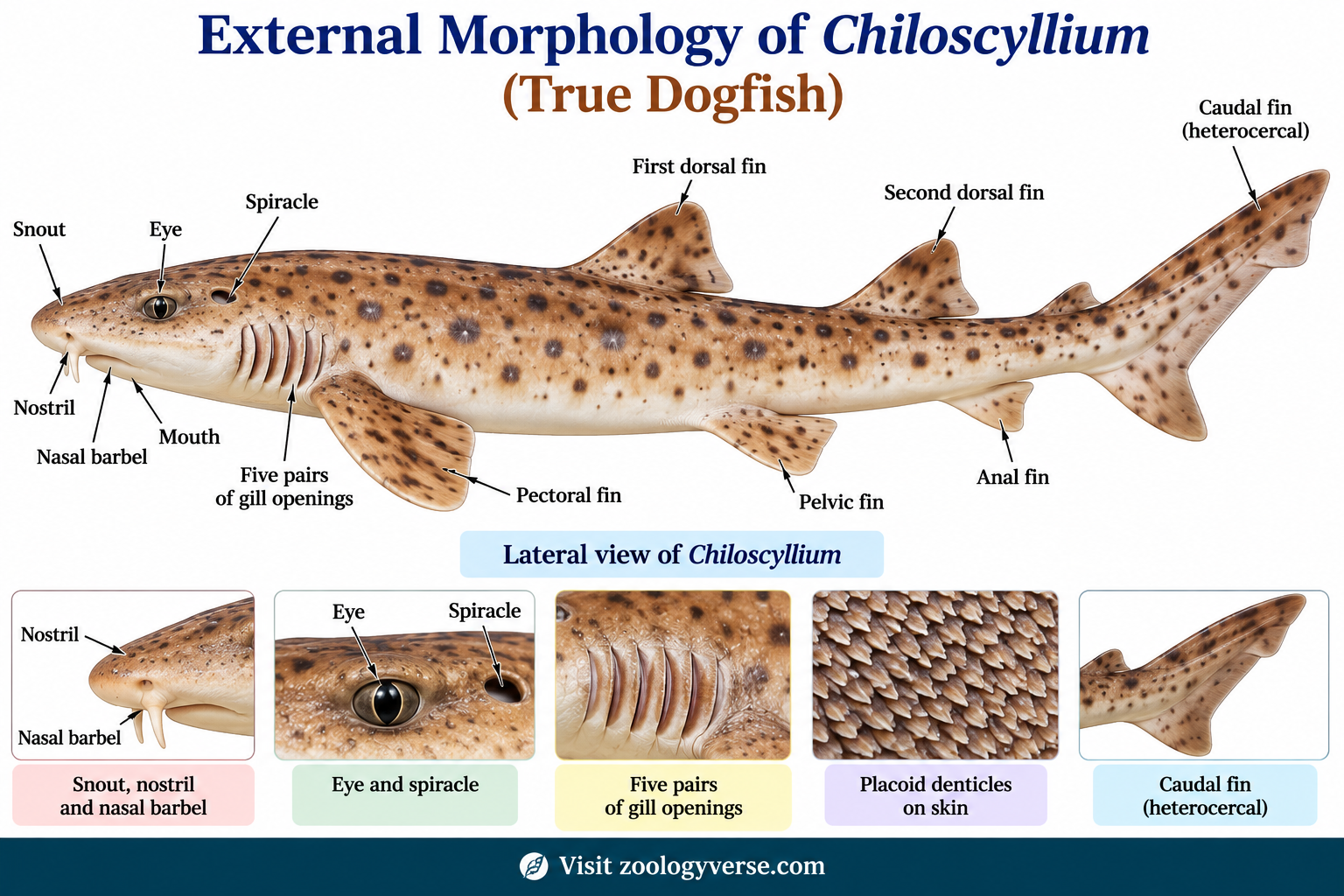
External Morphology of Chiloscyllium
The body is elongated and slender and gradually tapers toward the tail. The animal has the general external organization characteristic of elasmobranchs.
Body :- The body is elongated and somewhat cylindrical. It gradually becomes narrower toward the posterior end. The skin is rough because it bears numerous placoid denticles. These dermal denticles give the surface a sandpaper-like texture.
Head and Snout:- The head is relatively broad, while the snout is long and rounded. The anterior region of the head bears the nostrils and characteristic nasal barbels. These barbels are useful in identifying the specimen.
Eyes and Spiracles :- The eyes are small and situated on the upper lateral region of the head. A pair of spiracles occurs behind the eyes. Spiracles allow water to enter the respiratory system, particularly when the animal is resting near the bottom.
Mouth :- The mouth is small and transverse and is situated on the ventral surface of the head. The teeth are relatively small and are adapted mainly for grasping and holding prey.
Gill Openings :- Five pairs of separate gill openings occur on each side of the head. The gill openings are not covered by an operculum, as occurs in bony fishes.
Fins :- The fins include:
- One pair of pectoral fins
- One pair of pelvic fins
- Two dorsal fins
- One anal fin
- One caudal fin
- The dorsal fins are positioned along the posterior region of the body.
Caudal Fin:- The caudal fin is strongly asymmetrical and therefore shows a heterocercal condition. The upper portion is more developed than the lower portion. The caudal fin contributes to propulsion during swimming.
Colouration :- The dorsal surface is generally light brown or brownish, while the ventral surface is paler. Numerous dark spots or markings may occur over the body and fins. The colour pattern provides an additional external identification feature.
Digestive System of Chiloscyllium
The digestive system is adapted to its carnivorous and bottom-feeding habit.
Mouth and Buccal Cavity :- The mouth is situated ventrally and contains small teeth. The teeth help seize and retain prey. Food passes from the mouth into the buccal cavity and then into the oesophagus.
Oesophagus :- The oesophagus is a short muscular tube connecting the buccal region with the stomach. Its muscular wall helps transport swallowed food toward the stomach.
Stomach :- The stomach is a muscular sac where food is stored temporarily and subjected to gastric digestion. Digestive secretions help break down proteins and other components of the food.
Intestine :- The intestine is relatively short. A spiral intestinal valve increases the internal surface area and slows the passage of food, allowing more efficient absorption of nutrients.
Rectum and Cloaca :- The posterior part of the intestine leads toward the cloaca. The cloaca is a common chamber associated with the terminal digestive, urinary and reproductive systems.
Also Check our post for a comparative account, see the digestive system in vertebrates.
Feeding and Food
The True dogfish is primarily a carnivorous bottom feeder.
It searches for food near the substrate and feeds mainly on small aquatic animals. Its diet may include:
- Small fishes
- Crustaceans
- Molluscs
- Other small benthic invertebrates
The small teeth help grasp prey, while the relatively sluggish body form is suited to searching for food close to the bottom rather than pursuing fast-swimming prey over long distances.
Respiratory System of Chiloscyllium
The respiratory system is adapted for aquatic respiration.
Water enters through the mouth and, particularly when the animal is resting, through the spiracles. It passes over the gills, where oxygen is absorbed and carbon dioxide is released.
There are five pairs of gill openings on each side of the head.
The gills are supported by cartilaginous structures. Unlike bony fishes, the gills do not open into a single opercular chamber covered by an operculum.
The spiracles are especially useful in a bottom-dwelling shark because they can allow water to enter while the mouth remains close to the substrate.
Also check our article on respiratory System in Vertebrates.
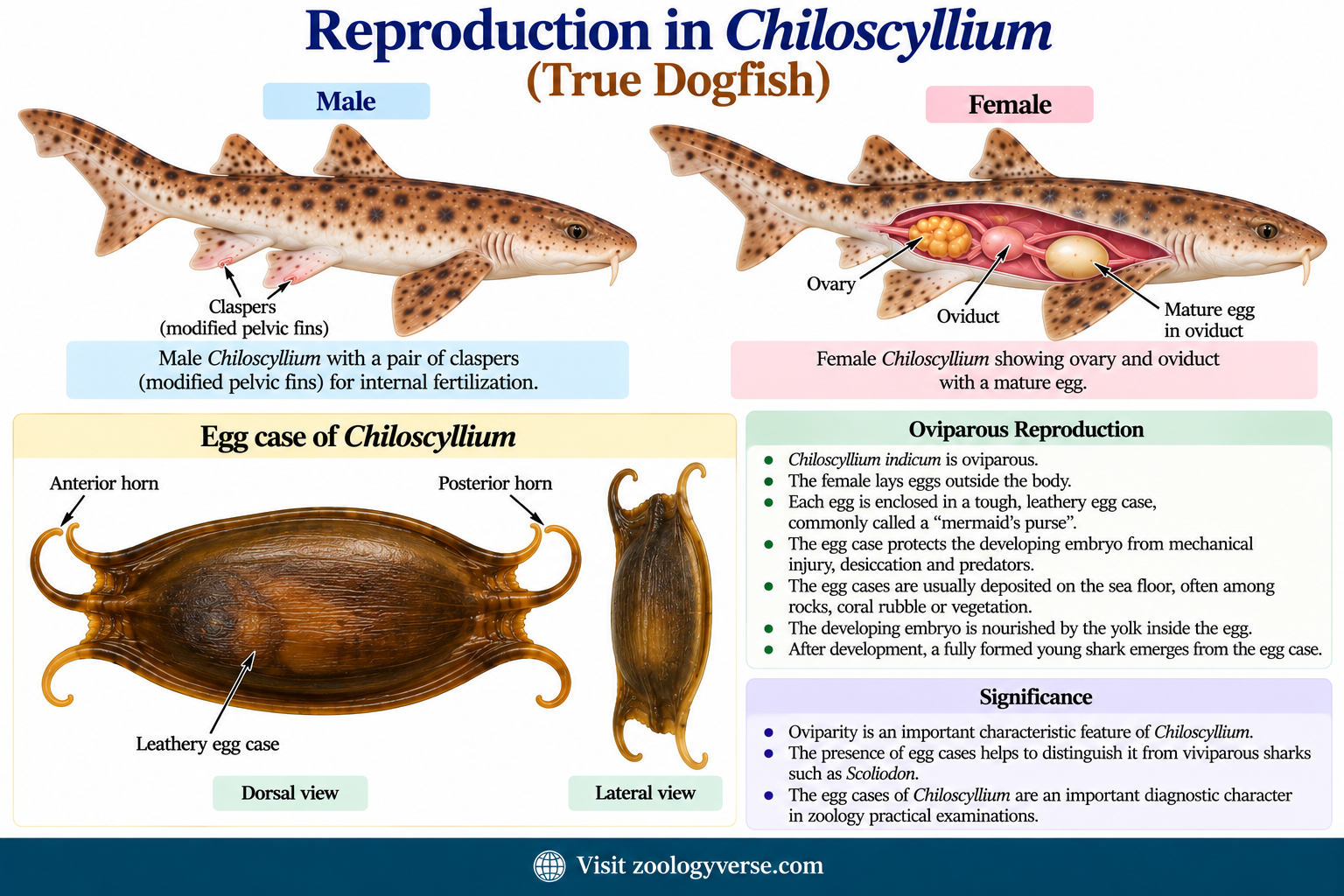
Reproduction in Chiloscyllium
One of the most important biological features of Chiloscyllium indicum is its mode of reproduction.
It is oviparous, meaning that the female lays eggs outside the body.
The eggs are enclosed within protective egg cases. The developing embryo remains inside the egg case and receives nourishment primarily from the yolk.
This reproductive condition is an important distinction between Chiloscyllium and Scoliodon. Scoliodon is viviparous, whereas Chiloscyllium indicum lays eggs.
Sexes and fertilisation :- The sexes are separate (dioecious), and sexual dimorphism is present. Fertilisation is internal. The male transfers sperm into the female’s cloaca using his claspers, so the eggs are fertilised before the egg case is formed.
Male reproductive system :- Males bear a pair of claspers, which are rod-like modifications of the inner part of the pelvic fins. Claspers are the easiest external feature for identifying the sex of a specimen. The internal organs include a pair of testes, which produce sperm, and ducts that carry the sperm to the cloaca.
Female reproductive system :- Females lack claspers. The internal organs include the ovaries, which produce large yolk-rich eggs, and the oviducts. A shell gland (nidamental gland) in the oviduct secretes the protective case around the egg. The eggs are then laid on the sea floor.
Remember: presence of claspers = male. Internal fertilisation + egg case = oviparous elasmobranch.
Egg Case :- The egg case protects the developing embryo from external environmental conditions and predators.
The egg case is generally leathery and encloses the developing embryo along with the yolk supply. The oviparous mode of reproduction is one of the most important biological features to remember when studying this specimen.
Another oviparous member of Orectolobiformes is Stegostoma (tiger shark).
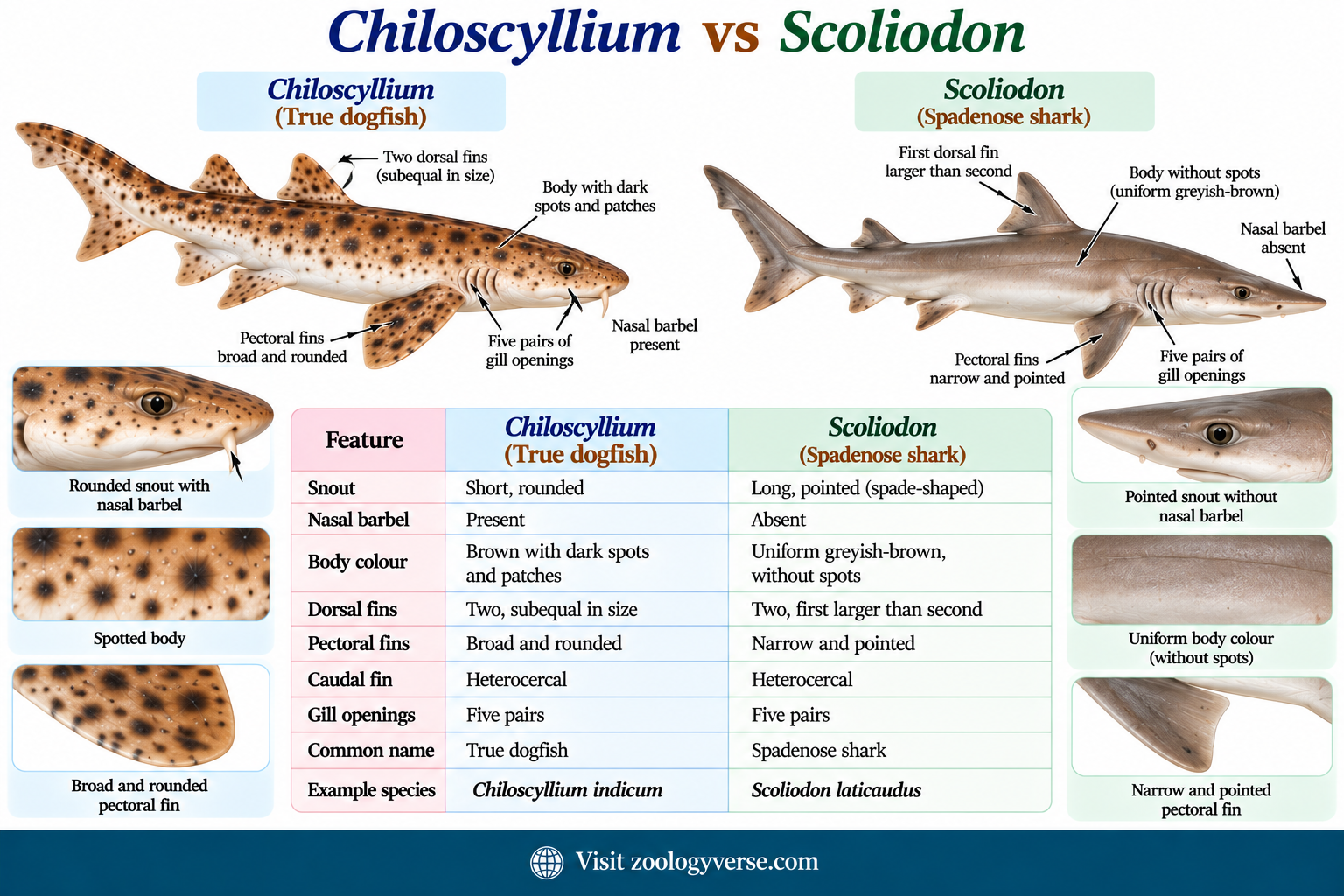
Chiloscyllium vs Scoliodon
Both Chiloscyllium and Scoliodon are cartilaginous sharks and may be encountered in zoology practical studies. However, several characters help distinguish them.
| Feature | Chiloscyllium | Scoliodon |
|---|---|---|
| Common practical name | True dogfish | Dogfish |
| Family | Hemiscylliidae | Carcharhinidae |
| Order | Orectolobiformes | Carcharhiniformes |
| Body | Slender and elongated | Streamlined |
| Snout | Long and rounded | Broad and flattened |
| Nasal barbels | Present | Absent |
| Gill openings | Five pairs | Five pairs |
| Reproduction | Oviparous | Viviparous |
| Egg cases | Present | Absent |
| Habitat | Mainly demersal | Coastal and demersal |
| Body markings | Dark spots | Generally plain or less distinctly spotted |
The presence of nasal barbels and egg cases are particularly useful characters for distinguishing Chiloscyllium from Scoliodon.
Economic Importance
The economic importance of Chiloscyllium indicum is relatively limited compared with larger commercially important sharks.
It may be caught as part of inshore fisheries and may be used as food in some regions.
Its greater importance in zoology is educational. It provides an example of an elasmobranch with a distinctive external structure and an oviparous mode of reproduction.
Conservation Status
Chiloscyllium indicum is currently assessed as Vulnerable (VU) on the IUCN-linked information reported by FishBase, with the assessment dated 28 May 2020. The species may be affected by fishing pressure and habitat disturbance in shallow coastal environments. Protection of coastal habitats and sustainable fishing practices are therefore important for its conservation.
Key Takeaways: Chiloscyllium
- Chiloscyllium is a cartilaginous shark.
- It is traditionally called True dogfish in practical zoology.
- The representative species discussed here is Chiloscyllium indicum.
- It belongs to family Hemiscylliidae.
- Modern classification places it in order Orectolobiformes.
- The body is elongated and slender.
- The snout is long and rounded.
- Nasal barbels are present.
- Five pairs of gill openings occur.
- Placoid denticles cover the skin.
- Two dorsal fins and one anal fin are present.
- The caudal fin is strongly asymmetrical.
- The body has characteristic dark spots.
- It is mainly a demersal shark.
- It feeds on small aquatic animals and bottom-dwelling organisms.
- It is oviparous.
- Eggs are enclosed in protective egg cases.
- Its current IUCN-linked status is Vulnerable (VU).
Frequently Asked Questions
What is Chiloscyllium?
Chiloscyllium is a genus of small bamboo sharks belonging to the family Hemiscylliidae. They are mainly bottom-dwelling sharks of tropical coastal waters.
Why is Chiloscyllium called True dogfish?
True dogfish is a traditional practical-zoology name used for this specimen to distinguish it from other sharks commonly called dogfish.
What are the main Characteristics of Chiloscyllium?
The main Characteristics of Chiloscyllium include an elongated slender body, long rounded snout, nasal barbels, five pairs of gill openings, placoid denticles, two dorsal fins, one anal fin and a strongly asymmetrical caudal fin.
Is Chiloscyllium oviparous or viviparous?
Chiloscyllium indicum is oviparous. The female lays eggs enclosed in protective egg cases.
Where does Chiloscyllium live?
It is mainly associated with shallow tropical coastal environments, including sandy, muddy, rocky and coral-associated bottoms.
How can Chiloscyllium be identified in a practical examination?
It can be identified by its elongated body, long rounded snout, nasal barbels, five pairs of gill openings, spotted colouration, two dorsal fins and strongly asymmetrical caudal fin.
Recommended Study Resource
Sharks of the World
by Rodney Steel (Author)
Practical Zoology: Vertebrate
by S. S. Lal (Author)
As an Amazon Associate I earn from qualifying purchases.
References
- FishBase. Chiloscyllium indicum — Species Summary and biological information.
- FishBase. Chiloscyllium indicum — Distribution and country information.
- FAO. Species identification information for Chiloscyllium indicum.
- IUCN Red List. Conservation assessment information for Chiloscyllium indicum.
Discover more from Zoologyverse
Subscribe to get the latest posts sent to your email.