
The genus Sabellaria belongs to the Sabellariidae family of marine polychaete worms. Sabellaria alveolata is the type species (Linnaeus, 1767). These sedentary worms construct tubes out of pieces of shell and sand to survive. When found in large quantities, certain species known as honeycomb worms can create reefs on rocks and other hard surfaces. They are filter feeders that collect plankton and other floating debris by extending a fan of radioles that resembles a plume from the end of the tube. When the radioles are retracted, their characteristic operculum is used to obstruct the tube’s opening.
Classification of Sabellaria
Kingdom :- Animalia (Multicellular eukaryotic organisms)
Phylum :- Annelida (Segmented worms with true coelom and metamerism)
Class :- Polychaeta (Marine bristle worms with parapodia)
Order :- Canalipalpata (Sedentary polychaetes with grooved palps)
Family :- Sabellariidae
Genus :- Sabellaria
Habit and habitat of Sabellaria
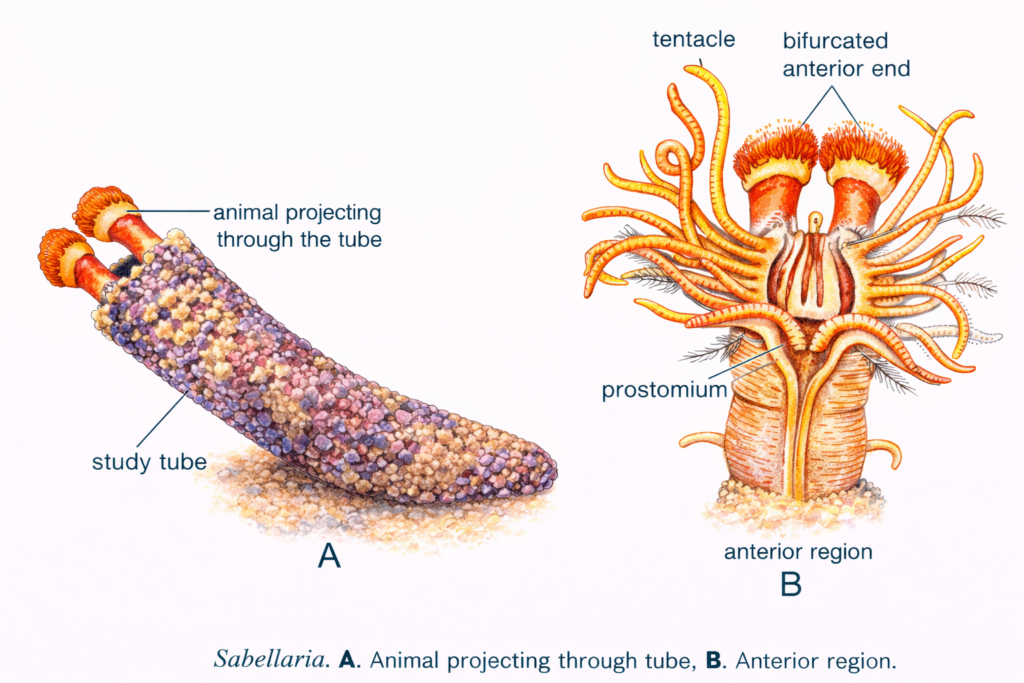
It is a marine, sedentary polychaete, more or less Y-shaped. The animals live in simple tubes in sand formed by them.
Distribution
Found in Europe and U.S.A.
General Characteristics on Sabellaria
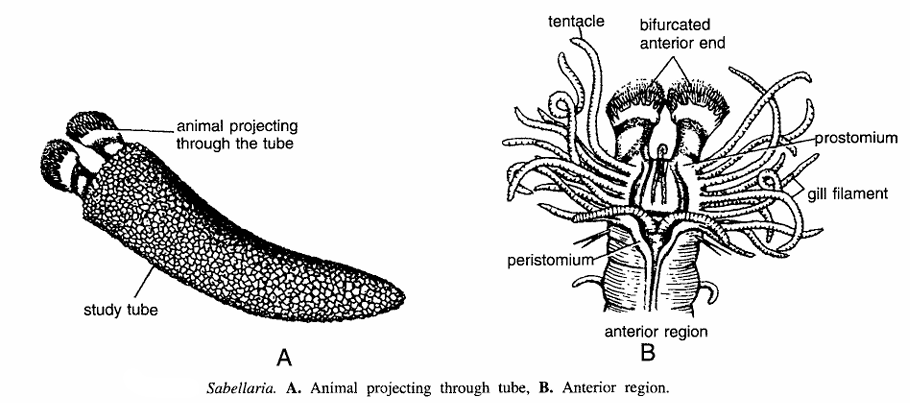
- Body is elongated, segmented and cylindrical with a broad and bifurcated anterior end.
- The rest of the body tapers posteriorly.
- Animal projects through the sandy tube.
- Head is constituted by the prostomium and peristomium.
- The prostomium contains a pair of tentacles.
- Peristomium fuses with the palps and becomes comparatively larger and branched.
- Dorsal cirri are modified as gill filaments.
- Each metamere except first and last possesses a pair of appendages or podia.
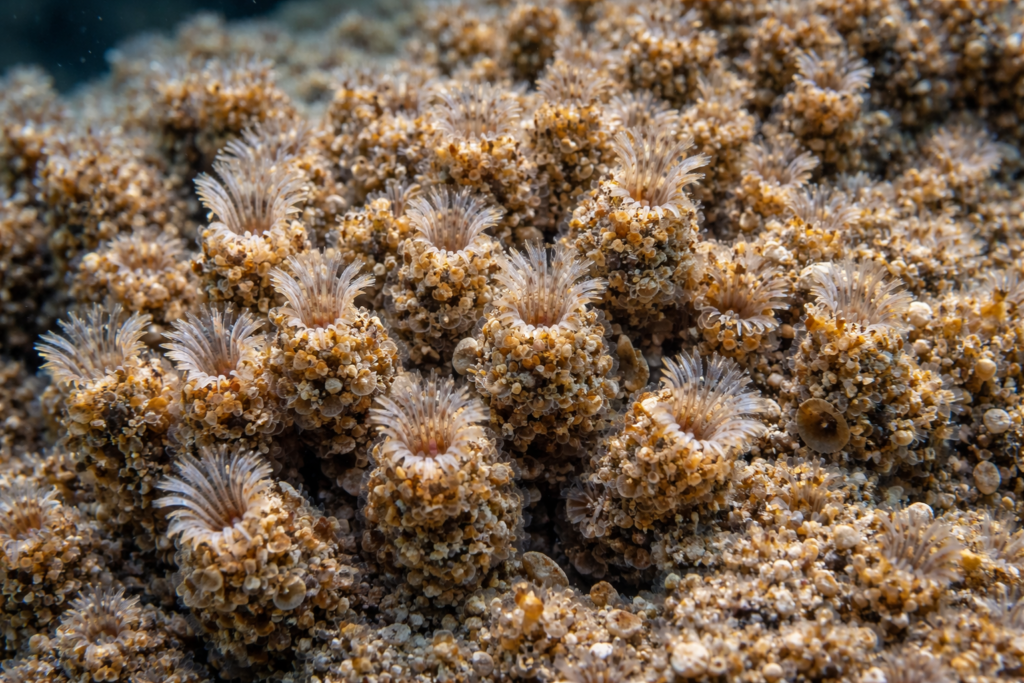
- Sabellaria often occur in large closely set colonies.
- They are filter feeders that collect plankton and other floating debris by extending a fan of radioles that resembles a plume from the end of the tube.
Identification
Since the specimen has bifurcated anterior end and all above characters, hence itis Sabellaria.
See Other Posts Also
- Hantavirus: Symptoms, Causes, Prevention
- DNA – STRUCTURE AND TYPES OF DNA
- STRUCTURE OF PROTEIN – PRIMARY, SECONDARY, TERTIARY AND QUATERNARY
- Modifications of Aortic Arches in Vertebrates
- Integument or Skin and its Derivatives in Vertebrates
Discover more from Zoologyverse
Subscribe to get the latest posts sent to your email.