
Lugworms and black lugs belong to the genus Arenicola, which is commonly referred to as sandworms.
On the coasts of North America and Humboldt Bay, California, A.cristata is the most common warm-water lugworm. While Arenicola marina is primarily found in Europe, including Norway, A. caroledna is more common in China and Japan. Only Southern Africa is home to Arenicola loveni.
Classification of Arenicola
Kingdom :- Animalia (Multicellular eukaryotic organisms)
Phylum :- Annelida (Segmented worms with true coelom and metamerism)
Class :- Polychaeta (Marine bristle worms with parapodia)
Order :- Sedentaria (Tubicolous, sedentary and proboscis not-protrusible, without jaws or teeth)
Genus :- Arenicola (The Lug worm)
Habit and habitat of Arenicola
It is also tubiculous and burrowing polychaete, occurring just below the tide line in sea, where the water is less saline. Animals lives in a J-shaped burrow made of sand and mucus.
Distribution
It is distributed in Europe and U.S.A. (Florida to Cape Cod)
Comments on Arenicola
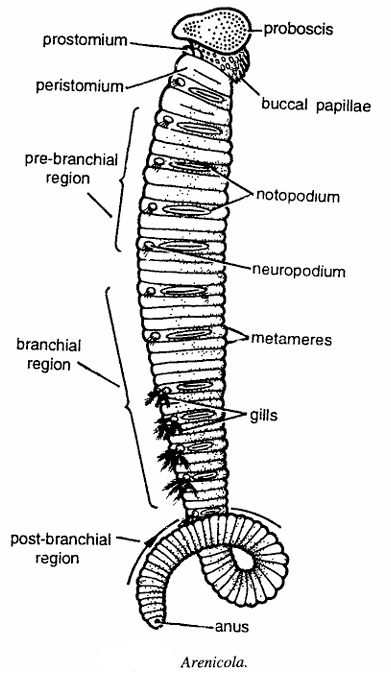
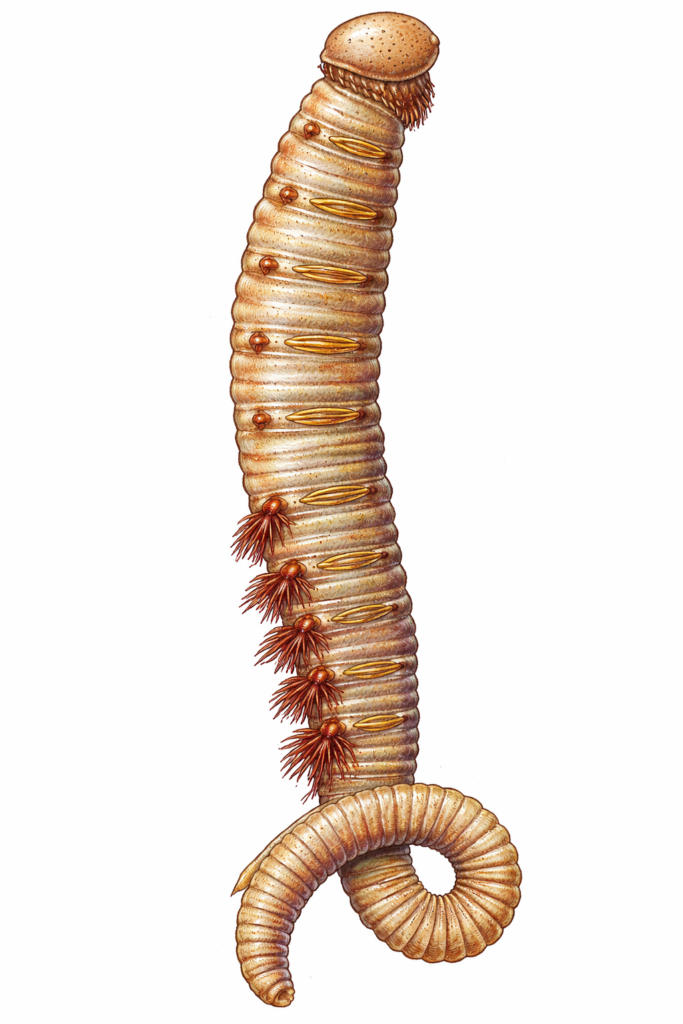
- Body is stout, elongated, cylindrical and approximately 15 cm long, brownish or greenish in colour and divided into metameres.
- Head without appendages and with an unarmed proboscis.
- Animal is differentiated into an anterior pre-branchial, a middle branchial and a posterior post-branchial region.
- Anterior region consists of a small trilobed prostomium with no eyes or tentacles, an achaetus peristomium and 6 segments bearing rudimentary parapodia.
- Parapodia contains reduced notopodium and neuropodium.
- Mouth lies ventral to the prostomium.
- The buccal region and pharynx protrude as proboscis which is covered by chitinized buccal papillae.
- Middle region has 13 segments, each bearing in addition to neuropodia, a pair of extensively branched gills. Nephridia six pairs.
- Posterior region has variable number of segments and devoid of parapodia or gills. Anus opens through last segment.
- Arenicola is generally used as bait for fishing.
Identification
Since the specimen has pre-branchial, branchial and post-branchial regions and all above features, hence it is Arenicola.
See other posts also
Discover more from Zoologyverse
Subscribe to get the latest posts sent to your email.