
Classification of Ostrea verginiana
| Phylum | Mollusca | Soft bodied, non-metameric, shelled. |
| Class | Pelecypoda | Bivalve shell |
| Order | Pseudolamellibranchiata | Gills form vertical folds |
| Genus | Ostrea | |
| Species | verginiana |
Habit and habitat
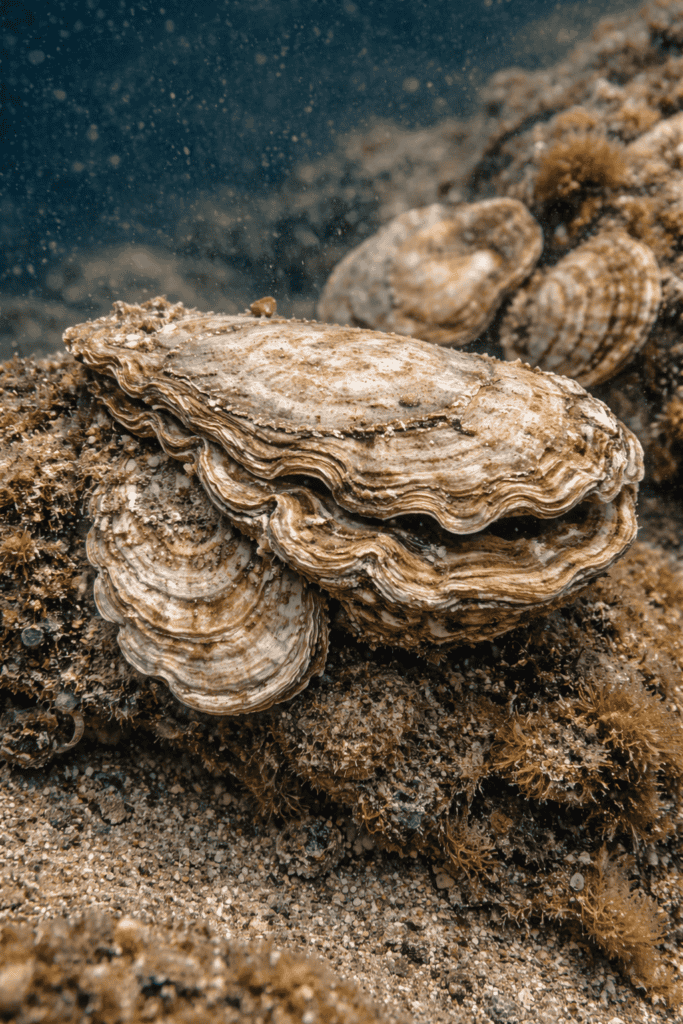
Ostrea is a sedentary bivalve attached to rocks or other shells and abundantly found in shallows and brackish marine water and in all seas except colder ones.
Distribution
It is found in Atlantic and Pacific coasts, India and Gulf of Mexico to Massachusetts.
Comments on of Ostrea verginiana
- Commonly called as edible oyster
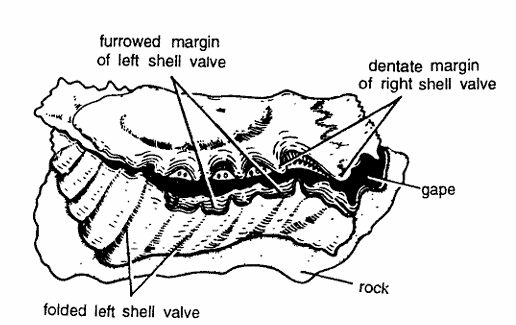
- Shell valves are irregular and variable it:! shape. Very thick and often with folded layers.
- Left valve is large, thick, convex, folded and permanently attached to rocks by byssus.
- Right valve is small and flattened forming lid. Shell ,mrface is rough, irregular and dextate with denticles.
- Foot is totally absent. There is a single adductor muscle, i.e, monomyrian near the middle just in front of heart.
- Umbo and hinge at anterior end. Hermaphroditic or unisexual.
Special features of Ostrea verginiana
The sex is changeable in oysters. Most of the young oysters are male but later on half of them change into female. The egg production (fecundity) is very high. Mortality of eggs is also high. The eggs develop inside the egg and later hatch into veliger larva which settles down and is called as ‘spat’.
Economic importance
The Indian oyster, O. virginiana is highly valued as food. Oysters are cultivated by men like other animal products industry, such as chickens. Oysters have been a favourite food of man from prehistoric times. In addition to their delicious flesh, they are highly nutritious being rich in vitamins and minerals. The Madras Fisheries Department maintains oyster beds in Pulicate Lake, which supply large quantities of cultivated oysters during the season. The shells of oyster are ground up and used as a source of calcium for poultry.
Identification
Since the specimen contains ruffled shell and all above features, hence it is Ostrea.
Discover more from Zoologyverse
Subscribe to get the latest posts sent to your email.