
Environmental Limiting Factors
Limiting Factors – All living things need food, water, shelter and space to survive. As long as organisms have all of these things available to them their population will continue to grow. However, populations can not grow forever. Some form of environmental resistance will stop the population’s growth. The form of environmental resistance is called a limiting factors since it limit the population.
Classification of limiting factors
- Density independent factors
- Density dependent factors
DENSITY INDEPENDENT FACTORS
- Factors that limit population size, regardless of population density.
- These are usually abiotic factors.
- Example are natural disasters, temperature, sunlight, human activities physical characteristics and behaviors of organism affect any and all populations regardless of their densities.
Natural Disasters – Natural disasters such as droughts, flood, hurricanes and fires can be devastating to aquatic life. For example, a serve drought could lower the water levels of lake and decrease its carrying capacity. Thus the fish population would decrease.
Temperature – Temperature influences the activity and growth of organisms. If temperature vary too much out the range of the species will either die or move to different location. Temperature also influences the chemical properties of water. The rate of chemical reaction in the water increases as the temperature increases. For example, warm water holds less oxygen than cool water, so even though there activity in warm water there may not be enough oxygen for the activity to continue for long periods of time.
Sunlight – Sunlight can only penetrate to a depth of 30 meters in water. Thus most photosynthesis in aquatic environments occurs near the surface. This means that most plants cannot grow if they are at the bottom of a deep lake.
Physical Characteristics – Physical characteristics of organisms can affect their population. Many organisms have adapted and evolved in order to increase their chance of survival. For example, some species use camouflage colors to help them hide and avoid being eaten.
Behaviour – Behaviour of organisms can also affect their population. For example, some species migrate to find new food sources or to mate. Some organisms create societies or feeding territories.
Density Dependent Factors
- Any factor in the environment that depends on the number of members in a population per unit area.
- These are usually biotic factors.
- Example are competition, predation, disease, etc and these factors only affect population with high densities.
Competition – Competition can occur between many organisms that live in same habitat. Resources are limited in a habitat so organisms must compete for food, water, space and shelter. Competition occur between individuals of same species are called Intraspecific. Competition occur between individuals of different species are called interspecific.
Predator and prey relationships – Predators/prey relationships play a big role in animal population. If the balance between predator prey changed. Population are changed. Predation occurs when the population density of predators is high. The predators will consume their prey and increase their own population. However, the population of the prey will decrease. On the other hand, the lack of predation will cause problems for the prey’s population. When there are few predators, the prey’s population increases very quickly and this can lead to the depletion of resources.
Parasitism – Parasitism is a relationship in which one species benefits at the expense of the other. A parasite is an organism that lives in or in another organism (called a host) to get nourishment. While the parasite benefits from this relationship the host is harmed or killed.
Crowding – Crowding only occurs at high densities. Over-crowding can cause depletion of resources disease and stress.
Stress – Stress usually has a negative effect on populations. Stress can make organisms weak and more prone disease.
Laws of limiting factors
- Blackman’s law of limiting factors
- Liebig’s law / law of minimum
- Shelford’s law of tolerance
Blackman’s law of limiting factors
- Blackman proposed the law of limiting factors in 1905.
- According to this law, when a process depends on a number of factors, its rate is limited by the pace of the slowest factor.
- For example, Water, carbon dioxide, sunlight are the raw materials for photosynthesis. If one of them becomes limited then the rate of photosynthesis becomes affected.
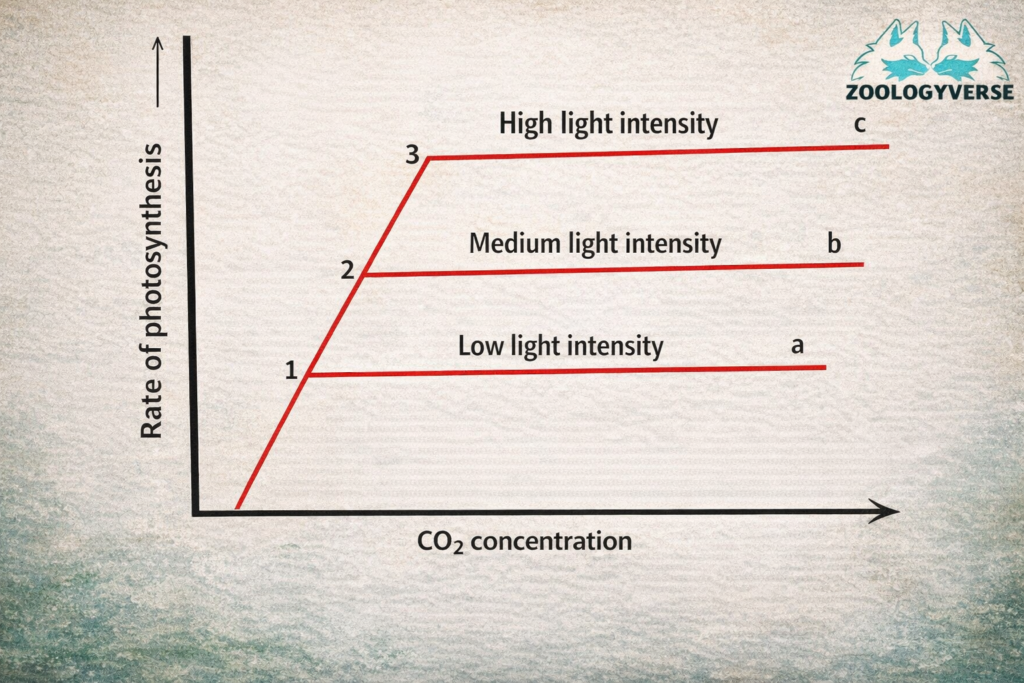
In the graph the rate of photosynthesis is depicted on Y axis while CO2 concentration in X-axis. At first when the concentration of CO2 increases, the rate of photosynthesis is directly proportional to the amount of CO2 supplied and the graph (slope 1) shows increase in rate of photosynthesis but after a limit any further increase in CO2 concentration has no effect on the rate and the rate become constant (Line 1 to a). Now at this time when the increase in CO2 has no effect on rate of photosynthesis, the intensity of light became the limiting factor. And now as we increase the intensity of light further increase in the rate of photosynthesis is achieved (slope 2). After a point any further increase at this intensity will not affect the rate and it became constant again (line 2 to b). The rate reaches its highest limits (slope 3) at high intensity of light and CO2 concentration and again became constant (line 3 to c).
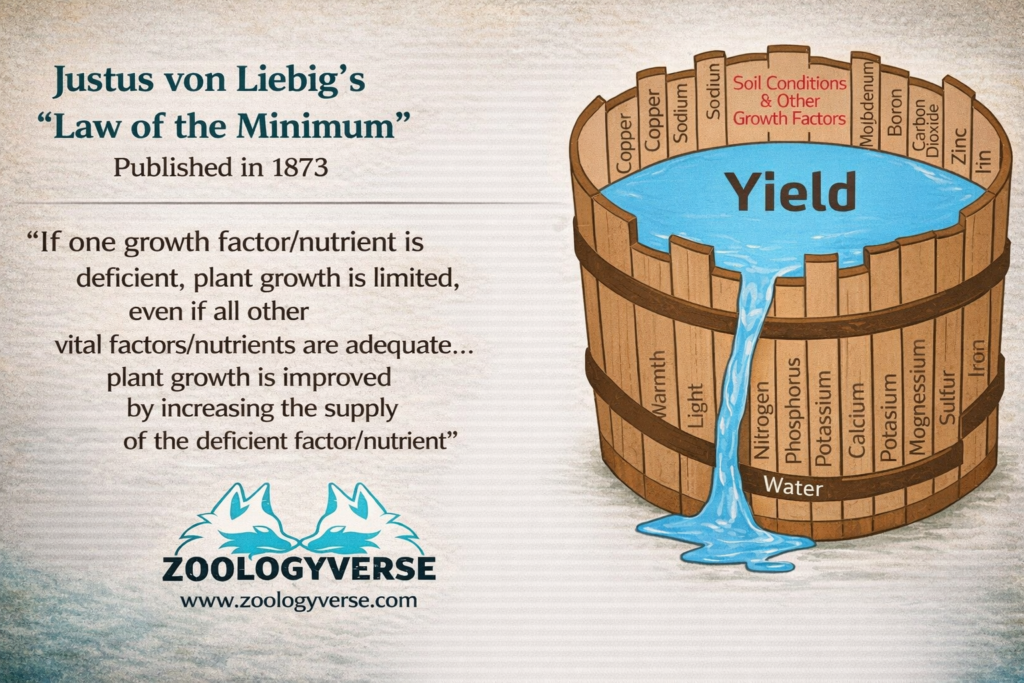
Liebig’s law
- Also known as law of minimum
- Growth of biological process is affected by limiting factors while their abundance doesn’t affect the growth rate.
- For example, if we increase the supply of nutrients already present in enough amounts, it does not affect the growth of plants i.e. no further growth happens. But when we provide the nutrients which are present in scarcity or in limited supply, growth improvements are detectable.
Shelford’s law of tolerance
- It states that it’s not only the factor present in limits/scarcity but also the excess/ abundance of that same factor can affect the growth, development of organism or rate of biological process.
- For instance all nutrients required for the growth and development of organism/plant are equally important but any nutrient in abundance may limit other nutrients absorption, thus indirectly restricting or limiting the growth of organism/plant.
- The law of tolerance by Shelford’s revealed that the growth and development of organism depends on the maximum and minimum limits of factors involved in the biological process. Thus every factor has its own maximum and minimal limits in every organism and the “Zone of tolerance” is the range between these two limits.
Based on this, the environmental factors have two zones:
- Zone of Intolerance-The Zone unfavorable for the growth and development of organism is termed as Zone of Intolerance.
- The limit of tolerance varies from species to species with respect to different factors.
- Organism survives best if have a wide range of tolerance and broad distribution range.
- Zone of Tolerance– organism grows best in the Zone of Tolerance, which is favourable for its development. The Zone of tolerance is sub divided into three zones;
- Optimal zone
- Critical minimum zone
- Critical maximum zone.
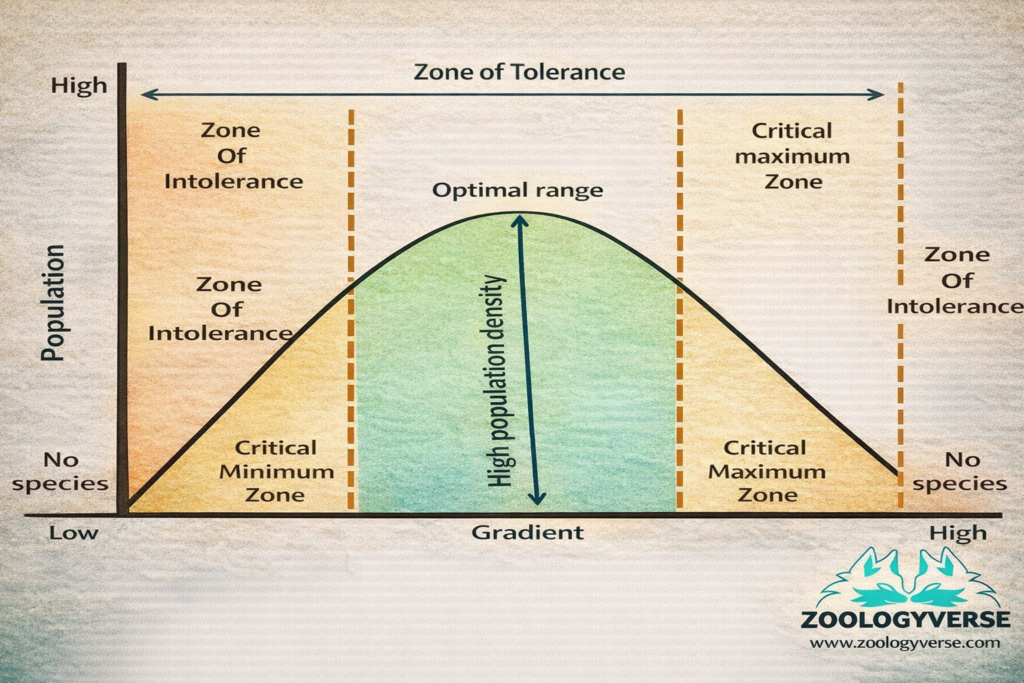
- Optimum zones: optimum zone is the most favourable zone in the range between two extreme limits thus supports maximum for the growth and development of organism.
- Critical minimum Zone: it’s the lowest limit of minimum below which the organism growth is inhibited.
- Critical maximum zone: it’s the maximum limit of tolerance zone above which organism growth ceases.
Conclusion
Limiting factors may be physical or biological. This recognition that there is always a single limiting factor is vital in ecology; and the concept has parallels in numerous other processes. The limiting factor also causes competition between individuals of a species population. The concept is based upon the Law of the Minimum, which states that the functioning of an organism is controlled or limited by that essential environmental factor or combination of factors present in the least favorable amount that may not be continuously existing but only at some critical period of time.
References
- Ecology by Purohit Agrawal
- Ecology by S.Arora
- Book of ecology by Arumugam
- Book of ecology by kumar
Download ppt from here :- https://www.slideshare.net/slideshow/environmental-limiting-factors-by-zoologyverse-pptx/286042328
See other post also
- Limulus (Horseshoe crab)
- Differences between Crocodile vs Alligator vs Gharial
- What is Taxonomic Hierarchy?
- Crayfish vs Lobster : Differences Explained
Discover more from Zoologyverse
Subscribe to get the latest posts sent to your email.