
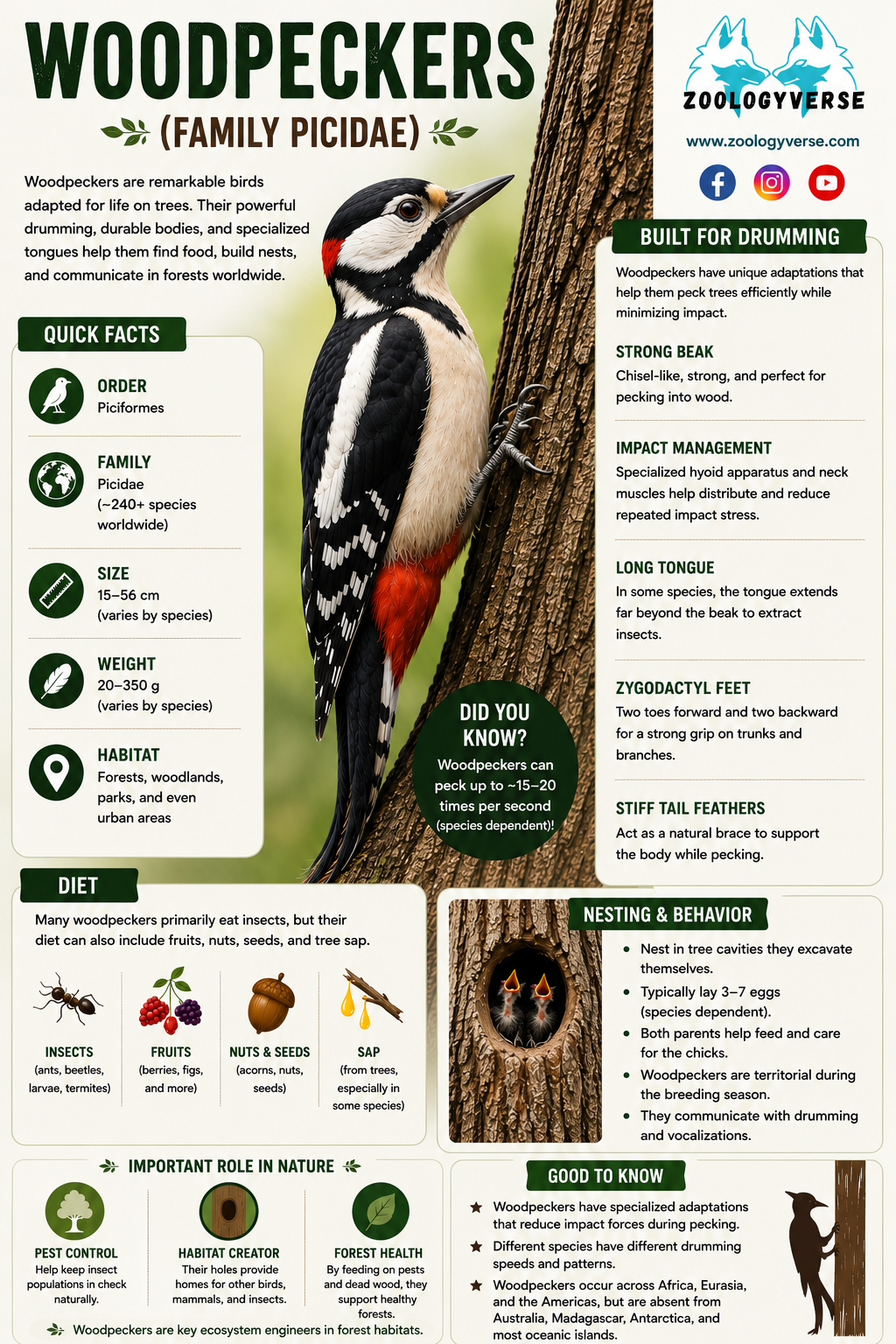
The Yellow-crowned Woodpecker (Leiopicus mahrattensis) is a medium-sized woodpecker found across parts of the Indian subcontinent.
It is recognized by its distinctive black-and-white spotted plumage, contrasting crown, strong chisel-shaped bill and specialized feet for climbing tree trunks.
The species forages mainly for insects and their larvae by probing and pecking bark and woody surfaces.
Leiopicus mahrattensis belongs to the family Picidae and order Piciformes. Its zygodactyl feet, stiff tail feathers and powerful bill are important adaptations for climbing, feeding and excavating nesting cavities.
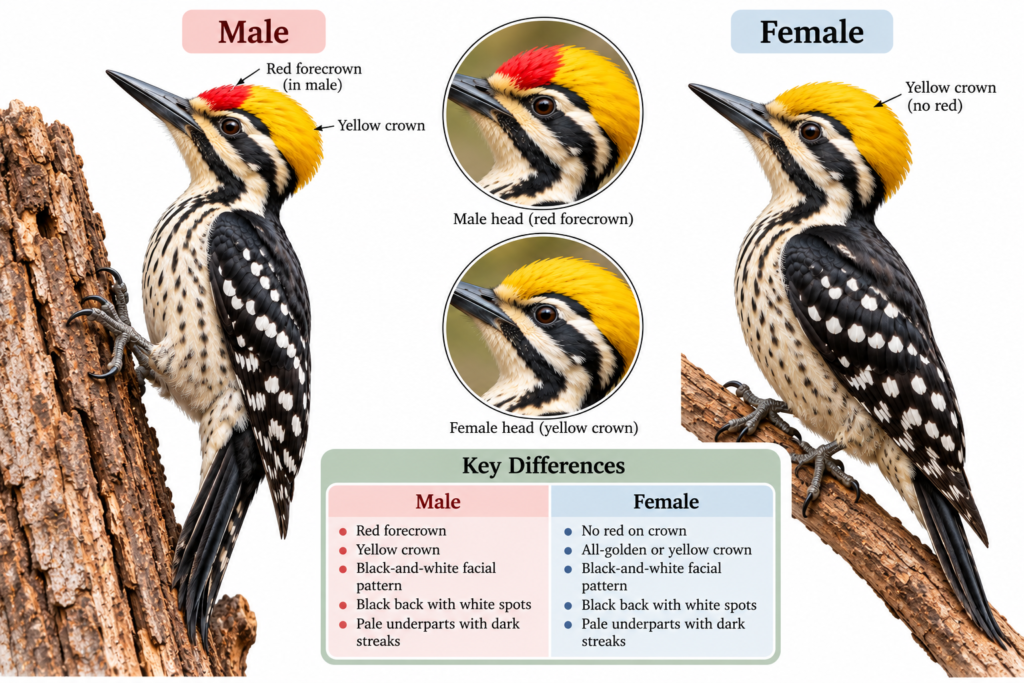
Males and females can be distinguished by differences in crown coloration, with the male showing a red forecrown and the female having an all-golden or yellow crown.
This article covers the classification, identifying features, physical characteristics, feeding adaptations, communication, nesting, ecological role and conservation status of Leiopicus mahrattensis.
For Practical Study 🧪
Classification of Leiopicus mahrattensis
| Rank | Classification | Characteristic |
|---|---|---|
| Kingdom | Animalia | Multicellular, heterotrophic animals |
| Phylum | Chordata | Dorsal tubular nerve cord, notochord and gill-slits present. |
| Group | Craniata | Definite head, Cranium with brain present. |
| Sub-phylum | Vertebrata | Vertebral column present. |
| Division | Gnathostomata | Jaws and paired appendages present |
| Super Class | Tetrapoda | Paired limbs, lungs, cornified skin and bony skeleton. |
| Class | Aves | Biped and feathered vertebrates. |
| Sub-Class | Neornithes | True birds. Metacarpals fused. |
| Super-Order | Neognathae | Modern birds. no teeth. sternum keeled. |
| Order | Piciformes | Woodpeckers and related birds |
| Family | Picidae | Woodpeckers, sapsuckers and related birds |
| Genus | Leiopicus | A genus of pied woodpeckers |
| Species | Leiopicus mahrattensis | Yellow-crowned Woodpecker |
Geographical Distribution
It is widely distributed in Indian subcontinent
Habit and Habitat
The Dendrocopus Mahrattensis (woodpecker) is a small bird inhabiting light scrub in countryside, thin forests, mango orchards, groves of trees and other leafy trees.
They scuttle up tree trunks and branches, tapping on the bark and peer into the cracks for ants and grubs which are extracted by the help of long worm-like tongue.
They produce sharp voice click, click or click-r-r-r. It excavates nest cavities by destroying the wood itself.
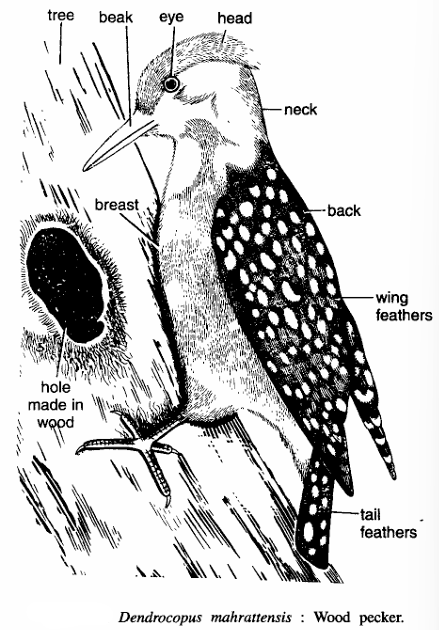
Comments
- Commonly called Yellow-crowned Woodpecker.
- It has the size of a Bulbul. Body divisible into head, neck, back, breast, abdomen.
- Head contains eyes and beak. Beak is long, stout and pointed owl-like with which they destroy wood.
- Beak adapted for chiseling or wood cutting.
- Eyes are large and tongue roughened with barbs near the tip and protrusible.
- Toes 2 in front and 2 behind, not reversible Upper plumage contains black and white spots on wings and tail feather.
- Male has scarlet patches.
- Tail is stiff and wedge-shaped.
- Tail feathers with pointed tips.
- It makes nest by destroying the wood itself. They live in pairs.
Special Features
- The yellow-crowned woodpecker (Leiopicus mahrattensis), a small woodpecker species native to South Asia, is known for its unique adaptations and behaviors that make it a fascinating member of forest ecosystems. Here are its special features:
Identification
Since this bird has pointed beak and above features, hence it is Leiopicus mahrattensis.
Quick Identification of Leiopicus mahrattensis
| Feature | Description |
|---|---|
| Common name | Yellow-crowned Woodpecker / Mahratta Woodpecker |
| Scientific name | Leiopicus mahrattensis |
| Class | Aves |
| Order | Piciformes |
| Family | Picidae |
| Body | Medium-sized woodpecker |
| Upperparts | Black with dense white spots and bars |
| Underparts | Blotchy brown-and-white plumage |
| Crown | Golden-yellow in females; males have a red forecrown |
| Bill | Strong, pointed and adapted for chiselling wood |
| Eyes | Bright crimson-red in adults |
| Feet | Zygodactyl, with two toes directed forward and two backward |
| Tail | Stiff and pointed, helping support the bird while climbing |
| Key identification feature | Pied black-and-white plumage with a contrasting yellow/golden crown; males show red on the forecrown |
Physical Characteristics of Leiopicus mahrattensis
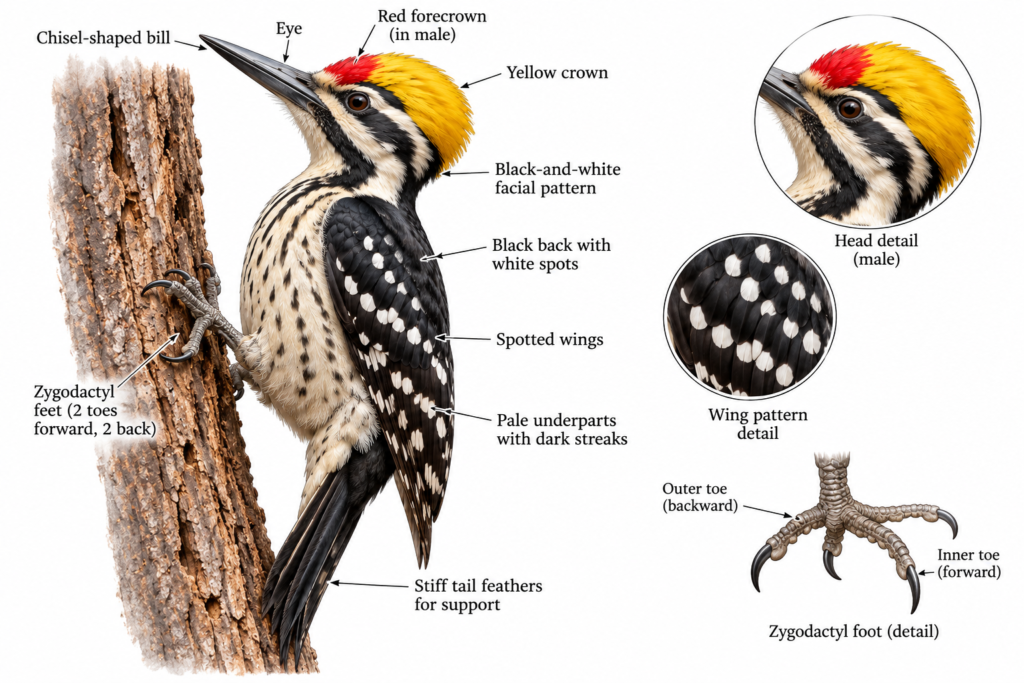
Leiopicus mahrattensis is a medium-sized woodpecker with a distinctive black-and-white spotted appearance and contrasting crown coloration. Its body is adapted for climbing tree trunks and searching bark and wood for food.
- Head: The head has contrasting black, white and brown markings. The crown is golden-yellow in females, while males show a red forecrown.
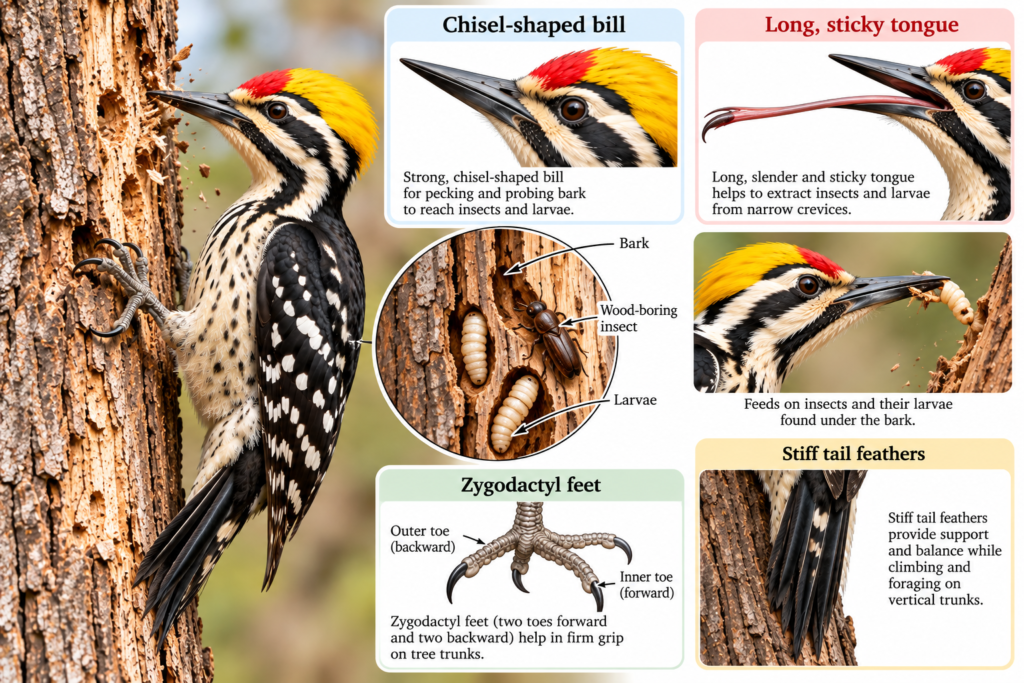
- Bill: The bill is strong, pointed and chisel-shaped, allowing the bird to strike and probe wood and bark.
- Upperparts: The back and wings are predominantly black with numerous white spots and bars.
- Underparts: The breast and abdomen have blotchy brown-and-white markings, giving the bird a mottled appearance.
- Eyes: The eyes are positioned laterally on the head and are suited to visual detection while climbing and foraging.
- Wings: The wings are rounded and patterned with black-and-white markings.
- Tail: The tail feathers are stiff and pointed. They provide support against tree trunks while the bird climbs and feeds.
- Feet: The feet are zygodactyl, with two toes directed forward and two backward. This arrangement provides a strong grip on tree trunks.
- Plumage: The contrasting spotted and barred plumage provides camouflage among branches, bark and foliage.
Sexual Dimorphism in Leiopicus mahrattensis
Male and female Yellow-crowned Woodpeckers are similar in overall body pattern, but their crown coloration provides a useful distinguishing feature.
- Male: The male has a yellow crown with a contrasting red forecrown.
- Female: The female has an all-golden or yellow crown without the red forecrown.
- Other features: Both sexes have similar black-and-white spotted upperparts, blotchy brown-and-white underparts, strong bills and zygodactyl feet.
The crown pattern is therefore one of the most useful external features for distinguishing the sexes in this species.
Feeding and Foraging Adaptations of Leiopicus mahrattensis
The Yellow-crowned Woodpecker is mainly an insect-feeding woodpecker that searches tree trunks, branches and bark for small invertebrate prey.
- Strong chisel-shaped bill: Used to strike, chip and probe bark and woody surfaces.
- Zygodactyl feet: Two toes point forward and two backward, providing a firm grip while climbing tree trunks.
- Stiff tail feathers: The tail acts as a supporting prop against the trunk during climbing and feeding.
- Long, extensible tongue: Helps extract insects and larvae from crevices in bark and wood.
- Foraging behaviour: The bird searches bark, branches and cracks for insects and their larvae, often combining visual inspection with probing and pecking.
- Insectivorous diet: Insects and insect larvae form an important part of its diet.
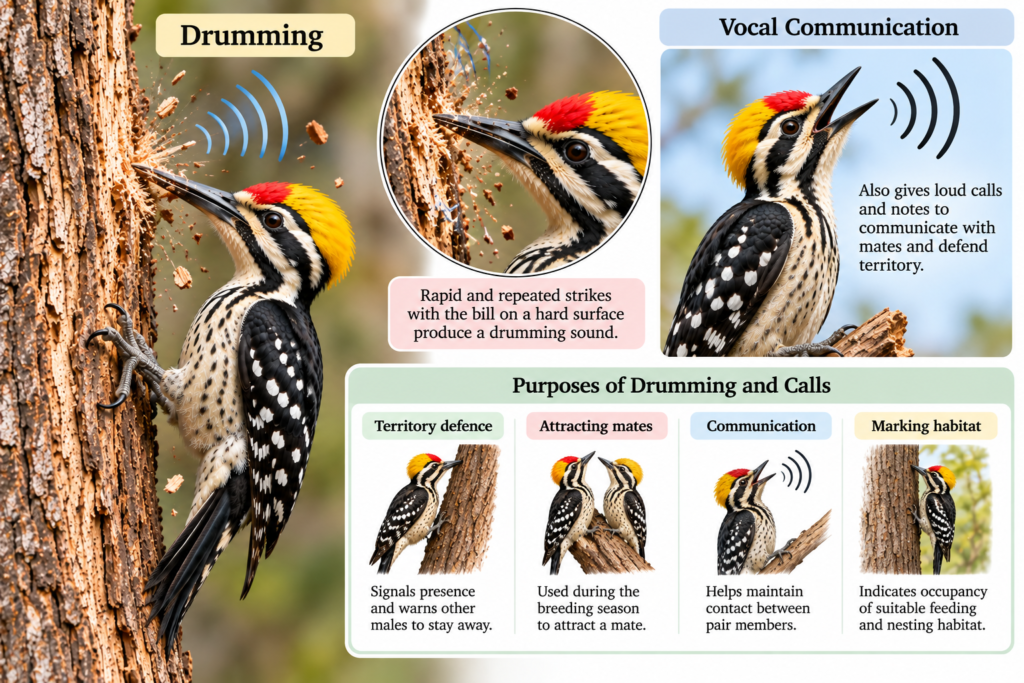
Drumming and Communication in Leiopicus mahrattensis
Like other woodpeckers, the Yellow-crowned Woodpecker uses vocal calls and rapid bill strikes against wood as important forms of communication.
- Drumming: Rapidly striking a suitable surface with the bill produces a distinctive drumming sound.
- Territorial communication: Drumming can help communicate presence and territory to other woodpeckers.
- Vocal calls: Sharp calls are also used during social interactions and while responding to nearby birds.
- Visual signalling: Body posture and movements may complement acoustic communication.
- Species recognition: The combination of calls and drumming helps woodpeckers communicate with members of their own species.
Nesting and Reproduction in Leiopicus mahrattensis
The Yellow-crowned Woodpecker is a cavity-nesting bird. It excavates or uses cavities in trees for breeding.
- Nesting site: The breeding cavity is usually made in a tree trunk or branch.
- Cavity excavation: The strong bill allows the bird to excavate suitable wood for the nest cavity.
- Eggs: The female lays eggs inside the protected cavity.
- Incubation: The eggs are incubated by the parents, with parental care continuing after hatching.
- Chicks: Newly hatched young remain dependent on the adults for food and protection.
- Fledging: Young birds eventually leave the nest after developing sufficient strength and flight ability.
- Breeding period: Breeding activity varies geographically; records from the Indian subcontinent indicate nesting activity during the cooler-to-pre-monsoon months in some regions.
Tree cavities provide protection for eggs and young and are an important part of the species’ breeding biology.
Ecological Role of Leiopicus mahrattensis
The Yellow-crowned Woodpecker contributes to woodland ecosystems through its feeding and nesting activities.
- Insect predation: By feeding on insects and their larvae, it participates in the regulation of arthropod populations.
- Foraging activity: Pecking and probing tree bark helps the bird access prey hidden in crevices and beneath bark.
- Cavity creation: Excavated tree cavities can later provide nesting or shelter opportunities for other cavity-using organisms.
- Food-web role: As an insect-eating bird, it forms part of the food web of woodland and scrub habitats.
- Adaptation to modified habitats: Its occurrence in open woodland, scrub, orchards and other human-modified environments shows that it can use a variety of habitats.
Conservation Status of Leiopicus mahrattensis
The global IUCN Red List status of Leiopicus mahrattensis (Yellow-crowned Woodpecker) is currently Least Concern (LC).
The Yellow-crowned Woodpecker occurs across parts of the Indian subcontinent and is able to use a range of relatively open wooded habitats. Its conservation is therefore closely connected with the continued availability of suitable trees and foraging areas.
Potential local threats include:
- Loss and fragmentation of woodland and scrub habitats
- Removal of mature trees that provide feeding and nesting sites
- Reduction of suitable nesting cavities
- Intensive changes in agricultural and semi-natural landscapes
- Local disturbance and habitat degradation
Conservation of mature trees, woodland patches, orchards and other suitable habitats can help maintain feeding and nesting opportunities for the species.
Frequently Asked Questions
What is the scientific name of the Yellow-crowned Woodpecker?
The scientific name is Leiopicus mahrattensis. Older literature may refer to the species as Dendrocopos mahrattensis.
What is the IUCN status of Leiopicus mahrattensis?
The Yellow-crowned Woodpecker is currently classified as Least Concern (LC) on the global IUCN Red List.
Which family does the Yellow-crowned Woodpecker belong to?
It belongs to the family Picidae, the woodpecker family.
What is the main food of the Yellow-crowned Woodpecker?
It mainly feeds on insects and their larvae, which it searches for beneath bark and in crevices of trees.
How does the Yellow-crowned Woodpecker climb trees?
It uses zygodactyl feet, with two toes directed forward and two backward, together with stiff tail feathers that provide support against the trunk.
What is the difference between male and female Yellow-crowned Woodpeckers?
The male has a red forecrown, while the female has an all-golden or yellow crown. Their general black-and-white body pattern is similar.
Where does the Yellow-crowned Woodpecker nest?
It is a cavity-nesting species and uses cavities excavated in trees for breeding.
Why does the Yellow-crowned Woodpecker drum on trees?
Drumming produces rapid sounds that can function in communication and territorial signalling, in addition to its vocal calls.
Recommended Study Resource
Practical Zoology Vertebrate 12/Ed
by Ss Lal (Author)
Rastogi Publications MODERN TEXT BOOK OF ZOOLOGY: VERTEBRATES (Z-3)
by Prof. R. L. Kotpal (Author)
As an Amazon Associate I earn from qualifying purchases.
References
- ITIS. Leiopicus mahrattensis (Latham, 1801) — Taxonomic information and accepted scientific name.
- eBird. Yellow-crowned Woodpecker (Leiopicus mahrattensis) — identification, distribution and behaviour.
- Yellow-crowned woodpecker
- Birds of Kaiga
Discover more from Zoologyverse
Subscribe to get the latest posts sent to your email.