
Psittacula eupatria, commonly known as the Alexandrine Parakeet, is one of the largest and most striking parakeets of South and Southeast Asia.
Recognized by its long tail, powerful red beak, and the characteristic maroon shoulder patch, the species thrives in forests, farmlands, and urban green spaces.
Highly intelligent and social, Alexandrine Parakeets form strong pair bonds and communicate with loud, resonant calls.
Their adaptability, vibrant coloration, and long history in aviculture make them one of the most familiar parrots across the Indian subcontinent.
For Practical Study 🧪
Classification of Psittacula eupatria
| Rank | Classification | Characteristic |
|---|---|---|
| Kingdom | Animalia | Multicellular, heterotrophic animals |
| Phylum | Chordata | Dorsal tubular nerve cord, notochord and gill-slits present. |
| Group | Craniata | Definite head, Cranium with brain present. |
| Sub-phylum | Vertebrata | Vertebral column present. |
| Division | Gnathostomata | Jaws and paired appendages present |
| Super Class | Tetrapoda | Paired limbs, lungs, cornified skin and bony skeleton. |
| Class | Aves | Biped and feathered vertebrates. |
| Sub-Class | Neornithes | True birds. Metacarpals fused. |
| Super-Order | Neognathae | Modern birds. no teeth. sternum keeled. |
| Order | Psittaciformes | Bill stout and hooked at tip. |
| Family | Psittaculidae | Old World parrots and parakeets |
| Genus | Psittacula | Old World parrots/parakeets with long tails |
| Species | P. eupatria | Alexandrine Parakeet |
Geographical Distribution
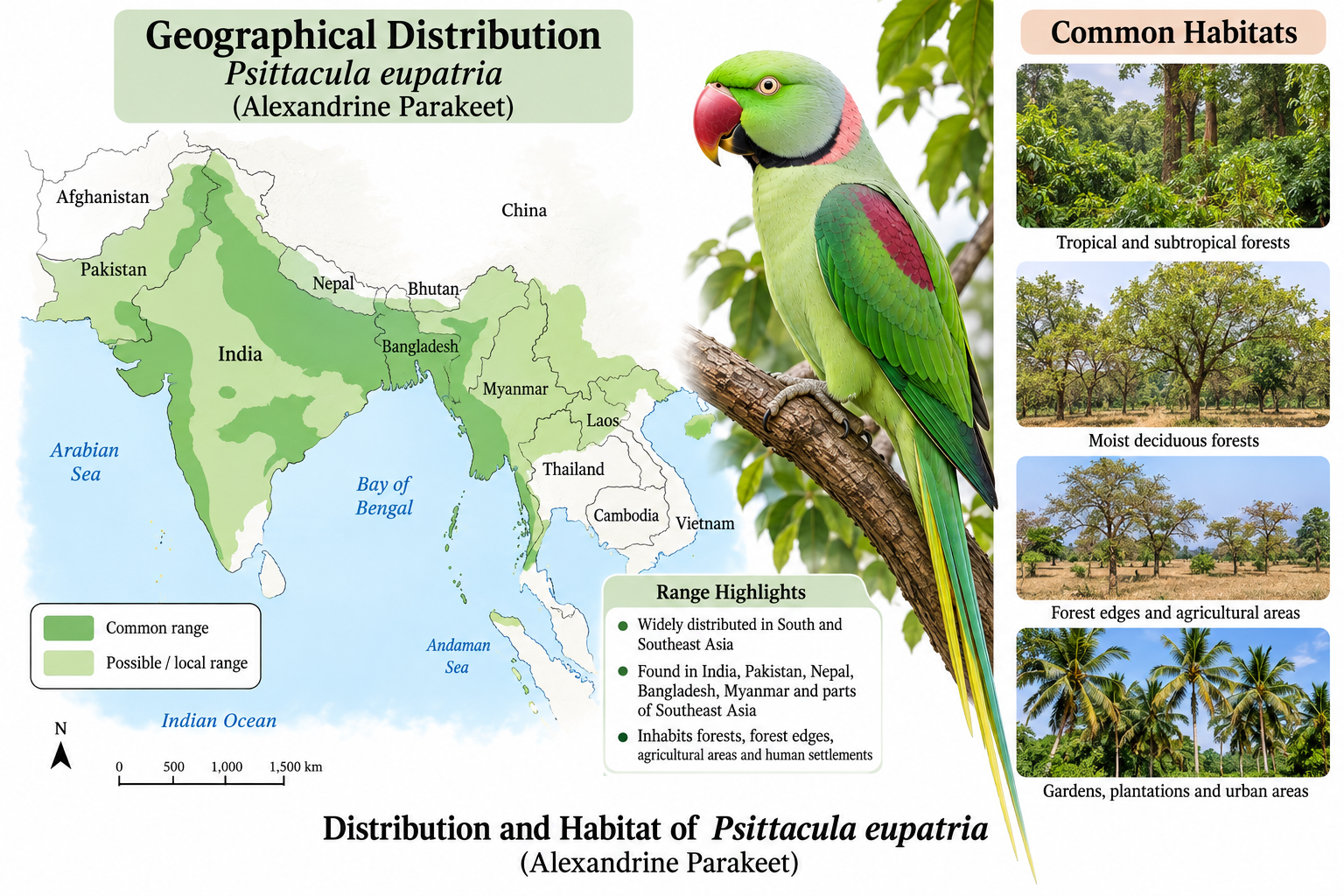
Psittacula eupatria is native to parts of South Asia and Southeast Asia, with populations occurring in India, Pakistan, Nepal, Sri Lanka and parts of mainland Southeast Asia. It occurs in forests, woodland, agricultural landscapes and areas around human settlements.
Habit and Habitat
It is found on tall trees in flocks in city as well as in villages. It is also commonly found in the fruit trees, ripe crops and in jungles. Gregarious with loud voices. Feeds on fruits and crops.
Psittacula eupatria is mainly diurnal and arboreal. It commonly inhabits forests, woodland, agricultural areas, gardens and urban or semi-urban environments. It feeds mainly on fruits, seeds, grains, buds and other plant material. It often nests in tree cavities and may occur in small groups or larger flocks when feeding.
Comments
- Commonly called as Alexandrine Parakeet.
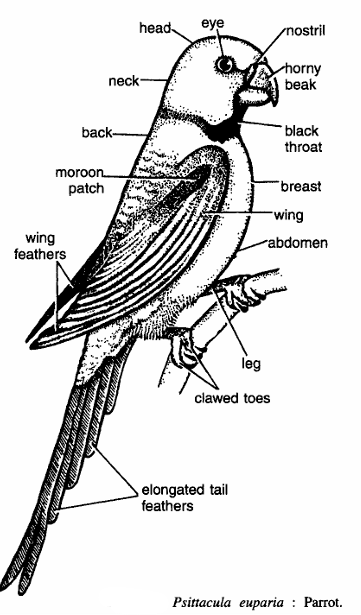
- It has brilliant blue-green plumage with massive, deeply-hooked red bill and a distinct maroon patch on each shoulder. P. krameri has no shoulder patches, while P. cyanocephala has a bluish-red head and maroon shoulder patches.
- Body is divisible into head, neck, back, breast and abdomen. Head contains eye, nostril and horny beaks.
- Beak stout, narrow, sharp edged and hooked at the tip and adapted for fruit eating.
- The upper mandible moves on the frontal bone of the skull, and its articulation causes the upper beak to rise automatically when the lower beak drops. The upper beak curves at the tip.
- The feet adapt for grasping, holding, and climbing. They show a zygodactylous arrangement in which digits I and IV point backward and digits II and III point forward, providing a firm grip on tree branches.
- Tail feathers elongated. Maroon patches on wing feathers. Flight is graceful and voice powerful.
- Female is green all over, but the male has a rose pink and black neck collar ring.
- Nesting season December to April.
Special Features
Parrot is a popular domesticated cage bird, found almost in every home and it copies and speaks some words like man.
A serious agricultural pest to the cultivators and food growers.
It causes enormous harm to standing crops and ripening orchard fruits. It eats maize, pulse, groundnuts and sometimes does considerable damage in newly sown fields. Its voice is sharp, well familiar and screaming kee-ak, kee-ak, kee-ak, kee-ak.
Identification
Since this bird has green plumage and all above features, hence it is Psittacula
Quick Identification of Psittacula eupatria
| Feature | Description |
|---|---|
| Common name | Alexandrine Parakeet |
| Scientific name | Psittacula eupatria |
| Class | Aves |
| Order | Psittaciformes |
| Family | Psittaculidae |
| Body | Large, slender parakeet with a long tail |
| Plumage | Mainly green |
| Bill | Large, strong and strongly curved |
| Feet | Zygodactyl, adapted for climbing and grasping |
| Key identifying character | Large red-and-black bill, long tail and green plumage |
Physical Characteristics of Psittacula eupatria
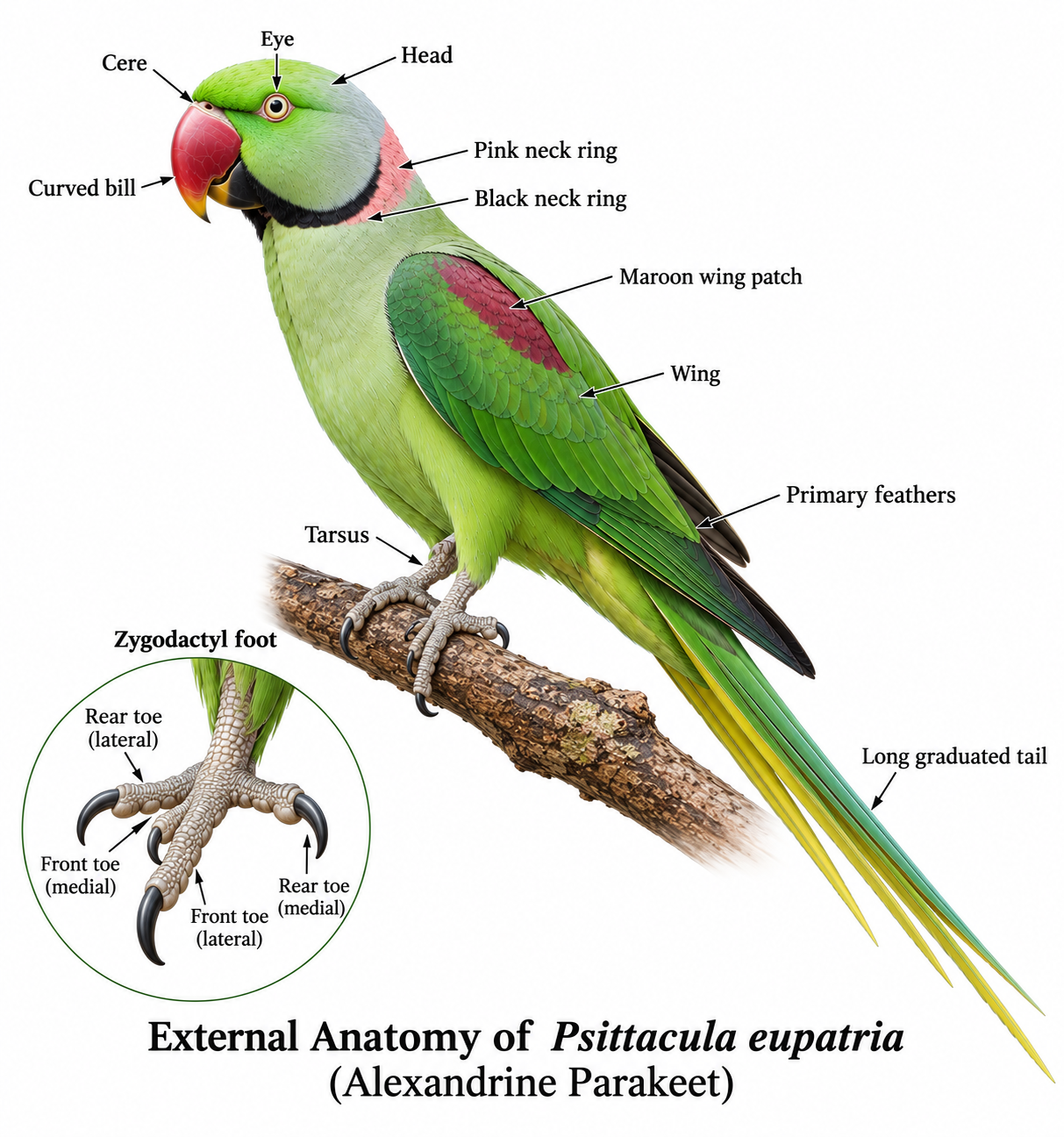
Psittacula eupatria, commonly called the Alexandrine Parakeet, is a large green parakeet with a long graduated tail and a prominent red bill. Its plumage is mainly green, while the neck and wing regions show characteristic darker markings. Adult males generally develop a black-and-pink neck ring, whereas females lack the complete male pattern.
Main Physical Features
- Body: Large and slender parakeet.
- Head: Rounded with a relatively large bill.
- Bill: Large, powerful and strongly curved; typically red with a darker tip.
- Eyes: Prominent with a pale orbital area.
- Neck: Green, with a characteristic neck-ring pattern in adult males.
- Wings: Broad and powerful, adapted for active flight.
- Tail: Long and graduated.
- Feet: Strong zygodactyl feet, with two toes directed forward and two backward.
- Plumage: Predominantly green with darker wing markings.
- Sexual dimorphism: Adult males and females differ mainly in the development of the neck ring.
Sexual Dimorphism in Psittacula eupatria
Psittacula eupatria shows noticeable sexual dimorphism in adults, mainly in the neck-ring pattern.
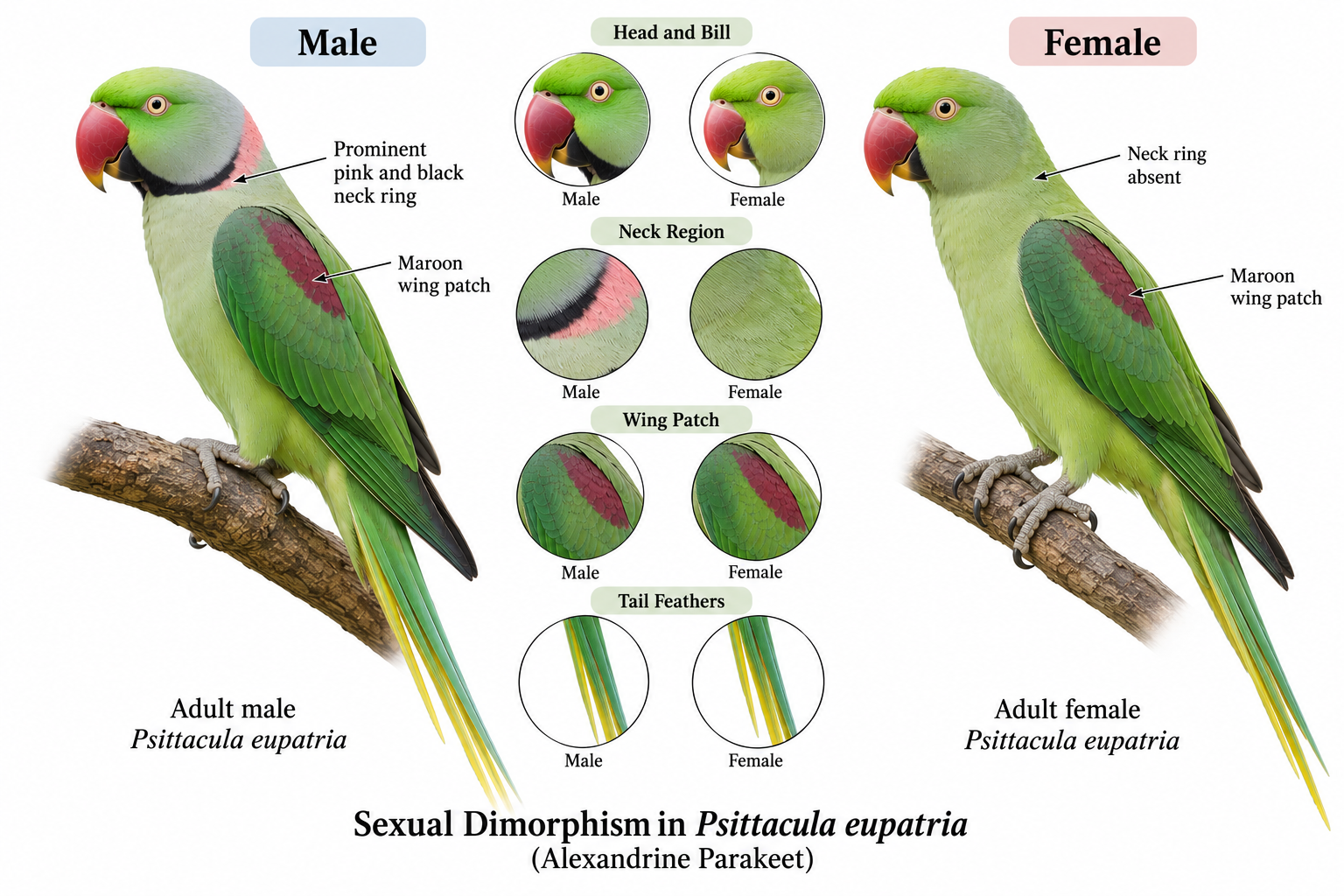
- Adult male: develops a distinctive black neck ring bordered by a pink/rose band.
- Adult female: generally lacks the complete black-and-pink neck ring.
- Juveniles: resemble females and do not develop the adult male neck-ring pattern until maturity.
- Both sexes are otherwise similar in their predominantly green plumage, large curved red bill, maroon wing patch and long graduated tail.
Practical identification point: The presence of a prominent black-and-pink neck ring is a useful feature for identifying an adult male Psittacula eupatria.
Feeding and Adaptations of Psittacula eupatria
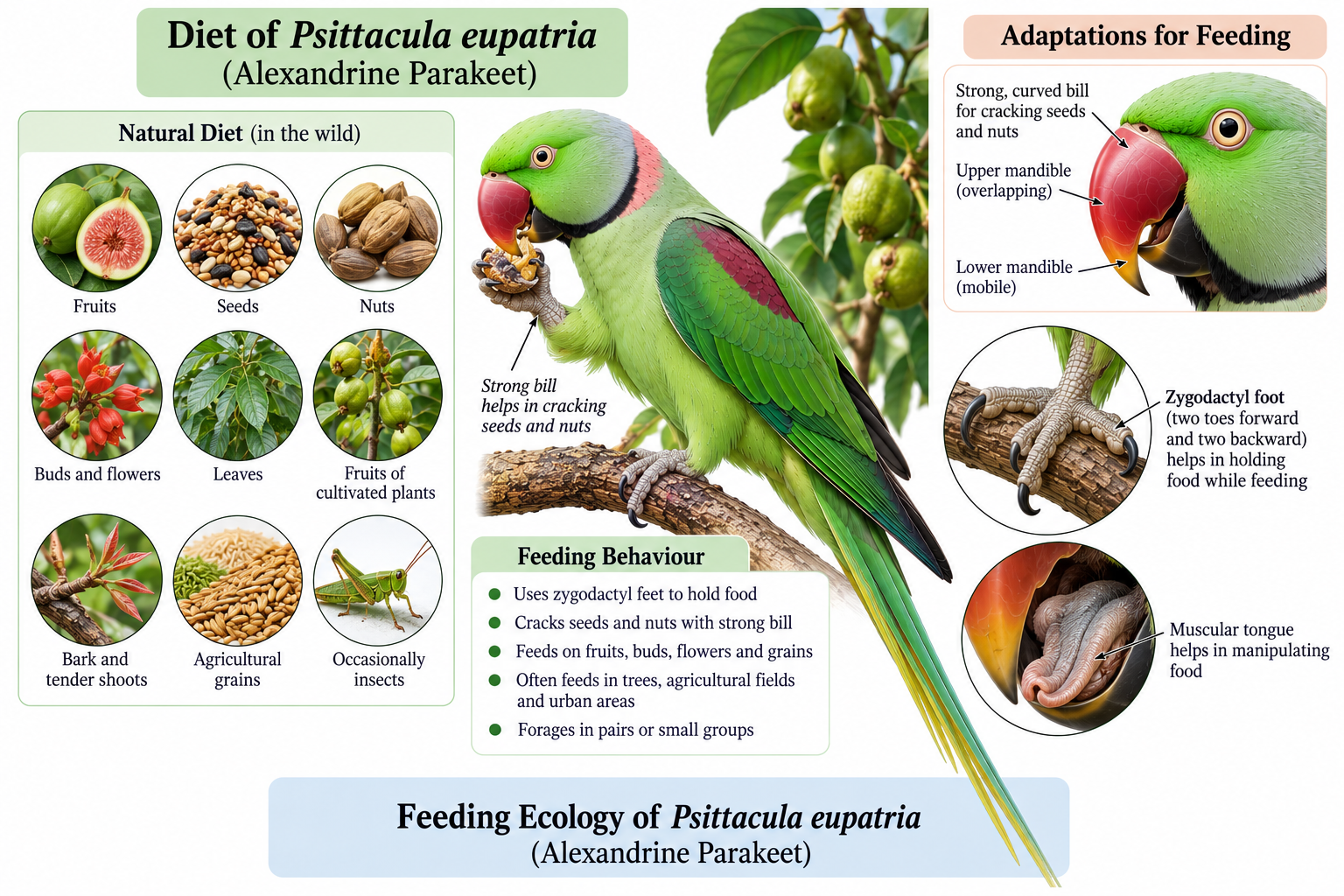
Psittacula eupatria has a mainly plant-based diet consisting of fruits, seeds, grains, buds, flowers and other plant material. Its strong, curved bill is particularly useful for opening and handling hard seeds and fruits. Its feet also assist feeding because the zygodactyl arrangement allows the bird to grasp branches and food items effectively.
| Adaptation | Function |
|---|---|
| Strong curved bill | Cracks and handles seeds and hard fruits |
| Zygodactyl feet | Grasp branches and hold food |
| Powerful jaws | Process hard food items |
| Strong tongue | Manipulates food inside the bill |
| Long, flexible toes | Improve grip while climbing and feeding |
| Broad wings | Support strong, controlled flight between feeding sites |
Habitat and Distribution of Psittacula eupatria
Psittacula eupatria is native to parts of South Asia and Southeast Asia. It occurs in a variety of habitats, including open woodland, forests, agricultural landscapes, plantations and areas near human settlements. It is mainly arboreal and often uses large trees for roosting and nesting.
Behaviour of Psittacula eupatria
Psittacula eupatria is mainly diurnal and arboreal. It is an active, social parakeet that often moves between trees in search of food and suitable resting sites. It may occur singly, in pairs or in groups, particularly when feeding. Its strong feet and curved bill help it climb branches, manipulate food and move efficiently through trees.
Key Behavioural Features
- Diurnal: Most activities occur during daylight.
- Arboreal: Spends much of its time in trees.
- Social: May occur in pairs or groups.
- Strong climber: Uses its feet and bill to climb branches.
- Vocal: Produces loud calls used for communication.
- Strong flyer: Makes active flights between feeding and roosting sites.
- Roosting: Often gathers in trees or other suitable elevated locations.
Reproduction in Psittacula eupatria
Psittacula eupatria usually nests in tree cavities, where the female lays a clutch of eggs. The species is generally associated with cavity nesting, and both parents contribute to raising the young. The chicks remain dependent on the parents until they are sufficiently developed to leave the nest and become independent.
Main Reproductive Features
- Breeding: Seasonal, with timing varying across its geographic range.
- Nest: Usually constructed in a natural cavity or suitable hollow in a tree.
- Eggs: White and generally rounded or oval.
- Incubation: Mainly performed by the female.
- Parental care: Both parents participate in feeding and caring for the young.
- Young: Hatch relatively undeveloped and remain in the nest until fledging.
Conservation Status of Psittacula eupatria
Psittacula eupatria is currently assessed as Least Concern (LC) at the global level. However, local populations may face pressures from habitat loss, trapping for the wild-bird trade and changes in agricultural and forested landscapes. Protection of nesting trees and natural habitats is important for maintaining wild populations.
- Global status: Least Concern (LC)
- Habitat loss can affect suitable nesting and feeding areas.
- Illegal trapping and capture for the cage-bird trade can affect wild populations.
- Preservation of mature trees helps maintain natural nesting sites.
- Responsible management of human–wildlife interactions can support local populations.
Frequently Asked Questions
What is the scientific name of the Alexandrine Parakeet?
The scientific name is Psittacula eupatria.
What is the common name of Psittacula eupatria?
It is commonly known as the Alexandrine Parakeet.
What is the classification of Psittacula eupatria?
It belongs to Kingdom Animalia, Phylum Chordata, Class Aves, Order Psittaciformes and Family Psittaculidae.
What does the Alexandrine Parakeet eat?
It mainly feeds on fruits, seeds, grains, buds, flowers and other plant material.
What is special about the feet of Psittacula eupatria?
It has zygodactyl feet, with two toes directed forward and two backward, helping it climb and grasp food.
How can Psittacula eupatria be identified?
It can be recognized by its green plumage, large red-and-black curved bill, long tail and characteristic neck-ring pattern in adult males.
Where does Psittacula eupatria live?
It occurs mainly in South and Southeast Asia, inhabiting forests, woodland, agricultural areas and human-modified landscapes.
What is the conservation status of Psittacula eupatria?
The species is currently assessed globally as Least Concern (LC).
Recommended Study Resource
ISE Integrated Principles of Zoology
by Allan Larson (Author), Cleveland Hickman (Author), David Eisenhour (Author), Susan Keen (Author)
A Manual Of Practical Zoology: Chordates P.S. Verma
by DR P S VERMA (Author)
As an Amazon Associate I earn from qualifying purchases.
References
Discover more from Zoologyverse
Subscribe to get the latest posts sent to your email.