
One of the many kinds of leeches used as therapeutic leeches is Hirudo medicinalis. Other Hirudo species, such as H. orientalis, H. troctina, and H. verbana, are occasionally also utilized as medical leeches. Macrobdella decora is the medicinal leech found in North America, while Hirudinaria manillensis is found in Asia. Due to the great demand in medical settings, medicinal leech populations were drastically reduced in several countries throughout the 19th century, and they are still in danger in many nations today.
Classification of Hirudo medicinalis
Kingdom :- Animalia (Multicellular eukaryotic organisms)
Phylum :- Annelida (Segmented worms with true coelom and metamerism)
Class :- Hirudinea (Annelids with fixed segments, without parapodia and with anterior and posterior suckers)
Order :- Rhynchobdellida or gnathobdellia (Proboscis protrusible; jaws and setae absent.)
Genus :- Hirudo
Species :- medicinalis
Habit and habitat
Hirudo medicinalis is found in ponds, marshes and streams. They are Sangivorous (blood sucking) ectoparasites on submerged cattles.
Distribution
It has cosmopolitan distribution. Found in India, Myanmar, U.K. and U.S.A.
Comments of Hirudo medicinalis
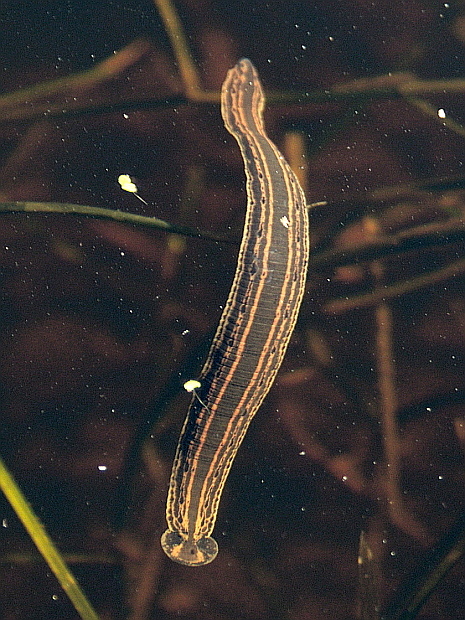
- Commonly known as Indian cattle leech.
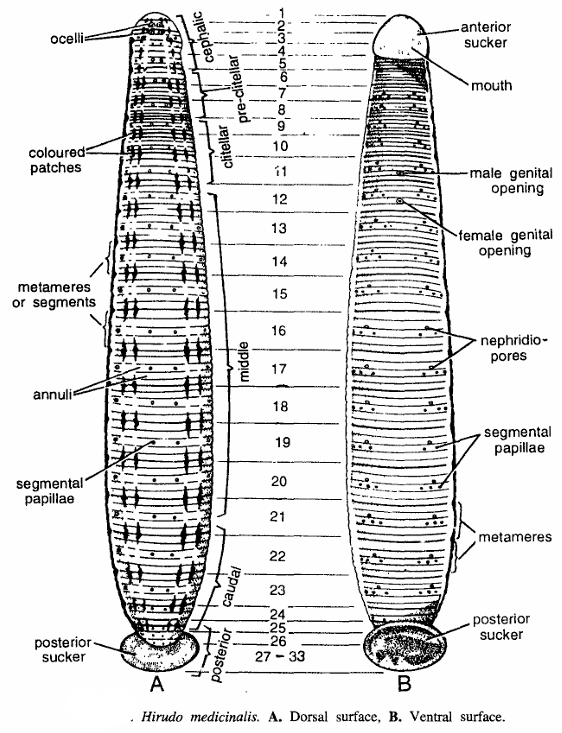
- Body is cylindrically elongated dorsoventrally flattened having variable pigments on dorsal surface, measuring 40 cm.
- Anterior and posterior suckers are well developed and are meant for attachment.
- Anterior sucker is formed by prostomium and rest of the body contains about 95 superficial segments or annuli and 36 to 37 true segments.
- Segments 3, 4 and 5, 6 have 2 and 3 annuli each, respectively.
- Rest of the segments have 5 annuli each.
- The first 5 segments have 5 pairs of small eyes in the first annulus.
- First annulus of each segment contains segmental papillae.
- Posterior end contains posterior sucker formed by the union of 7 segments.
- The entire animal is divided into cephalic, preclitellar, clitellar, middle, caudal regions and posterior sucker.
- Mouth is found as a narrow, tri·radiate aperture opening in the pre-oral chamber.
- Nephridiopores are found ventrally on the last annulus of each segment from 6 to 22. The coelom is replaced by spongy botryoidal tissue.
- The coelom is reduced in the form of 4 channels, called as haemocoelomic channels.
- Hermaphroditic. Development takes place in cocoons or ootheca. Male and female genital pores are on 10th and 11th segments respectively.
Special features
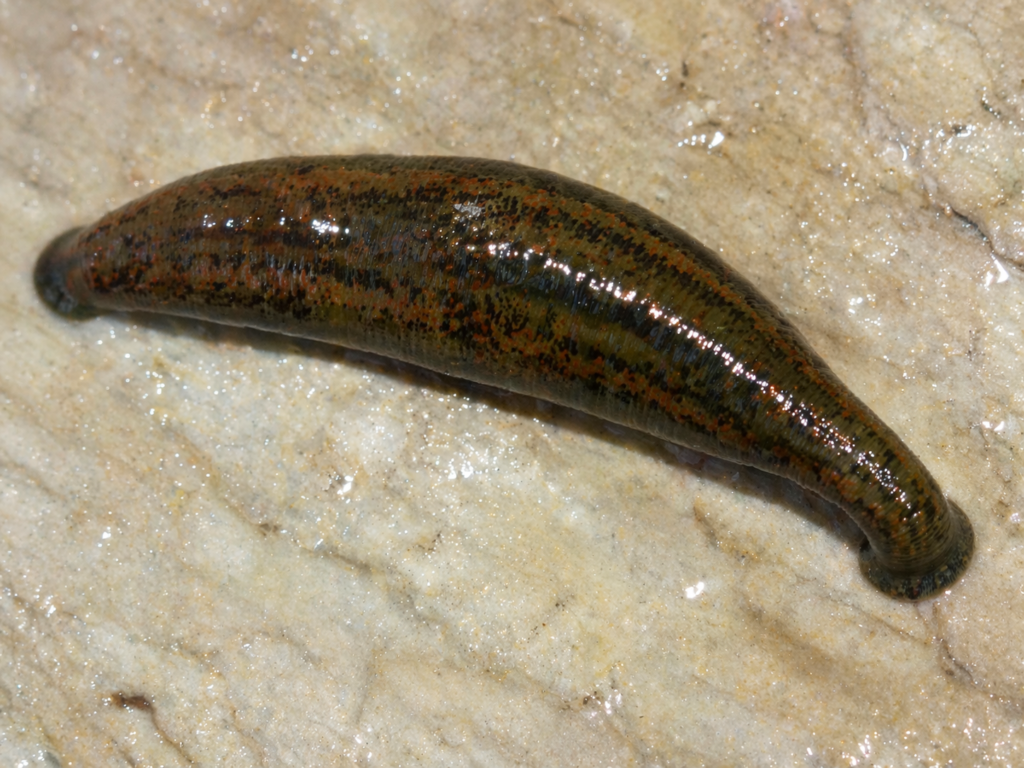
In old days, Hirudo was used by physicians to suck the blood of some ill persons, because they believed illness was due to some sort of imbalance in body fluids. In the mouth are three cutting teeth that make a V-shaped incision in the skin. Numerous small salivary glands around the mouth secrete a substance that prevents the coagulation of blood. This substance called Hirudin is commercially extracted from leeches and used medicinally when anticoagulants are indicated.
Identification
Since specimen contains 36-37 segments, and all above features hence it is Hirudo medicinalis.
See other posts also
- OSMOREGULATION OF FRESHWATER AND MARINE INVERTEBRATES
- PRIMITIVE NERVOUS SYSTEM OF COELeNTERATES AND ECHINODERMS
- Larval Forms of Crustaceans
- Larval forms of Mollusca
- Larval Forms in Echinodermata
Discover more from Zoologyverse
Subscribe to get the latest posts sent to your email.