
The echidna, or spiny anteater, is a unique oviparous mammal (monotreme) native to Australia and New Guinea, characterized by a spiny, hairy body and a long, sticky tongue used for eating ants and termites. One of five living monotremes, it is solitary, has a low body temperature, and has a baby pouch known as a puggle.
Classification of Echidna (Spiny Anteater)
- Phylum :- Chordata (Dorsal tubular nerve cord, notochord and gill-slits present.)
- Group :- Craniata (Definite head, Cranium with brain present.)
- Sub phylum :- Vertebrata (Vertebral column present.)
- Division :- Gnathostomata (Jaws and paired appendages present.)
- Super Class :- Tetrapoda (Paired limbs, lungs, cornified skin and bony skeleton.)
- Class :- Mammalia (Body covered with hairs. Females have mammary glands.)
- Sub Class :- Prototheria (Egg-laying mammals.)
- Order :- Monotremata
- Genus :- Tachyglossus
Geographical distribution
- Distributed in Australia, Tasmania and New Guinea
Habit and habitat
- It is terrestrial burrowing and nocturnal. Feeds on ants.
General Characteristics of Echidna (Spiny Anteater)
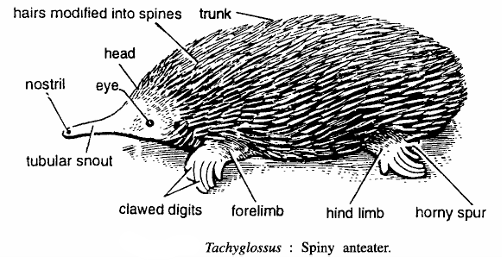
- Commonly called as spiny anteater. Body divisible into head, neck and trunk.
- Externally neck and body indistinct and covered with strong pointed spines.
- Coarse hair hair lies at the base of spines. Lower surface has only hairs, no spines.
- Head small and produced into a small tubular pointed snout. Containing eye and nostril.
- Eyes small, without nictitating membrane. External ears absent. Tongue long and sticky and teeth absent in adult.
- Girdles forelimbs and hind limbs reptile-like.
- Feet without web. Sharp claws used for digging the earth and nests of insects.
- Second digit of hind limb has a long and curved toilet claw to clean spines.
- Tarsus of male has a grooved horny venomous spur.
- Male also possesses mammary glands secreting milk and this condition is called as gynaecomastisus, where both parents nourish young one. Teats absent.
- Mammary glands open inside a ventral abdominal pouch by several apertures.
- Eggs transferred by mother into the pouch where the young are nourished with milk.
- In defensive position Echidna rolls in such a manner that bilateral barrier of spines completely covers it.
Special features
- Echidna has phylogenetic significance, as it serves a link between reptiles and mammals. The animal is specialized for ant eating. The jaws are pointed forming a rostrum devoid of any teeth. Tongue is protrusible. The posterior region of the tongue is serrated to grind insects and the secretion of salivary gland neutralizes formic acid of ants.

Identification
- Since this mammal has tubular snout, spiny body and above features, hence it is Echidna.

Key Takeaways
- Echidna, also called the spiny anteater, is an egg-laying mammal belonging to Order Monotremata.
- It is native to Australia, Tasmania, and New Guinea. The body is covered with sharp spines and coarse hair for protection.
- Echidnas feed mainly on ants and termites using their long, sticky tongue.
- Like the platypus, the echidna lays eggs but nourishes its young with milk.
- It is an important example of mammalian evolution because it retains several primitive characteristics.
Conservation Status
The short-beaked echidna (Tachyglossus aculeatus) is currently listed as Least Concern by the IUCN because of its wide distribution. However, local populations may be affected by habitat loss, road mortality, and bushfires.
Interesting Facts
- Echidnas are one of only five living monotreme species.
- They can detect weak electrical signals from prey.
- They have no teeth and use a long sticky tongue to catch insects.
- Females carry the egg in a temporary pouch until it hatches.
- A baby echidna is called a puggle.
Frequently Asked Questions (FAQs)
What is Echidna?
Echidna, also known as the spiny anteater, is an egg-laying mammal belonging to Order Monotremata. It is one of the few living monotremes found in Australia and New Guinea.
Where is Echidna found?
Echidnas are found in Australia, Tasmania, and New Guinea, where they inhabit forests, grasslands, deserts, scrublands, and woodlands.
Why is Echidna called a monotreme?
Echidna is called a monotreme because it is one of the few mammals that lays eggs instead of giving birth to live young.
What does Echidna eat?
Echidnas are insectivorous mammals that mainly feed on ants, termites, insect larvae, and other small invertebrates using their long, sticky tongue.
How does Echidna protect itself?
Echidnas protect themselves with their sharp spines. When threatened, they curl into a ball or dig into the ground, exposing only their spines to predators.
What are the main characteristics of Echidna?
The echidna has a spiny body, long snout, sticky tongue, strong claws for digging, and lays eggs. It is a solitary, burrowing mammal adapted to a variety of habitats.
Does Echidna lay eggs?
Yes. Echidna is an oviparous mammal. The female lays a single egg, which is carried in a temporary pouch until it hatches.
Why is Echidna important in zoology?
Echidna is an important zoological specimen because it represents one of the most primitive living mammals, helping scientists understand the evolution of mammals and the unique characteristics of monotremes.
Discover more from Zoologyverse
Subscribe to get the latest posts sent to your email.