
The nucleus is one of the most important organelles in a eukaryotic cell. It contains most of the cell’s genetic material and provides a specialized environment where important processes such as DNA replication, transcription, and RNA processing occur.
Because the nucleus separates DNA from the cytoplasm, it helps regulate how genetic information is used by the cell. It also coordinates activities related to cell growth, metabolism, development, and reproduction.
The nucleus is surrounded by a double membrane called the nuclear envelope, which contains nuclear pores. Inside it are the nucleoplasm, chromatin, and nucleolus, each contributing to the organization and function of the nucleus.
Understanding the structure and functions of the nucleus is essential for understanding how eukaryotic cells store, protect, and use genetic information.
What is the Nucleus?
The nucleus is a membrane-bound organelle found in most eukaryotic cells. It contains the cell’s nuclear DNA and provides an organized environment for many processes involved in gene expression.
The nucleus is sometimes described as the control center of the cell because it contains genetic information that directs many cellular activities.
However, this phrase is a simplification: cellular functions are coordinated through interactions between the nucleus and the cytoplasm rather than being controlled by the nucleus alone.
One of the major advantages of having a nucleus is the physical separation between transcription and translation.
In eukaryotic cells, DNA is transcribed into RNA inside the nucleus, while most protein synthesis takes place in the cytoplasm.
Nucleus = nuclear envelope + nuclear pores + nucleoplasm + chromatin + nucleolus
Structure of Nucleus
The nucleus has several structural components that work together to organize genetic material and regulate communication between the nucleus and cytoplasm.
1. Nuclear Envelope
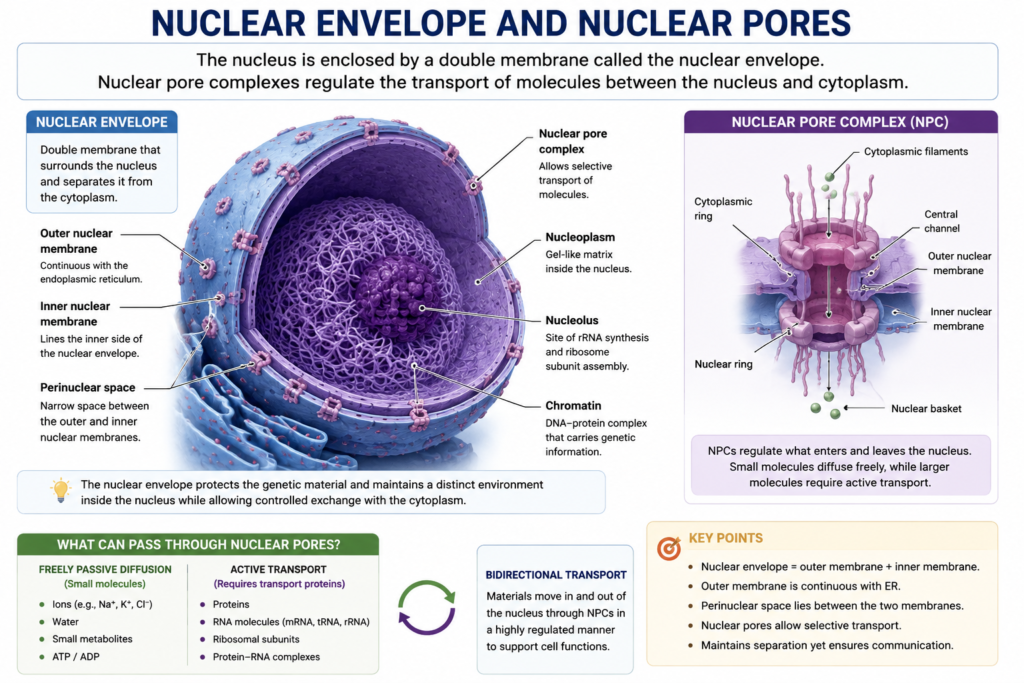
The nuclear envelope is the double membrane surrounding the nucleus.
It consists of two lipid bilayers:
- Outer nuclear membrane
- Inner nuclear membrane
The outer nuclear membrane is continuous with the endoplasmic reticulum, making the nucleus closely connected to the endomembrane system.
The nuclear envelope protects the genetic material and separates the nucleoplasm from the cytoplasm.
2. Nuclear Pore Complexes
The nuclear envelope contains numerous nuclear pore complexes (NPCs).
These are large protein structures that regulate the movement of substances between the nucleus and cytoplasm.
Small molecules can pass through nuclear pores relatively easily, while larger proteins and RNA-containing complexes generally require regulated transport mechanisms.
Nuclear pores therefore act as selective gateways rather than simple open holes.
They allow the nucleus to communicate with the cytoplasm while helping maintain the distinct chemical environment of the nucleus.
3. Nucleoplasm
The nucleoplasm is the internal medium of the nucleus in which chromatin, the nucleolus, and various nuclear proteins are located.
It provides an environment for several important nuclear processes, including DNA replication, transcription, and RNA processing.
The nucleoplasm should not be considered simply as an empty fluid.
The nucleus contains an organized internal environment with different functional regions and molecular complexes.
4. Chromatin
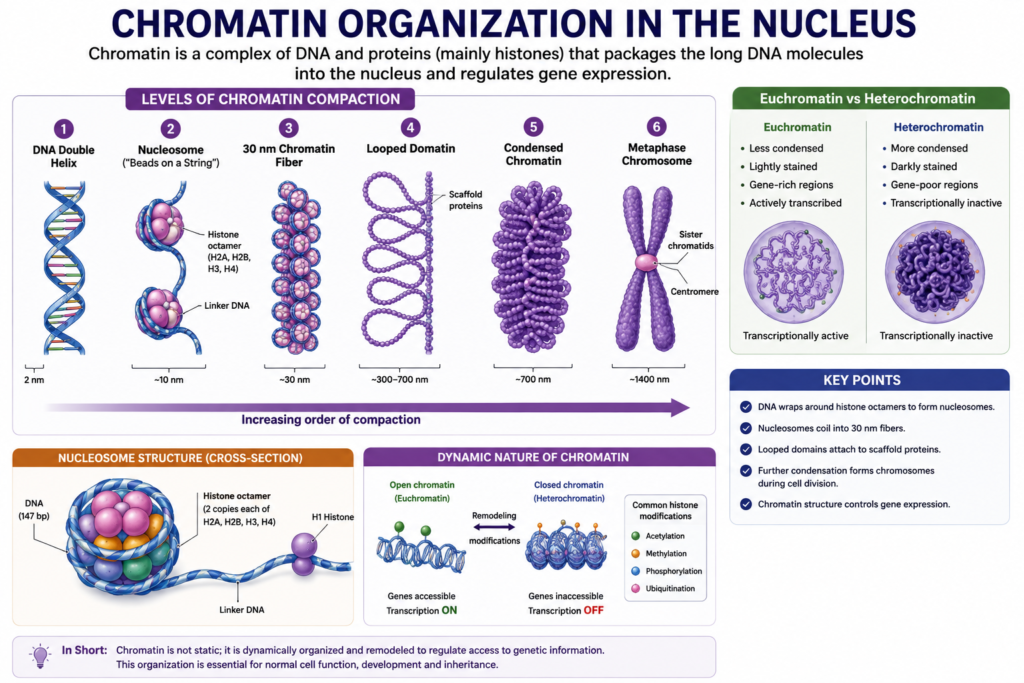
Chromatin is the complex of DNA and associated proteins found inside the nucleus.
DNA is extremely long, so it must be organized and compacted to fit within the nucleus while remaining accessible when genes need to be expressed.
DNA associates with proteins called histones, forming structures called nucleosomes. Further organization of chromatin allows the genetic material to be packaged into chromosomes.
Chromatin can exist in relatively open or compact states.
Euchromatin is generally less condensed and is often associated with active gene transcription, whereas heterochromatin is more condensed and is generally associated with lower transcriptional activity.
6. Nuclear Lamina
The nuclear lamina is a protein network associated mainly with the inner surface of the nuclear envelope.
It is composed largely of proteins called lamins and helps provide mechanical support to the nucleus.
The nuclear lamina also interacts with the nuclear envelope and chromatin, contributing to the organization of the nuclear interior.
7. Nucleolus
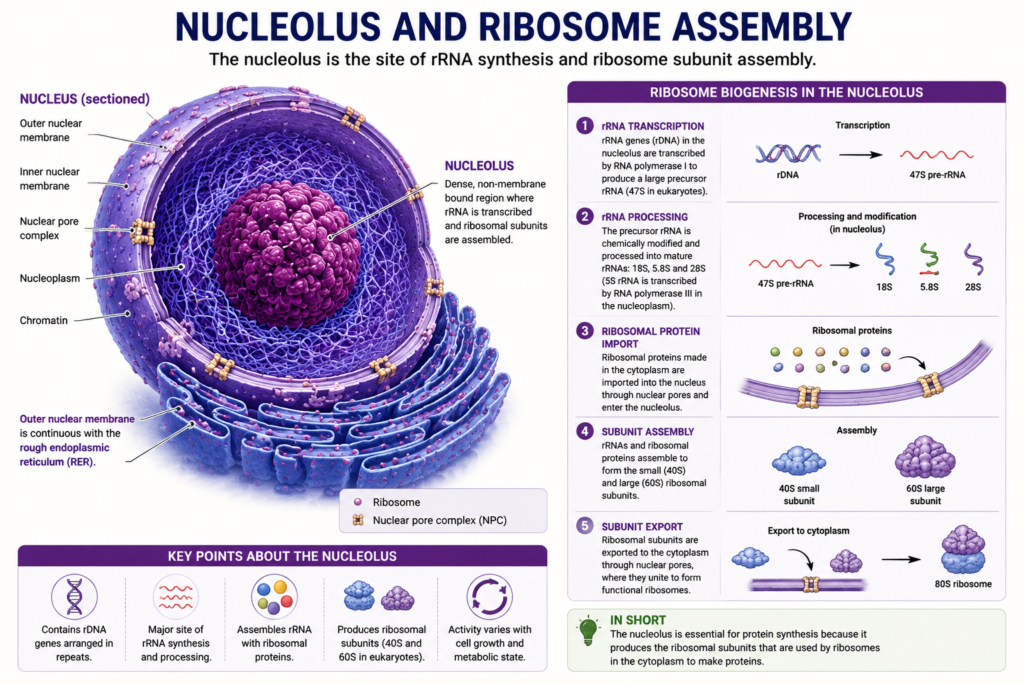
The nucleolus is a prominent, dense region inside the nucleus. Unlike the nucleus itself, it is not surrounded by a membrane.
Its main function is ribosome biogenesis. The nucleolus is the major site where ribosomal RNA (rRNA) is produced and processed and where rRNA combines with ribosomal proteins to form the small and large ribosomal subunits.
The ribosomal proteins are synthesized in the cytoplasm and transported into the nucleus.
Inside the nucleolus, they associate with rRNA during ribosomal subunit assembly.
The completed ribosomal subunits then leave the nucleus through nuclear pore complexes and enter the cytoplasm, where they participate in protein synthesis.
The nucleolus also changes during the cell cycle. It is prominent during interphase but disassembles during mitosis and reappears as the daughter nuclei form.
Functions of Nucleus
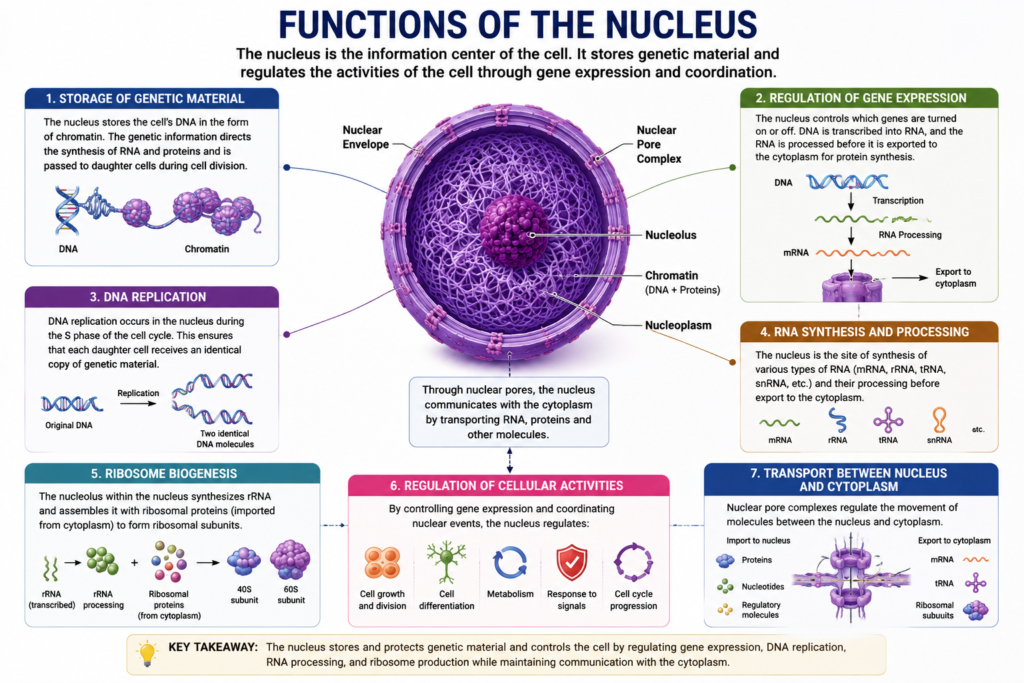
The nucleus performs several essential functions in eukaryotic cells.
1. Storage of Genetic Material
One of the primary functions of the nucleus is to store and protect DNA.
The DNA contains genes that provide instructions for producing RNA and proteins and regulating many cellular processes.
By keeping the genome within a specialized compartment, the cell can organize and regulate access to genetic information.
2. Regulation of Gene Expression
The nucleus plays a major role in gene expression.
DNA is transcribed into RNA within the nucleus, and the resulting RNA molecules undergo processing before many of them are transported to the cytoplasm.
The organization of chromatin also influences which genes are accessible for transcription.
Thus, the nucleus helps determine when and where particular genes are expressed.
3. DNA Replication
Before a cell divides, its DNA must be accurately copied.
DNA replication takes place in the nucleus during the S phase of the cell cycle in eukaryotic cells.
The replicated DNA is then organized into chromosomes so that genetic material can be distributed to daughter cells during cell division.
4. RNA Synthesis and Processing
The nucleus is a major site of RNA synthesis.
Different types of RNA are produced, including messenger RNA (mRNA), ribosomal RNA (rRNA), and various non-coding RNAs.
Many newly synthesized RNA molecules also undergo processing before they become functional. For example, pre-mRNA can undergo capping, splicing, and polyadenylation before mature mRNA is exported to the cytoplasm.
5. Ribosome Biogenesis
The nucleolus within the nucleus is the main site of ribosome biogenesis.
It produces and processes rRNA and helps assemble rRNA with ribosomal proteins into ribosomal subunits. These subunits are subsequently transported to the cytoplasm.
This makes the nucleus indirectly essential for protein synthesis throughout the cell.
6. Regulation of Cellular Activities
Because the nucleus contains the genome and controls access to genetic information, it plays a major role in regulating processes such as:
- Cell growth
- Cell differentiation
- Metabolism
- Development
- Cell-cycle progression
- Responses to environmental signals
However, these activities depend on coordinated communication between the nucleus and the rest of the cell.
7. Transport Between Nucleus and Cytoplasm
Nuclear pore complexes regulate the movement of proteins, RNA molecules, and other substances between the nucleus and cytoplasm.
For example, RNA molecules produced in the nucleus can be exported to the cytoplasm, while specific proteins required inside the nucleus can be imported through nuclear pores.
This controlled exchange is essential for proper cellular function.
Nucleus During Cell Division
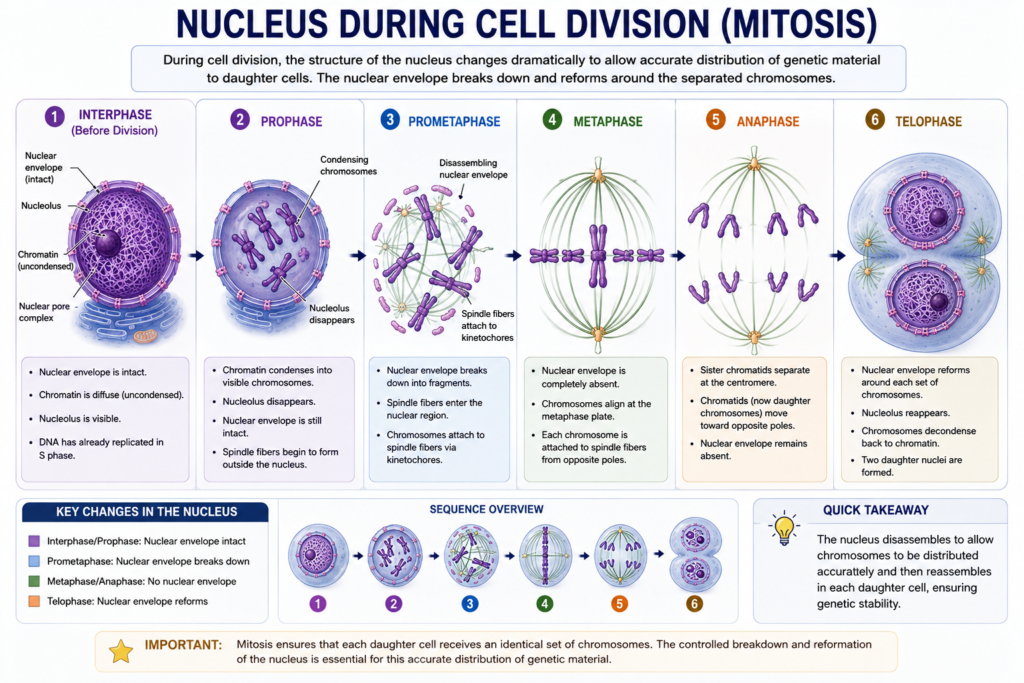
The structure of the nucleus changes considerably during cell division.
Before division, DNA is replicated and chromatin becomes progressively condensed into visible chromosomes.
During mitosis in many eukaryotic cells, the nuclear envelope breaks down, allowing the mitotic spindle to interact with chromosomes. Later, the nuclear envelope is re-formed around the separated chromosome sets.
This temporary reorganization allows chromosomes to be accurately distributed to the daughter cells.
Importance of the Nucleus
The nucleus is essential because it provides a protected and organized environment for the cell’s genome.
Its compartmentalization allows DNA replication, transcription, and RNA processing to occur separately from most translation in the cytoplasm. This separation gives eukaryotic cells additional opportunities to regulate gene expression.
The nucleus also works closely with other organelles. For example, the nuclear envelope is continuous with the endoplasmic reticulum, while the nucleolus produces ribosomal subunits that are used by ribosomes in the cytoplasm.
Therefore, the nucleus should not be viewed as an isolated structure. It is an active part of an interconnected cellular system.
Conclusion
The nucleus is a highly organized membrane-bound organelle that stores most of the genetic material of eukaryotic cells and provides a controlled environment for important genetic processes.
Its major structural components include the nuclear envelope, nuclear pore complexes, nucleoplasm, chromatin, nucleolus, and nuclear lamina. Each contributes to the organization and function of the nucleus.
The nucleus stores DNA, regulates gene expression, supports DNA replication and RNA processing, and contributes to ribosome production through the nucleolus. Its controlled communication with the cytoplasm also allows genetic information to be converted into cellular activity.
Rather than being simply the “control center” of the cell, the nucleus is better understood as a dynamic information-processing and regulatory compartment that works together with the rest of the cell.
Key Takeaways
- The nucleus is a membrane-bound organelle of eukaryotic cells.
- It contains most of the cell’s DNA.
- The nucleus is surrounded by a double-membrane nuclear envelope.
- Nuclear pore complexes regulate transport between the nucleus and cytoplasm.
- Chromatin consists of DNA associated with proteins, especially histones.
- Euchromatin is generally less condensed and more transcriptionally active.
- Heterochromatin is generally more condensed and less transcriptionally active.
- The nucleolus produces and processes rRNA and helps assemble ribosomal subunits.
- The nucleus is a major site of DNA replication, transcription, and RNA processing.
- The nuclear envelope is continuous with the endoplasmic reticulum.
- The structure of the nucleus changes during cell division.
- The nucleus plays a central role in regulating gene expression and cellular activity.
Frequently Asked Questions
What is the nucleus?
The nucleus is a membrane-bound organelle that contains most of the genetic material of a eukaryotic cell and provides a specialized environment for DNA replication, transcription, and RNA processing.
What is the main function of the nucleus?
The main functions of the nucleus include storing DNA, regulating gene expression, supporting DNA replication and RNA processing, and coordinating genetic information with cellular activities.
What are the main parts of the nucleus?
The main structural components are the nuclear envelope, nuclear pores, nucleoplasm, chromatin, nucleolus, and nuclear lamina.
What is the nuclear envelope?
The nuclear envelope is a double membrane surrounding the nucleus. It separates the nuclear contents from the cytoplasm and contains nuclear pore complexes that regulate molecular transport.
What is the function of nuclear pores?
Nuclear pores regulate the movement of proteins, RNA, ions, and other molecules between the nucleus and cytoplasm.
What is chromatin?
Chromatin is a complex of DNA and associated proteins, including histones. It organizes and packages DNA inside the nucleus.
What is the function of the nucleolus?
The nucleolus produces and processes ribosomal RNA and helps assemble ribosomal subunits.
Is the nucleolus surrounded by a membrane?
No. The nucleolus is a non-membrane-bound nuclear structure.
Is the nucleus present in prokaryotic cells?
Typical prokaryotic cells do not have a membrane-bound nucleus. Their DNA is located in a region called the nucleoid.
Is the nucleus present in plant and animal cells?
Yes. Both plant and animal cells are eukaryotic and generally contain a nucleus, although mature mammalian red blood cells are a notable exception because they lose their nucleus during development.
What is the difference between nucleus and nucleolus?
The nucleus is the membrane-bound organelle containing DNA, while the nucleolus is a non-membrane-bound region inside the nucleus involved mainly in rRNA production and ribosome assembly.
References
- Cooper, G. M. The Cell: A Molecular Approach. NCBI Bookshelf, Chapter 8: The Nucleus.
- OpenStax. Biology 2e, Section 4.3: Eukaryotic Cells.
- Cooper, G. M. The Cell: A Molecular Approach. NCBI Bookshelf, section on internal organization of the nucleus and chromatin.
- Alberts, B. et al. Molecular Biology of the Cell. NCBI Bookshelf, sections on the nucleolus and RNA processing.
- Biology 2e, Section 10.1: Cell Division, for chromosome organization and nuclear changes during division.
Discover more from Zoologyverse
Subscribe to get the latest posts sent to your email.