
Pristis, commonly known as the sawfish, is a distinctive group of cartilaginous fishes belonging to the family Pristidae. It is easily recognized by its long, flattened, saw-like rostrum, which bears numerous tooth-like structures along both sides. Although its appearance resembles that of a shark, Pristis is more closely related to rays and is adapted for life near the bottom of coastal and estuarine environments.
The elongated rostrum is the most remarkable feature of the sawfish. It contains specialized sensory organs that help detect prey, while the rostral teeth assist in disturbing, striking, and capturing small aquatic animals. The flattened body, broad pectoral fins, ventrally positioned mouth, and five pairs of gill slits reflect its adaptation to a predominantly bottom-dwelling mode of life.
Sawfishes occur mainly in tropical and subtropical waters, including shallow coastal areas, estuaries, lagoons, mangrove-associated habitats, and, in some species, freshwater environments. They are important examples for understanding the diversity and specialized adaptations of Chondrichthyes. In practical zoology, Pristis is particularly important because its characteristic toothed rostrum provides an easy means of identification. The genus is therefore commonly studied in vertebrate zoology and practical examinations.
For Practical Study
The following notes are arranged in a practical examination format for easy study and identification.
Classification of Pristis (sawfish)
| Rank | Classification | Characteristic |
|---|---|---|
| Kingdom | Animalia | Multicellular, heterotrophic organisms without a cell wall. |
| Phylum | Chordata | Dorsal nerve cord and other chordate features are present during development. |
| Subphylum | Vertebrata | Cranium and vertebral column are present. |
| Class | Chondrichthyes | Endoskeleton is predominantly cartilaginous |
| Subclass | Elasmobranchii | Five pairs of gill openings |
| Order | Rhinopristiformes | Includes batoid fishes with specialized flattened bodies and rostra |
| Family | Pristidae | Sawfishes with an elongated, toothed rostrum |
| Genus | Pristis | Large sawfishes characterized by a long, flattened rostrum |
Example Species
Some recognized species of Pristis include Pristis pristis, the common or largetooth sawfish, and Pristis zijsron, the green sawfish.
Geographical Distribution
Pristis species are distributed mainly in tropical and subtropical marine and estuarine waters. Sawfishes occur in coastal regions, bays, lagoons, estuaries and, in some species, freshwater reaches of large rivers.
Habit and Habitat
Pristis is a bottom-dwelling, predatory fish. It commonly inhabits shallow coastal waters, estuaries, mangrove-associated habitats, lagoons and sandy or muddy bottoms. Some species can move considerable distances into brackish and freshwater environments.

Comments on Pristis (sawfish)
- Body is elongated and dorsoventrally flattened, especially toward the anterior region.
- Snout is greatly elongated into a flattened saw-like rostrum.
- The rostrum bears numerous sharp lateral teeth.
- Mouth is situated on the ventral side of the head.
- Five pairs of gill slits are present.
- Pectoral fins are broad and resemble those of rays.
- The tail bears a well-developed caudal fin.
- The body is covered with placoid scales (denticles).
- It is a cartilaginous fish and lacks a true bony endoskeleton.
- The rostrum is an important structure used in prey detection and capture.
Special Features
- Saw-like rostrum: The elongated rostrum is the most distinctive feature of Pristis.
- Rostral teeth: Lateral teeth help the sawfish detect and injure prey.
- Electroreception: Sensory organs on the rostrum help detect weak electrical signals produced by prey.
- Bottom-feeding adaptation: The flattened body and ventrally positioned mouth are suited to feeding near the substrate.
- Broad pectoral fins: These provide effective movement and control close to the bottom.
Identification
Pristis can be identified by its long, flattened, saw-like rostrum bearing prominent lateral teeth, flattened ray-like body, ventral mouth and cartilaginous endoskeleton.
External Morphology of Pristis
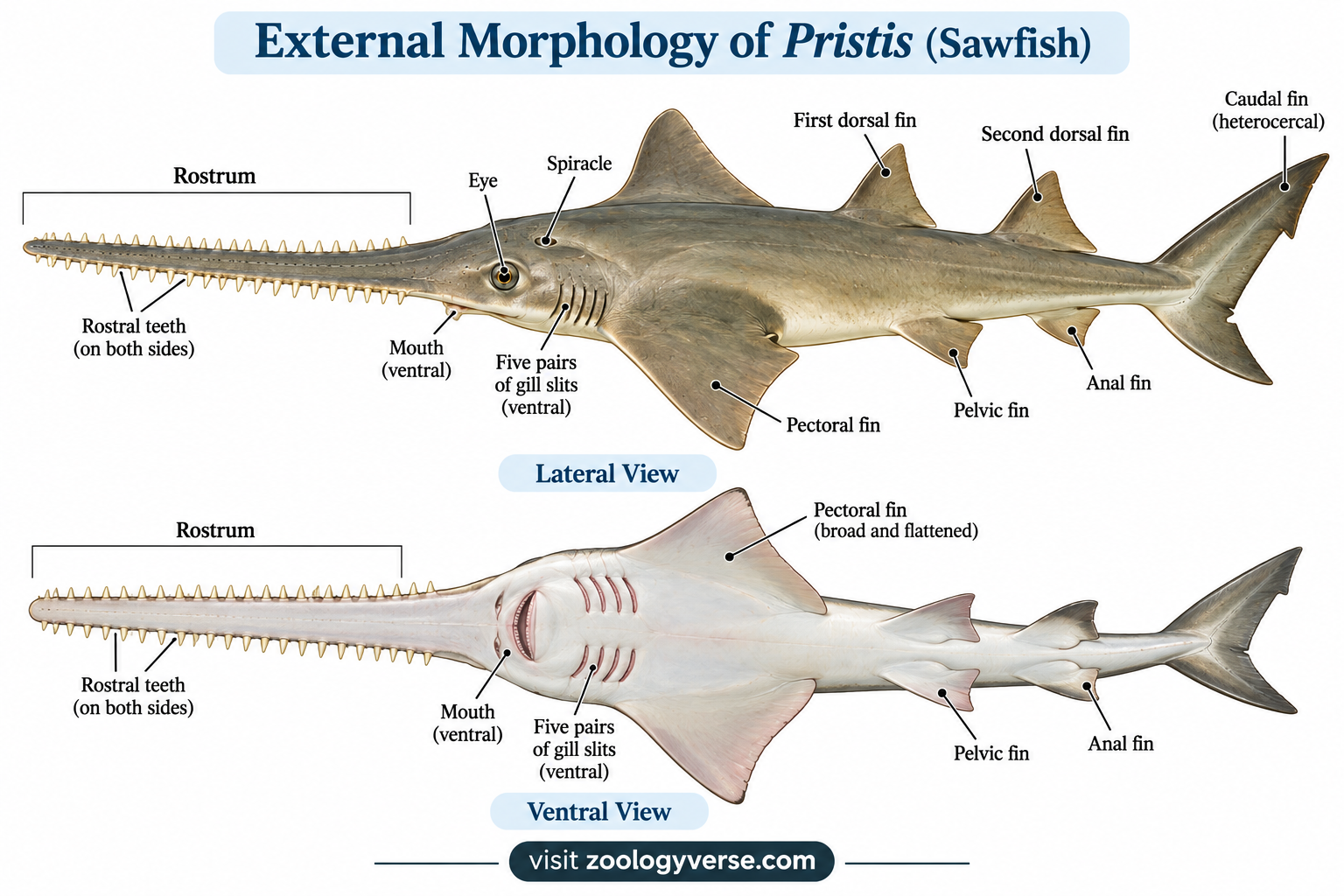
Pristis has an elongated, dorsoventrally flattened body with a distinctive saw-like rostrum extending forward from the head. Although its general appearance resembles a shark, its broad pectoral fins and flattened body give it a distinctly ray-like appearance.
1. Rostrum: The most characteristic feature is the long, flattened rostrum. It bears a series of strong, pointed rostral teeth along both lateral margins. The rostrum contains sensory structures that help the animal detect prey.
2. Head and Mouth: The head is flattened and the mouth is located on the ventral surface. The ventral position of the mouth is suited to feeding close to the bottom.
3. Eyes: The eyes are situated dorsally on the head, allowing the animal to maintain visual awareness while its body remains close to the substrate.
4. Gill Slits: There are five pairs of gill slits, located on the ventral side of the head. Unlike bony fishes, the gill openings are not covered by an operculum.
5. Fins: The pectoral fins are broad and extend from the sides of the body. Other fins include the pelvic fins, dorsal fins, and caudal fin.
6. Skin: The body is covered with placoid scales (dermal denticles), a characteristic feature of cartilaginous fishes.
7. Tail: The tail is elongated and bears a well-developed caudal fin. Its structure contributes to propulsion during swimming.
Rostrum of Pristis
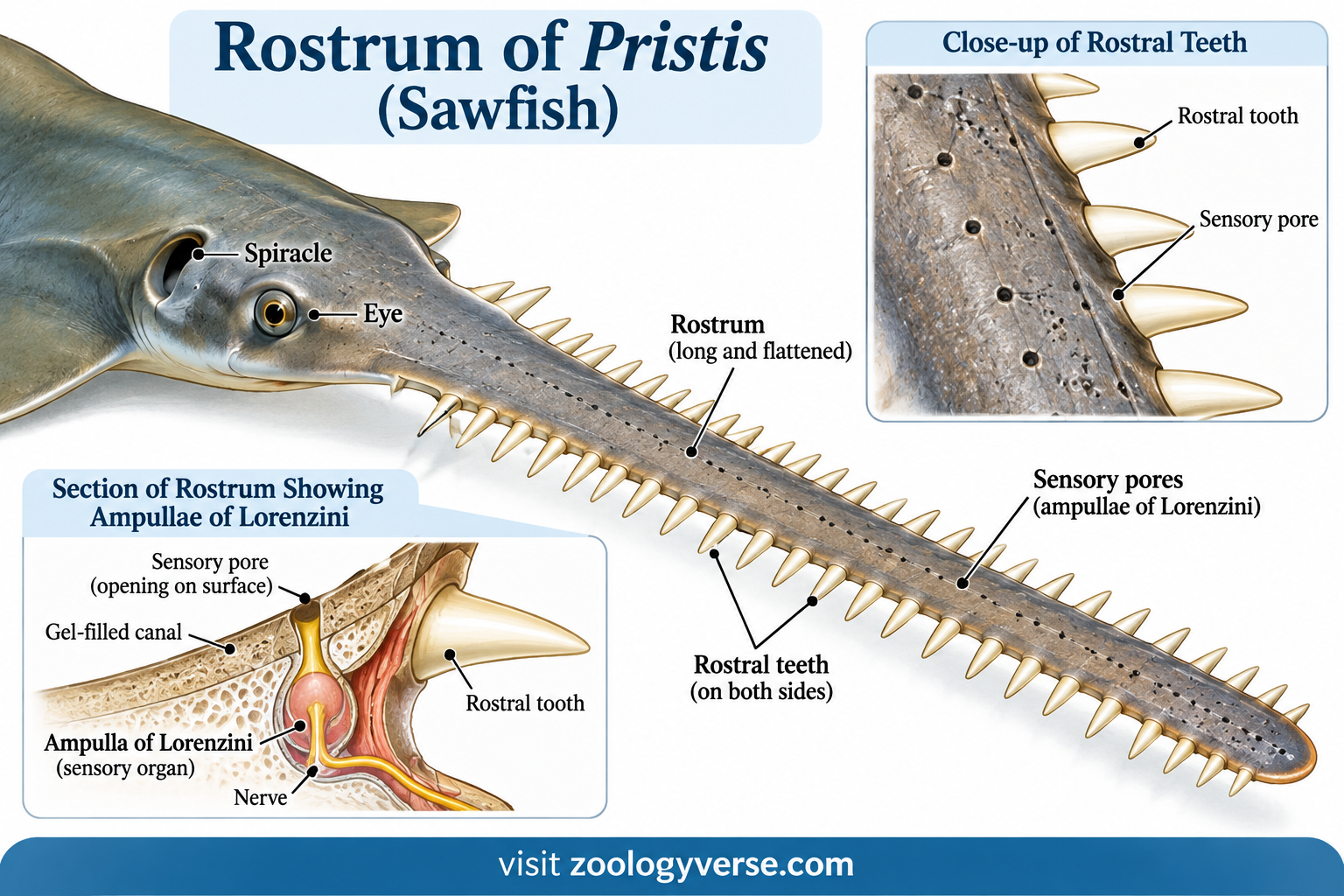
The rostrum is the most distinctive and specialized structure of Pristis. It forms a long, flattened, blade-like projection at the anterior end of the head and gives the animal its common name, sawfish.
Structure of the Rostrum
The rostrum is elongated and laterally flattened, with a series of sharp rostral teeth arranged along both margins. These teeth are embedded in the rostral cartilage and are not ordinary oral teeth.
The rostrum also contains numerous electroreceptive sensory organs, which help the sawfish detect weak electrical signals produced by nearby organisms. This is particularly useful when prey is concealed in muddy or turbid water.
Functions of the Rostrum
The rostrum performs several important functions:
- Prey detection: Electroreceptors help detect nearby prey.
- Prey capture: Rapid lateral movements of the rostrum can injure or disable prey.
- Disturbing the substrate: It can be moved through sand or mud to expose hidden organisms.
- Defence: The toothed rostrum can also serve as a defensive structure.
Fins of Pristis
The fins of Pristis are adapted for efficient swimming and maneuvering near the bottom. The broad pectoral fins give the body a ray-like appearance and are particularly important in controlling movement.
1. Pectoral Fins: The pectoral fins are large, broad, and wing-like. They extend laterally from the anterior part of the body and are continuous with the flattened body region.
They help in:
- Maintaining stability
- Steering and maneuvering
- Producing lift during swimming
- Moving close to the bottom
2. Pelvic Fins: A pair of pelvic fins is present on the posterior ventral region of the body. They assist in stabilization and directional control.
3. Dorsal Fins: Dorsal fins are present on the posterior part of the body. They help maintain stability while swimming and prevent excessive rolling.
4. Caudal Fin: The tail terminates in a well-developed caudal fin, which provides the main propulsive force during swimming. The caudal fin is asymmetrical, as is typical of many elasmobranchs, with the vertebral column extending into the upper portion of the fin.
Feeding and Digestive Adaptations in Pristis
Pristis is a predatory fish that feeds mainly on fishes and other aquatic animals. Its feeding mechanism is closely associated with the specialized rostrum.
Feeding Mechanism
The sawfish uses its elongated rostrum to detect, disturb, and capture prey. Electroreceptive organs on the rostrum can detect electrical signals produced by nearby organisms, helping the animal locate prey even when visibility is poor.
Once prey is detected, the rostrum may be moved rapidly from side to side, allowing the rostral teeth to injure or stun prey. The prey is then taken into the mouth.
Mouth and Teeth
The mouth is positioned ventrally, an arrangement suited to feeding near the substrate. Small teeth are present in the jaws and are adapted for grasping and processing food rather than cutting large pieces.
Feeding Adaptations
Important feeding adaptations include:
- Long toothed rostrum for prey capture and disturbance.
- Electroreceptors for detecting prey.
- Ventral mouth for bottom feeding.
- Flattened body for moving close to the substrate.
- Strong jaws and teeth for grasping prey.
Thus, the feeding apparatus of Pristis represents a specialized adaptation for predatory feeding in shallow, often turbid aquatic environments.
Electroreception in Pristis: How Sawfish Detect Prey
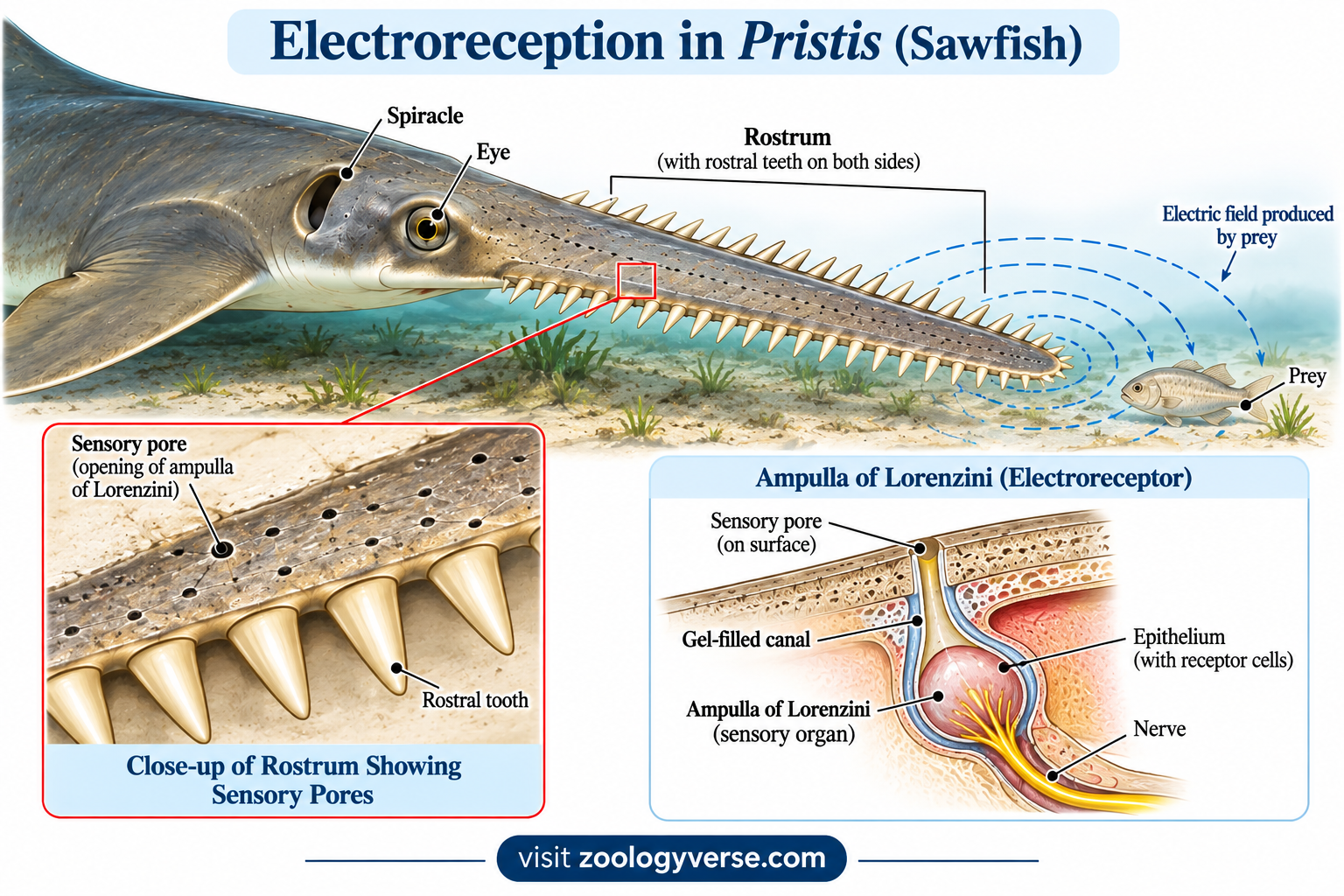
One of the most specialized sensory adaptations of Pristis is electroreception. The rostrum contains numerous sensory pores connected to specialized electroreceptive organs called the ampullae of Lorenzini.
These receptors can detect extremely weak electrical signals produced by the muscles and nervous systems of nearby animals. This ability is particularly useful because sawfishes often inhabit shallow, turbid, or muddy waters where visibility may be poor.
The sensory pores open at the surface of the rostrum and are connected to receptor organs through gel-filled canals. When an electrical signal from nearby prey reaches these receptors, it stimulates sensory cells and generates nerve signals that are transmitted to the brain.
Electroreception therefore helps Pristis locate prey even when the prey cannot be seen clearly. The sawfish can then use its long toothed rostrum to disturb, strike, and capture the prey.
Importance of Electroreception
- Detects weak electrical signals produced by prey.
- Helps locate prey in dark or turbid water.
- Works together with other sensory systems during hunting.
- Makes the highly specialized rostrum an important sensory as well as feeding structure.
Pristis can use its rostrum not only as a “saw” but also as a sensitive electrical detection system for locating nearby prey.
Respiration in Pristis
Pristis respires through gills, which are characteristic of cartilaginous fishes. Five pairs of gill slits are present on the ventral side of the head.
Water is taken into the mouth and passes over the gill surfaces, where gas exchange occurs. Oxygen from the water diffuses into the blood, while carbon dioxide diffuses from the blood into the surrounding water.
Gill Structure and Function
The gills contain numerous thin-walled respiratory surfaces that provide a large area for efficient exchange of gases. Continuous movement of water across the gills maintains the oxygen gradient required for respiration.
Spiracles: Well-developed spiracles are present behind the eyes. They provide an additional route for water to enter the respiratory system, which is particularly useful when the animal is resting close to the bottom.
Respiratory Adaptations
- Five pairs of gill slits are present.
- Spiracles help supply water to the gills.
- Gills provide a large surface area for gas exchange.
- The ventral position of the gill openings is associated with the flattened, bottom-dwelling body form.
Reproduction in Pristis
Pristis shows sexual reproduction with internal fertilization, a characteristic feature of elasmobranch fishes. The sexes are separate, and males possess claspers associated with the pelvic fins for transferring sperm to the female during mating.
Sawfishes are aplacental viviparous. The embryos develop inside the female, but they are not connected to the mother by a placenta. During development, the embryos obtain nourishment primarily from the yolk within their eggs.
The young are born as well-developed individuals and are capable of independent movement after birth. The rostral teeth of developing young are initially covered by a soft tissue sheath, which protects the mother during gestation and is lost around the time of birth.
Key reproductive features
- Sexes are separate.
- Internal fertilization occurs.
- Males possess claspers.
- Development takes place inside the female.
- Young are born relatively well developed.
- The developing rostral teeth are temporarily covered by a protective sheath.
Economic and Ecological Importance of Pristis
Sawfishes play an important role in aquatic ecosystems, particularly in coastal, estuarine, and riverine food webs. Their ecological significance is greater than their commercial value.
Ecological Importance
- Predator in aquatic food webs: Pristis feeds on fishes and other aquatic organisms and contributes to regulating prey populations.
- Indicator of healthy habitats: Their presence can indicate the availability of suitable coastal, estuarine, or riverine habitats.
- Role in benthic ecosystems: Their bottom-oriented feeding behaviour connects them with organisms living near the substrate.
- Biodiversity value: Sawfishes represent a distinctive evolutionary lineage of batoid fishes with highly specialized adaptations.
Conservation Importance
Sawfishes have experienced severe population declines because of overfishing, accidental capture in fishing gear, habitat degradation, and loss of suitable coastal and freshwater habitats.
Consequently, conservation of their habitats and reduction of accidental capture are important for maintaining remaining populations.
Difference Between Pristis and Sharks
Although Pristis may resemble a shark because of its elongated body and dorsal fins, it is actually a batoid fish and is more closely related to rays. The following differences are useful for practical identification.
| Feature | Pristis (Sawfish) | Typical Shark |
|---|---|---|
| Group | Batoid fish | Shark |
| Body form | Broad and dorsoventrally flattened anteriorly | Generally streamlined and cylindrical |
| Rostrum | Very long, flattened and toothed | Usually short or moderately elongated and without lateral rostral teeth |
| Pectoral fins | Broad and closely associated with the head | Distinct from the head |
| Mouth | Ventral | Usually ventral or subterminal |
| Gill openings | Five pairs of ventral gill slits | Usually five pairs of lateral gill slits |
| Overall appearance | Ray-like body with a saw-like snout | Streamlined fish-like body |
Frequently Asked Questions About Pristis
What is Pristis?
Why is Pristis called a sawfish?
Is Pristis a shark?
What is the most characteristic feature of Pristis?
How many pairs of gill slits are present in Pristis?
How does Pristis locate prey?
Where does Pristis live?
How does Pristis reproduce?
Why is Pristis important in zoology?
Why are sawfishes threatened?
References
- FishBase — Pristis — Taxonomy, distribution and biological information on Pristis.
- NOAA Fisheries — Sawfish — Information on sawfish biology, habitat and conservation.
- Encyclopaedia Britannica — Sawfish — General zoological information on sawfish morphology and biology.
- FAO — Fisheries and Aquaculture — Background information on fisheries, aquatic biodiversity and conservation.
- Catalog of Fishes — Pristidae — Taxonomic reference for fish classification.
Discover more from Zoologyverse
Subscribe to get the latest posts sent to your email.