
Aschelminthes is a traditional zoological grouping used in many textbooks to describe a collection of small, unsegmented, bilaterally symmetrical, pseudocoelomate animals. The name is commonly associated with animals that possess a body cavity called a pseudocoelom, although the organisms historically included in this group are not considered a single natural evolutionary group today.
The traditional concept of Aschelminthes includes organisms that were once grouped together because of similarities such as a pseudocoel, small body size, and the absence of specialized circulatory and respiratory systems. Historically, the group included animals such as nematodes, rotifers, gastrotrichs, nematomorphs, and kinorhynchs.
Among these groups, Nematoda is especially important because it contains numerous free-living and parasitic roundworms, including Ascaris, Ancylostoma, Enterobius, and filarial nematodes.
Important: In modern zoological classification, Aschelminthes is not generally recognized as a valid single phylum. The term is mainly retained in traditional and educational contexts.
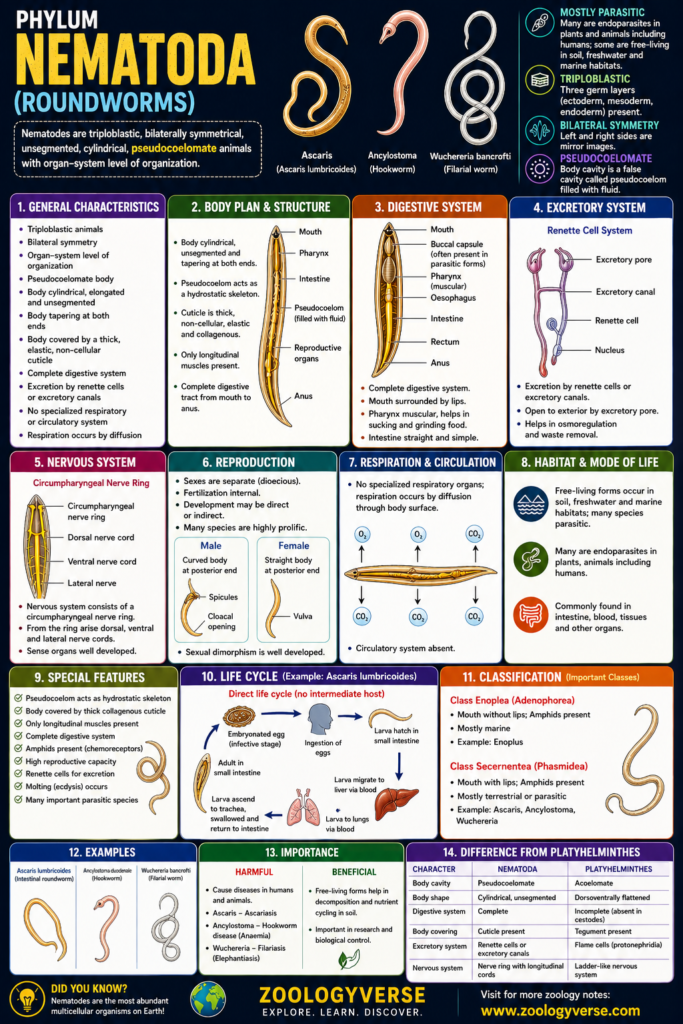
What Are Aschelminthes?
The term Aschelminthes has historically been used for a group of pseudocoelomate or similarly organized invertebrates.
Traditional descriptions generally characterize these animals as:
- Triploblastic
- Bilaterally symmetrical
- Unsegmented
- Usually small and worm-like
- Pseudocoelomate
- Possessing an organ-system level of organization
- Having a complete digestive tract in many included groups
- Lacking a specialized circulatory system
- Lacking a specialized respiratory system in many groups
- Often possessing a protective cuticle
- Frequently reproducing sexually
Historical classifications varied considerably, and different textbooks included different groups within Aschelminthes.
Important Note on Modern Classification
The traditional grouping of Aschelminthes was based largely on shared morphological characteristics, particularly the presence of a pseudocoelom. Molecular studies later showed that the traditional Aschelminthes does not form a single evolutionary lineage. In other words, the organisms included within it do not all share one exclusive common ancestor.
Therefore:
Traditional classification:
Aschelminthes → a broad group of pseudocoelomate animals
Modern classification:
The organisms historically placed in Aschelminthes are distributed among several separate phyla.
For example, Nematoda, Rotifera, and Gastrotricha are now treated as separate phyla rather than classes of one valid phylum called Aschelminthes.
This distinction is important for students because many introductory Zoology courses still teach the traditional Aschelminthes classification.
General Characteristics of Aschelminthes
The following characteristics describe the traditional educational concept of Aschelminthes.
1. Body Shape
The body is generally:
- Elongated
- Cylindrical or worm-like
- Unsegmented
- Usually tapering toward one or both ends
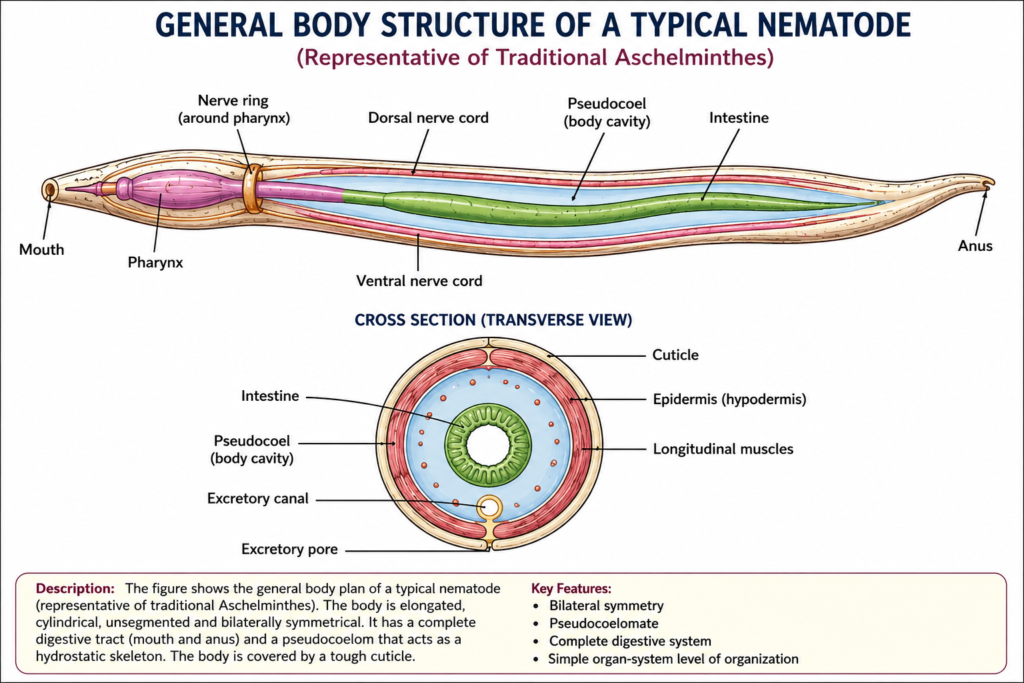
Nematodes are particularly characteristic of this body plan, with a cylindrical body enclosed by a tough cuticle.
2. Symmetry
They are generally bilaterally symmetrical, meaning the body can be divided into approximately equal right and left halves along a single longitudinal plane.
3. Germ Layers
They are triploblastic animals, developing from three embryonic germ layers:
- Ectoderm
- Mesoderm
- Endoderm
4. Level of Organization
The traditional Aschelminthes are generally described as having an organ-system level of organization.
5. Body Cavity
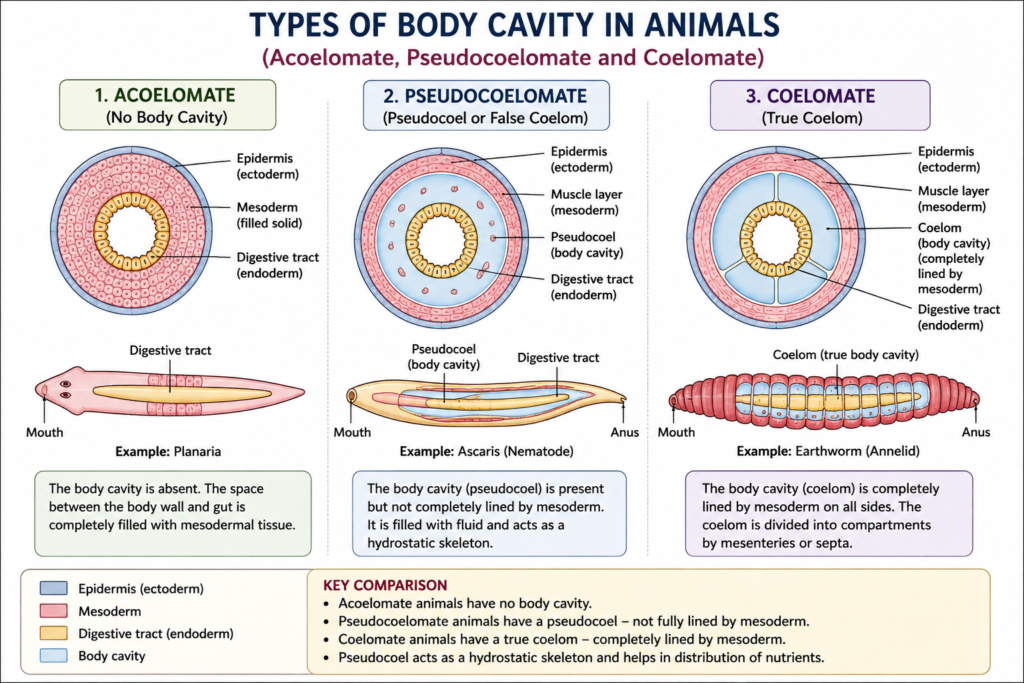
A characteristic feature is the presence of a pseudocoelom.
Unlike a true coelom, a pseudocoel is not completely lined by mesodermal epithelium. The fluid-filled cavity can provide internal support and, particularly in nematodes, contributes to the hydrostatic skeleton.
6. Body Wall
The body wall commonly includes:
- A protective outer cuticle
- Epidermis
- Muscular layer
In nematodes, the cuticle is especially important because it provides protection and works with the longitudinal muscles during movement.
7. Digestive System
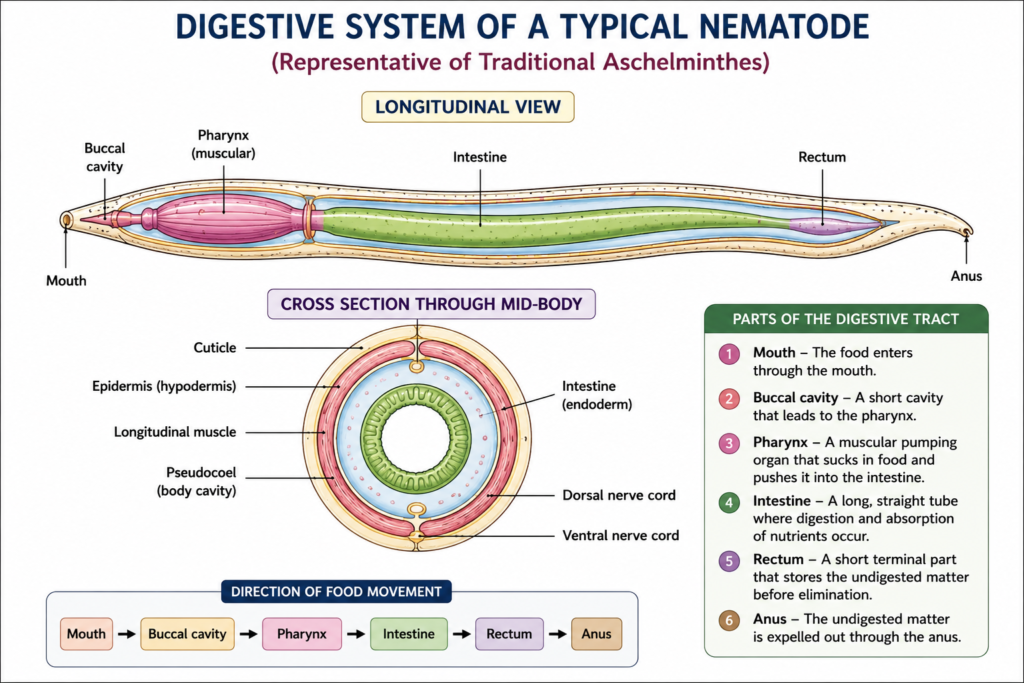
Many traditionally included groups possess a complete digestive tract, with separate mouth and anus.
In nematodes, the alimentary canal includes a mouth, muscular pharynx, intestine, and anus.
This represents an important difference from the incomplete digestive system characteristic of many flatworms.
8. Circulatory System
A specialized circulatory system is absent in the traditional description.
Materials can be distributed through body fluids and diffusion. In larger pseudocoelomate animals, the pseudocoelomic fluid can contribute to internal transport.
9. Respiratory System
A specialized respiratory system is generally absent.
Gas exchange occurs primarily by diffusion across the body surface in many of the traditionally included forms.
10. Excretion
Excretory structures vary among the groups historically included within Aschelminthes.
Traditional descriptions may mention protonephridia, excretory canals, or specialized excretory cells, depending on the group being discussed.
11. Nervous System
The nervous system is relatively simple compared with that of more complex animals.
In nematodes, a nerve ring surrounds the pharynx and connects with longitudinal nerve cords.
12. Reproduction
Sexual reproduction is common.
Many nematodes have separate male and female individuals, and sexual dimorphism is often present. Males are frequently smaller than females.
Some groups, particularly rotifers, can also reproduce through parthenogenesis.
13. Habitat
The organisms historically grouped under Aschelminthes occupy diverse habitats, including:
- Freshwater
- Marine environments
- Soil
- Moist terrestrial environments
- Plant tissues
- Animal hosts
Nematodes, for example, occur in marine, freshwater, and terrestrial environments and include both free-living and parasitic forms.
Body Cavity of Aschelminthes: Pseudocoelom
The pseudocoelom is one of the most important features traditionally associated with Aschelminthes.
It is a fluid-filled cavity between the body wall and digestive tract that is not completely lined by mesoderm.
Functions of the pseudocoel
The pseudocoelomic fluid can:
- Provide internal support
- Act as a hydrostatic skeleton
- Assist movement
- Help distribute substances within the body
- Provide space for internal organs
In nematodes, the pseudocoel is particularly important for maintaining body shape and supporting locomotion.
Digestive System
A complete digestive tract is an important feature of many organisms traditionally placed in Aschelminthes.
The general arrangement can be represented as:
Mouth → Pharynx → Intestine → Anus
The complete digestive tract allows food to move in one direction.
In Nematoda
The nematode digestive system commonly includes:
- Mouth
- Muscular pharynx
- Intestine
- Rectum
- Anus
The muscular pharynx helps ingest and move food into the intestine.
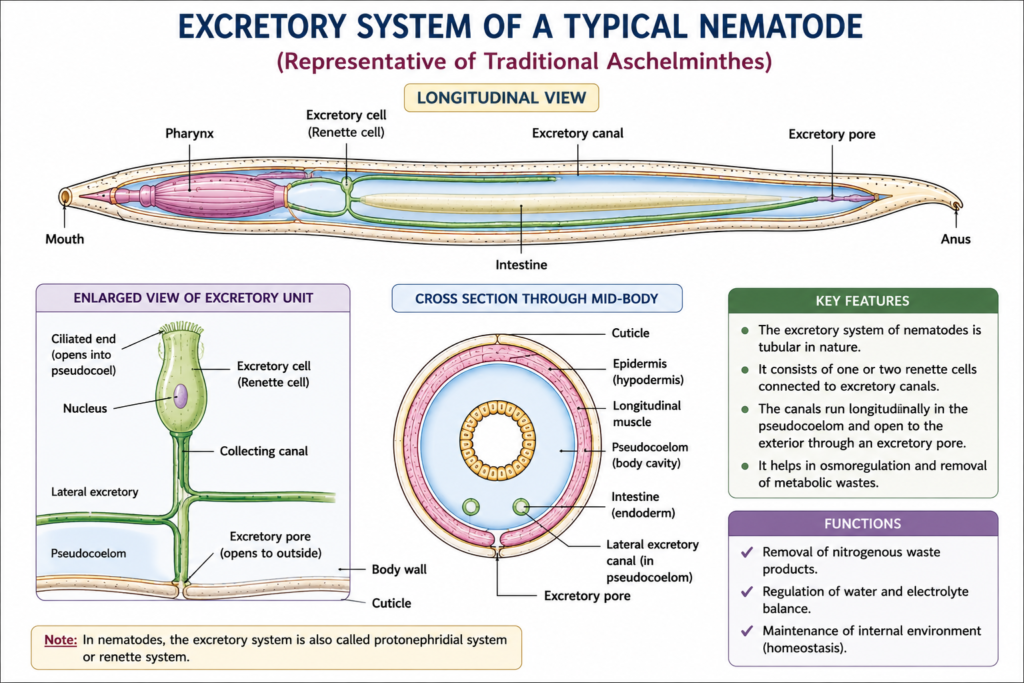
Excretory System
The excretory system differs among the groups historically included within Aschelminthes.
In nematodes, excretion can involve excretory canals and an excretory pore, while older textbook descriptions may also refer to specialized excretory or renette cells.
The major functions include:
- Removal of metabolic wastes
- Regulation of water and ions
- Maintenance of internal conditions
Because Aschelminthes is a historical grouping, it is better to discuss excretion separately for each major group rather than claiming that all members possess exactly the same excretory system.
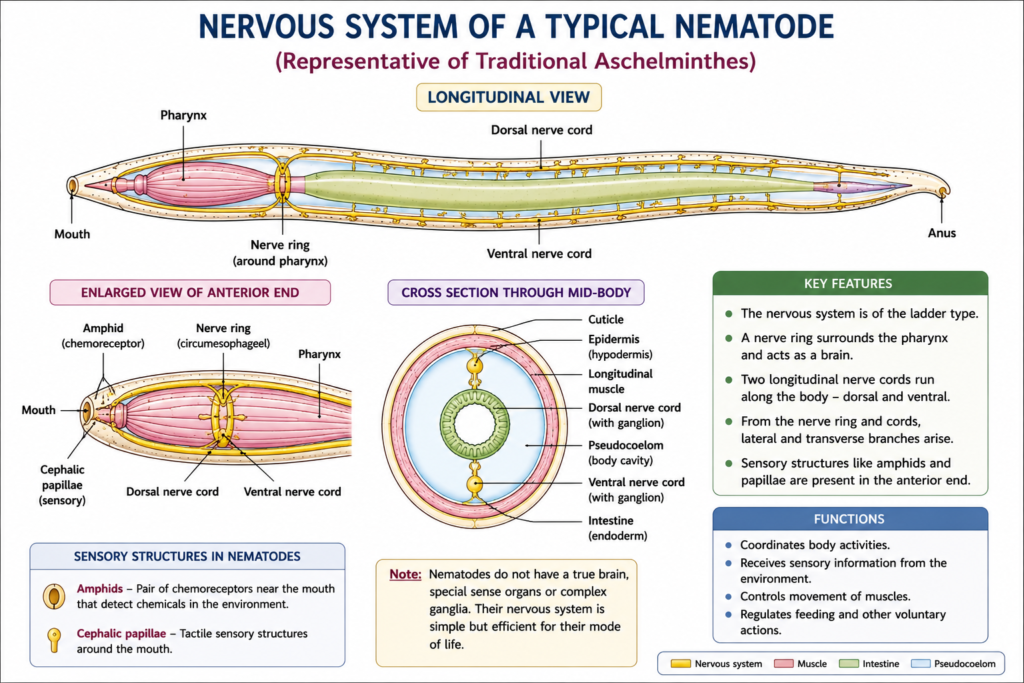
Nervous System
The nervous system is relatively simple.
In a typical nematode, a nerve ring surrounds the pharynx and gives rise to longitudinal nerve cords extending along the body.
Sensory structures occur around the anterior end and elsewhere on the body.
Reproduction in Aschelminthes
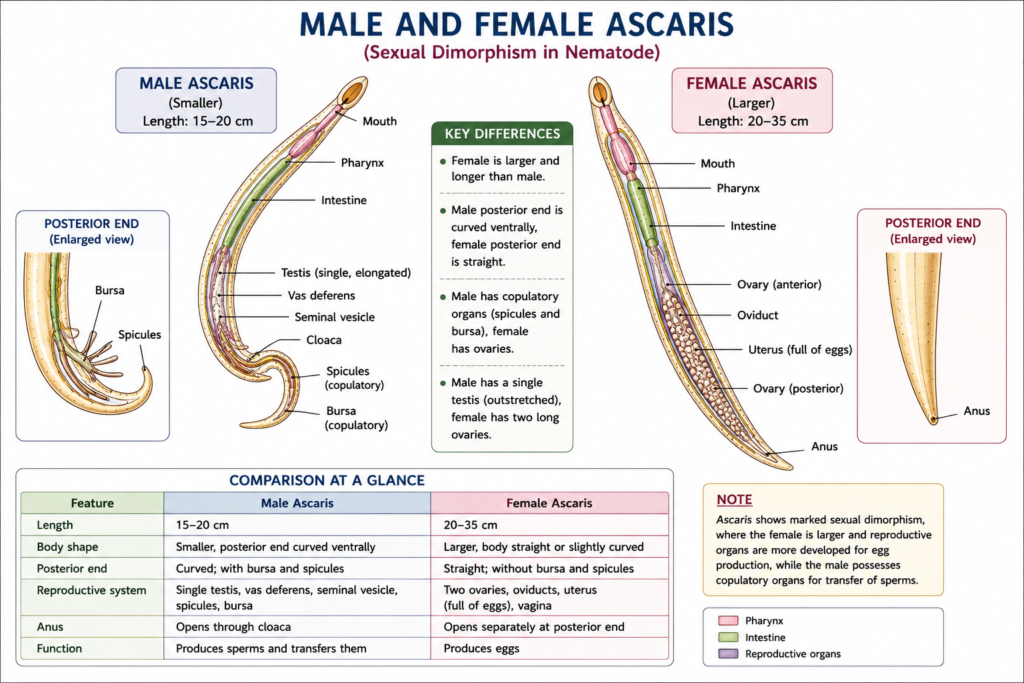
Sexual Reproduction
Sexual reproduction is common among the traditionally included groups.
In many nematodes:
- Sexes are separate.
- Males produce sperm.
- Females produce eggs.
- Fertilization is generally internal.
- Development may be direct or involve larval stages.
Sexual dimorphism is common, with males often being smaller than females.
Asexual Reproduction
Asexual reproduction is not a universal characteristic of Aschelminthes.
Some rotifers are capable of parthenogenesis, in which offspring develop from unfertilized eggs. Rotifers therefore provide an important example of reproductive diversity within the historical Aschelminthes grouping.
Traditional Classification of Phylum Aschelminthes
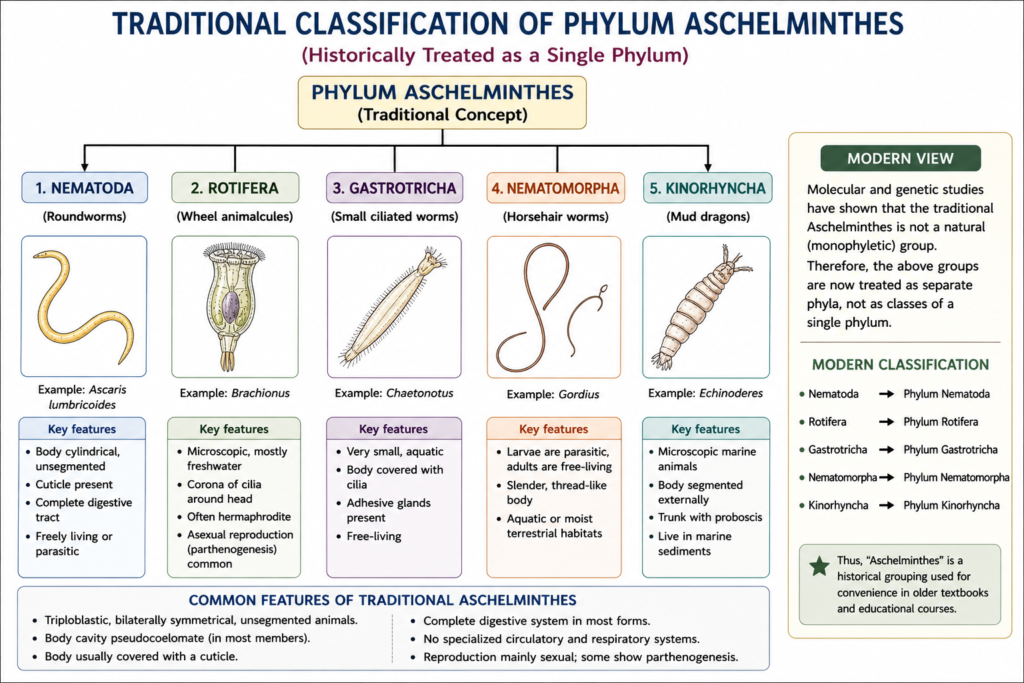
Historically, different authors proposed different classifications.
One traditional classification divided Aschelminthes into groups such as:
- Rotifera
- Gastrotricha
- Nematoda
- Nematomorpha
- Kinorhyncha
Some historical classifications also included additional groups.
Older educational sources therefore do not always agree on the exact number or membership of classes.
Modern interpretation
Today, these groups are generally treated as separate phyla rather than classes of one valid phylum.
Major Groups Traditionally Included in Aschelminthes
1. Nematoda
Nematodes are commonly called roundworms.
They include both free-living and parasitic species and occur in marine, freshwater, and terrestrial environments.
Examples
- Ascaris lumbricoides
- Enterobius vermicularis
- Ancylostoma duodenale
- Wuchereria bancrofti
- Caenorhabditis elegans
Nematodes are particularly important in medicine, agriculture, ecology, and research.
2. Rotifera
Rotifers are microscopic animals commonly known as wheel animals.
They are especially abundant in freshwater habitats, although marine species also occur.
A characteristic feature is the corona, a ciliated structure that produces currents and assists feeding and locomotion.
Many rotifers are extremely small and exhibit diverse body forms.
3. Gastrotricha
Gastrotrichs are very small aquatic animals commonly associated with freshwater and marine environments.
Their bodies are often covered with cilia, and many possess adhesive structures that help them attach to surfaces.
Modern molecular studies support treating Gastrotricha as a separate phylum rather than a class of Aschelminthes.
4. Nematomorpha
Nematomorphs are commonly called horsehair worms.
Their larvae are parasitic, while adults are generally free-living.
They were traditionally included among the aschelminth groups but are now treated as a separate phylum.
5. Kinorhyncha
Kinorhynchs are tiny marine animals commonly called mud dragons.
They live mainly in marine sediments and possess a segmented-looking external body divided into specialized regions.
They were also traditionally included among the Aschelminth groups but are now recognized separately.
Examples of Aschelminthes
Because Aschelminthes is a historical grouping, examples should ideally be identified by their modern group.
| Traditional Aschelminth group | Example | Common name |
|---|---|---|
| Nematoda | Ascaris lumbricoides | Roundworm |
| Nematoda | Enterobius vermicularis | Pinworm |
| Nematoda | Ancylostoma duodenale | Hookworm |
| Nematoda | Wuchereria bancrofti | Filarial worm |
| Rotifera | Brachionus | Rotifer |
| Gastrotricha | Chaetonotus | Gastrotrich |
| Nematomorpha | Gordius | Horsehair worm |
| Kinorhyncha | Echinoderes | Mud dragon |
Medical and Economic Importance
The organisms historically grouped under Aschelminthes have both beneficial and harmful effects.
Medical Importance
Several nematodes are important human parasites.
Ascaris lumbricoides
It is an intestinal roundworm that causes ascariasis.
Enterobius vermicularis
It causes pinworm infection and is particularly common among children.
Ancylostoma duodenale
It is a hookworm that can cause intestinal blood loss and contribute to anemia.
Wuchereria bancrofti
It is a filarial nematode associated with lymphatic filariasis.
Ecological Importance
Not all nematodes and other traditional aschelminth groups are harmful.
Free-living nematodes occur abundantly in soil and aquatic environments, where they participate in:
- Decomposition
- Nutrient cycling
- Food webs
- Microbial regulation
Rotifers are also important components of freshwater food webs and contribute to nutrient cycling.
Scientific Importance
Some organisms traditionally associated with Aschelminthes have become important research organisms.
A notable example is Caenorhabditis elegans, a nematode widely used in developmental biology, genetics, neuroscience, and cell biology.
Its small size, short generation time, and well-characterized development make it an important model organism.
Diseases Associated With Parasitic Nematodes
| Parasite | Disease/condition | Main transmission | |
|---|---|---|---|
| Ascaris lumbricoides | Ascariasis | Ingestion of infective eggs | |
| Enterobius vermicularis | Pinworm infection | Fecal–oral transmission | |
| Ancylostoma duodenale | Hookworm infection | Larvae penetrate skin | |
| Wuchereria bancrofti | Lymphatic filariasis | Mosquito transmission |
Aschelminthes vs Platyhelminthes
| Feature | Traditional Aschelminthes | Platyhelminthes |
|---|---|---|
| Body cavity | Pseudocoelom in many traditional members | Acoelomate |
| Body | Usually cylindrical in nematodes | Often dorsoventrally flattened |
| Digestive tract | Complete in many groups | Usually incomplete or absent |
| Anus | Present in many | Generally absent |
| Segmentation | Absent | Absent |
| Symmetry | Bilateral | Bilateral |
| Germ layers | Triploblastic | Triploblastic |
| Examples | Ascaris, rotifers | Planaria, tapeworms |
Aschelminthes vs Annelida
| Feature | Aschelminthes | Annelida |
|---|---|---|
| Body cavity | Pseudocoelom in many traditional members | True coelom |
| Segmentation | Absent | Present |
| Body shape | Often cylindrical | Cylindrical and segmented |
| Circulatory system | Generally absent | Usually closed |
| Musculature | Varies among groups | Well-developed circular and longitudinal muscles |
| Examples | Ascaris, rotifers | Earthworm, leech |
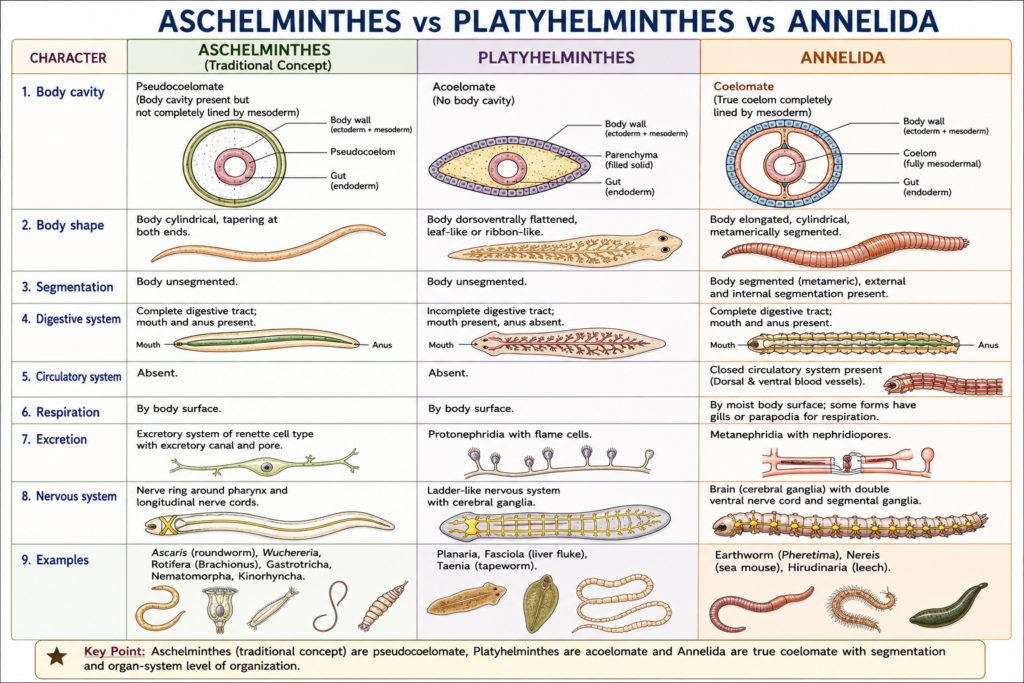
Key Features of Aschelminthes at a Glance
| Feature | Description |
|---|---|
| Traditional status | Historical grouping |
| Symmetry | Bilateral |
| Germ layers | Triploblastic |
| Body | Usually small and unsegmented |
| Body cavity | Pseudocoelom in many traditional members |
| Body covering | Often cuticle |
| Digestive system | Complete in many groups |
| Circulatory system | Generally absent |
| Respiratory system | Generally absent |
| Reproduction | Mainly sexual; varies among groups |
| Habitat | Marine, freshwater, terrestrial, parasitic |
| Important groups | Nematoda, Rotifera, Gastrotricha, Nematomorpha, Kinorhyncha |
| Important example | Ascaris lumbricoides |
Frequently Asked Questions
1. What is Phylum Aschelminthes?
Aschelminthes is a traditional zoological grouping of small, mostly unsegmented pseudocoelomate animals. It is no longer generally regarded as a valid single phylum because the groups historically included within it are evolutionarily diverse.
2. What are the main characteristics of Aschelminthes?
The traditional group is characterized by bilateral symmetry, triploblastic organization, an unsegmented body, a pseudocoelom in many members, and generally simple organ systems.
3. What type of body cavity is found in Aschelminthes?
A pseudocoelom is traditionally considered a characteristic feature of Aschelminthes.
4. Is Aschelminthes a valid phylum?
Not in modern classification. Aschelminthes is considered a historical or informal grouping because the organisms placed within it do not form a single monophyletic group.
5. Are Aschelminthes and Nematoda the same?
No. Nematoda is a separate phylum in modern classification. Nematodes were historically included within the broader Aschelminthes grouping.
6. What are examples of Aschelminthes?
Traditional examples include Ascaris, Enterobius, Ancylostoma, Wuchereria, rotifers, gastrotrichs, nematomorphs, and kinorhynchs.
7. Which Aschelminth causes lymphatic filariasis?
The nematode Wuchereria bancrofti is an important cause of lymphatic filariasis.
8. What is the difference between a coelom and pseudocoelom?
A true coelom is completely lined by mesoderm-derived tissue, whereas a pseudocoelom is not completely lined by mesoderm.
9. Do Aschelminthes have a complete digestive system?
Many organisms traditionally included within Aschelminthes possess a complete digestive tract with a mouth and anus.
Conclusion
Aschelminthes is an important term in traditional invertebrate Zoology, particularly in courses that use classical animal classification. Members historically placed in this group are generally small, unsegmented, bilaterally symmetrical animals, and many possess a pseudocoelom and complete digestive tract.
However, modern zoology has shown that the traditional Aschelminthes is not a single natural evolutionary group. Molecular studies demonstrated that its members belong to different evolutionary lineages, leading modern classifications to recognize groups such as Nematoda, Rotifera, Gastrotricha, Nematomorpha, and Kinorhyncha as separate phyla.
For examination purposes, students should therefore understand both the traditional concept of Aschelminthes and its modern taxonomic interpretation.
References
- University of Alberta — overview of the traditional Aschelminthes grouping and its characteristics.
- University of Alberta — diversity of the traditionally included groups, including Nematoda and Rotifera.
- Oxford Academic — molecular evidence demonstrating the polyphyletic nature of traditional Aschelminthes.
- University of Uttarakhand — zoology study material discussing the traditional pseudocoelomate concept.
- Central Institute of Educational Technology — educational material on traditional Aschelminthes/Nematoda characteristics.
- University of Modena and Reggio Emilia — current overview of Gastrotricha and its modern phylogenetic interpretation.
Discover more from Zoologyverse
Subscribe to get the latest posts sent to your email.