
Oikopleura is a genus of small, free-swimming marine tunicates commonly known as larvaceans. It belongs to Phylum Chordata, Subphylum Tunicata, Class Appendicularia and Family Oikopleuridae. Unlike adult ascidians, which usually become sessile, Oikopleura retains a fish-like body plan and remains planktonic throughout its life.
The Characteristics of Oikopleura include a small transparent body, a persistent notochord, a dorsal nerve cord, a post-anal tail and a specialized mucous feeding house. The tail produces water currents that help the animal filter tiny food particles from seawater.
The Classification of Oikopleura is particularly important in zoology because it represents a highly specialized group of tunicates that retain several chordate features in the adult stage. Its simple body organization also provides useful insights into chordate evolution and development.
The Life cycle of Oikopleura is relatively simple compared with many other tunicates. The animal reproduces sexually, and the developing young grow into free-swimming adults without passing through the typical sessile ascidian stage.
This article covers the Classification of Oikopleura, Characteristics of Oikopleura, body organization, feeding adaptations, locomotion, reproduction, Life cycle of Oikopleura and its ecological importance.
For Practical Study
The following notes are arranged in a practical examination format for easy study and identification.
Classification of Oikopleura
| Rank | Classification | Characteristic |
|---|---|---|
| Kingdom | Animalia | Multicellular animals |
| Phylum | Chordata | Animals showing fundamental chordate features during development |
| Subphylum | Tunicata | Marine chordates enclosed by a protective tunic |
| Class | Appendicularia | Small, permanently free-swimming tunicates retaining a tail and chordate features in adults |
| Order | Copelata | Pelagic appendicularians with a persistent tail and mucous feeding house |
| Family | Oikopleuridae | Small larvaceans characterized by a compact body, long tail and elaborate mucus house |
| Genus | Oikopleura | Free-swimming larvaceans with a persistent notochord, muscular tail and specialized filter-feeding house |
Geographical Distribution
Oikopleura occurs in marine waters throughout many oceanic regions. Different species occupy different geographic and depth ranges, and many are common components of plankton communities.
Habit and Habitat
Oikopleura is a free-swimming pelagic tunicate that lives suspended in the water column. It remains planktonic throughout its life and uses its muscular tail for swimming and generating water currents for feeding.

Comments
- Oikopleura is minute and microscopic measuring about 2 mm.
- Animal lives in a ‘house or test’ made by secretion from a special part of the skin, called as oikoplastic epithelium. Body wall contains test and ectoderm.
- It has larva-like appearance comprising body, tail and persistent notochord.
- Body narrows towards mouth and expands posteriorly dorsoventrally.
- The caudal appendages have undergone torsion of 90°.
- Tail is a broad structure, which rests at an angle to the rest of the body. It has notochord, nerve cord, broad tail fin and 7 to 12 striped muscle cells.
- Movement of the tail produces water current. Food particles are filtered by an elaborate arrangement in the house.
- Water enters into house by a pair of posterior filtering windows and is passed through filter pipes in front of mouth. Minute flagellates are sucked by mouth.
- Dorsal lamina and tentacles are absent. Otocyst present.
- Mouth leads into alimentation comprising of pharynx, oesophagus, stomach and intestine. Pharynx has gill-slits opening to outside. The food consists of microorganisms.
- Protandrously hermaphroditic, kidney-shaped two testis. Left testis encloses.
- Internal space filled by haemocoelomic lacunae having blood circulation by a transport heart.
Special Features
- The general structural organization resembles with a typical ascidian tadpole and it can be very safely concluded that these forms have arisen from tunicates by the acceleration of the fate of development of alimentation and reproductive systems, so that the metamorphosis and the adult stage are omitted and it shows phenomenon of neoteny or paedomorphosis.
- The anatomy of the animal suggests that larvaceans are not like the ancestral chordates but are neotenic descendants of the sessile ancestors resembling Urochordata.
- Mucus House Production:
- Continuously builds and discards intricate mucus houses for feeding.
- Each house filters large volumes of water, extracting food efficiently.
- Rapid Reproduction: Short life cycles and high reproductive rates enable quick population growth in favorable conditions.
- Transparency: Almost completely transparent, providing camouflage in the open ocean.
- Adaptability: Can thrive in varying environmental conditions, making them resilient and widespread.
Identification
A small transparent pelagic tunicate with a distinct notochord-bearing tail, compact body and characteristic mucous feeding house can be identified as Oikopleura.
Quick Identification of Oikopleura
Oikopleura is a small, transparent free-swimming larvacean that retains important chordate features throughout its adult life.
- Common name: Larvacean or appendicularian
- Scientific name: Oikopleura
- Phylum: Chordata
- Subphylum: Tunicata
- Class: Appendicularia
- Order: Copelata
- Family: Oikopleuridae
- Body: Small, transparent and compact
- Lifestyle: Free-swimming and pelagic
- Tail: Long muscular post-anal tail containing the notochord
- Feeding: Suspension or filter feeding
- Feeding structure: Large gelatinous mucous house
- Key chordate features: Notochord, dorsal nerve cord and post-anal tail
- Key identifying feature: A larva-like body retained throughout adult life, together with a specialized mucous feeding house
Physical Characteristics of Oikopleura
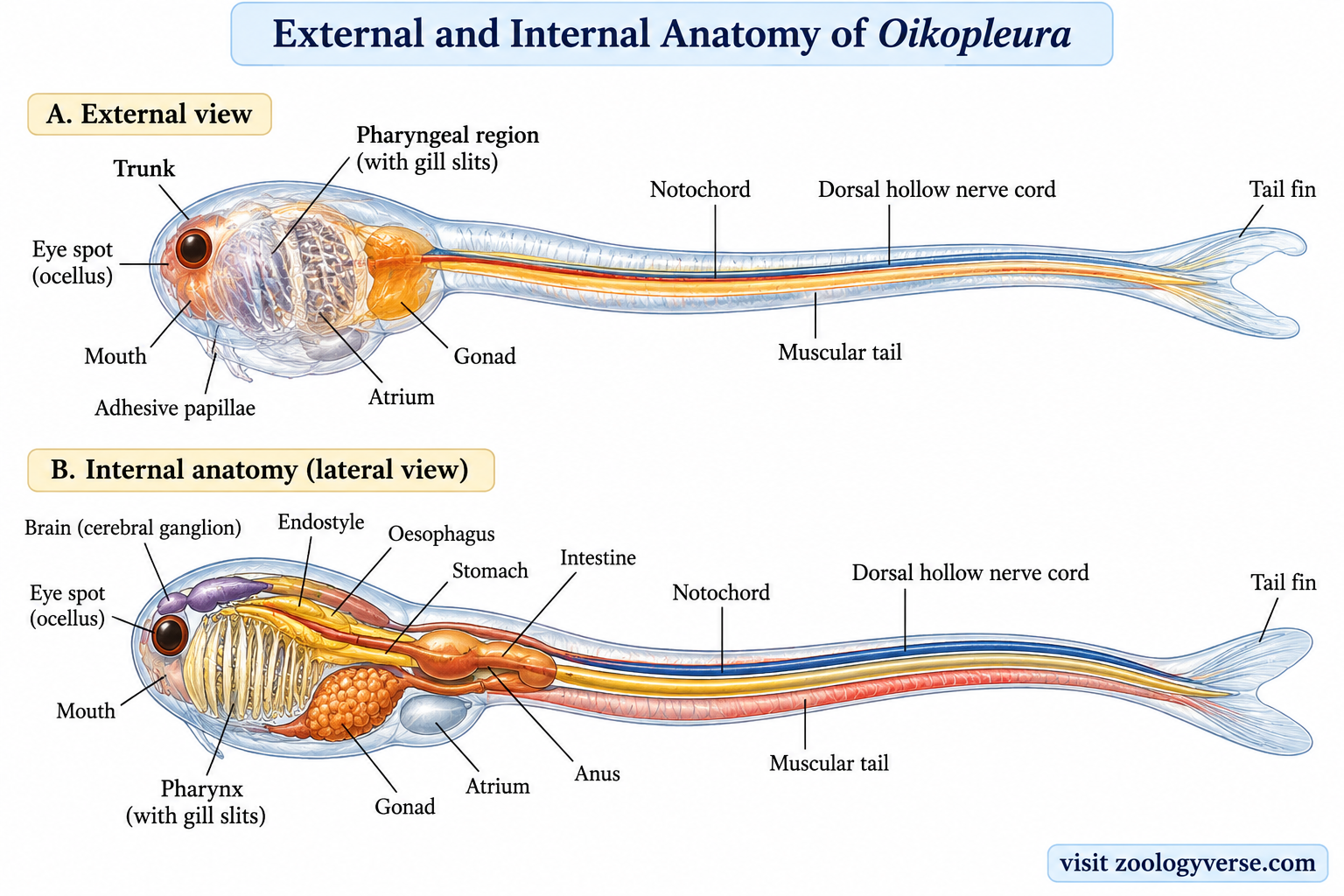
Oikopleura has a small, transparent body that retains a distinctly larva-like organization throughout adult life. Its body is divided into a compact trunk and a long muscular tail.
- The trunk contains most of the internal organs and is enclosed by a thin outer covering.
- The tail extends posteriorly from the trunk and contains a persistent notochord.
- A dorsal hollow nerve cord is associated with the tail and represents an important chordate feature.
- The tail contains powerful muscle bands that produce side-to-side movements during swimming.
- The body is generally transparent, making internal organs visible through the body wall.
- The trunk contains the pharyngeal region, digestive tract and reproductive organs.
- The pharyngeal region is specialized for suspension feeding.
- Oikopleura secretes a large gelatinous mucous house around its body, which functions as a specialized filter-feeding structure.
- The animal periodically discards its old house and secretes a new one.
- Unlike many adult tunicates, Oikopleura does not undergo a transformation into a sessile adult form; it remains free-swimming throughout its life.
Feeding and Filter-Feeding Adaptations of Oikopleura
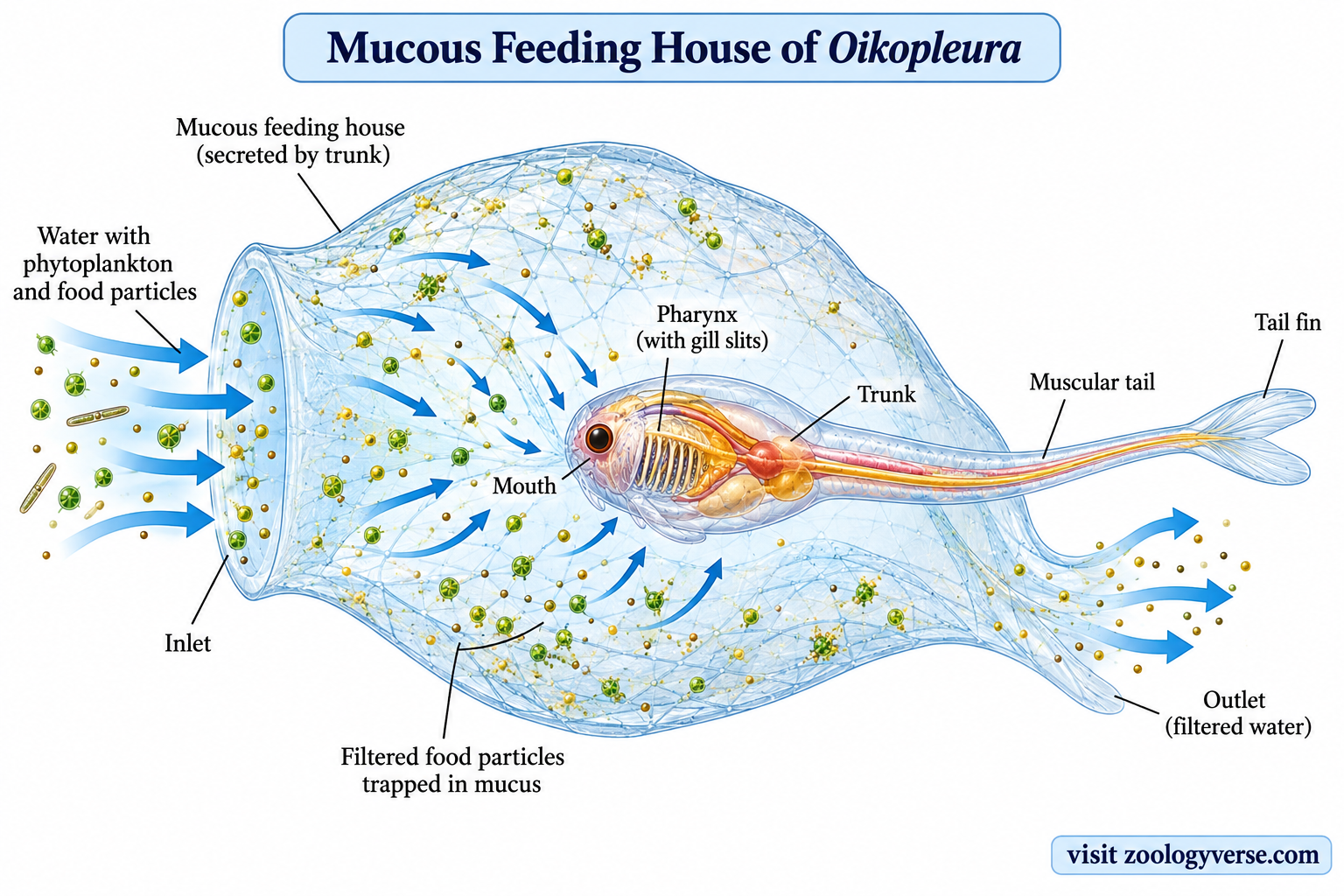
Oikopleura is an efficient suspension feeder that uses its specialized mucous feeding house to filter tiny food particles from seawater.
- The muscular tail generates water currents that draw seawater toward the feeding house.
- Seawater passes through the mucous filters of the house.
- Tiny suspended particles, including phytoplankton and other microorganisms, become trapped in the mucus.
- The filtered food is directed toward the animal’s mouth.
- The endostyle contributes mucus to the feeding process.
- Ciliary activity helps transport captured particles toward the digestive tract.
- Food is digested in the gut, while undigested material is expelled from the body.
- The feeding house also helps prevent larger particles from entering the animal.
- When the house becomes clogged or damaged, Oikopleura abandons it and rapidly produces a new one.
This specialized mucous-house system allows Oikopleura to efficiently exploit very small particles in the plankton and makes it an important component of marine pelagic food webs.
Locomotion and Tail Adaptations in Oikopleura
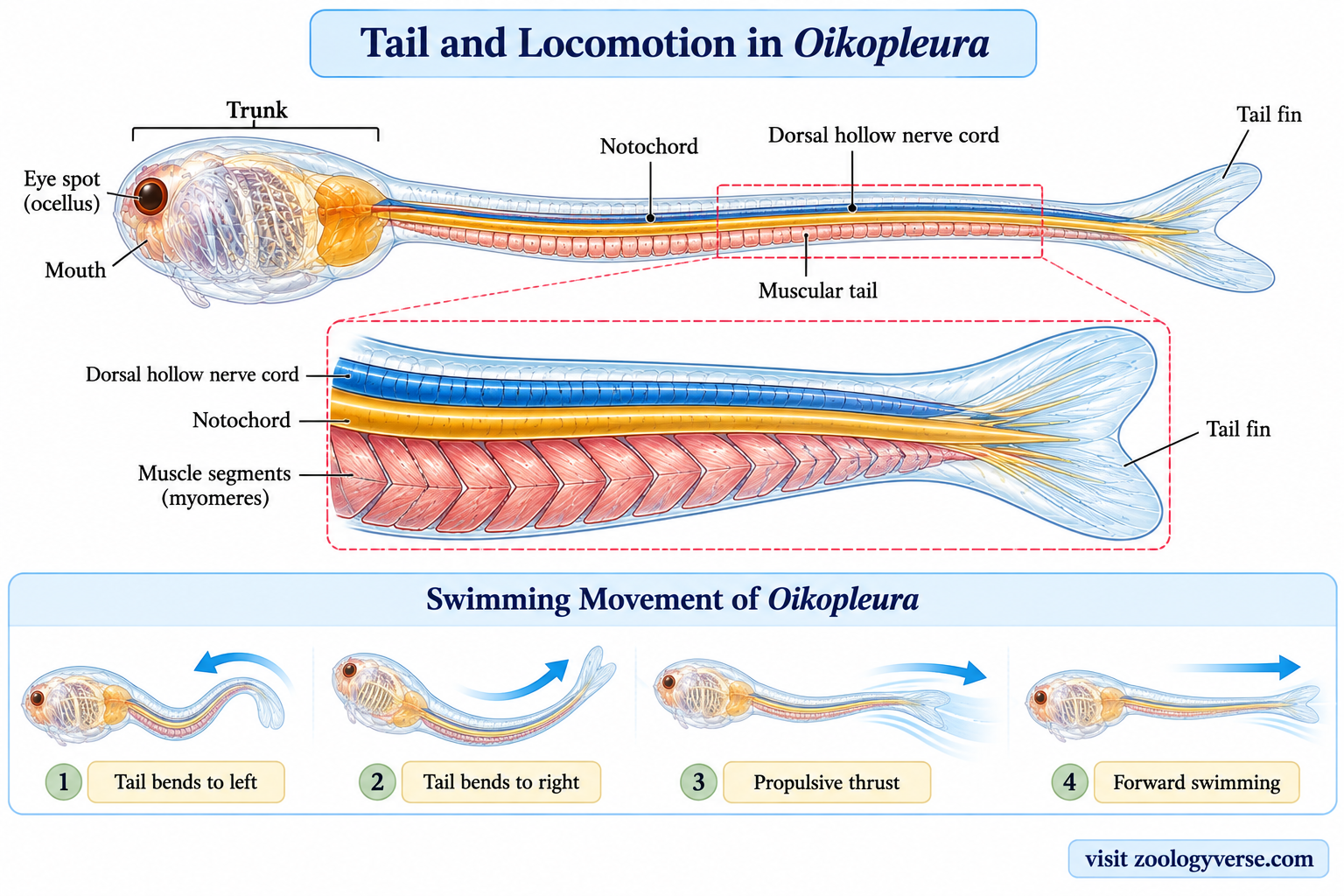
Oikopleura uses its long, muscular tail for swimming and generating water currents required for feeding. The tail is a major chordate feature and remains functional throughout the adult stage.
- The tail contains a persistent notochord, which provides structural support.
- Muscular bands on either side of the notochord produce rhythmic lateral movements.
- Alternating contractions create undulatory movements of the tail.
- Tail movements propel the animal through the surrounding seawater.
- The same movements generate water currents that pass through the mucous feeding house.
- The tail therefore serves both locomotion and feeding functions.
- The streamlined body and flexible tail help Oikopleura remain suspended in the plankton.
- The persistent muscular tail distinguishes appendicularians from many other adult tunicates, which lose their larval tail during metamorphosis.
Reproduction and Life Cycle of Oikopleura
Oikopleura reproduces sexually and has a relatively simple life cycle compared with many other tunicates. It remains free-swimming throughout its life and does not develop into a sessile adult.
Reproduction
- Oikopleura is generally hermaphroditic, producing both male and female gametes during its reproductive life.
- Reproductive organs are located within the trunk.
- Gametes are released into seawater.
- Fertilization occurs externally in the surrounding water.
- The fertilized egg undergoes embryonic development and produces a young larvacean.
- The developing individual retains the characteristic trunk and tail organization.
- The notochord, dorsal nerve cord and post-anal tail remain prominent during development.
- The young animal soon becomes an independent planktonic organism.
Life Cycle
Adult Oikopleura → Gamete release → External fertilization → Embryo → Developing larvacean → Free-swimming juvenile → Adult
The absence of a sessile adult stage and the retention of chordate features throughout life make the life cycle of Oikopleura particularly important in the study of tunicate biology and chordate evolution.
Chordate Features of Oikopleura
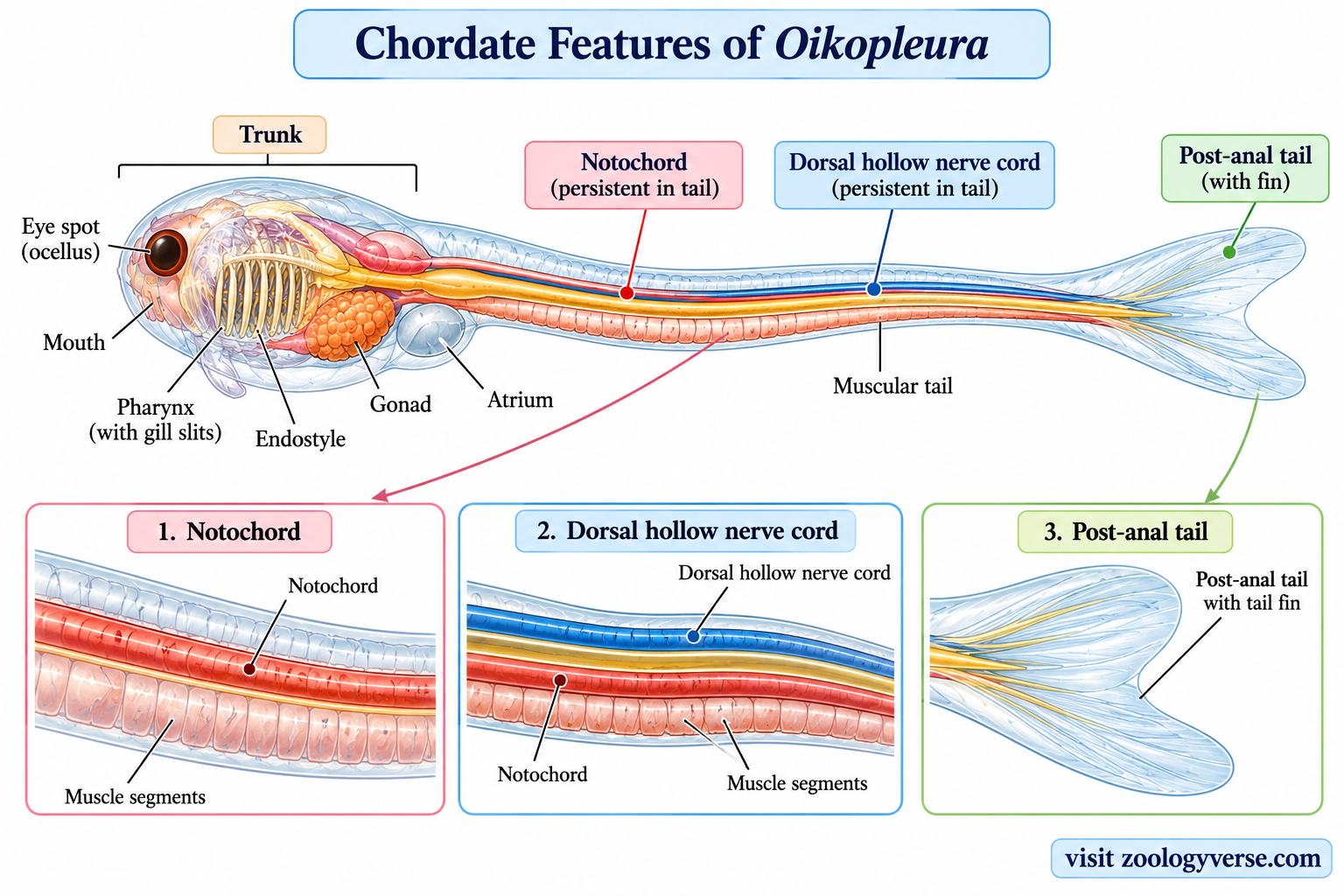
Oikopleura is unusual among tunicates because it retains major chordate features throughout its adult life rather than losing them during metamorphosis.
- Notochord: A persistent notochord extends along the tail and provides structural support during swimming.
- Dorsal hollow nerve cord: The nerve cord lies dorsally and extends into the tail.
- Post-anal tail: The muscular tail extends beyond the posterior end of the trunk.
- Pharyngeal region: The pharyngeal apparatus is associated with the feeding and respiratory functions.
- Endostyle: The endostyle produces mucus involved in filter feeding.
- Muscular tail: Tail muscles produce lateral movements for swimming and generate water currents for feeding.
- Unlike many other tunicates, Oikopleura does not lose its tail during metamorphosis.
These retained features make Oikopleura an important organism for studying tunicate biology, chordate development and evolutionary relationships within Chordata.
Ecological Importance of Oikopleura
Oikopleura is an important component of marine plankton communities and contributes to the movement of organic matter through pelagic food webs.
- Oikopleura consumes phytoplankton, microorganisms and other suspended particles from seawater.
- Its efficient mucous feeding house allows it to capture very small particles that may be difficult for larger filter feeders to collect.
- By filtering seawater, Oikopleura influences the abundance and distribution of suspended organic particles.
- Its fecal material contributes to the transfer of organic matter through the water column.
- Oikopleura serves as a food source for various marine organisms.
- Rapid growth and reproduction in favourable conditions allow larvacean populations to contribute significantly to plankton biomass.
- Discarded mucous houses can also become particles of organic matter that are consumed or transported through the marine food web.
Thus, Oikopleura contributes to plankton dynamics, marine food webs, particle processing and oceanic carbon cycling.
Key Takeaways
- Oikopleura is a small, free-swimming marine tunicate commonly called a larvacean.
- It belongs to Phylum Chordata, Subphylum Tunicata, Class Appendicularia, Order Copelata and Family Oikopleuridae.
- The body consists of a compact trunk and a long muscular tail.
- The tail contains a persistent notochord and dorsal hollow nerve cord.
- Unlike most adult tunicates, Oikopleura retains its post-anal tail throughout adult life.
- It uses a specialized gelatinous mucous house for filter feeding.
- The muscular tail provides both locomotion and water currents for feeding.
- Oikopleura reproduces sexually and remains pelagic throughout its life cycle.
- It contributes to plankton dynamics, marine food webs and oceanic carbon cycling.
- Its retention of chordate features makes Oikopleura particularly important for studying chordate evolution and development
Frequently Asked Questions
What is Oikopleura?
Oikopleura is a genus of small, free-swimming marine tunicates commonly called larvaceans or appendicularians.
What is the classification of Oikopleura?
Oikopleura belongs to Kingdom Animalia, Phylum Chordata, Subphylum Tunicata, Class Appendicularia, Order Copelata and Family Oikopleuridae.
Where does Oikopleura live?
Oikopleura lives in marine environments and is an important member of the plankton, remaining suspended in the water column throughout its life.
What does Oikopleura eat?
It is a suspension feeder that consumes phytoplankton, microorganisms and other small suspended particles.
What is the mucous house of Oikopleura?
The mucous house is a large gelatinous feeding structure secreted by the animal. It acts as a specialized filter that concentrates small food particles before they reach the mouth.
How does Oikopleura move?
It swims by producing rhythmic lateral movements of its muscular tail. The tail also generates water currents that help operate its feeding house.
Does Oikopleura have a notochord?
Yes. Oikopleura retains a persistent notochord within its tail throughout adult life.
References
- National Center for Biotechnology Information (NCBI). Oikopleura Taxonomy and Classification.
- World Register of Marine Species (WoRMS). Oikopleura and Oikopleuridae classification.
- National Center for Biotechnology Information (NCBI). Appendicularia Taxonomy.
- Ruppert, E. E., Fox, R. S., & Barnes, R. D. Invertebrate Zoology: A Functional Evolutionary Approach. Brooks/Cole.
- Brusca, R. C., Moore, W., & Shuster, S. M. Invertebrates. Sinauer Associates.
Discover more from Zoologyverse
Subscribe to get the latest posts sent to your email.