
Spongilla
Spongilla is a genus of freshwater sponges well-known for thriving in lakes, ponds, and slow-moving streams. These sponges play important ecological roles by filtering water and contributing to aquatic ecosystems.
The freshwater sponge genus Spongilla is a member of the Phylum Porifera. In ponds and lakes, it is frequently seen affixed to submerged rocks, sticks, and aquatic vegetation. It is renowned for the creation of gemmules and its rhagon canal system.
At a Glance
| Feature | Description |
|---|---|
| Common Name | Freshwater Sponge |
| Phylum | Porifera |
| Class | Demospongiae |
| Habitat | Freshwater |
| Canal System | Rhagon Type |
| Skeleton | Spongin + Siliceous Spicules |
| Reproduction | Sexual & Asexual |
Classification of Spongilla
- Phylum: Porifera (Pore-bearing animals with cellular grade and asymmetrical or radial symmetry)
- Class: Demospongiae (Sponges with skeletons composed of spongin fibers, siliceous spicules, or both)
- Order: Spongillida (Freshwater sponges adapted to non-marine habitats)
- Family: Spongillidae (Sponges typically with gemmule formation for dormancy)
- Genus: Spongilla
Habit and Habitat
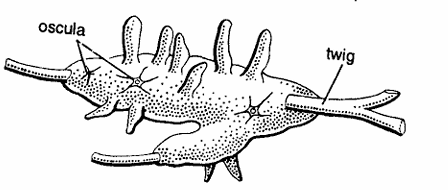
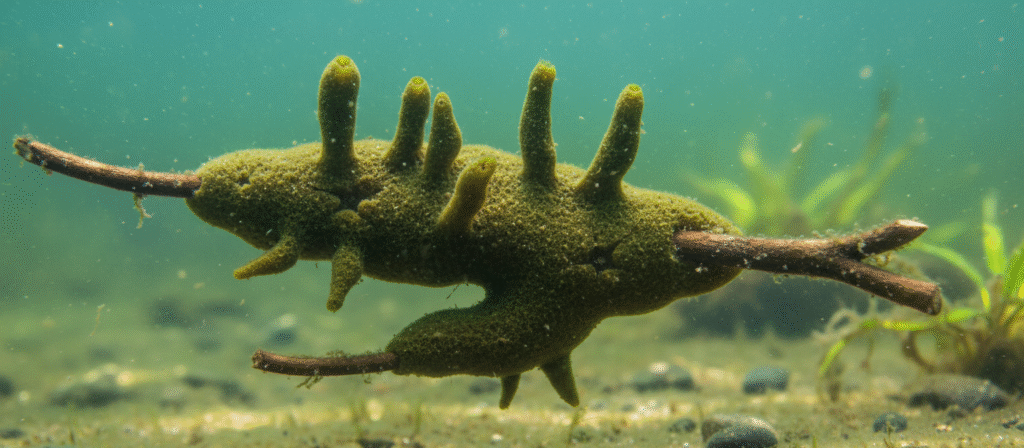
Spongilla are freshwater organisms that attach themselves to submerged objects such as rocks, logs, and aquatic plants in lakes, ponds, rivers, and slow-moving streams. They prefer clean, unpolluted, and still or slowly flowing water. These sponges can appear as encrusting or branching masses and often display greenish hues due to symbiotic algae living within their tissues.
Geographical Distribution
Spongilla species, particularly Spongilla lacustris, have a broad distribution across the Northern Hemisphere, including North America, Europe, and parts of Asia. They are common in temperate freshwater ecosystems, especially in Central Europe and Northern Britain, inhabiting both lentic and lotic water bodies.
General Characteristics of Spongilla
- Commonly known as fresh-water sponge.
- Colony is profusely branched, exhibiting various shades of green colour due to the presence of green algae, called as Zoochlorellae, in the cellular system.
- Body wall consists of very thin dermal membrane, perforated with dermal pores or ostia and several oscula.
- Skeleton is composed of spongin fibres. The siliceous spicules are in the form of network of smooth or spiny large and small oxeas, embedded in the spongin.
- Canal system is of the rhagon type. Water enters through dermal pores – sub-dermal cavity – incurrent canals – several flagellated chambers -excurrent canal -osculum.
- Asexual reproduction by gemmules. Sexual reproduction by sperm and ova.
- Gemmules are protected by amphidisk spicules.
- Larva is free swimming. It develops on floating submerged twigs or sticks.
- Spongilla varies in form from encrusting patches to branching or finger-like shapes.
- The outer layer is soft and velvety, often light yellow to green in color, influenced by the abundance of green algae (zoochlorella) symbionts.
- The body contains numerous ostia (small pores) and one or multiple oscula (large openings) for water circulation.
- Possesses a leuconoid canal system, the most complex sponge canal system, improving water filtration efficiency.
- Skeleton is composed of spongin fibers supported by siliceous spicules, which may be simple or tetraxial.
- Gas exchange and excretion occur via diffusion directly through the sponge membrane.
- Feeds on microorganisms and organic particles filtered from water.
- Lifecycle includes both sexual reproduction (hermaphroditic gametes) and asexual reproduction through budding and gemmule formation. Gemmules help survive harsh conditions like freezing or drying.
Special Features of Spongilla
A special adaptation of Spongilla sponges is the formation of gemmules—internal buds encased in a protective coat. Gemmules allow the sponge to endure adverse environmental conditions such as desiccation, freezing, or lack of oxygen. Once favorable conditions return, gemmules germinate to form new sponge individuals, maintaining population resilience.
Identification
The specimen has branched colony, ostia, rhagon type canal system and all above features and hence it is Spongilla.
Identifying Spongilla involves looking for its typical greenish or yellowish soft-bodied form attached to submerged surfaces. Microscopically, the skeleton with characteristic spongin fibers and siliceous spicules distinguishes it from other freshwater invertebrates. The presence of gemmules during dormant seasons is also a useful identification feature.
Key Takeaways
- Spongilla is a freshwater sponge belonging to Phylum Porifera and Class Demospongiae.
- It is commonly found attached to submerged rocks, aquatic plants, and wooden logs in ponds, lakes, and slow-moving streams.
- Spongilla has a rhagon type of canal system, which improves water circulation and filter feeding.
- Its skeleton is composed of siliceous spicules and spongin fibres, providing support and protection.
- It reproduces both asexually (by budding, fragmentation, and gemmules) and sexually.
- Spongilla plays an important ecological role by filtering water and maintaining freshwater ecosystem health.
Frequently Asked Questions (FAQs)
What is Spongilla?
Spongilla is a genus of freshwater sponges belonging to Phylum Porifera. It commonly grows on submerged rocks, logs, and aquatic plants in freshwater habitats.
Where is Spongilla found?
Spongilla is found in ponds, lakes, reservoirs, and slow-moving freshwater streams, where it attaches to hard surfaces.
What type of canal system is present in Spongilla?
Spongilla possesses a rhagon canal system, a modified form of the leuconoid canal system that efficiently circulates water for feeding and respiration.
What is the skeleton of Spongilla made of?
The skeleton of Spongilla consists of siliceous spicules embedded in spongin fibres, which provide structural support.
How does Spongilla reproduce?
Spongilla reproduces both asexually (through budding, fragmentation, and gemmule formation) and sexually by producing gametes.
Why are gemmules important in Spongilla?
Gemmules are resistant structures that help Spongilla survive unfavorable environmental conditions such as drought or freezing temperatures. They germinate when conditions become favorable.
What is the ecological importance of Spongilla?
Spongilla acts as a natural water filter, removing suspended particles and improving water quality. It also provides habitat for small aquatic organisms.
What are the main characteristics of Spongilla?
The main characteristics of Spongilla include:
- Freshwater habitat
- Cellular level of organization
- Rhagon canal system
- Siliceous spicules and spongin fibres
- Filter-feeding habit
- Presence of gemmules for asexual reproduction
References:
- BYJU’S – Spongilla Classification and Examples
- Wikipedia – Spongilla lacustris
- Sealifebase – Spongilla
Discover more from Zoologyverse
Subscribe to get the latest posts sent to your email.