
Torpedo is a genus of electric rays belonging to the family Torpedinidae and order Torpediniformes. These marine cartilaginous fishes are well known for their ability to produce powerful electrical discharges using specialized electric organs located on either side of the head and pectoral disc.
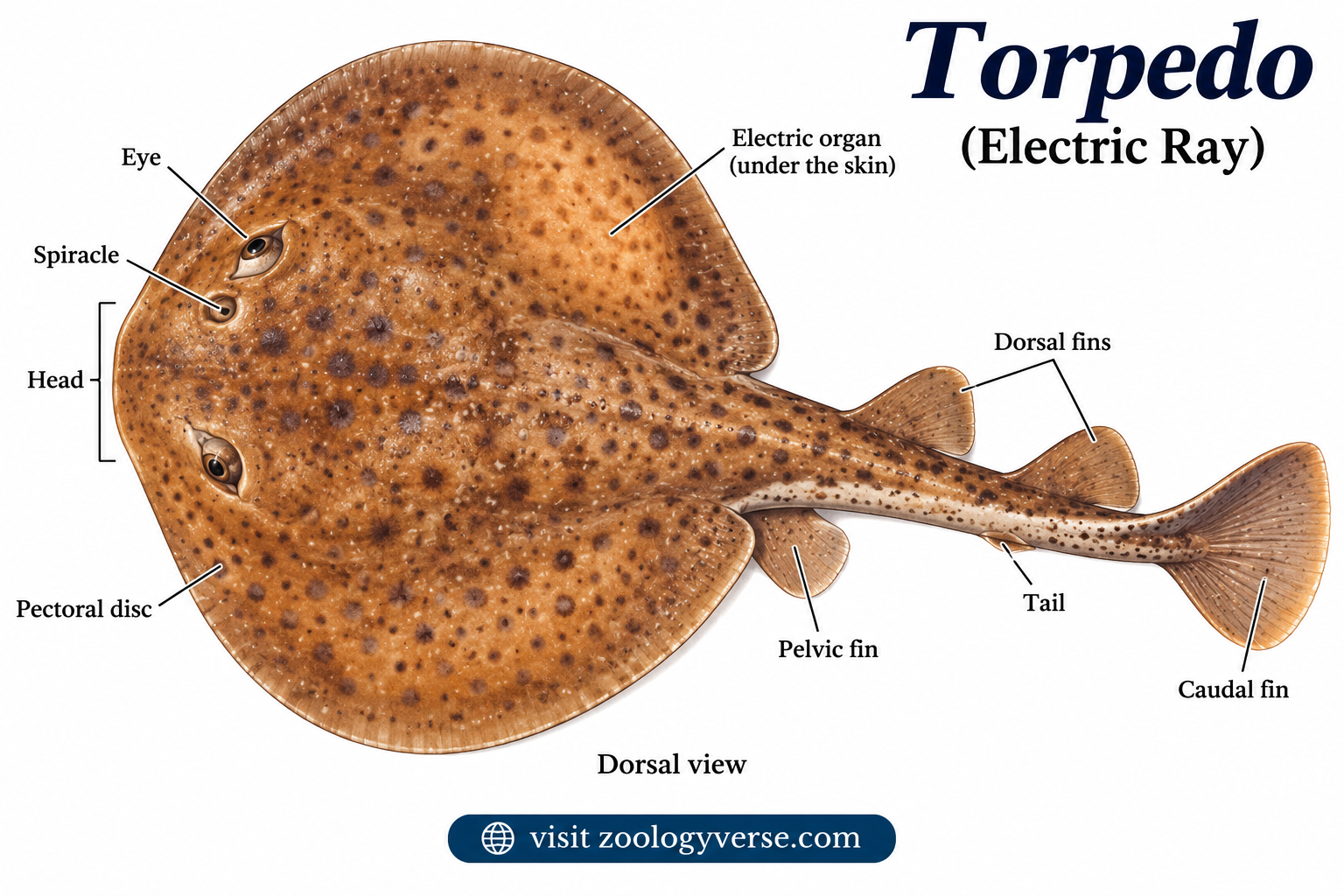
The body of Torpedo is strongly dorsoventrally flattened, with a broad, rounded pectoral disc and a relatively short, stout tail. The eyes are small and positioned on the dorsal surface, while the mouth and gill openings are located on the ventral side. Spiracles are present behind the eyes and assist in drawing water toward the gills, particularly when the ray is resting on the sea floor.
Unlike most rays, Torpedo possesses paired electric organs capable of generating electrical pulses. These discharges are used primarily for capturing prey and defence. The electric organs are composed of specialized cells called electrocytes, which function together to produce an electrical potential.
Members of Torpedo occur mainly in marine environments, where they inhabit sandy or muddy bottoms, continental shelves, and other suitable coastal or offshore habitats. They are generally bottom-dwelling predators that feed on fishes and other small marine animals.
Torpedo is therefore an important zoological example for studying the adaptations of cartilaginous fishes, particularly electric organs, bottom-dwelling habits, specialized body form, and predatory feeding.
Species of Torpedo
Torpedo is a genus of electric rays in the family Torpedinidae. The family belongs to the order Torpediniformes, a group of batoid fishes specialized for producing electric discharges.
The name Torpedo should therefore be used for the genus as a whole, rather than as the name of a single animal. Different species within the genus vary in body size, coloration, geographical range, and habitat.
| Scientific name | Common name |
|---|---|
| Torpedo torpedo | Common torpedo |
| Torpedo marmorata | Marbled electric ray |
| Torpedo nobiliana | Atlantic torpedo |
| Torpedo sinuspersici | Variable torpedo |
| Torpedo panthera | Panther torpedo |
| Torpedo fuscomaculata | Black-spotted torpedo |
For Practical Study
The following notes are arranged in a practical examination format for easy study and identification.
Classification of Torpedo (Electric Ray)
| Rank | Classification | Characteristic |
|---|---|---|
| Kingdom | Animalia | Multicellular, heterotrophic organisms without a cell wall. |
| Phylum | Chordata | Dorsal nerve cord and other chordate features are present during development. |
| Subphylum | Vertebrata | Cranium and vertebral column are present. |
| Class | Chondrichthyes | Endoskeleton is predominantly cartilaginous |
| Subclass | Elasmobranchii | Five pairs of gill openings |
| Order | Torpediniformes | Electric rays |
| Family | Torpedinidae | Electric organs present |
| Genus | Torpedo | Broad electric-ray body disc |
Geographical Distribution
Members of Torpedo occur in marine waters of the Atlantic, Mediterranean, and Indo-West Pacific regions, depending on the species. The genus includes species associated with tropical, subtropical, and temperate marine environments. FishBase currently recognizes 11 species in Torpedo.
Habit and Habitat
Torpedo is primarily demersal, living close to the sea floor. Species commonly occur over sandy or muddy bottoms, particularly in coastal and continental-shelf environments. Some species can occur at considerable depths. For example, Torpedo torpedo has been recorded from approximately 2–400 m.
Characteristics Of Torpedo (Electric Ray)
- Body strongly dorsoventrally flattened.
- Pectoral fins form a broad disc.
- Electric organs occur on either side of the head.
- Spiracles are present behind the eyes.
- Mouth and gill openings are situated ventrally.
- Tail is relatively short and stout.
- Two dorsal fins are present in typical members of the genus.
- Produces an electrical discharge for prey capture and defence.
- Feeds mainly on small fishes and benthic animals.
Special Features
Torpedo is a bottom-dwelling electric ray with a broad, rounded pectoral disc, short stout tail, small dorsal eyes, ventral mouth, and specialized electric organs. The electric organs are the most distinctive adaptation of the group.
Identification of Torpedo (Electric Ray)
Torpedo can be identified by its broad rounded electric-ray disc, small dorsal eyes, prominent spiracles, short stout tail, and paired electric organs near the head.
External Morphology of Torpedo
The body of Torpedo is highly specialized for a bottom-dwelling marine lifestyle. It is dorsoventrally flattened, with a broad disc formed mainly by the greatly expanded pectoral fins and a relatively short, muscular tail.
Body, Head and Pectoral Disc
The body of Torpedo is strongly dorsoventrally flattened. The pectoral fins are greatly expanded and fused with the sides of the head and trunk, forming a broad, rounded pectoral disc. The head lies at the anterior part of the disc and is relatively broad, but it remains anatomically distinct from the pectoral fins.
The broad disc provides a large surface area for resting on the sea floor and supports the animal during its bottom-dwelling lifestyle. The anterior margin of the disc is rounded, while the posterior region narrows toward the tail.
The eyes and spiracles are positioned dorsally on the head, with the spiracles located behind the eyes. The mouth and gill openings occur on the ventral side of the head.
Head and Eyes
The head is incorporated into the anterior region of the disc. The eyes are small and dorsally placed, allowing the animal to detect its surroundings while resting on the bottom.
Behind each eye is a prominent spiracle. The spiracles provide an important route for drawing water into the respiratory system, especially when the animal is resting on the substrate.
Mouth and Gill Openings
The mouth is situated on the ventral surface of the head. It is adapted for capturing prey from the sea floor. The gill openings are also located ventrally and are associated with the respiratory mechanism of the ray.
Electric Organs
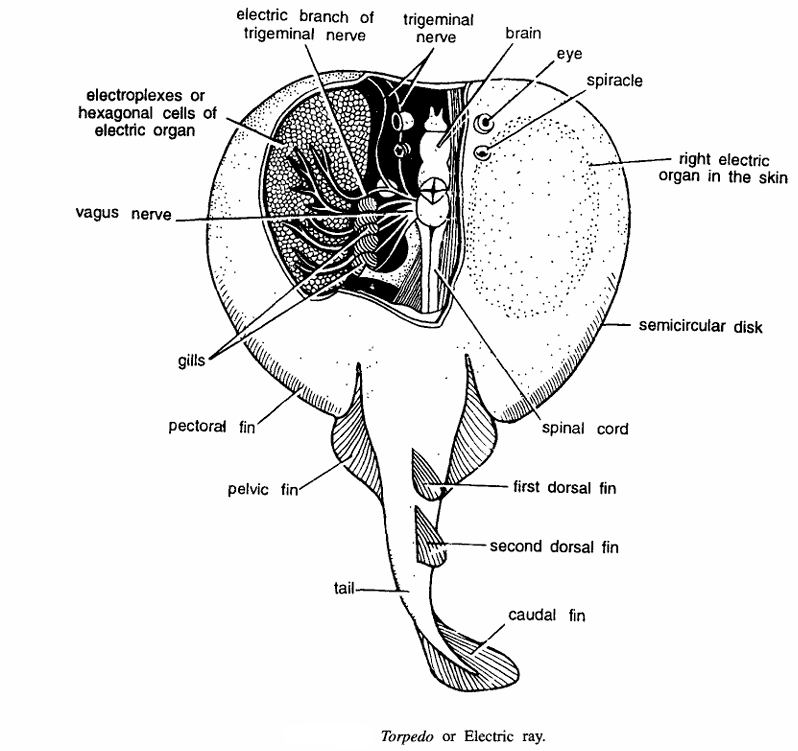
One of the most distinctive external features of Torpedo is the presence of paired electric organs on either side of the head and pectoral disc. These organs are responsible for producing electrical discharges used in prey capture and defence.
Tail and Fins
The tail is relatively short and stout compared with that of many other rays. Two dorsal fins are present on the posterior part of the tail, followed by a caudal fin. The pelvic fins are located on the ventral posterior region of the disc.
Skin
The skin is generally smooth compared with that of many sharks and other batoids. Colouration varies among species and may include brownish, greyish, or patterned dorsal surfaces, often providing camouflage against the sea floor.
Electric Organs and Electric Discharge
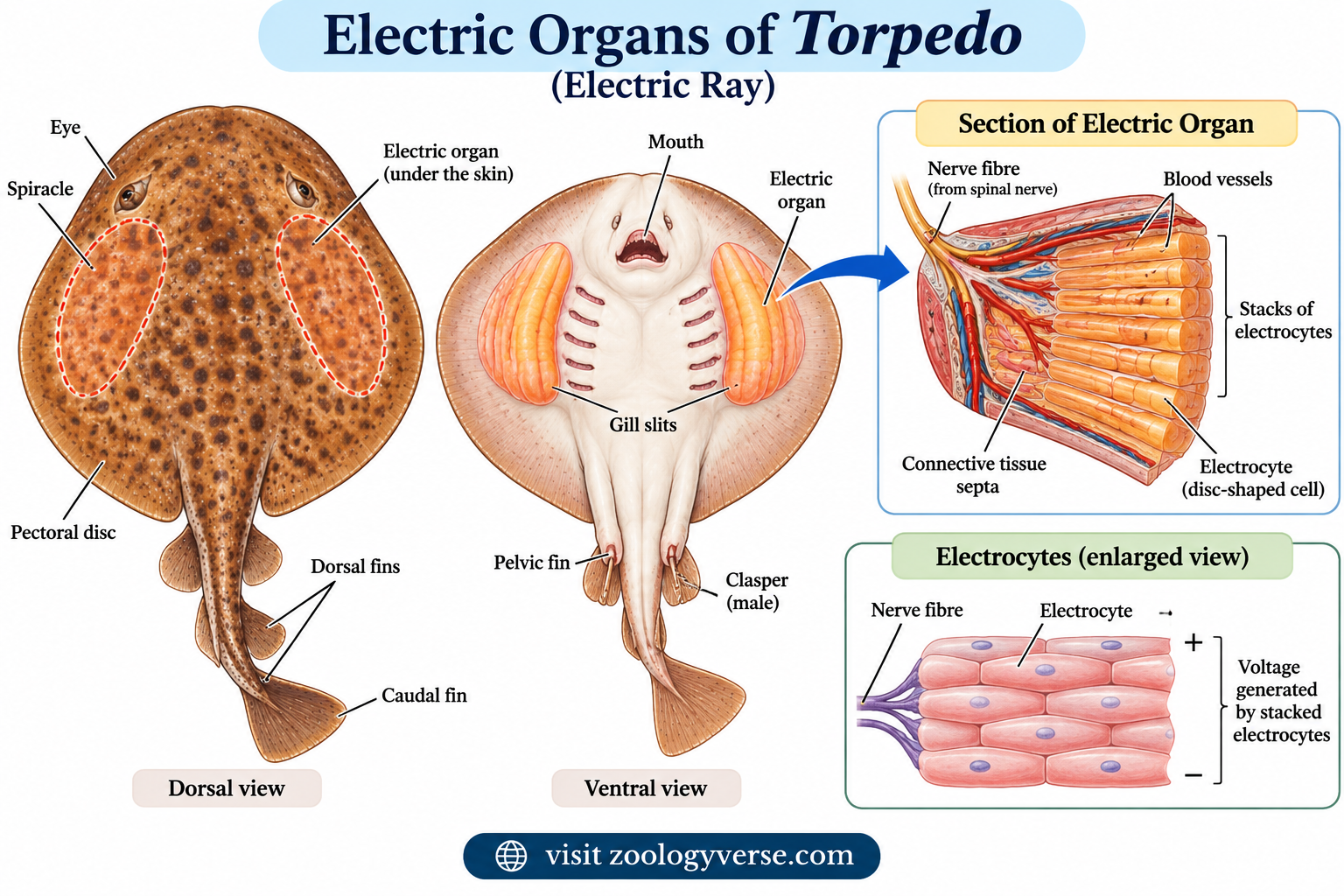
The most remarkable feature of Torpedo is its ability to produce an electric discharge. This is made possible by a pair of specialized electric organs situated on either side of the head, within the anterior region of the pectoral disc.
Structure of the Electric Organs
Each electric organ is composed of numerous specialized cells called electrocytes. These cells are arranged in stacks and function together to produce an electrical potential.
The two electric organs are positioned symmetrically on the left and right sides of the head. Their large size and strategic position allow the electrical discharge to act effectively around the anterior part of the animal.
Position of the Electric Organs
In Torpedo, a pair of large electric organs is embedded within the anterior portion of the pectoral disc, one on each side of the head. They lie laterally behind the eyes and spiracles, extending through the thick basal region of the pectoral disc.
The organs are therefore positioned between the head region and the expanded pectoral fin tissue, rather than being separate structures located externally on the surface.
Each electric organ is composed of numerous specialized electrocytes arranged in columns. Their close bilateral arrangement allows the electrical discharge to be transmitted effectively through the surrounding seawater.
How the Electric Discharge Is Produced
Electrocytes are modified cells derived from muscle tissue. When stimulated by the nervous system, they undergo changes in electrical potential across their membranes. Because many electrocytes are arranged together, their individual electrical potentials combine to produce a much stronger discharge.
The discharge can pass through the surrounding seawater and affect nearby animals.
Functions of the Electric Discharge
The electric discharge serves two major functions:
1. Prey Capture:
Torpedo can use an electric shock to stun or immobilize nearby prey before capturing it with its mouth.
2. Defence:
A strong discharge can discourage predators or other animals that come into close contact with the ray.
Nervous Control
The electric organs are under nervous control. Sensory information about a nearby animal can trigger neural activity that activates the electrocytes and produces a discharge.
Zoological Significance
The electric organs of Torpedo provide an important example of specialized electrical organs in vertebrates. They demonstrate how modified cells can work collectively to produce an electrical discharge that has an important role in predation and defence.
Torpedo produces electricity using paired electric organs containing numerous electrocytes, and the discharge is primarily used for prey capture and defence.
Feeding and Digestive Adaptations
Torpedo is primarily a carnivorous, bottom-dwelling predator. It feeds on animals that occur near or on the sea floor. The diet varies among species and according to habitat and prey availability.
Feeding Habit
The ventrally positioned mouth allows Torpedo to capture prey while resting on or moving close to the sea floor. Its diet may include:
- Small fishes
- Crustaceans
- Molluscs
- Other small benthic animals
The electric discharge provides an important advantage during feeding by stunning or immobilizing nearby prey before the ray captures it with its mouth.
Feeding Adaptations
Several features assist Torpedo in obtaining food:
- Electric organs can immobilize prey.
- Ventral mouth is well positioned for bottom feeding.
- Flattened body keeps the animal close to the substrate.
- Strong jaws and teeth help grasp and retain prey.
- Sensory structures help detect animals in the surrounding water and on the sea floor.
Digestive Tract
The digestive system follows the basic elasmobranch pattern. Food passes through:
Mouth → Buccal cavity → Pharynx → Oesophagus → Stomach → Intestine → Rectum → Cloaca
The spiral valve in the intestine increases the internal absorptive surface and slows the movement of food, allowing more efficient absorption of nutrients.
Accessory digestive organs such as the liver and pancreas contribute to digestion and metabolism.
Significance of the Feeding Adaptations
The combination of a ventral mouth, flattened body, sensory abilities, and electric organs makes Torpedo well adapted to capturing prey near the sea floor. The electric discharge is particularly important because it can temporarily incapacitate prey before ingestion.
Respiration
Torpedo obtains oxygen through gills, as in other cartilaginous fishes. Its respiratory system is especially suited to a bottom-dwelling lifestyle, where the animal may remain close to or partly buried in the sea floor.
Spiracles
A prominent spiracle is present behind each eye. These openings are particularly important when Torpedo is resting on the substrate because they allow water to enter the respiratory system without requiring the animal to draw large amounts of water through the mouth.
The spiracles therefore help maintain a continuous flow of water over the gills while the mouth may remain close to the sea floor.
Gills
The gills are located within the pharyngeal region and are supplied with a rich network of blood vessels. As water passes over the respiratory surfaces, oxygen diffuses into the blood while carbon dioxide diffuses from the blood into the water.
The respiratory pathway can be represented as:
Spiracles and/or mouth → Pharyngeal cavity → Gills → External water
Gas Exchange
The gill filaments contain numerous fine secondary lamellae, which provide a large surface area for gas exchange. The thin respiratory surfaces and extensive blood supply facilitate efficient uptake of dissolved oxygen.
Importance of the Respiratory Adaptation
The combination of dorsal spiracles and ventral gill openings is particularly advantageous for a bottom-dwelling ray. It allows Torpedo to continue respiration while resting on the sea floor, reducing the need to lift its mouth away from the substrate.
Reproduction
Torpedo reproduces by sexual reproduction and has separate male and female individuals (dioecious). Like other elasmobranchs, fertilization is internal.
Internal Fertilization
The male possesses paired claspers, which are modified portions of the pelvic fins. During mating, a clasper is used to transfer sperm into the female reproductive tract.
Mating → Sperm transfer → Internal fertilization → Embryonic development → Birth of young
Development of Young
Species of Torpedo are viviparous, with embryos developing inside the female. The developing young remain within the reproductive tract until they are sufficiently developed to be born.
In some electric rays, developing embryos initially utilize yolk reserves and may subsequently receive additional nourishment from the mother. The exact mode and degree of maternal nourishment can vary among species.
Reproductive Adaptations
Important reproductive features include:
- Separate male and female individuals
- Internal fertilization
- Male claspers for sperm transfer
- Embryonic development within the female
- Birth of fully developed young
Zoological Significance
The reproductive system of Torpedo demonstrates an important adaptation of elasmobranchs: internal fertilization combined with protected development of the young inside the female. This reduces the exposure of developing embryos to external marine conditions compared with fishes that release eggs for external fertilization.
Locomotion and Bottom-Dwelling Adaptations
Torpedo is primarily a bottom-dwelling ray and is adapted for movement close to the sea floor. Its locomotion differs from that of many typical sharks because the broad pectoral disc plays an important role in movement.
Movement of the Pectoral Disc
The greatly expanded pectoral fins of Torpedo are the principal structures involved in propulsion. During swimming, waves of movement pass along the broad pectoral disc, producing thrust and allowing the ray to glide through the water.
This type of swimming is characteristic of rays and is commonly referred to as rajiform locomotion. The pectoral disc therefore functions as a broad propulsive surface rather than simply being flapped as a single rigid structure.
The movement can be controlled to allow Torpedo to swim close to the sea floor, change direction, and maintain its position while searching for prey.
Role of the Tail
The relatively short, stout tail and its fins contribute mainly to stability, steering, and additional propulsion, while the broad pectoral disc provides the principal propulsive movement.
Bottom-Dwelling Adaptations
Several features help Torpedo maintain a benthic lifestyle:
- Flattened body keeps it close to the sea floor.
- Broad pectoral disc provides stability and supports movement.
- Dorsally positioned eyes allow observation of the surroundings while resting on the bottom.
- Spiracles allow water to enter the respiratory system while the animal remains close to the substrate.
- Electric organs provide an effective mechanism for prey capture and defence without requiring rapid pursuit.
Overall Locomotion
Unlike fast-swimming pelagic sharks, Torpedo generally moves close to the bottom and can remain stationary or partially concealed before approaching or electrically stunning nearby prey.
Ecological Importance
Torpedo plays a role in marine ecosystems as a bottom-dwelling predator. By feeding on fishes and other small marine animals, it participates in the transfer of energy through benthic food webs.
Role as a Predator
The combination of a ventral mouth, sensory abilities, and electric organs allows Torpedo to capture prey near the sea floor. Its electric discharge can temporarily immobilize prey, making capture more efficient.
Position in the Food Web
Torpedo occupies a predatory position within marine food webs. It consumes smaller animals and, in turn, may serve as prey for larger marine predators.
Contribution to Marine Biodiversity
Electric rays such as Torpedo contribute to the diversity of batoid fishes and represent a specialized evolutionary adaptation for electrogenesis. Their electric organs provide an important example of how vertebrates can evolve specialized structures for prey capture and defence.
Scientific Importance
Torpedo has long been important in zoological and physiological studies because its electric organs provide a useful natural system for investigating:
- Bioelectricity
- Nerve and muscle physiology
- Electrocyte function
- Electrical signalling
- Adaptations for predation and defence
Thus, Torpedo is ecologically significant as a marine predator and scientifically important as a classic example of electrogenic adaptation in vertebrates.
Key Takeaways
- Torpedo is a genus of electric rays belonging to the family Torpedinidae.
- It is placed in the order Torpediniformes within the cartilaginous fishes.
- The body is strongly dorsoventrally flattened, with a broad, rounded pectoral disc.
- The pectoral fins form the broad disc and produce propulsion through waves of movement across the disc.
- Small eyes and prominent spiracles are located on the dorsal surface of the head.
- The mouth and gill openings are positioned on the ventral side.
- A pair of specialized electric organs is embedded in the anterior lateral portions of the pectoral disc.
- Electric organs contain numerous electrocytes that generate electrical discharges.
- The electric discharge is mainly used for prey capture and defence.
- Torpedo is primarily a bottom-dwelling carnivore that feeds on fishes and other small marine animals.
- Internal fertilization occurs, and males possess claspers for sperm transfer.
- Different species of Torpedo have different distributions and conservation statuses.
Frequently Asked Questions About Torpedo
What is Torpedo?
Why is Torpedo called an electric ray?
Where are the electric organs of Torpedo located?
What is the function of the electric organs?
What are electrocytes?
How does Torpedo move?
Where does Torpedo live?
How does Torpedo breathe while resting on the sea floor?
What does Torpedo eat?
Is Torpedo a shark?
Does Torpedo have a backbone?
Does Torpedo have spiracles?
How does Torpedo reproduce?
What is the characteristic feature of Torpedo?
References
- FishBase. Torpedinidae – Electric rays. World Wide Web electronic publication.
- FishBase. Genus Torpedo – Species list and taxonomic information.
- World Register of Marine Species (WoRMS). Torpediniformes and Torpedinidae – Marine taxonomic information.
- Nelson, J. S., Grande, T. C., & Wilson, M. V. H. Fishes of the World. Wiley.
- Compagno, L. J. V. FAO Species Catalogue: Sharks of the World. Food and Agriculture Organization of the United Nations.
- Last, P. R., White, W. T., de Carvalho, M. R., Séret, B., Stehmann, M. F. W., & Naylor, G. J. P. (eds.). Rays of the World. CSIRO Publishing.
Discover more from Zoologyverse
Subscribe to get the latest posts sent to your email.