
Hyalonema
Hyalonema is a genus of deep-sea glass sponges that belongs to the class Hexactinellida. These sponges are known for their long, twisted stalk made of silica spicules, which anchors them securely to the ocean floor in very deep marine environments. Their delicate, lattice-like body structure allows them to filter microscopic food particles from seawater. Hyalonema is ecologically important because it supports deep-sea biodiversity by offering shelter for small organisms and contributing to nutrient cycling in the ocean’s depths.
Classification of Hyalonema
- Phylum :- Porifera (Pore bearing, cellular grade, asymmetrical or radially symmetrical)
- Class :- HexactineIlida (Marine glass sponges with siliceous spicules of triaxon or six-pointed type)
- Order :- Amphidiscophora (Hexaster spicules absent; amphidiscs present and skeleton mainly of diactins)
- Family: Hyalonematidae (Deep-sea sponges with long root tuft of spicules anchoring them to sediment)
- Genus :- Hyalonema (Glass rope sponges with a bundle of twisted root spicules, forming stalk-like structure)
Habit and habitat
- Hyalonema is marine animal, found 60 to 95 fathoms deep
Distribution
- Found along new England coast.
General Characterstics of Hyalonema
- Commonly called as glassrope sponge.
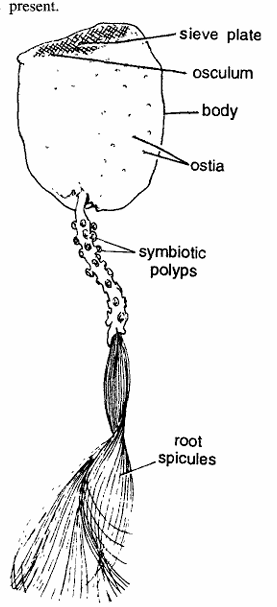
- Body is spherical or ovoidal and axially traversed by a bundle of long spicules.
- Spicules are often fused to form a lattice-like skeleton, giving the sponge a glasslike appearance when dried.
- Glass sponges are most symmetrical and most individualized. Body is cup or vase-shaped measuring 10 to 30 cm in height.
- Spongocoel is well developed. Osculum contains sieve plate.
- Stick or-columella is composed of a root tuft or root spicules which acts as hold fast organ.
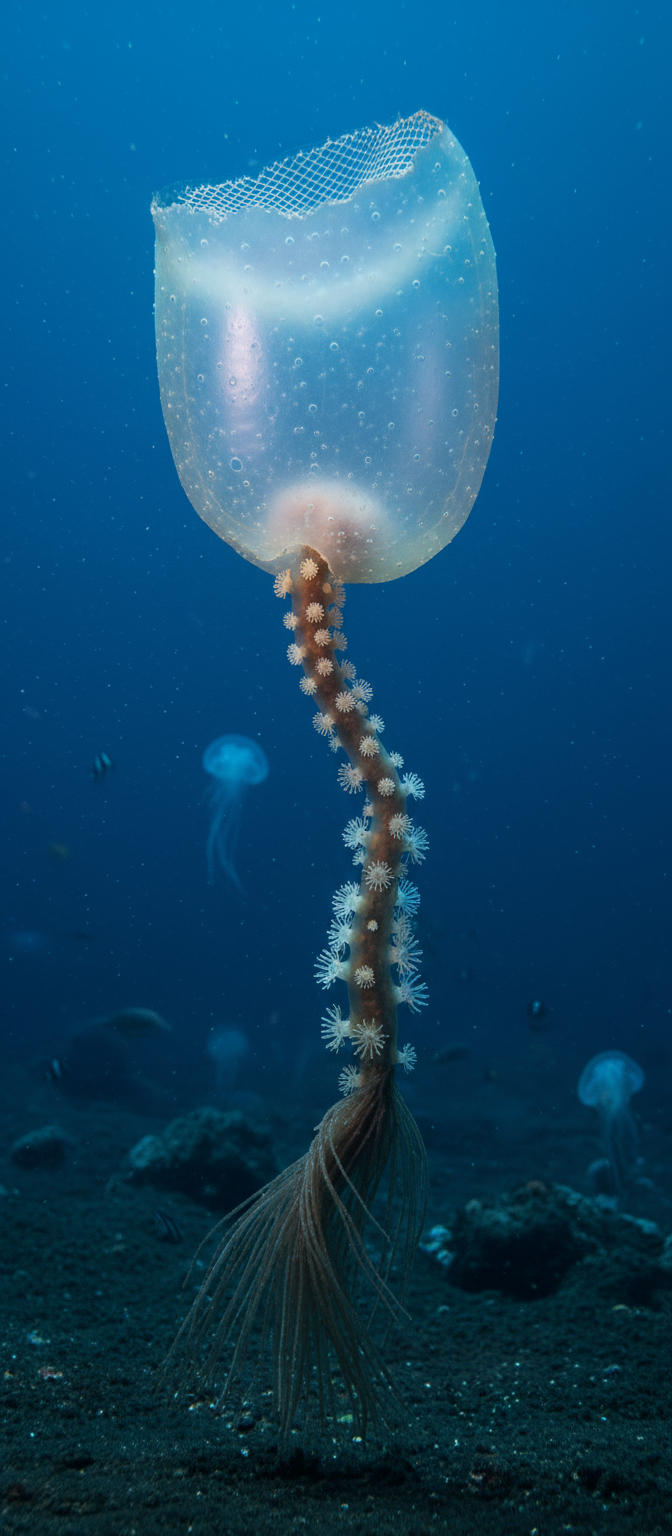
- Root spicules are compact, stalk like elongated, twisted and giving the appearance of a rope.
- The middle columella contains symbiotic polyps (Epizoanthus).
- It possesses large and small amphidisk spicules like fresh-water sponges. Entire body contains small, branching, six-rayed spicules resembling Christmas trees on cross-shaped bases.
- When the upper surface of the sponge is depressed, spongocoel IS formed and excurrent canals open into it but when columella is projected into gastral cone, no spongocoel exists.
- Flagellated chambers are arranged radially and in parallel planes in the sponge wall.
Identification of Hyalonema
- Since the specimen has glossy root tuft, large osculum, ostia symbiotic polyps and all above features hence it is Hyalonema.
Discover more from Zoologyverse
Subscribe to get the latest posts sent to your email.