
1. Concept and Meaning of Evolutionary Forces
Evolution is the process through which the inherited characteristics of populations change over successive generations. These changes occur through several biological processes collectively called evolutionary forces. They influence the genetic composition of populations by introducing new variants, changing the frequencies of existing alleles, or reshuffling genetic combinations. The combined action of evolutionary forces explains how populations adapt, become genetically differentiated, and contribute to biological diversity.
In population genetics, evolution is commonly measured as a change in allele frequencies across generations. The major mechanisms of evolution include mutation, natural selection, genetic drift and gene flow. Non-random mating and recombination also influence population genetic structure, although their effects are not identical. Understanding evolutionary forces therefore requires distinguishing between processes that directly change allele frequencies and those that mainly alter genotype frequencies or combinations of alleles.
Evolutionary change is explained through several scientific theories, including Darwinism and the Modern Synthetic Theory. Read more about the Theories of Evolution to understand how evolutionary explanations developed.
1.1 Definition of Evolutionary Forces
Evolutionary forces are biological mechanisms that cause or contribute to changes in the genetic composition of populations over generations. They may alter allele frequencies, genotype frequencies, or the distribution of genetic variation within and between populations. In evolutionary biology, these processes are collectively studied to understand how populations change genetically over time.
Mutation creates new alleles through changes in DNA. Natural selection produces differences in reproductive success among individuals carrying different heritable traits. Genetic drift changes allele frequencies through random sampling, particularly in small populations. Gene flow transfers alleles between populations when individuals or reproductive cells move and contribute to the next generation. Together, these mechanisms of evolution shape the genetic structure of populations.
1.2 Evolutionary Forces in Population Genetics
Population genetics is the branch of biology that studies genetic variation within populations and how this variation changes over time. It provides the mathematical and conceptual framework for analysing evolutionary forces and their effects on the genetic composition of organisms.
A population contains different forms of genes, called alleles. The proportion of a particular allele among all copies of a gene is its allele frequency. The proportion of individuals with a particular genetic combination, such as AA, Aa or aa, is its genotype frequency. By measuring these values in successive generations, researchers can investigate whether a population is changing genetically.
The principal mechanisms of evolution have different effects:
- Mutation introduces new alleles and supplies new genetic variation.
- Natural selection favours heritable variants associated with greater reproductive success in a particular environment.
- Genetic drift produces chance changes in allele frequencies, with stronger effects generally occurring in small populations.
- Gene flow moves alleles among populations and can introduce variation or reduce genetic differences between them.
- Non-random mating changes patterns of mating and can alter genotype frequencies, often affecting homozygosity and heterozygosity.
- Recombination produces new combinations of existing alleles during meiosis.
These processes may operate simultaneously. Their relative effects depend on population size, reproductive patterns, environmental conditions and the movement of individuals between populations. The combined effects of evolutionary forces determine how genetic variation is maintained or redistributed within populations.
1.3 Relationship with Allele and Genotype Frequencies
Allele frequency is central to the population-genetic definition of evolution. If the frequency of an allele changes from one generation to another, the population is evolving at that genetic locus. Genotype frequencies describe how alleles are combined in individuals and provide additional information about population structure.
The Hardy–Weinberg Principle offers a baseline for evaluating genetic stability. Under its ideal conditions, allele and genotype frequencies remain constant across generations. When observations differ from expected values, researchers investigate possible causes rather than assuming that a particular evolutionary process is responsible.
Mutation, natural selection, genetic drift and gene flow can directly change allele frequencies. In contrast, non-random mating can change genotype frequencies without necessarily changing allele frequencies. Recombination reshuffles alleles into new combinations but does not, by itself, usually change the frequency of individual alleles. This distinction is essential when interpreting the effects of evolutionary forces and identifying the mechanisms responsible for genetic changes.
1.4 Major Characteristics
The major characteristics of evolutionary forces include:
- Effects on genetic composition: They influence allele frequencies, genotype frequencies, or the arrangement of genetic variation in populations.
- Action across generations: Their cumulative effects can produce measurable genetic changes over successive generations.
- Different modes of action: Some processes are random with respect to fitness, while others depend on differences in survival and reproduction.
- Generation and redistribution of variation: Mutation creates new alleles, while gene flow and recombination redistribute existing variation.
- Simultaneous operation: Several mechanisms of evolution may act on the same population at the same time.
- Consequences for adaptation and divergence: Natural selection can promote adaptation, while drift and restricted gene flow can contribute to differences between populations.
These characteristics demonstrate that evolutionary forces do not operate through a single pathway. Each mechanism has a distinct influence, and their combined effects determine the genetic changes observed in populations.
1.5 Classification of Major Evolutionary Forces
| Process | Main mechanism | Principal genetic effect |
|---|---|---|
| Mutation | Change in DNA sequence | Introduces new alleles |
| Natural selection | Differential reproductive success | Changes allele frequencies according to fitness |
| Genetic drift | Random sampling of alleles | Changes allele frequencies by chance |
| Gene flow | Movement of alleles between populations | Transfers genetic variation |
| Non-random mating | Unequal mating probabilities | Alters genotype frequencies and homozygosity |
| Recombination | Exchange and rearrangement of genetic material | Creates new combinations of existing alleles |
This classification shows why evolutionary forces should not be treated as interchangeable. Mutation is a source of new alleles, selection and drift alter their representation in populations, and gene flow transfers them between populations. Non-random mating and recombination influence how genetic variants are combined and distributed. Together, these mechanisms of evolution contribute to changes in population genetic structure.
1.6 Biological Importance
The study of evolutionary forces helps explain how populations respond to environmental change and why populations of the same species may differ genetically. It is relevant to conservation biology, medical genetics, agriculture, ecology and evolutionary research.
In conservation, understanding genetic drift and gene flow helps assess the risks faced by small or isolated populations. In medical genetics, population-level allele frequencies can inform the study of inherited conditions. In agriculture, natural selection and genetic variation are important in developing crop varieties and livestock breeds. In ecology, these processes help explain how populations respond to changing environments.
Overall, evolutionary forces provide the central mechanisms through which the genetic composition of populations changes. Studying their individual effects and interactions makes it possible to understand the patterns and processes of biological evolution.
2. Mutation as an Evolutionary Force
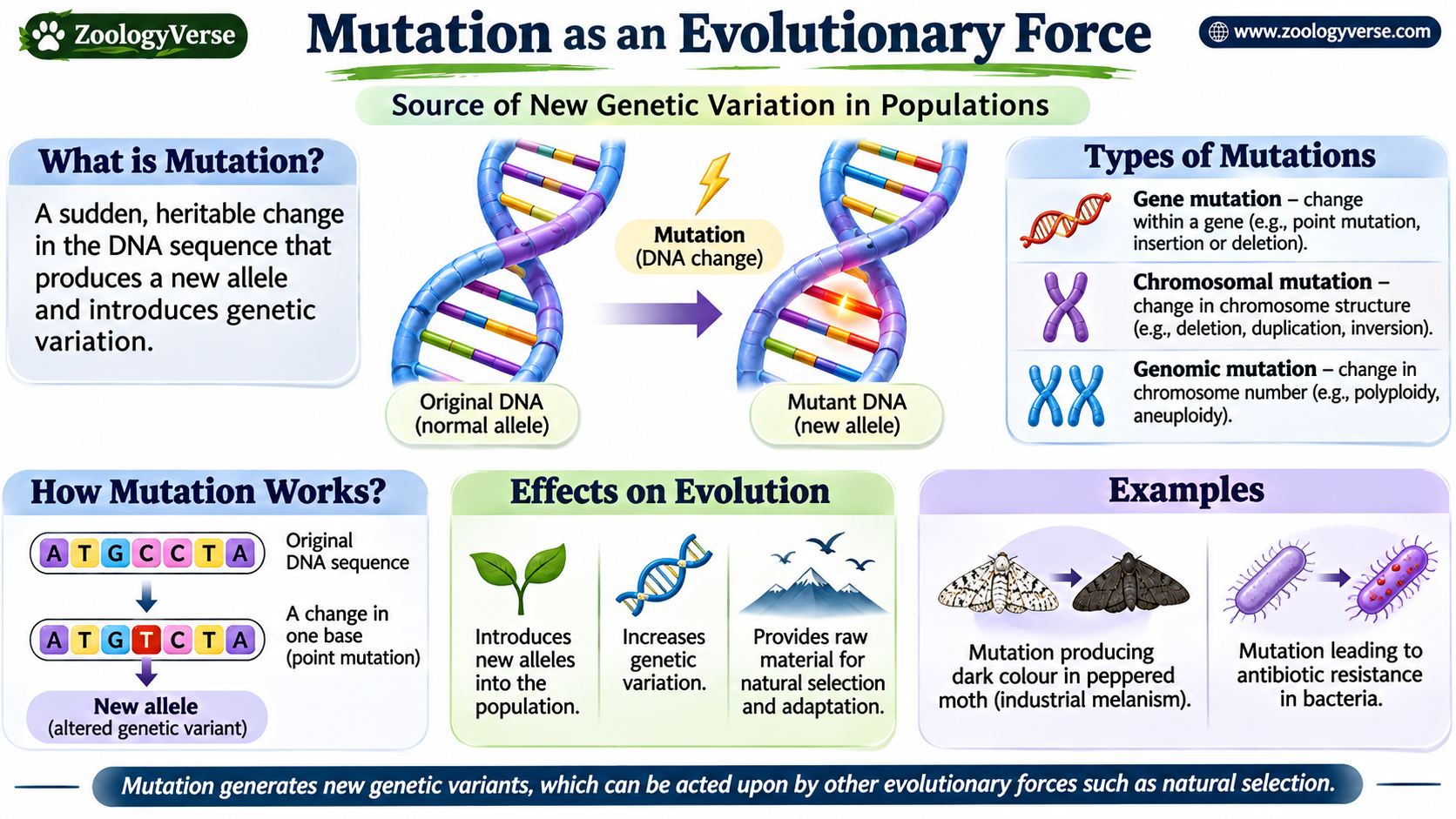
Mutation is one of the fundamental Evolutionary Forces because it produces new genetic variants. A mutation is a heritable change in the nucleotide sequence of DNA. Mutations may arise spontaneously during DNA replication or through exposure to mutagens such as certain chemicals and forms of radiation. Although many mutations have no noticeable effect, some influence an organism’s phenotype and may affect its survival or reproductive success.
Among the major Evolutionary Forces, mutation has a distinctive role: it introduces new alleles into populations. Natural selection, genetic drift and gene flow can change the frequencies or distribution of existing alleles, but mutation creates new versions of genes. For this reason, mutation supplies the raw genetic variation on which other mechanisms of evolution can act.
2.1 Meaning and Nature of Mutation
A mutation is a change in genetic material that can be transmitted to subsequent generations when it occurs in cells that contribute to reproduction. In sexually reproducing organisms, mutations in germ-line cells can be inherited by offspring, whereas most mutations restricted to somatic cells are not passed to the next generation.
Mutations may involve a single nucleotide, several nucleotides, or larger sections of chromosomes. Their effects depend on the location and nature of the change. Some mutations are neutral, some are harmful, and a smaller proportion may be beneficial in a particular environment. A mutation is not produced because an organism needs a particular adaptation; it arises without regard to whether it will be advantageous.
The importance of mutation among Evolutionary Forces lies in its ability to create heritable differences without anticipating environmental requirements. These new genetic variants may subsequently be affected by selection, drift or migration.
2.2 Types of Mutation
Mutations can be classified according to the scale of genetic material affected. This classification helps explain how mutation contributes to Evolutionary Forces operating at different genetic levels.
1. Gene mutations: These involve changes in the nucleotide sequence of an individual gene. Substitution, insertion and deletion are common examples. Insertions or deletions that are not multiples of three can cause a frameshift in a protein-coding sequence.
2. Chromosomal mutations: These involve changes in chromosome structure, such as deletion, duplication, inversion and translocation. Such changes may affect multiple genes and can influence fertility, development or gene expression.
3. Genomic mutations: These involve changes in chromosome number, including aneuploidy and polyploidy. They can have major effects on development and may contribute to evolutionary change, particularly in plants.
Mutations can also be described as spontaneous or induced. Spontaneous mutations arise through natural cellular processes, while induced mutations result from exposure to external mutagenic agents. Regardless of their origin, only mutations that enter the reproductive gene pool can contribute directly to inherited variation in a population. This inherited variation provides material for other Evolutionary Forces to act upon.
2.3 Mutation and Genetic Variation
Mutation increases genetic variation by introducing alleles that were not previously present at a particular locus in the population. A new allele may initially be rare, especially if it originates in a single individual. Its subsequent frequency depends on several factors, including selection, genetic drift, migration and the rate at which further mutations occur.
The relationship between mutation and other Evolutionary Forces is important. Natural selection may increase the frequency of a beneficial mutation or reduce the frequency of a harmful one. Genetic drift may cause a new neutral allele to disappear or become common by chance, particularly in small populations. Gene flow can move a mutation from one population into another when carriers reproduce after migration.
Mutation therefore does not necessarily produce adaptation by itself. Instead, it creates genetic alternatives, while other Evolutionary Forces influence how those alternatives are distributed through populations. This interaction explains why the appearance of a new mutation does not automatically result in a permanent evolutionary change.
2.4 Role of Mutation in Evolution
Mutation contributes to evolution in several important ways and forms an essential component of the major Evolutionary Forces:
- Origin of new alleles: It generates new forms of genes and expands the range of genetic variants available in a population.
- Source of heritable variation: Mutations transmitted through reproduction provide variation that can be inherited by later generations.
- Material for natural selection: Selection can favour or eliminate mutations depending on their effects in a particular environment.
- Long-term genetic divergence: The accumulation of mutations in separated populations can contribute to genetic differences over evolutionary time.
- Evolution of new functions: In some cases, gene duplication followed by mutation and divergence can contribute to the evolution of new or modified biological functions.
The effects of mutation are generally gradual at the population level. A mutation may remain rare for many generations, become more frequent through selection or drift, or be lost from the population. Thus, mutation interacts with other Evolutionary Forces rather than determining the direction of evolution on its own.
2.5 Mutation Rate and Evolutionary Change
Mutation rate refers to the frequency at which new mutations arise in a gene, genome or organism over a specified period or number of cell divisions. Mutation rates differ among organisms, genes and genomic regions. DNA repair systems help limit the accumulation of errors, while certain environmental agents can increase the rate of mutation.
At a population level, the supply of new mutations depends on mutation rate and the number of gene copies in the population. A large population may generate more new mutations in total even when the mutation rate per gene copy is low. However, the fate of each new allele is also influenced by natural selection, genetic drift and gene flow.
This relationship demonstrates that mutation does not operate independently of other Evolutionary Forces. The rate at which new genetic variants arise influences the supply of variation, while population conditions and evolutionary mechanisms influence whether those variants persist or disappear.
Mutation is therefore an essential source of genetic novelty, but it is not the only determinant of evolutionary outcomes. Its effects must be considered alongside the other Evolutionary Forces that shape allele frequencies and genetic diversity.
2.6 Examples of Evolutionary Significance
An example of mutation’s evolutionary importance is the emergence of a genetic variant that changes an organism’s response to an environmental factor. If the variant improves reproductive success under particular conditions, natural selection may increase its frequency over generations. In another situation, a neutral mutation may rise or fall in frequency through genetic drift without providing a selective advantage.
Mutations also contribute to differences among populations that have been separated for long periods. When gene flow is limited, distinct mutations may arise and accumulate independently. Over time, these differences, together with selection and drift, can contribute to population divergence. These processes illustrate how different Evolutionary Forces interact during the development of genetic differences between populations.
Mutation is consequently a foundational process in evolutionary biology. It introduces new heritable variants, while the other Evolutionary Forces determine how those variants persist, spread or disappear within populations.
3. Natural Selection as an Evolutionary Force
Natural selection is one of the most important Evolutionary Forces responsible for adaptation and evolutionary change in populations. It is the process through which individuals possessing heritable characteristics that improve their survival or reproductive success tend to contribute more offspring to subsequent generations than individuals with less favourable characteristics.
Natural selection acts on phenotypic variations, but its evolutionary effects depend on the heritable genetic differences underlying those variations. When individuals carrying particular alleles reproduce more successfully, the frequencies of those alleles may increase in subsequent generations. In this way, natural selection changes the genetic composition of populations and contributes to adaptation.
Among the major Evolutionary Forces, natural selection is distinctive because its effects are non-random with respect to reproductive fitness. However, the appearance of mutations is not directed towards producing useful adaptations. Instead, existing heritable variations are differentially favoured or selected against under particular environmental conditions.
Natural selection also contributes to broader evolutionary patterns, including adaptive radiation, convergent evolution and divergent evolution. Explore Trends in Evolution to understand these patterns.
3.1 Definition and Concept of Natural Selection
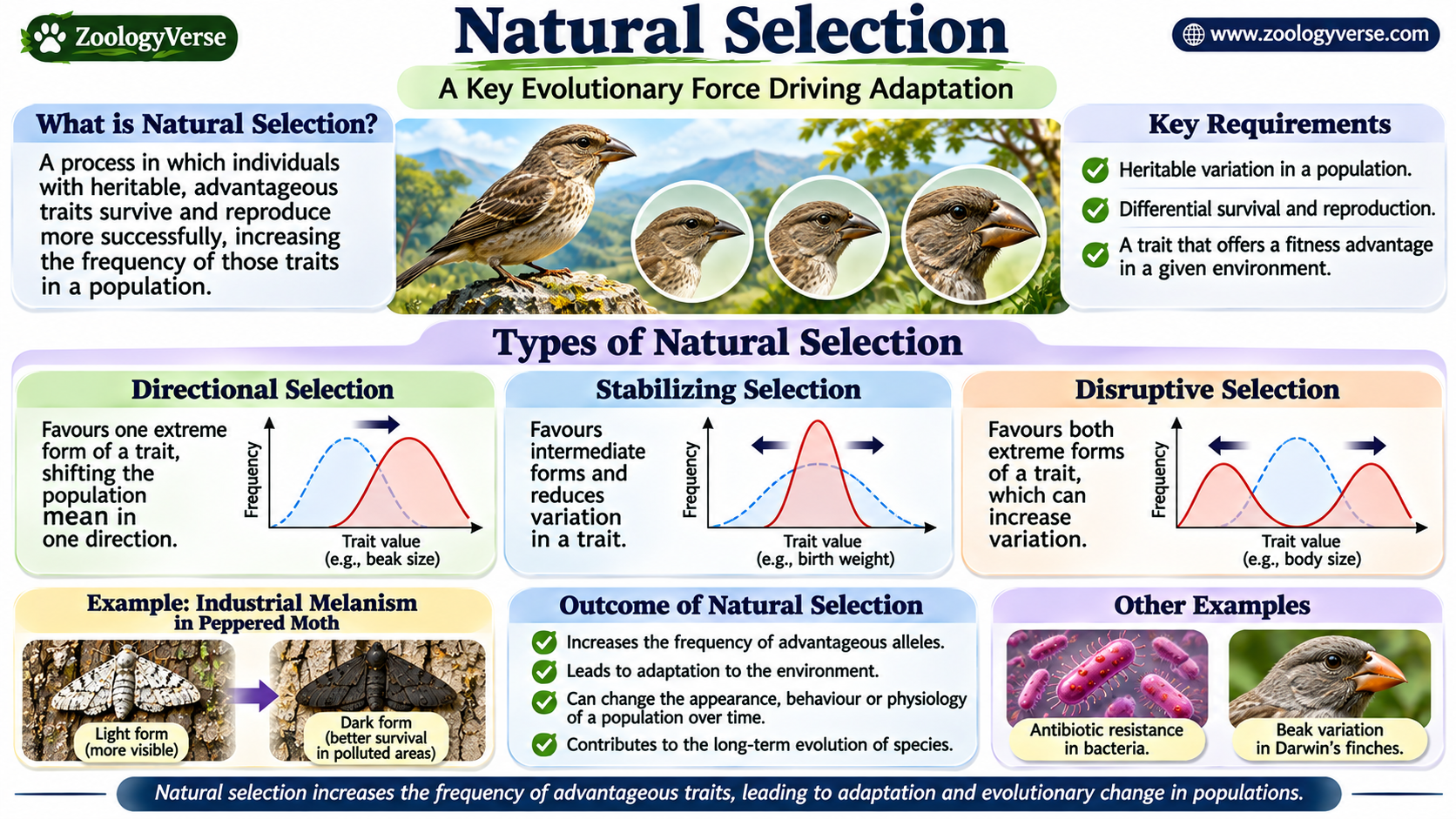
Natural selection can be defined as the differential survival and reproduction of individuals due to heritable variations in their characteristics. Individuals possessing advantageous traits under particular environmental conditions generally have greater reproductive success and may pass the associated alleles to their offspring.
The basic concept of natural selection involves three essential conditions:
- Variation: Individuals within a population differ in their morphological, physiological, behavioural or genetic characteristics.
- Heritability: At least some of these differences are genetically inherited and can be transmitted to offspring.
- Differential reproductive success: Individuals carrying certain heritable characteristics contribute more offspring to future generations than others.
When these conditions operate together, the genetic composition of the population may change over generations. This makes natural selection one of the central Evolutionary Forces involved in biological adaptation.
3.2 Mechanism of Natural Selection
Natural selection operates through a sequence of biological processes that connect heritable variation with reproductive success.
1. Production of genetic variation: Mutations and recombination produce genetic differences among individuals. These differences may influence characteristics such as body size, coloration, metabolic activity or resistance to environmental stress.
2. Environmental pressure: Environmental conditions, including food availability, climate, predators, parasites and competition, influence the survival and reproduction of organisms.
3. Differential survival and reproduction: Individuals possessing heritable characteristics that provide an advantage under prevailing conditions may survive or reproduce more successfully.
4. Transmission of favourable alleles: Successful individuals pass their genetic variants to their offspring. If the advantage persists, the associated alleles may become more common over generations.
5. Change in population composition: As allele frequencies change, the population may become better adapted to its environment.
These stages explain how natural selection operates as one of the major Evolutionary Forces. Its outcome depends on the relationship between inherited variation and environmental conditions.
3.3 Types of Natural Selection
Natural selection can produce different patterns of phenotypic change depending on which characteristics are favoured.
3.3.1 Directional Selection
Directional selection occurs when individuals at one extreme of a phenotypic distribution have greater reproductive success than individuals with other phenotypes. Consequently, the population mean may shift towards the favoured extreme.
Example: During the industrial revolution in Britain, dark-coloured forms of the peppered moth (Biston betularia) became more common in many polluted industrial areas. Their darker coloration provided better camouflage on soot-darkened surfaces, reducing their visibility to predators.
Directional selection is an important example of how Evolutionary Forces can produce changes in the distribution of inherited characteristics under particular environmental conditions.
3.3.2 Stabilizing Selection
Stabilizing selection favours individuals with intermediate phenotypic characteristics and selects against individuals at both extremes. It tends to reduce phenotypic variation around the population mean without necessarily changing the mean substantially.
Example: Human birth weight provides a commonly discussed example. Extremely low and extremely high birth weights are associated with greater risks of certain complications than intermediate birth weights.
Stabilizing selection demonstrates how Evolutionary Forces may maintain characteristics that provide reproductive or survival advantages under relatively stable environmental conditions.
3.3.3 Disruptive Selection
Disruptive selection occurs when individuals at both extremes of a phenotypic distribution have greater reproductive success than individuals with intermediate characteristics. It may increase variation within a population and, under certain conditions, contribute to population differentiation.
Example: In some bird populations, individuals with either small or large beaks may use different food resources more efficiently than birds with intermediate-sized beaks.
Disruptive selection illustrates how Evolutionary Forces can favour multiple phenotypic forms when different ecological resources or environmental conditions provide distinct advantages.
3.4 Natural Selection and Genetic Fitness
Fitness is the relative reproductive success of an organism compared with other individuals in the same population. It is an important concept for understanding how natural selection influences allele frequencies.
An organism’s fitness is not determined simply by its physical strength, lifespan or ability to survive. It depends primarily on its contribution of viable offspring to subsequent generations. A characteristic that increases reproductive success in one environment may provide little advantage or even become disadvantageous in another.
Natural selection acts on phenotypes, while evolutionary change occurs when differences in reproductive success are associated with heritable genetic variation. Therefore, Evolutionary Forces such as selection influence population genetics through the relationship between phenotype, genotype and reproductive success.
3.5 Factors Affecting Natural Selection
The intensity and direction of natural selection depend on several biological and environmental factors:
- Environmental conditions: Changes in temperature, climate, food availability and habitat can alter which traits provide an advantage.
- Genetic variation: Selection requires heritable variation upon which differences in reproductive success can act.
- Competition: Competition for food, territory, mates and other resources can influence reproductive success.
- Predation and disease: Predators, parasites and pathogens may favour individuals possessing protective or resistant characteristics.
- Reproductive patterns: Differences in mating success and fertility can influence the transmission of alleles to subsequent generations.
- Population structure: Population size, isolation and gene flow can influence the genetic context in which selection operates.
These factors determine how natural selection interacts with other Evolutionary Forces in a population.
3.6 Examples and Evolutionary Significance
Natural selection can be observed in many biological situations. The development of antibiotic resistance in bacteria is an important example. When a bacterial population is exposed to an antibiotic, susceptible bacteria may be eliminated more effectively, while bacteria carrying resistance-associated genetic variants may survive and reproduce. Consequently, resistance-associated alleles can increase in frequency in the population.
Another example is pesticide resistance in insects. Repeated exposure to a pesticide can favour individuals carrying heritable resistance characteristics, leading to an increase in their representation over generations.
Natural selection also contributes to adaptation in wild populations by influencing characteristics associated with feeding, reproduction, defence and environmental tolerance.
As one of the principal Evolutionary Forces, natural selection explains how heritable variation becomes associated with differences in reproductive success. It can change allele frequencies, promote adaptation and contribute to the long-term diversification of living organisms. Its effects, however, depend on environmental conditions and interactions with mutation, genetic drift and gene flow.
4. Genetic Drift as an Evolutionary Force
Genetic drift is an important mechanism of evolution that produces random changes in allele frequencies within populations over successive generations. Unlike natural selection, which operates through differences in reproductive success, genetic drift occurs because of chance events affecting which individuals reproduce and which alleles are passed to the next generation.
Among the major Evolutionary Forces, genetic drift has a particularly strong influence on small populations. Random fluctuations can cause certain alleles to become more common, while others may disappear completely, even when they do not provide any selective advantage or disadvantage. Consequently, genetic drift can reduce genetic variation, increase genetic differences between populations and contribute to evolutionary divergence.
Genetic drift is especially important in population genetics because it demonstrates that evolutionary change does not always occur through adaptation. Some changes in the genetic composition of populations arise simply because inheritance involves random sampling of alleles from one generation to another.
4.1 Definition and Concept of Genetic Drift
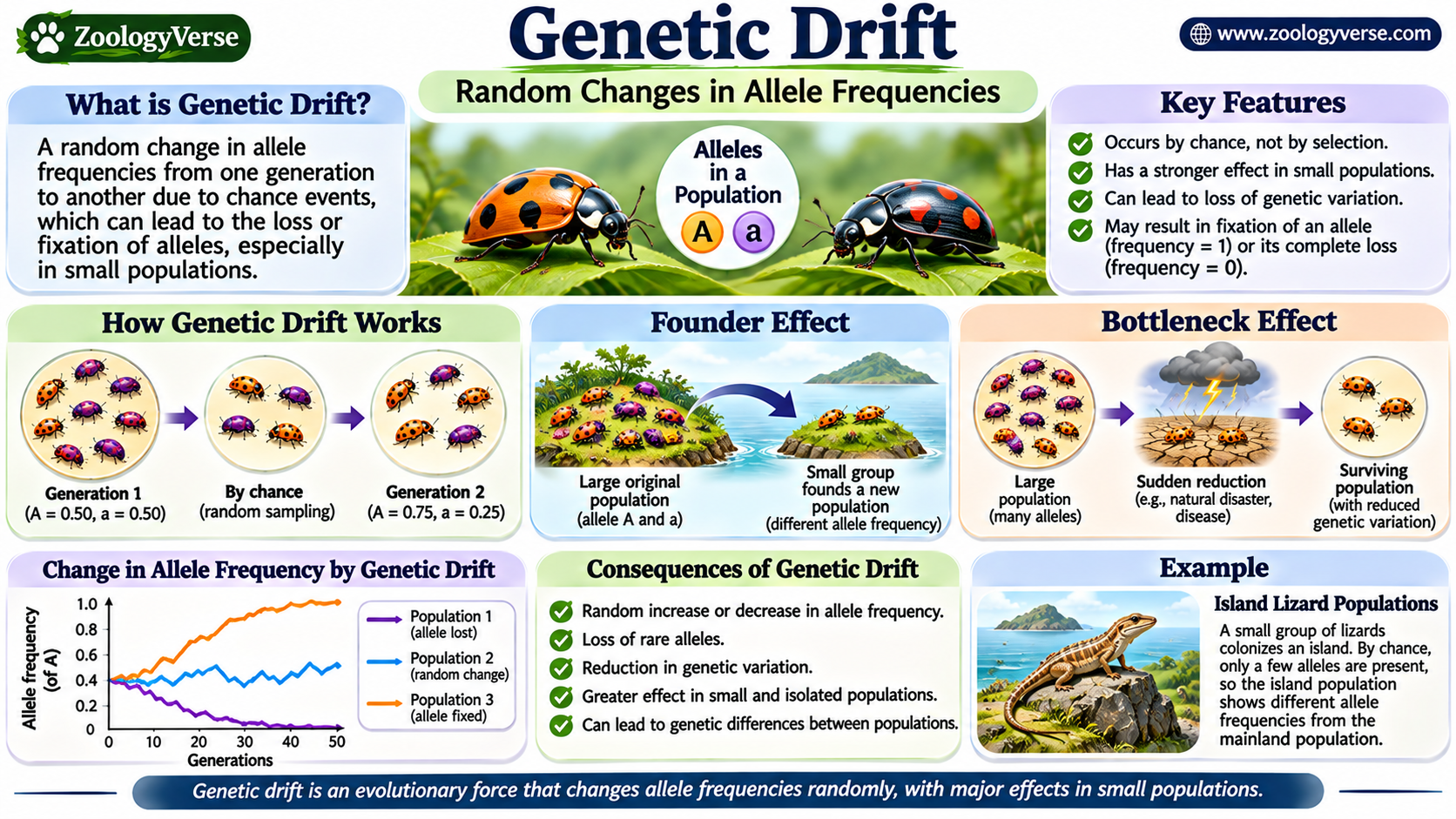
Genetic drift can be defined as the random change in allele frequencies in a population from one generation to the next due to chance variations in the transmission of alleles.
In an idealized population, the number of copies of an allele inherited by the next generation may differ from its expected number because only a limited sample of individuals contributes genetically to that generation. These random differences can accumulate over generations and produce substantial changes in allele frequencies.
For example, consider a small population in which two alleles, A and a, are initially present at equal frequencies. By chance, individuals carrying allele A may produce more offspring in one generation than individuals carrying allele a. The frequency of A may consequently increase, even if both alleles have equal effects on survival and reproduction.
This illustrates how genetic drift operates independently of the adaptive advantages associated with particular traits. It is one of the Evolutionary Forces capable of changing population genetics without producing an adaptation.
4.2 Characteristics of Genetic Drift
Genetic drift possesses several important characteristics that distinguish it from other evolutionary mechanisms.
- Random nature: Changes in allele frequencies occur because of chance events rather than differences in reproductive fitness.
- Stronger effects in small populations: Random fluctuations generally produce greater changes in smaller populations.
- Loss of genetic variation: Alleles may disappear from a population through chance, reducing genetic diversity.
- Fixation of alleles: An allele may eventually reach a frequency of 100%, becoming the only allele present at a particular locus.
- Independent population changes: Isolated populations may experience different random changes, causing them to become genetically distinct.
- No necessary adaptive advantage: An allele may increase in frequency through genetic drift even when it does not improve an organism’s survival or reproduction.
These characteristics explain why genetic drift is an important component of Evolutionary Forces, particularly in small and isolated populations.
4.3 Factors Influencing Genetic Drift
The magnitude of genetic drift depends on several population characteristics and biological circumstances.
1. Population size: Population size is one of the most important factors. Random changes in allele frequencies are generally greater in small populations because each individual’s reproductive contribution represents a larger proportion of the next generation’s gene pool.
2. Reproductive sampling: When only a limited number of individuals contribute offspring, the alleles transmitted to the next generation may not represent the original population accurately.
3. Population isolation: Restricted gene flow prevents the regular exchange of alleles between populations. Consequently, isolated populations may undergo different random genetic changes.
4. Fluctuations in population size: Sudden reductions in population size can increase the effects of genetic drift. When a population becomes small, rare alleles are particularly vulnerable to accidental loss.
5. Effective population size: Effective population size refers to the number of individuals contributing genetically to future generations in a way that reflects the population’s reproductive structure. It may be considerably smaller than the total number of individuals.
The strength of genetic drift is commonly related to effective population size. A smaller effective population generally experiences stronger random fluctuations in allele frequencies.
4.4 Major Types of Genetic Drift
Two important forms of genetic drift are the founder effect and the bottleneck effect. Both involve changes in allele frequencies caused by random sampling, particularly when only a small number of individuals contribute to a population.
4.4.1 Founder Effect
The founder effect occurs when a small number of individuals become separated from a larger original population and establish a new population in another geographical area.
The founders carry only a limited sample of the genetic variation present in the original population. As a result, some alleles may become more common, while others may be absent from the newly established population.
Example: When a small group of organisms colonizes an isolated island, the allele frequencies in the new population may differ from those of the original mainland population. Certain rare alleles may become relatively common simply because they were present among the founders.
The founder effect demonstrates how geographical isolation and random sampling can influence genetic composition. It is an important example of how Evolutionary Forces contribute to genetic differences between populations.
4.4.2 Bottleneck Effect
The bottleneck effect occurs when a population undergoes a sudden and substantial reduction in size because of events such as natural disasters, disease outbreaks, habitat destruction or overhunting.
Only a small proportion of the original population survives. These survivors carry a limited sample of the original genetic variation, and the allele frequencies of the surviving population may differ considerably from those of the population before the reduction.
Example: Northern elephant seals experienced a severe reduction in population size due to intensive hunting during the nineteenth century. The surviving population subsequently recovered in number, but it retained relatively low genetic diversity.
The bottleneck effect illustrates how a temporary reduction in population size can have long-lasting genetic consequences. Even when population numbers recover, lost alleles may not return unless new variants enter through mutation or gene flow.
4.5 Genetic Drift and Allele Fixation
Allele fixation occurs when one allele reaches a frequency of 100% at a particular genetic locus, meaning that alternative alleles have disappeared from the population.
In a finite population, genetic drift can eventually lead to the fixation or loss of alleles through random fluctuations. For a neutral allele, its probability of eventual fixation under standard idealized conditions is equal to its initial frequency.
For example, if a neutral allele initially has a frequency of 0.2, its probability of eventual fixation in an idealized population is 0.2. This does not mean fixation is certain; the allele may instead disappear.
Fixation through genetic drift does not necessarily indicate that an allele is beneficial. It may simply reflect random reproductive sampling. This is an important distinction between genetic drift and natural selection as Evolutionary Forces.
4.6 Genetic Drift and Genetic Variation
Genetic drift generally reduces genetic variation within a population when alleles are lost or become fixed. At the same time, it can increase genetic differences between populations when separate populations experience different random changes.
Consider two small populations that originate from the same ancestral population. Even if they experience similar environmental conditions, random changes may cause different alleles to increase or disappear in each population. Over many generations, their genetic compositions may become increasingly different.
Gene flow can counteract some of these differences by transferring alleles between populations, while mutation may introduce new genetic variants. Natural selection may also influence which alleles become more common when they affect reproductive success.
Thus, the effects of genetic drift must be understood in relation to other Evolutionary Forces. Its influence depends on population size, isolation, mutation and the movement of individuals between populations.
4.7 Evolutionary Significance of Genetic Drift
Genetic drift is significant because it explains evolutionary changes that cannot be attributed entirely to natural selection. Its effects are particularly important in small populations, endangered species and geographically isolated groups.
In conservation biology, genetic drift is a major concern because small populations may lose rare alleles and experience increased genetic similarity. Reduced genetic variation can limit the range of heritable characteristics available for future responses to environmental change.
Genetic drift can also contribute to population differentiation. When populations remain isolated, random changes may cause them to develop distinct genetic compositions over time. Together with restricted gene flow, these changes may contribute to long-term evolutionary divergence.
Among the major Evolutionary Forces, genetic drift therefore demonstrates that chance plays an important role in evolution. It can alter allele frequencies, remove genetic variation and produce differences between populations without necessarily increasing their adaptation to the environment.
5. Gene Flow (Migration) as an Evolutionary Force
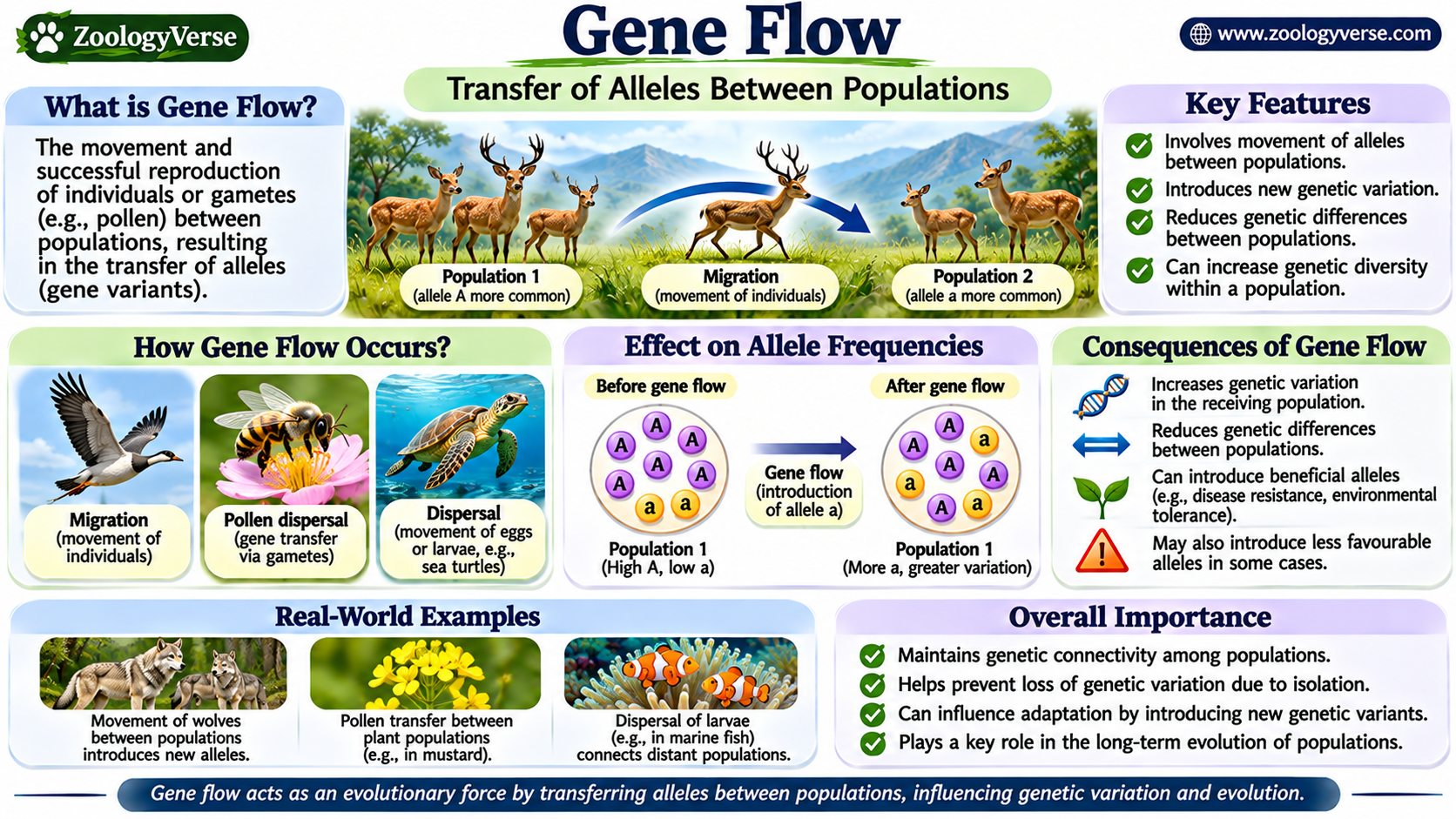
Gene flow is the movement of alleles between populations through the migration of individuals or the transfer of reproductive cells, such as pollen. It is an important process in population genetics because it introduces genetic variants into populations and changes the distribution of alleles across geographical areas. Among the major Evolutionary Forces, gene flow connects populations genetically and can reduce differences between them.
Gene flow occurs when migrants enter a population and reproduce, or when gametes move between populations and contribute to fertilization. Migration alone does not necessarily produce gene flow: individuals must contribute their alleles to the receiving population. The magnitude and direction of gene flow depend on migration rate, reproductive success, population size and the genetic differences between populations. These variables determine how strongly this member of the Evolutionary Forces affects a population. Gene flow is therefore a key component of the Evolutionary Forces shaping population structure.
5.1 Definition and Concept of Gene Flow
Gene flow, also called migration in population genetics, refers to the transfer of alleles from one population to another. It may occur when animals move between habitats and reproduce, when seeds are dispersed to new locations, or when pollen is carried between plant populations.
The movement of alleles can alter allele frequencies in the receiving population. If migrants carry alleles that are uncommon or absent in that population, their reproduction may increase genetic variation. Conversely, the movement of alleles between genetically different populations can make their gene pools more similar. The broader pattern reflects the influence of Evolutionary Forces on allele frequencies.
Gene flow is therefore one of the Evolutionary Forces that influences both variation within populations and genetic differentiation between populations. Its role among the Evolutionary Forces is especially clear when isolated populations begin exchanging reproductive individuals. This makes gene flow an important member of the Evolutionary Forces considered in population genetics.
5.2 Mechanisms and Modes of Gene Flow
Gene flow can occur through several biological routes:
- Animal migration: Individuals move from one population or habitat to another and reproduce in the new location.
- Pollen dispersal: Pollen is transferred between plant populations by wind, water or animal pollinators.
- Seed dispersal: Seeds move away from their parent population and establish new individuals elsewhere.
- Movement of gametes: Reproductive cells may be transported between locations, allowing alleles to enter another population.
The effectiveness of these mechanisms depends on successful reproduction. This reproductive requirement distinguishes gene flow from other Evolutionary Forces that may act within a population without migration. Gene flow is not simply the movement of organisms; successful reproduction is required for hereditary material to enter another population.
5.3 Effects of Gene Flow on Allele Frequencies
Gene flow can change allele frequencies when migrants contribute alleles at proportions different from those already present in the receiving population. This is one of the direct ways in which Evolutionary Forces alter the genetic composition of a population. For example, if a population has a low frequency of allele A and migrants carry allele A at a higher frequency, reproduction by those migrants may increase the frequency of A in subsequent generations.
The extent of this change depends on the proportion of migrants that successfully reproduce and the difference in allele frequencies between the source and receiving populations. These factors determine the strength of gene flow as one of the Evolutionary Forces. A small amount of migration may have little effect in a very large population, whereas the same number of migrants may have a greater effect in a small population.
Gene flow can introduce alleles, restore variants lost through genetic drift and reduce the genetic effects of isolation. However, it does not always increase adaptation. Its consequences depend on the alleles transferred and the environmental conditions in the receiving population. This is one reason Evolutionary Forces are important in conservation genetics.
5.4 Gene Flow and Genetic Variation
Gene flow often increases genetic variation within a population by introducing alleles from other populations. This can be especially important for small or isolated populations that have lost genetic variants through drift or inbreeding.
The interaction between gene flow and other Evolutionary Forces influences population genetic structure. In particular, the combined action of Evolutionary Forces can either maintain genetic differences or promote genetic similarity among populations. Mutation produces new alleles, while gene flow can transfer those alleles between populations. Genetic drift may remove variants from small populations, whereas migration can reintroduce some of them. Natural selection may favour or oppose incoming alleles depending on their effects in the local environment.
Thus, gene flow can maintain shared genetic variation among populations, although its effects are not always beneficial. The introduction of alleles that are poorly suited to local conditions may reduce local adaptation.
5.5 Gene Flow and Population Differentiation
Gene flow generally reduces genetic differentiation between populations when migrants reproduce and exchange alleles. In contrast, restricted gene flow allows populations to accumulate genetic differences through mutation, natural selection and genetic drift.
For example, two populations separated by a geographical barrier may experience limited exchange of individuals. Over many generations, their allele frequencies may diverge. If the barrier is removed and individuals begin to migrate and reproduce between the populations, gene flow may reduce some of those differences. These changes illustrate how Evolutionary Forces shape the gene pools of natural populations.
The relationship between migration and isolation is therefore central to understanding population divergence. It also illustrates how Evolutionary Forces can produce different outcomes depending on whether populations remain connected. Gene flow can connect populations genetically, while barriers to dispersal can allow independent evolutionary changes to accumulate.
5.6 Examples of Gene Flow
Gene flow occurs in many natural populations. Wind-pollinated plants may exchange pollen over considerable distances, transferring alleles between neighbouring populations. Animal species may also exchange genes when individuals disperse from their birthplace and reproduce in another group.
In fragmented habitats, the movement of individuals between habitat patches can maintain genetic connectivity. Wildlife corridors, for example, may allow animals to move between isolated areas and reproduce, helping maintain gene flow. This makes gene flow central to understanding the interaction of Evolutionary Forces.
These examples show that gene flow is influenced by landscape structure, dispersal behaviour and reproductive success. Such ecological factors influence how effectively these Evolutionary Forces operate in natural populations. The pattern provides a clear example of Evolutionary Forces acting across population boundaries.
5.7 Evolutionary Significance of Gene Flow
Gene flow is important because it redistributes genetic variation and influences the genetic relationships among populations. It may increase variation within a population, reduce genetic differentiation between populations and counteract some effects of genetic drift.
In conservation biology, maintaining connectivity between small populations can help reduce isolation and support the exchange of genetic variants. This is one reason Evolutionary Forces are important in conservation genetics. However, conservation planning must also consider the possibility that incoming alleles may be poorly adapted to local conditions.
Gene flow is not simply the movement of organisms; it is the successful transfer of hereditary material between populations. This distinction is essential when comparing the different Evolutionary Forces and measuring their effects. Alongside mutation, natural selection and genetic drift, it helps determine how allele frequencies change and how populations remain connected or become genetically distinct over evolutionary time. Gene flow must therefore be considered alongside the other Evolutionary Forces in evolutionary studies.
6. Non-Random Mating as an Evolutionary Force
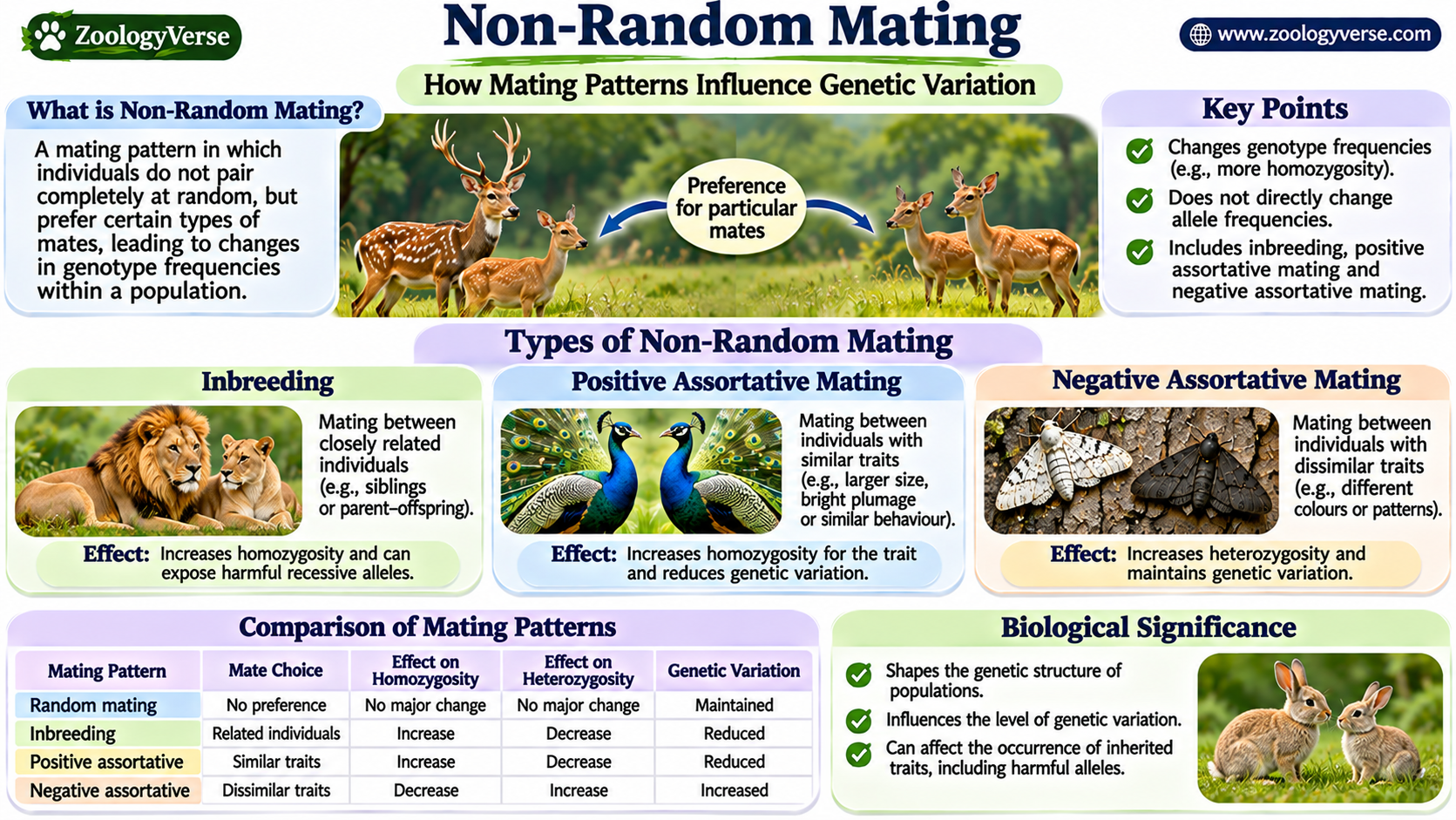
Non-random mating occurs when individuals do not choose mates independently of their genetic characteristics, physical traits, relatedness or other features. Instead, mating takes place according to particular preferences or patterns. In population genetics, non-random mating is one of the Evolutionary Forces of interest because it changes how alleles are combined in individuals and can alter genotype frequencies over generations.
Among the major Evolutionary Forces, non-random mating has a distinctive effect. It often changes the proportions of homozygous and heterozygous individuals without directly changing the overall allele frequencies. Its consequences as one of the Evolutionary Forces depend on the mating pattern, the traits involved and whether mating preferences are associated with reproductive success. Therefore, when comparing Evolutionary Forces, non-random mating must be distinguished from mechanisms that directly alter allele frequencies.
6.1 Meaning and Concept of Non-Random Mating
Under random mating, individuals have equal opportunities to mate with one another with respect to the gene being studied. Non-random mating occurs when the probability of mating depends on particular characteristics or relationships between individuals.
For example, individuals may preferentially mate with others that resemble them, choose partners with different traits, or mate with relatives because of limited dispersal. These patterns influence the combinations of alleles passed to offspring and help explain the effects of Evolutionary Forces on population structure.
Non-random mating is considered among the Evolutionary Forces because it changes the genetic structure of populations, especially genotype frequencies. However, it does not automatically cause a change in allele frequencies. This distinction is essential when comparing Evolutionary Forces and interpreting population-genetic data or evaluating departures from Hardy–Weinberg expectations.
6.2 Types of Non-Random Mating
Non-random mating can occur in several forms, depending on the characteristics influencing mate choice.
6.2.1 Inbreeding
Inbreeding is mating between individuals that are more closely related than randomly selected members of the population. It increases the probability that offspring inherit identical alleles from a common ancestor.
Inbreeding generally increases homozygosity and decreases heterozygosity. It can also increase the probability that harmful recessive alleles occur in homozygous condition and are expressed. Inbreeding itself does not necessarily change allele frequencies, although selection against harmful recessive genotypes may subsequently alter them.
6.2.2 Positive Assortative Mating
Positive assortative mating occurs when individuals preferentially mate with others that resemble them in one or more characteristics. For example, individuals of similar body size or colour may mate more frequently than expected under random mating.
As one of the Evolutionary Forces affecting genotype structure, this pattern tends to increase homozygosity at genes associated with the selected traits and can strengthen phenotypic similarities within groups. Its effects on allele frequencies depend on additional processes, such as selection or population subdivision.
6.2.3 Negative Assortative Mating
Negative assortative mating occurs when individuals preferentially mate with partners that differ from them in particular characteristics. Such mating can increase heterozygosity at the loci associated with those traits.
This pattern, considered among the Evolutionary Forces affecting mating structure, may maintain different alleles within a population and influence the distribution of genotypes. The overall effect depends on which traits influence mate choice and how strongly the preference operates.
6.3 Effects on Genotype Frequencies
The major genetic effect of non-random mating is often a change in genotype frequencies. Inbreeding and positive assortative mating tend to increase homozygous genotypes, whereas negative assortative mating may increase heterozygous genotypes at the relevant loci.
For a gene with two alleles, A and a, random mating under Hardy–Weinberg conditions produces expected genotype frequencies of p² for AA, 2pq for Aa and q² for aa. Non-random mating, unlike some other Evolutionary Forces, can alter these proportions even when the allele frequencies p and q remain unchanged.
This explains why a population may show a deviation from Hardy–Weinberg genotype expectations without necessarily undergoing a change in allele frequencies. When examining the combined effects of Evolutionary Forces, researchers must therefore distinguish changes in genotype proportions from changes in the frequencies of alleles themselves.
6.4 Non-Random Mating and Inbreeding Depression
Inbreeding depression refers to a reduction in average biological fitness associated with increased inbreeding. It commonly occurs because inbreeding increases homozygosity and makes harmful recessive alleles more likely to be expressed.
Its effects may include reduced fertility, lower survival, developmental abnormalities and decreased resistance to environmental stress. The severity of inbreeding depression varies among species and populations, depending on their genetic history and the number of harmful recessive alleles carried.
In small or isolated populations, inbreeding may occur more frequently because individuals have fewer unrelated potential mates. Genetic drift may also increase the frequency of certain alleles in these populations. These interacting processes show how different Evolutionary Forces can influence population fitness and genetic structure.
6.5 Evolutionary Significance of Non-Random Mating
Non-random mating is important in evolutionary biology because it influences the distribution of genetic combinations within populations. By changing homozygosity and heterozygosity, it can affect the expression of recessive alleles and the amount of genetic variation present within individuals.
Non-random mating may also influence how natural selection acts. For example, increased homozygosity can expose harmful recessive alleles to selection, while mate preferences can affect reproductive success for particular phenotypes. In such cases, mating patterns interact with other Evolutionary Forces and may contribute indirectly to changes in allele frequencies.
The study of non-random mating is also useful in conservation genetics. Small populations may experience increased inbreeding, reduced heterozygosity and greater risks associated with inbreeding depression. Conservation strategies that maintain connectivity and access to unrelated mates can help reduce some of these risks.
Non-random mating therefore has an important role in population genetics, but its effects must be interpreted carefully. It can alter genotype frequencies without directly changing allele frequencies, distinguishing it from several other Evolutionary Forces. Its interaction with selection, drift and gene flow helps determine the genetic structure and evolutionary potential of populations.
7. Recombination and Genetic Variation
Recombination is an important genetic process that produces new combinations of alleles during sexual reproduction. It complements other Evolutionary Forces by generating new allele combinations for evolutionary processes to act upon. Unlike mutation, which can create new alleles, recombination rearranges existing genetic variants. It therefore contributes to genetic diversity and provides additional combinations upon which natural selection can act. In the study of Evolutionary Forces, recombination is important because it changes the association of alleles within populations, even though it does not usually change the frequency of individual alleles by itself. Among the Evolutionary Forces, it is distinctive because it reshuffles existing variation rather than creating new alleles. Understanding Evolutionary Forces therefore requires distinguishing recombination from mutation and from processes that directly alter allele frequencies.
7.1 Meaning and Concept of Recombination
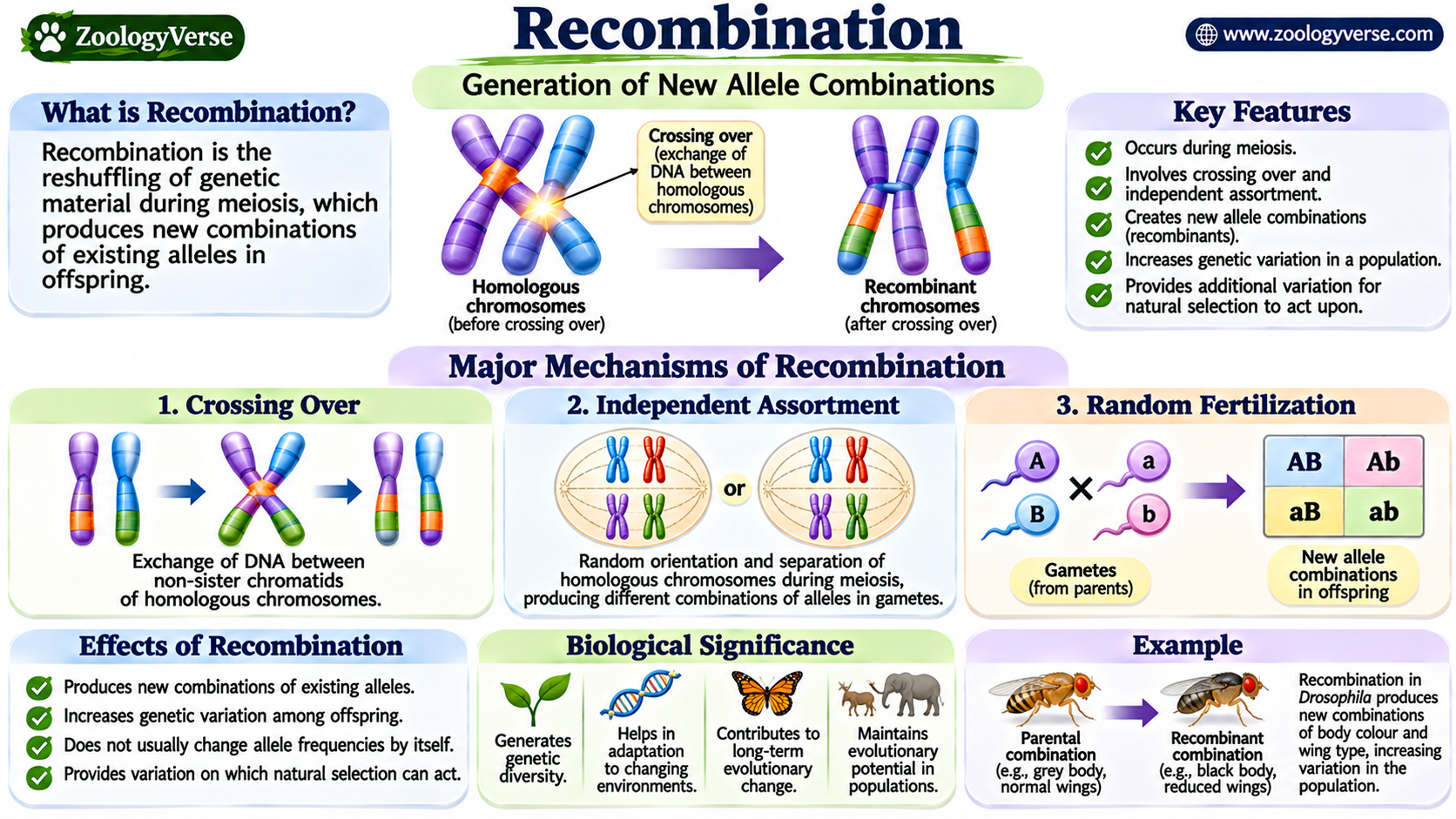
Genetic recombination is the process by which genetic material is exchanged or reassorted to produce new combinations of alleles. In sexually reproducing organisms, recombination occurs mainly during meiosis, when homologous chromosomes pair and exchange corresponding DNA segments. Independent assortment of chromosomes also produces different combinations of maternal and paternal chromosomes in gametes.
These processes generate genetic combinations that may differ from those present in either parent. This contribution makes recombination relevant to the combined action of Evolutionary Forces in sexually reproducing populations. Recombination is therefore an important source of variation among offspring. Although it is discussed alongside other Evolutionary Forces, it should be distinguished from mutation: recombination rearranges existing alleles, whereas mutation can produce new alleles. This distinction is important when comparing Evolutionary Forces in population genetics.
7.2 Crossing Over During Meiosis
Crossing over is the exchange of corresponding DNA segments between non-sister chromatids of homologous chromosomes. It generally occurs during prophase I of meiosis, particularly the pachytene stage, after homologous chromosomes have paired.
The exchange produces recombinant chromatids containing combinations of alleles that differ from the original parental arrangements. The resulting gametes can carry new combinations of genetic variants. These combinations provide additional variation through which Evolutionary Forces may influence later generations. This process contributes to variation among offspring and influences how genetic characteristics are inherited.
Crossing over is one mechanism through which recombination contributes to the genetic variation on which Evolutionary Forces such as natural selection can act. It demonstrates how Evolutionary Forces can influence the combinations of inherited characteristics available in a population. Its effects are especially important for genes located on the same chromosome, because crossing over can separate alleles that were previously inherited together.
7.3 Independent Assortment of Chromosomes
Independent assortment is the random orientation of homologous chromosome pairs at the metaphase plate during meiosis I. The maternal and paternal homologues of each chromosome pair separate independently of the other pairs, producing gametes with different combinations of chromosomes.
In organisms with multiple chromosome pairs, independent assortment can generate a large number of possible chromosome combinations. In humans, for example, independent assortment alone can produce 2²³ possible combinations of maternal and paternal chromosomes in gametes, excluding crossing over.
Independent assortment does not create new alleles, but it increases the variety of genetic combinations among offspring. This is relevant to Evolutionary Forces because selection and drift may subsequently affect the representation of these combinations. Together with crossing over, it helps explain how recombination contributes to genetic diversity and supplies combinations upon which Evolutionary Forces can act.
7.4 Recombination and Genetic Variation
Recombination increases genetic variation by producing new combinations of existing alleles. This variation can influence phenotypic characteristics and may affect the survival and reproductive success of individuals in particular environments.
The relationship between recombination and other Evolutionary Forces is important. Mutation introduces new alleles, while recombination reshuffles alleles into different combinations. The distinction clarifies the separate contributions of these Evolutionary Forces. Natural selection may favour some combinations over others, and genetic drift may change their frequencies by chance. Gene flow can also introduce alleles that subsequently become part of new recombinant combinations.
Recombination therefore contributes to the variation upon which Evolutionary Forces operate, but it does not generally change the frequency of individual alleles on its own. In this respect, Evolutionary Forces include processes with different effects on alleles and genotypes. Its main effect is to change the association of alleles, especially at different loci.
7.5 Linkage and Recombination Frequency
Linkage refers to the tendency of genes located close together on the same chromosome to be inherited together. Linked genes do not assort independently as frequently as genes located on different chromosomes or far apart on the same chromosome.
Recombination frequency is the proportion of recombinant offspring or gametes produced between two genetic loci. Genes that are farther apart on the same chromosome generally have a greater probability of being separated by crossing over than genes located close together. This relationship helps explain how recombination affects the genetic patterns on which Evolutionary Forces act.
Recombination frequency is useful in constructing genetic maps. One map unit, commonly called a centimorgan (cM), corresponds approximately to a recombination frequency of one percent for loci in the appropriate mapping range. Recombination frequencies cannot exceed 50% as an observable value because multiple crossing-over events can obscure the original combinations.
7.6 Evolutionary Significance of Recombination
Recombination is significant because it creates new combinations of genetic variants without necessarily introducing new alleles. These combinations increase variation among individuals and can influence how populations respond to changing environmental conditions.
By breaking down associations between alleles, recombination can bring beneficial variants together and separate them from harmful variants. This can alter the combinations upon which Evolutionary Forces such as selection act. It can also influence the efficiency of natural selection, because selection acts on combinations of traits as well as on individual genetic variants.
Recombination is therefore an important contributor to the genetic variation involved in evolution. Its relationship with other Evolutionary Forces helps explain why genetically diverse populations contain many combinations of inherited traits. It works alongside other Evolutionary Forces to shape the genetic composition of populations. However, it is not equivalent to mutation or gene flow, and it does not usually alter allele frequencies directly. Its contribution is primarily through reshuffling existing genetic material, while other Evolutionary Forces influence the frequency and persistence of the resulting variants.
8. Interaction of Different Evolutionary Forces
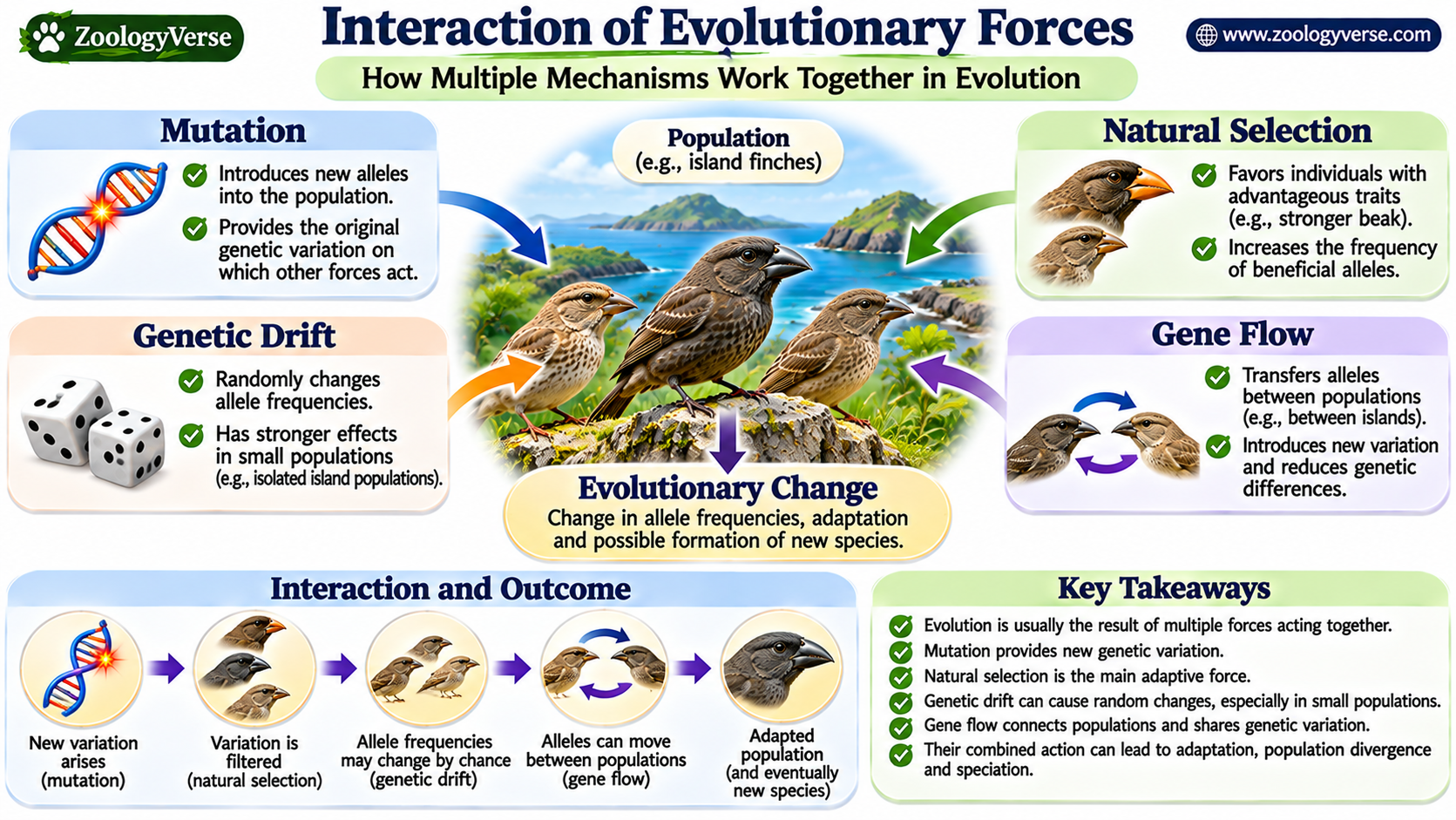
Different evolutionary mechanisms rarely operate in complete isolation. In natural populations, mutation, natural selection, genetic drift, gene flow and non-random mating may act simultaneously. Their combined effects determine how genetic variation is generated, distributed and maintained across generations. Understanding these interactions is essential because the outcome of one process may be influenced or modified by another.
The interaction of Evolutionary Forces explains why populations do not always follow a single predictable evolutionary pathway. Mutation introduces new alleles, natural selection favours or eliminates heritable variants according to their effects on reproductive success, genetic drift changes allele frequencies randomly, and gene flow transfers alleles between populations. Recombination produces new combinations of existing alleles, while non-random mating influences genotype frequencies. Together, these mechanisms of evolution shape population genetic structure.
The combined action of mutation, natural selection, genetic drift and gene flow forms an important part of modern evolutionary biology. Learn more about the Theories of Evolution, particularly the Modern Synthetic Theory.
8.1 Interaction Between Mutation and Natural Selection
Mutation and natural selection are closely connected because mutation supplies new genetic variants, while natural selection influences their frequency according to their effects on fitness.
A mutation may be beneficial, harmful or neutral in a particular environment. A beneficial mutation may increase reproductive success and become more common through natural selection. A harmful mutation may decrease in frequency if it reduces survival or reproduction. Neutral mutations may persist or change in frequency through genetic drift.
For example, a mutation that provides resistance to a particular antibiotic may give bacteria a reproductive advantage when that antibiotic is present. Natural selection can then increase the frequency of the resistance-associated allele in the bacterial population.
This interaction demonstrates how Evolutionary Forces work together: mutation provides genetic variation, whereas selection influences which variants become more common under particular environmental conditions.
8.2 Interaction Between Genetic Drift and Natural Selection
Genetic drift and natural selection can act on the same alleles but produce changes through different mechanisms. Natural selection operates through differences in reproductive fitness, whereas genetic drift produces random fluctuations in allele frequencies.
In large populations, the effects of selection may be more readily distinguishable from random genetic fluctuations. In small populations, however, genetic drift can be strong enough to counteract weak selection. As a result, an advantageous allele may sometimes be lost by chance, while a mildly harmful allele may increase in frequency.
The relative strength of these Evolutionary Forces depends on population size, selection intensity and the reproductive contribution of individuals. This interaction is particularly important in small, isolated and endangered populations.
8.3 Interaction Between Gene Flow and Genetic Drift
Gene flow and genetic drift often have opposing effects on population differentiation. Genetic drift can cause isolated populations to become genetically different through random changes in allele frequencies. Gene flow can reduce these differences by transferring alleles between populations.
For example, two small populations separated by a geographical barrier may gradually develop different allele frequencies because of genetic drift. If individuals later migrate between these populations and reproduce, gene flow may introduce alleles into each population and reduce some of the accumulated differences.
The balance between these Evolutionary Forces influences the degree of genetic similarity among populations. Restricted migration allows genetic differentiation to accumulate, whereas regular successful migration can maintain genetic connectivity.
8.4 Interaction Between Mutation and Genetic Drift
Mutation introduces new alleles, while genetic drift determines their chance-based changes in frequency within finite populations. A newly arising neutral mutation may initially be present in only one or a few individuals.
In a small population, genetic drift may rapidly cause such an allele to disappear or become fixed. In a larger population, the same mutation may remain at a low frequency for many generations. The outcome depends on population size, mutation rate and the random contribution of individuals to subsequent generations.
These Evolutionary Forces therefore influence both the origin and persistence of genetic variation. Mutation supplies new variants, while genetic drift affects their representation in the population.
8.5 Interaction Between Natural Selection and Gene Flow
Gene flow may introduce alleles that are advantageous, neutral or disadvantageous in the receiving population. Natural selection then influences whether these incoming alleles increase or decrease in frequency.
For example, an allele that provides an advantage in one environment may be less beneficial in another. When migrants introduce this allele into a population occupying a different environment, natural selection may reduce its frequency if it lowers reproductive success under local conditions.
In other situations, gene flow can introduce beneficial genetic variants and provide additional variation for natural selection to act upon. Thus, the relationship between these Evolutionary Forces may either promote adaptation or oppose local adaptation, depending on environmental conditions and the characteristics of incoming alleles.
8.6 Interaction Between Non-Random Mating and Other Evolutionary Forces
Non-random mating influences the combinations of alleles found in individuals. Inbreeding and positive assortative mating generally increase homozygosity, whereas negative assortative mating may increase heterozygosity at the relevant loci.
These changes can influence the effects of natural selection. For example, increased homozygosity may expose harmful recessive alleles, allowing selection to act more effectively against certain genetic variants. Inbreeding may also reduce population fitness when harmful recessive alleles become more frequently expressed.
Genetic drift and non-random mating may occur together in small populations, particularly when individuals have limited opportunities to find unrelated mates. These interacting Evolutionary Forces can affect genetic diversity and the long-term viability of populations.
8.7 Combined Effects on Population Genetic Structure
The genetic composition of a population is determined by the combined action of several mechanisms rather than by one process alone. Mutation creates new alleles, recombination produces new combinations, selection and drift influence allele frequencies, and gene flow transfers variants between populations. Non-random mating changes the distribution of genotypes.
The following table summarizes the major interactions:
| Interacting processes | Combined effect |
|---|---|
| Mutation and natural selection | New variants arise and may increase or decrease according to their fitness effects |
| Genetic drift and natural selection | Random changes may reinforce or oppose selection |
| Gene flow and genetic drift | Migration may reduce genetic differences created by random changes |
| Mutation and genetic drift | New alleles arise and may be lost or fixed by chance |
| Gene flow and natural selection | Incoming alleles may be favoured or selected against in the receiving environment |
| Non-random mating and natural selection | Changes in homozygosity may influence the expression of recessive alleles |
| Recombination and natural selection | New allele combinations provide additional variation upon which selection can act |
These relationships show that Evolutionary Forces may reinforce, oppose or modify one another. Their combined effects depend on the biological characteristics of populations, their environments and their reproductive patterns.
8.8 Evolutionary Significance of Their Interaction
The interaction of different evolutionary mechanisms is important for explaining the complexity of evolution in natural populations. It helps clarify why the same allele may behave differently in different populations and why evolutionary outcomes cannot always be predicted from a single mechanism.
For example, a beneficial mutation may increase through natural selection in one population but disappear through genetic drift in another small population. Similarly, gene flow may introduce useful alleles into an isolated population, but it may also introduce variants that are poorly suited to local environmental conditions.
The combined effects of Evolutionary Forces influence adaptation, genetic diversity, population differentiation and the long-term evolutionary potential of species. Studying these interactions provides a more complete understanding of population genetics and the mechanisms responsible for evolutionary change.
9. Evolutionary Forces and Changes in Allele Frequencies
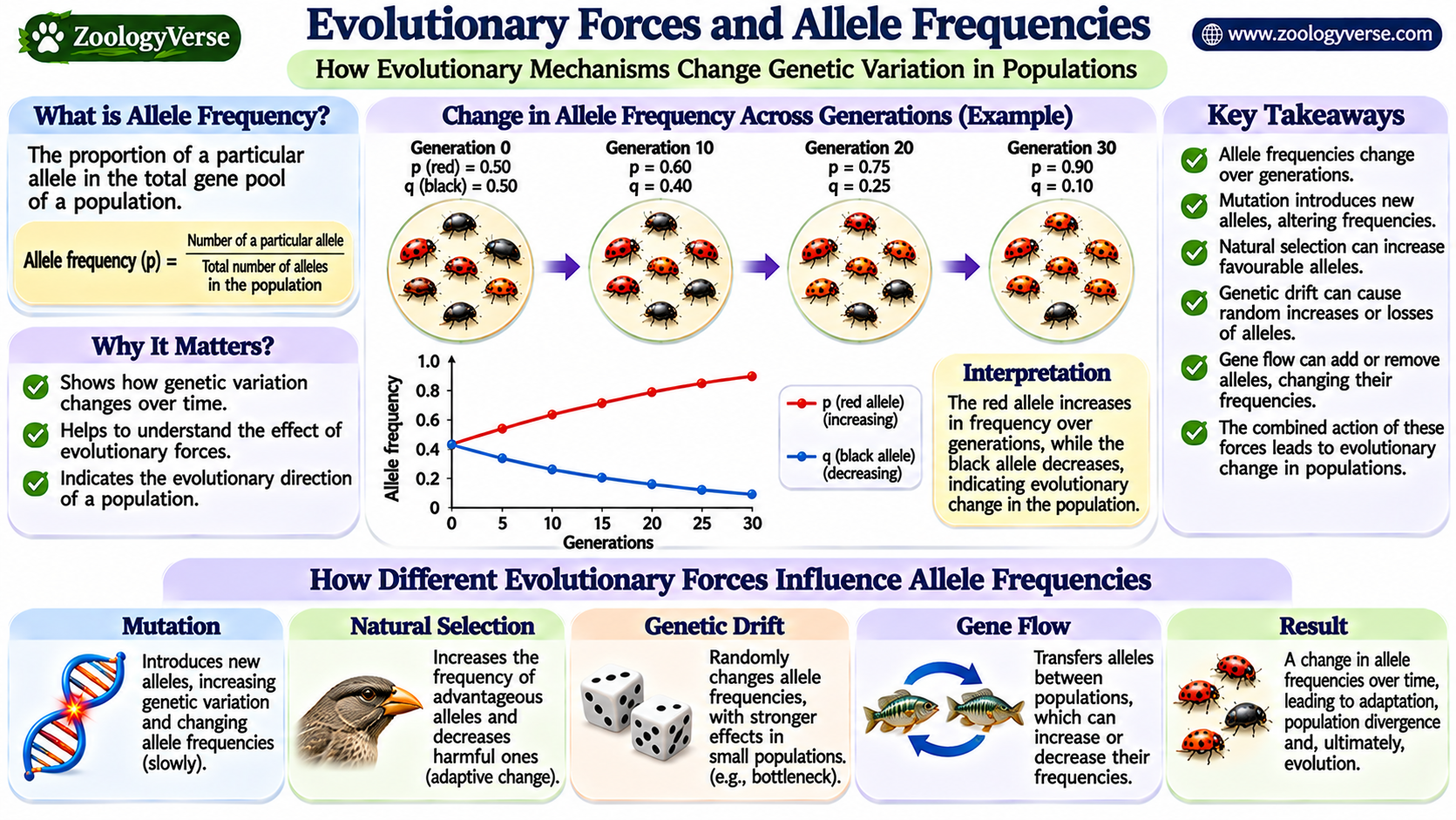
Evolutionary change is commonly measured by examining changes in allele frequencies within a population over successive generations. An allele frequency represents the proportion of a particular allele among all copies of a gene in a population. When these proportions change over time, the genetic composition of the population is changing. The major Evolutionary Forces influence this process through different mechanisms, including mutation, natural selection, genetic drift and gene flow.
Allele frequencies provide a measurable way to investigate evolution. This measurement is central to evaluating Evolutionary Forces. For a gene with two alleles, A and a, their frequencies are commonly represented by p and q. In a population containing only these two alleles, p + q = 1. Changes in either frequency necessarily affect the other. Tracking both values helps reveal how Evolutionary Forces influence a population. Studying these values across generations helps researchers identify patterns of genetic change and investigate the Evolutionary Forces responsible.
Changes in allele frequencies provide evidence of evolutionary change in populations. The Evidences of Evolution article explains the major scientific observations supporting evolution.
9.1 Allele Frequencies as a Measure of Evolution
Allele frequency is calculated by dividing the number of copies of a particular allele by the total number of copies of that gene in the population. In a diploid population of N individuals, there are generally 2N copies of an autosomal gene.
For two alleles, A and a, the frequency of A is represented by p, while the frequency of a is represented by q. Their relationship is:
[
p+q=1
]
If the frequency of A increases from 0.4 to 0.6 over several generations, while the frequency of a decreases from 0.6 to 0.4, the population has undergone an evolutionary change at that locus. Such a change may result from one or more Evolutionary Forces. Comparing populations across generations helps reveal the effects of Evolutionary Forces.
9.2 How Different Evolutionary Forces Change Allele Frequencies
Different mechanisms influence allele frequencies in distinct ways.
1. Mutation: Mutation changes DNA sequences and can convert one allele into another. Recurrent mutation may introduce new variants or alter the frequencies of existing alleles over generations.
2. Natural selection: When genotypes differ in reproductive success, alleles associated with greater fitness may increase in frequency. The direction and magnitude of change depend on the environment and the fitness effects of the alleles. This is a key way Evolutionary Forces produce non-random genetic change.
3. Genetic drift: Random sampling of alleles between generations can increase or decrease allele frequencies. These random changes are generally stronger in populations with small effective population sizes. This illustrates the population-size dependence of Evolutionary Forces.
4. Gene flow: The movement and successful reproduction of individuals or gametes can introduce alleles into a population or remove them from another. The resulting change depends on the migration rate and the difference in allele frequencies between populations. In this way, Evolutionary Forces connect local genetic change with migration.
These Evolutionary Forces can operate together, and their combined effects determine the observed genetic changes. The relative contribution of Evolutionary Forces depends on population conditions. Non-random mating usually changes genotype frequencies rather than allele frequencies directly, while recombination changes associations between alleles at different loci.
9.3 Allele Frequencies and Hardy–Weinberg Equilibrium
The Hardy–Weinberg Principle provides a mathematical model for understanding allele and genotype frequencies in an idealized population. For a gene with two alleles, A and a, the allele-frequency relationship is:
[
p+q=1
]
Under the assumptions of Hardy–Weinberg equilibrium, expected genotype frequencies are:
[
p^2+2pq+q^2=1
]
Here, p² represents the frequency of AA, 2pq represents the frequency of Aa, and q² represents the frequency of aa. This model provides a baseline for examining Evolutionary Forces.
When the conditions of the model are satisfied, allele frequencies remain constant across generations and genotype frequencies follow the expected proportions. Changes caused by mutation, selection, drift or gene flow can alter allele frequencies and move a population away from these expectations. These departures help researchers investigate the action of Evolutionary Forces. However, a deviation in genotype frequencies alone does not automatically establish that allele frequencies have changed.
9.4 Numerical Illustration of Allele-Frequency Change
Consider a population in which the frequency of allele A is initially 0.6 and the frequency of allele a is 0.4.
Therefore:
- Initial frequency of A (p) = 0.6
- Initial frequency of a (q) = 0.4
Suppose that after several generations, the frequency of A becomes 0.7 and the frequency of a becomes 0.3.
The change can be expressed as:
- Change in A = 0.7 − 0.6 = +0.1
- Change in a = 0.3 − 0.4 = −0.1
The increase in A and corresponding decrease in a indicate a change in allele frequencies. This example demonstrates evolutionary change at the studied locus, although further evidence would be required to identify which mechanism caused it. Identifying the responsible Evolutionary Forces requires additional population and ecological evidence.
9.5 Factors Affecting the Direction and Rate of Change
The direction and rate of allele-frequency change depend on several biological and population-level conditions. These conditions modify the strength of Evolutionary Forces.
- Selection intensity: Strong differences in reproductive success can produce more rapid changes in the frequencies of associated alleles.
- Effective population size: Small effective populations generally experience stronger random fluctuations due to genetic drift.
- Mutation rate: The rate at which new alleles arise influences the supply of genetic variation.
- Migration rate: The number of successful migrants and the genetic differences between source and receiving populations influence gene flow.
- Mating patterns: Non-random mating can alter genotype proportions and affect the way selection acts on genetic variants.
- Environmental conditions: Environmental changes may alter the relative fitness of different genotypes and change the direction of selection.
These factors interact, so the effects of Evolutionary Forces cannot always be predicted by considering each mechanism separately. This interaction is a central feature of Evolutionary Forces in natural populations.
9.6 Distinguishing Allele-Frequency Change from Genotype-Frequency Change
A correct interpretation of population-genetic data requires distinguishing allele frequencies from genotype frequencies. Allele frequencies describe the proportions of different alleles, whereas genotype frequencies describe the proportions of individuals carrying particular combinations of alleles.
For example, inbreeding can increase homozygosity and reduce heterozygosity without necessarily changing the frequencies of the alleles themselves. Population subdivision can also produce a deficit of heterozygotes when groups with different allele frequencies are analysed together. These patterns may cause departures from Hardy–Weinberg expectations without proving that allele frequencies have changed over time.
By contrast, mutation, natural selection, genetic drift and gene flow can directly change allele frequencies. Recombination generally changes the combinations and associations of alleles rather than their individual frequencies. This distinction is essential when assessing the effects of Evolutionary Forces. Accurate interpretation depends on identifying which Evolutionary Forces can change allele frequencies directly.
9.7 Importance in Evolutionary Studies
The analysis of allele frequencies is fundamental to evolutionary research because it allows genetic changes to be measured across generations and compared among populations. Researchers use allele-frequency data to investigate natural selection, genetic drift, migration, population history and genetic differentiation. Such comparisons provide evidence about Evolutionary Forces.
In conservation biology, monitoring allele frequencies can help identify the loss of genetic variation in small populations. In medical genetics, population frequencies help researchers study inherited variants. In evolutionary biology, comparisons among populations can provide evidence about historical isolation, migration and adaptation.
Allele-frequency analysis therefore provides a quantitative foundation for understanding evolution. It is also a practical way to study Evolutionary Forces. By combining genetic measurements with information about ecology, reproduction and population history, researchers can investigate how different Evolutionary Forces contribute to changes in populations over time. Such integrated analysis clarifies how Evolutionary Forces shape genetic diversity and population structure.
10. Biological Significance of Evolutionary Forces
Evolutionary Forces are important because they explain how populations change genetically over generations and how biological diversity develops. Mutation introduces new alleles, natural selection influences reproductive success, genetic drift produces random changes in allele frequencies, and gene flow transfers genetic variants between populations. Recombination creates new combinations of existing alleles, while non-random mating influences genotype frequencies. Together, these processes shape the genetic composition of populations and contribute to the history and diversity of life.
The biological significance of Evolutionary Forces extends beyond changes in allele frequencies. They help explain adaptation to environmental conditions, the maintenance or loss of genetic variation, differences between populations, and the emergence of reproductive isolation. Studying Evolutionary Forces also provides a framework for understanding evolutionary processes in ecology, conservation, medicine and agriculture.
Evolutionary changes can eventually contribute to population divergence and the formation of new species. Read about the Species Concept to understand how species are defined and distinguished.
Maintaining genetic diversity is important for the long-term survival of threatened populations. Explore In-situ Conservation and Ex-situ Conservation to learn about major conservation strategies.
10.1 Adaptation to Changing Environments
One important consequence of Evolutionary Forces is their role in biological adaptation. Natural selection can increase the frequency of heritable characteristics that improve reproductive success under particular environmental conditions. When environments change, the traits that provide an advantage may also change.
For example, insect populations may evolve resistance to pesticides when individuals carrying resistance-associated variants survive and reproduce more successfully. Similarly, bacteria may evolve antibiotic resistance under exposure to particular drugs. These examples show how Evolutionary Forces can alter the genetic composition of populations in response to environmental pressures. This adaptive role is one of the best-known biological consequences of Evolutionary Forces.
Adaptation does not occur because organisms deliberately develop the traits they need. Instead, heritable variation already present or newly introduced through mutation is filtered by differences in reproductive success. The outcome depends on the interaction of selection with mutation, drift and gene flow.
10.2 Maintenance and Loss of Genetic Variation
Genetic variation is essential for the long-term evolutionary potential of populations. Mutation introduces new alleles, while recombination produces new combinations of existing alleles. Gene flow may introduce variants from other populations and increase local genetic diversity.
In contrast, genetic drift can remove alleles by chance, especially in small populations. Natural selection may also reduce variation when particular alleles consistently provide higher fitness, although balancing forms of selection can maintain multiple variants. These different effects illustrate how Evolutionary Forces can either increase, redistribute or reduce genetic variation. The balance among Evolutionary Forces determines which variants persist.
The amount of variation within a population influences its capacity to respond to future environmental changes. Populations with very low genetic diversity may have fewer heritable alternatives available when conditions change.
10.3 Genetic Differentiation Between Populations
Evolutionary Forces contribute to genetic differences among populations. When populations become geographically or reproductively isolated, gene flow may decline. Mutation, natural selection and genetic drift can then cause their allele frequencies to change independently.
Genetic drift may produce random differences, particularly in small populations, while natural selection may favour different traits in different environments. Over time, these processes can increase genetic differentiation. Conversely, continued gene flow may reduce differences by transferring alleles between populations.
The balance among these Evolutionary Forces helps explain why populations of the same species may show different genetic characteristics across their geographical ranges. This is another way Evolutionary Forces shape biodiversity.
10.4 Contribution to Speciation
Speciation is the evolutionary process through which new species arise. It commonly involves the development of reproductive isolation between populations, preventing or greatly reducing successful interbreeding.
Evolutionary Forces can contribute to this process by changing genetic composition in separated populations. Natural selection may favour different adaptations in different environments, while genetic drift may cause independent changes in small isolated groups. Mutation and recombination contribute additional genetic variation, and reduced gene flow allows differences to accumulate.
These processes do not automatically produce new species. Speciation generally requires the development of reproductive barriers or other forms of persistent evolutionary independence. Nevertheless, the combined action of Evolutionary Forces can contribute to the divergence that precedes speciation.
10.5 Importance in Conservation Biology
Evolutionary Forces are important in conservation because the genetic health of a population influences its long-term persistence. Small and isolated populations are particularly vulnerable to genetic drift, inbreeding and the loss of rare alleles.
Gene flow between populations can help maintain genetic diversity and reduce some effects of isolation. Wildlife corridors and habitat connectivity may therefore support the movement and reproduction of individuals between fragmented populations. However, introducing individuals from genetically different populations requires careful assessment because incoming alleles may not always be suited to local conditions.
Conservation genetics uses information about allele frequencies, genetic diversity and population structure to guide management decisions. Understanding Evolutionary Forces helps conservation biologists assess risks and maintain the evolutionary potential of threatened populations. Conservation planning therefore benefits from understanding how Evolutionary Forces affect small populations.
10.6 Applications in Medicine and Agriculture
The study of Evolutionary Forces has practical applications in medical and agricultural sciences.
In medicine, evolutionary principles help explain the spread of antibiotic resistance and the changing genetic composition of disease-causing organisms. Population genetics can also help researchers investigate inherited variants and their distribution among populations.
In agriculture, artificial selection and knowledge of genetic variation are used in crop improvement and animal breeding. Plant breeders select heritable characteristics such as disease resistance, yield and tolerance to environmental stress. Animal breeders similarly use genetic information to improve desirable traits.
These applications demonstrate how knowledge of Evolutionary Forces can support practical decisions involving health, food production and the management of biological resources.
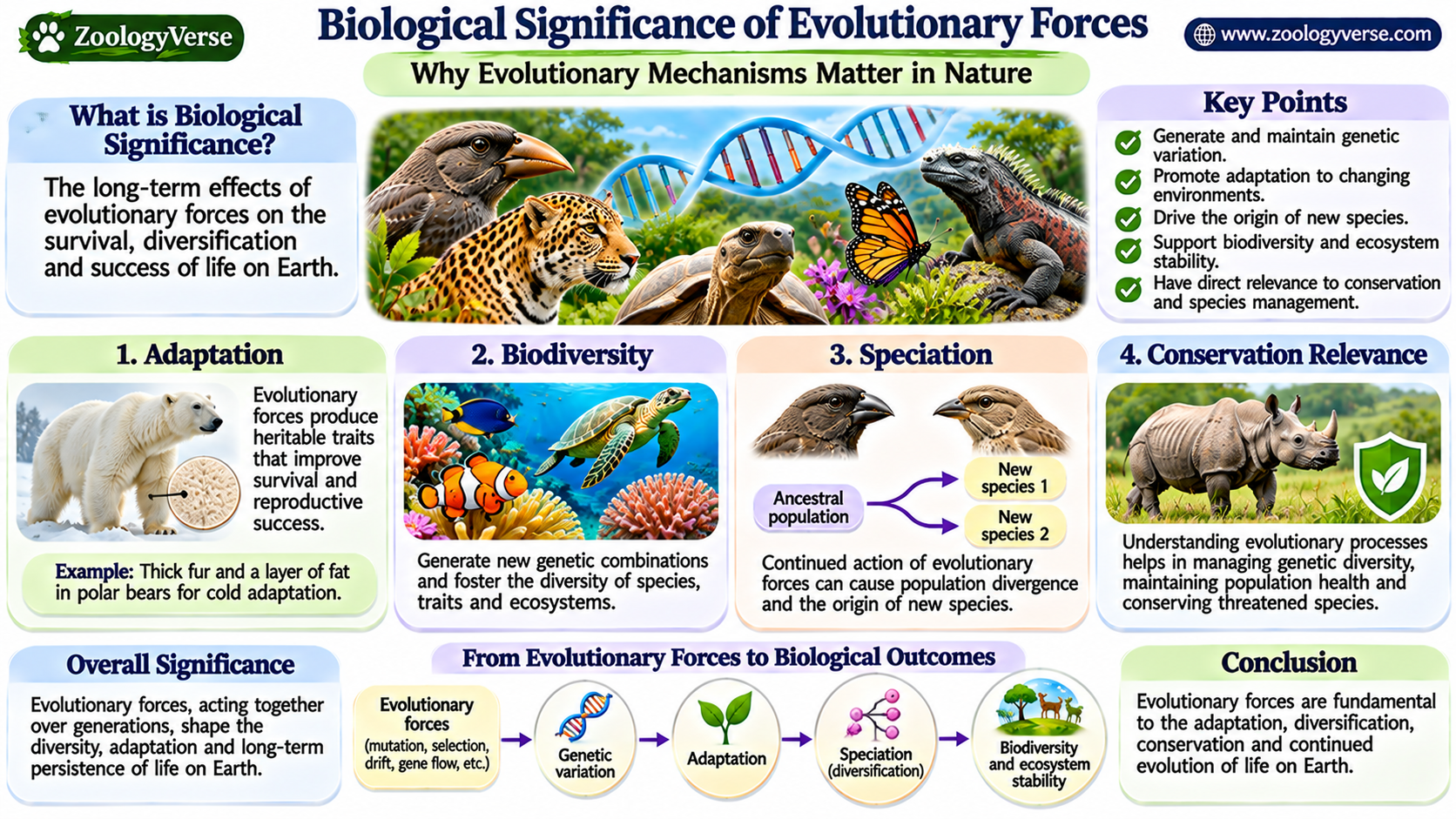
10.7 Understanding Biodiversity and Evolutionary History
The diversity of living organisms reflects genetic changes accumulated over long periods. Mutation, natural selection, genetic drift, gene flow and reproductive isolation have all contributed to the differences observed among populations and species.
Comparative genetic studies allow researchers to examine relationships among populations, identify patterns of common ancestry and investigate historical migration. Fossils, anatomical evidence, ecological observations and molecular data provide complementary information about evolutionary history.
By studying Evolutionary Forces, biologists can explain how genetic variation arises, how populations diverge and how biological diversity develops. These mechanisms provide a foundation for interpreting both present-day variation and long-term evolutionary patterns. In this way, Evolutionary Forces link population-level genetic processes with the broader history of life.
10.8 Overall Biological Importance
The biological importance of Evolutionary Forces lies in their combined influence on genetic variation, adaptation, population differentiation and the origin of species. Their effects are not always predictable from one mechanism alone because mutation, selection, drift, gene flow, recombination and mating patterns can interact.
Understanding these processes allows biologists to explain changes in natural populations and to apply evolutionary principles in conservation, medicine, agriculture and ecological research. Evolutionary Forces therefore provide a central framework for understanding how populations respond to environmental conditions and how the diversity of life has developed through successive generations.
11. Conclusion
Evolutionary Forces are the fundamental mechanisms responsible for genetic changes in populations across successive generations. They explain how genetic variation originates, how allele frequencies change and how populations respond to environmental conditions. The major mechanisms of evolution include mutation, natural selection, genetic drift and gene flow, while non-random mating and recombination influence genotype frequencies and the distribution of genetic variation.
Mutation introduces new alleles, natural selection favours heritable characteristics associated with greater reproductive success, genetic drift produces random changes in allele frequencies, and gene flow transfers genetic variants between populations. Recombination generates new combinations of existing alleles, while non-random mating influences patterns of homozygosity and heterozygosity.
The combined effects of Evolutionary Forces determine the genetic structure, diversity and evolutionary potential of populations. These processes may reinforce or oppose one another depending on population size, reproductive patterns and environmental conditions. Understanding Evolutionary Forces is therefore essential for explaining adaptation, genetic differentiation, speciation and biodiversity.
The study of these mechanisms also has practical importance in conservation biology, medicine, agriculture and ecological research. Together, they provide the population-genetic foundation for understanding how evolution operates and how the diversity of life develops over time.
Frequently Asked Questions (FAQs)
What are Evolutionary Forces?
What are the four major Evolutionary Forces?
What is the role of mutation in evolution?
How does natural selection cause evolution?
What is genetic drift?
What is gene flow in evolution?
What is the difference between genetic drift and natural selection?
Does non-random mating change allele frequencies?
What is the role of recombination in evolution?
How do Evolutionary Forces contribute to speciation?
Which evolutionary mechanism is strongest in small populations?
Why are Evolutionary Forces important in conservation biology?
13. References
- OpenStax. (2013). Concepts of Biology: 11.2 Mechanisms of Evolution. Rice University.
https://openstax.org/books/concepts-biology/pages/11-2-mechanisms-of-evolution - OpenStax. (2018). Biology 2e: 19.2 Population Genetics. Rice University.
https://openstax.org/books/biology-2e/pages/19-2-population-genetics - Shook, B., Braff, L., Nelson, K., Aguilera, K., & Alveshere, A. J. (2023). Explorations: An Open Invitation to Biological Anthropology, Chapter 4: Forces of Evolution.
https://opentextbooks.concordia.ca/explorations2/chapter/4/ - University of Minnesota. Introductory Biology: Population Genetics – How Populations Evolve.
https://pressbooks.umn.edu/ecoevobio/chapter/popgen/ - European Bioinformatics Institute (EMBL-EBI). Population Genetics – Human Genetic Variation.
https://www.ebi.ac.uk/training/online/courses/human-genetic-variation-introduction/types-of-genetic-variation-studies/population-genetics/ - Dey, S., & Kapoor, A. K. Human Origin and Evolution: Chapter 11 – Forces of Evolution. INFLIBNET.
https://ebooks.inflibnet.ac.in/antp14/chapter/forces-of-evolution/ - OpenStax. Biology 2e: 19.1 Population Evolution. Rice University.
https://openstax.org/books/biology-2e/pages/19-1-population-evolution - University of Minnesota. Human Biology 2e: 1.4 Mechanisms of Evolution.
https://open.lib.umn.edu/humanbiology2e/chapter/1-4-mechanisms-of-evolution/
Discover more from Zoologyverse
Subscribe to get the latest posts sent to your email.