
Crabs in the genus Carcinus (Greek: Καρκίνoς Karkinos) include the significant invasive species Carcinus maenas and the Mediterranean Sea-endemic species C. aestuarii.
Classification of Carcinus (Crab)
| Phylum | Arthropoda | Jointed appendages |
| Class | Crustacea | Exoskeleton thick, antennae 2 pairs, jaws 3 pairs |
| Sub-class | Malacostraca | Free-living Crustacea with compound eyes, biramous antennules, mandibles, 8 thoracic and 6 abdominal segments having appendages. |
| Order | Decapoda | Carapace present; first three thoracic limbs from maxillipedes. |
| Sub-Order | Brachyura | Abdomen reduced. |
| Family | Carcininae | |
| Genus | Carcinus |
Habit and habitat
Carcinus is found buried among rocks or mud in shallow water. The crabs are highly specialized crustacean. Breeding season is spring.
Distribution
It has cosmopolitan distribution and specially found in Europe, U.S.A. and India.
Comments on Carcinus
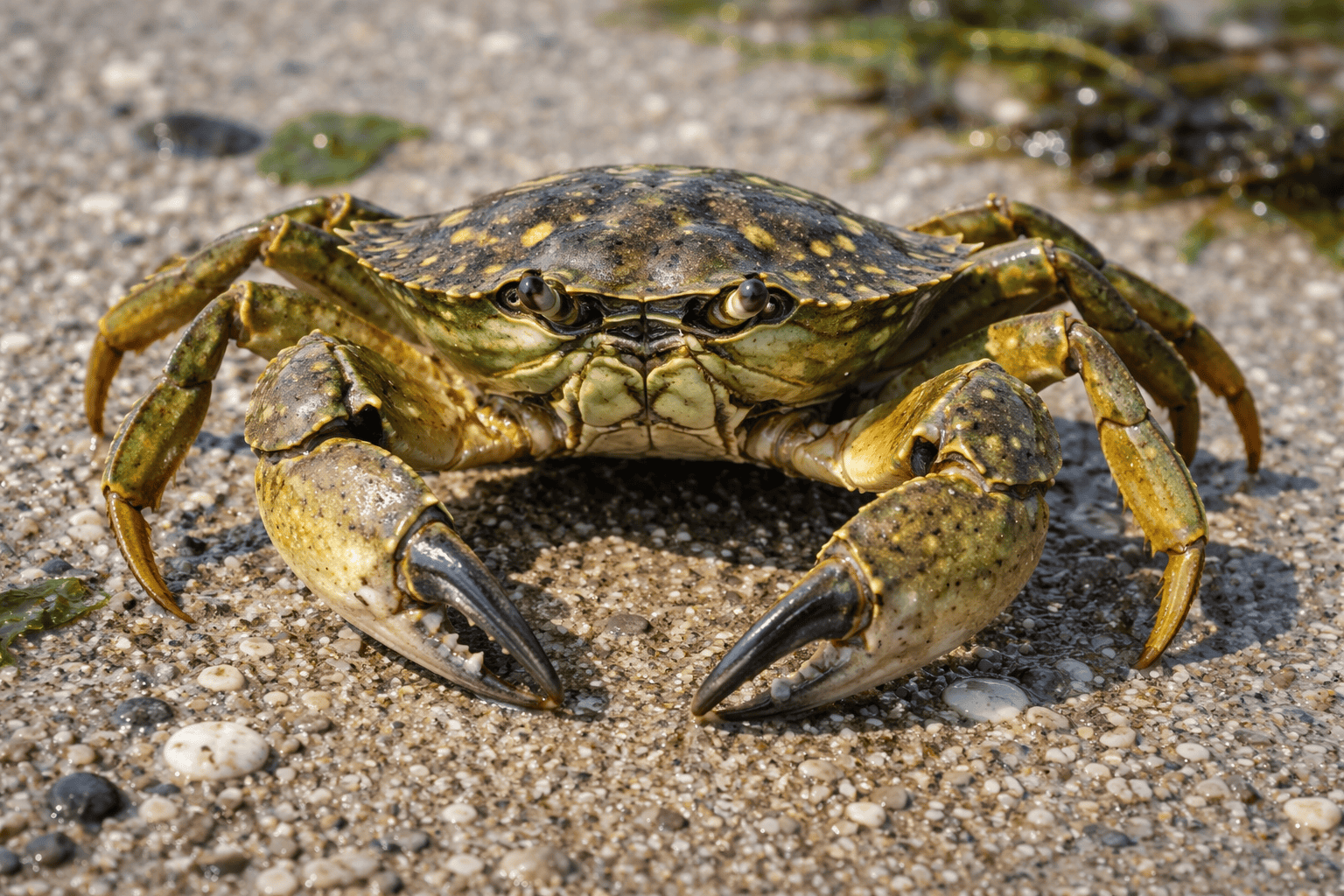
- Commonly called as Rock crab or True crab.
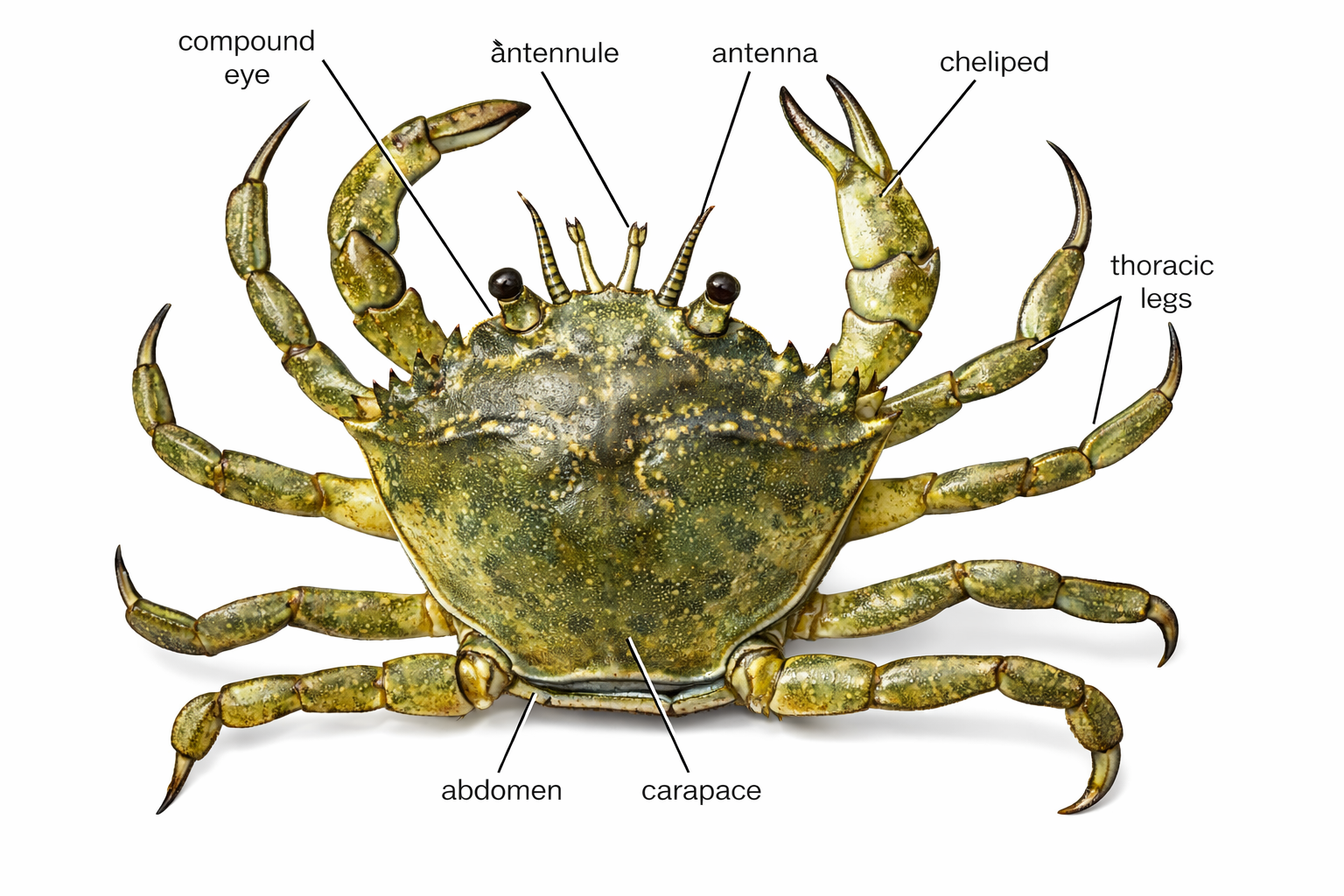
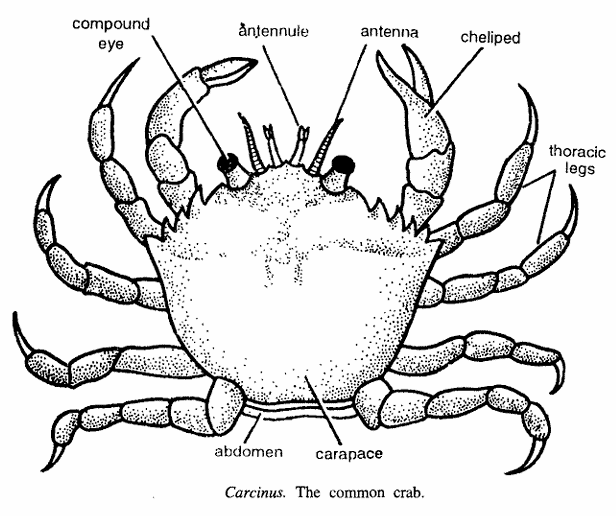
- Body generally dorsoventrally compressed and consist of a large and broad cephalothorax and a stumpy abdomen. Cephalothorax is broader than long.
- The carapace is fused with epistome at the sides and nearly always in the middle. Rostrum absent.
- Small antennules, antennae and eye spots are contained in the sockets of the carapace.
- Third maxillipedes are broad flat, valve like covering the other mouth parts on ventral surfaces.
- Five pairs of thoracic legs are well developed. Abdomen is reduced and fixed under cephalothorax.
- It is permanently bent under the cephalothorax fitting into a groove in the thoracic sterna, thus remaining invisible in the dorsal view of the animal.
- Abdomen is narrower in male but somewhat broader in female.
- The abdominal pleura greatly reduced or absent and the abdomen without tailfans. Pleopods are greatly reduced.
- The male has only 2 pairs of pleopods to act as copulatory organ while the female has 4 pairs for th.e attachment of the eggs.
- Uropods are absent. Young hatches in the zoaea stage and passes through a megalopa stage before reaching maturity.
Identification
Since the specimen contains stumpy abdomen and all above characters, hence it is Carcinus.
See other posts also
- King Bird-of-Paradise (Cicinnurus regius)
- Bee Hummingbird : The World’s Smallest Bird
- Top 10 Most Venomous Snakes in the World
- Differences between Crocodile vs Alligator vs Gharial
- Helix (Garden snail)
Discover more from Zoologyverse
Subscribe to get the latest posts sent to your email.