
1. Introduction
The Theories of Evolution provide scientific explanations for how living organisms have originated, changed and diversified over millions of years. Evolution is one of the fundamental principles of biology because it explains the unity and diversity of life, the origin of adaptations, the relationships among organisms and the development of new species. The study of evolutionary theories has helped scientists understand how simple ancestral populations gradually gave rise to the enormous diversity of organisms found on Earth today.
The idea that living organisms change over time has developed through centuries of scientific observation, investigation and debate. Early explanations of biological diversity were often based on philosophical or religious interpretations. However, advances in comparative anatomy, palaeontology, embryology, biogeography, genetics and molecular biology gradually provided evidence supporting the scientific study of evolution.
Several scientists proposed different explanations for evolutionary change. Jean-Baptiste Lamarck suggested that organisms could acquire characteristics in response to environmental requirements and transmit these acquired characteristics to their offspring. Charles Darwin, together with Alfred Russel Wallace, proposed natural selection as an important mechanism responsible for evolutionary change. Later, Hugo de Vries introduced Mutation Theory, emphasizing the role of sudden heritable variations in evolution.
During the twentieth century, discoveries in genetics and population biology contributed to the development of Neo-Darwinism, also known as the Modern Synthetic Theory of Evolution. This framework combined Darwinian natural selection with Mendelian genetics and explained evolutionary change through processes such as mutation, recombination, natural selection, genetic drift and gene flow.
The historical development of evolutionary thought is important because each theory contributed to the scientific understanding of biological change, even when some of its original explanations were later modified or rejected. A comparative study of these theories helps explain how evolutionary biology developed into a modern scientific discipline.
To understand biological evolution more completely, it is also important to study the origin of life, which investigates how the earliest living systems may have emerged from non-living chemical substances.
2. Historical Background of Evolutionary Thought
The development of evolutionary biology was a gradual process influenced by philosophical ideas, natural history observations, geological discoveries and biological investigations. Before the establishment of modern evolutionary science, many naturalists believed that living organisms were fixed and that species remained unchanged throughout their existence. Over time, evidence from fossils, geographical distribution and comparative anatomy challenged this belief and encouraged scientists to investigate the possibility of biological transformation.
2.1 Early Ideas About the Origin and Diversity of Life
Ancient Greek philosophers proposed several ideas concerning the origin and diversity of living organisms. Although these explanations were not based on modern experimental methods, they contributed to early discussions about the natural world.
- Anaximander: Suggested that life originated in water and that early organisms were associated with aquatic environments. He also proposed that humans might have developed from other animals.
- Empedocles: Suggested that living structures arose through natural processes and that organisms with suitable combinations of parts survived.
- Aristotle: Developed the concept of the Scala Naturae, or Great Chain of Being, which arranged organisms in a hierarchical order from simpler forms to more complex forms. His ideas generally supported the view that species were fixed.
These early explanations were philosophical interpretations rather than scientifically established evolutionary mechanisms.
2.2 The Concept of Fixity of Species
For many centuries, the dominant belief in European natural history was that species were permanent and unchanging. According to the concept of fixity of species, organisms had been created in their existing forms and remained essentially unchanged over generations.
This viewpoint influenced early biological classification and natural history. However, discoveries of extinct organisms and fossils that differed from living species gradually raised questions about the permanence of species.
The recognition of extinction was particularly important because it demonstrated that some forms of life had existed in the past but no longer survived.
2.3 Contributions of Geology
Developments in geology played an important role in establishing the scientific background for evolutionary thinking. Geological investigations revealed that Earth had undergone extensive changes over very long periods.
James Hutton (1726–1797) proposed the principle of gradual geological change. He argued that processes such as erosion, sedimentation and volcanic activity had operated over immense periods of time.
Charles Lyell (1797–1875) further developed uniformitarianism in his work Principles of Geology. He emphasized that many geological processes operating in the present also operated in the past.
These ideas supported the concept of an ancient Earth and provided sufficient geological time for gradual biological changes to occur.
2.4 Fossil Discoveries and Extinction
Fossils provided important evidence that the organisms living on Earth had changed throughout geological history. The discovery of extinct animals, including ancient marine organisms and large vertebrates, demonstrated that past biological communities differed considerably from modern ones.
Georges Cuvier (1769–1832) made major contributions to comparative anatomy and palaeontology. He demonstrated that extinction was a real phenomenon and proposed catastrophism to explain major changes in the fossil record.
Although Cuvier did not support the transformation of species, his work established the importance of fossils in reconstructing the history of life.
2.5 Early Scientific Proposals of Evolution
During the eighteenth and early nineteenth centuries, some naturalists began proposing that organisms could change over generations.
Buffon (1707–1788) suggested that environmental conditions could influence organisms and that different species might share common ancestors. His ideas challenged strict interpretations of species permanence.
Erasmus Darwin (1731–1802) proposed that living organisms might have originated from common ancestral forms and undergone gradual modification. His writings discussed the possibility of evolutionary relationships among organisms.
These proposals helped create an intellectual foundation for later evolutionary explanations, although they did not provide a complete mechanism supported by systematic evidence.
2.6 Development of Modern Evolutionary Theories
The nineteenth century marked a major turning point in the scientific understanding of biological change. Jean-Baptiste Lamarck proposed an early systematic explanation of evolutionary transformation, followed by Charles Darwin’s theory of natural selection and Alfred Russel Wallace’s independent contribution to the same principle.
Later developments in genetics, cytology and population biology helped explain the inheritance and distribution of heritable variations. These discoveries eventually contributed to the development of Neo-Darwinism and the modern synthesis.
The historical development of evolutionary thought therefore represents a progression from philosophical speculation to evidence-based scientific explanations of biological change.
The question of how life first emerged is distinct from the question of how living populations subsequently changed. The origin of life provides the background for understanding the beginning of biological systems, whereas evolutionary theories explain their diversification over generations.
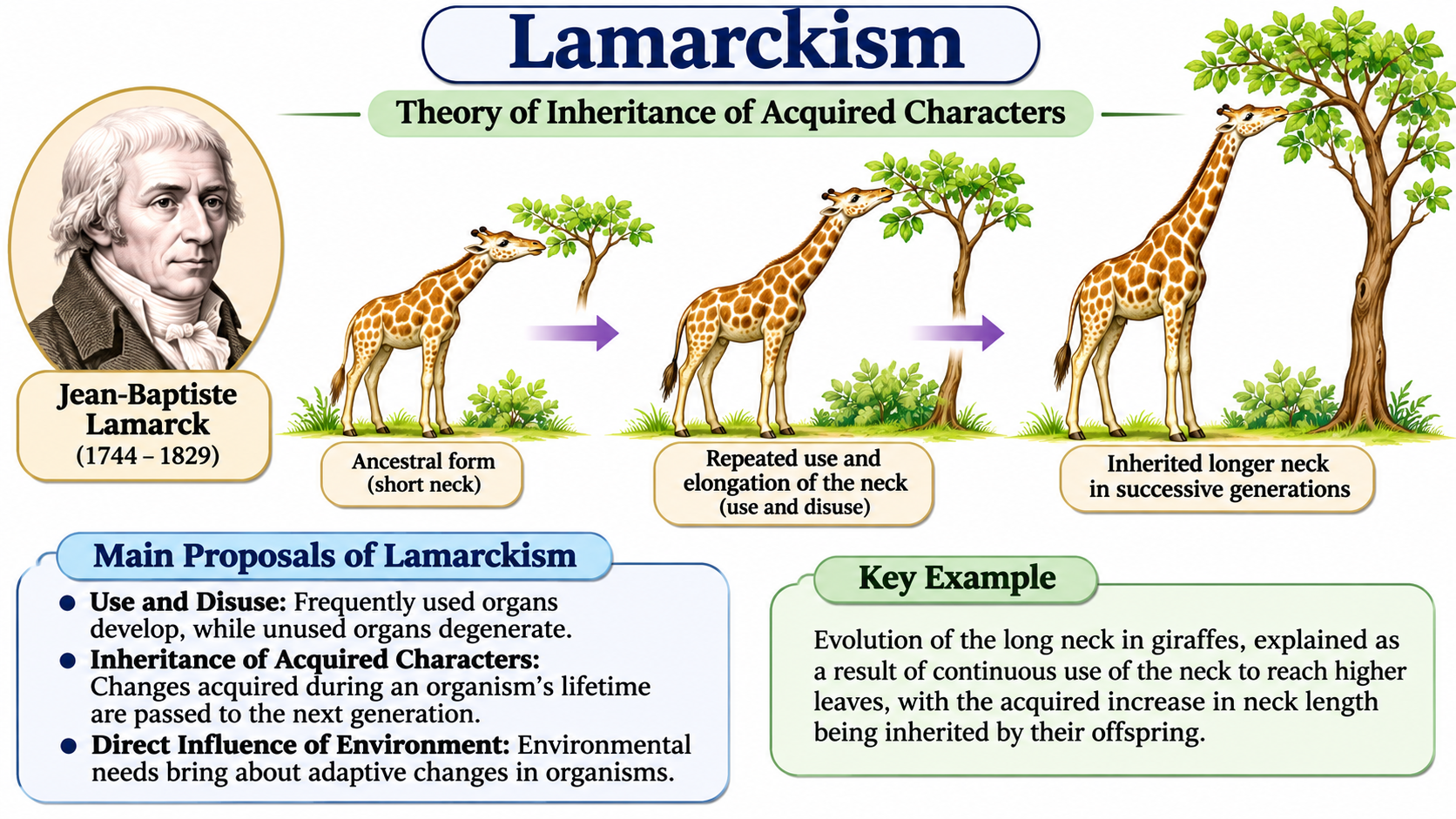
3. Lamarckism – Theory of Inheritance of Acquired Characters
Lamarckism is one of the earliest systematic explanations of organic evolution. It was proposed by the French naturalist Jean-Baptiste de Lamarck (1744–1829), who suggested that organisms undergo gradual changes in response to environmental conditions and that certain acquired characteristics can be transmitted to their offspring.
Lamarck presented his evolutionary ideas in his book Philosophie Zoologique (1809). He believed that organisms continuously adapt to changing environmental conditions through the use and disuse of organs. According to his explanation, frequently used organs become more developed, whereas organs that are not used gradually become reduced or disappear.
3.1 Main Principles of Lamarckism
Lamarckism is traditionally explained through the following principles.
3.1.1 Influence of Environmental Changes
According to Lamarck, changes in environmental conditions create new needs in organisms. These needs influence their habits and activities, gradually producing changes in their body structures.
For example, changes in food availability or habitat conditions may lead organisms to develop different habits that influence the development of particular organs.
3.1.2 New Needs and Changes in Habits
Lamarck suggested that environmental changes produce new requirements in organisms. To fulfil these requirements, organisms modify their habits and activities.
These altered habits were considered important factors responsible for changes in organ development.
3.1.3 Law of Use and Disuse
This principle states that organs used frequently become stronger, larger and more developed, whereas organs that are not used regularly become weak, reduced or may eventually disappear.
Examples:
- The neck of giraffes was traditionally explained as becoming longer through repeated stretching to reach leaves on tall trees.
- The reduced eyes of animals living in dark caves were historically explained through the disuse of visual organs.
- The development of strong muscles through repeated activity was considered an example of organ development through use.
These examples illustrate Lamarck’s proposed mechanism, although they are not accepted as evidence that acquired anatomical changes are generally inherited.
3.1.4 Inheritance of Acquired Characters
According to this principle, characteristics acquired by organisms during their lifetime through environmental influence, use and disuse could be transmitted to their offspring.
Lamarck believed that the gradual accumulation of such inherited changes over successive generations could produce evolutionary transformations.
3.2 Examples of Lamarckism
Lamarck used changes in organisms to explain how evolutionary transformations might occur. Several traditional examples are commonly discussed in zoology.
3.2.1 Evolution of the Giraffe’s Long Neck
The giraffe is the classical example used to explain Lamarckism.
According to the traditional Lamarckian explanation:
- The ancestors of giraffes had relatively short necks.
- Food was frequently available on the branches of tall trees.
- To reach higher leaves, these animals repeatedly stretched their necks.
- Repeated stretching gradually increased neck length during their lifetime.
- This acquired increase in neck length was believed to be inherited by offspring.
- Over many generations, the accumulation of these changes produced modern long-necked giraffes.
3.2.2 Reduction of Eyes in Cave-Dwelling Animals
Lamarckism also used the reduction of eyes in animals living in dark environments as an example of disuse.
According to this explanation, animals living in caves gradually reduced their dependence on vision. The reduced use of their eyes was believed to cause progressive degeneration, and the acquired reduction was considered transmissible to offspring.
Modern evolutionary biology explains eye reduction through heritable genetic variations and natural selection, genetic drift and other evolutionary processes in populations.
3.2.3 Development of Webbed Feet in Aquatic Birds
The traditional Lamarckian explanation suggests that repeated movement of the toes during swimming could gradually increase the development of skin between them. This acquired characteristic was then considered capable of inheritance.
However, the evolution of webbed feet is now understood through inherited variation and evolutionary processes acting across generations.
3.3 Experimental Evidence and Criticism
Lamarck’s proposal that acquired characteristics could be inherited was later challenged by experimental investigations.
August Weismann’s experiment: Weismann conducted experiments involving repeated removal of the tails of mice over successive generations. The offspring continued to develop normal tails.
This experiment demonstrated that the removal of a body part during an organism’s lifetime did not result in the inheritance of that acquired physical change by its offspring.
However, the experiment specifically tested the inheritance of this acquired alteration and did not, by itself, disprove every possible form of environmentally influenced inheritance.
3.4 Limitations of Lamarckism
The major limitations of classical Lamarckism include:
- Lack of general experimental support: The inheritance of acquired anatomical modifications through use and disuse has not been established as a general evolutionary mechanism.
- Incorrect explanation of inheritance: Changes acquired by ordinary body tissues are not generally transmitted to reproductive cells.
- Limited role of genetic mechanisms: Lamarck did not have access to modern knowledge of genes, chromosomes, DNA and mutation.
- Inadequate explanation of adaptation: The theory does not adequately explain how heritable variations arise and become more common in populations.
- Oversimplification of evolutionary change: Evolution cannot be explained simply as a direct response to an organism’s needs or efforts.
3.5 Significance of Lamarckism
Although classical Lamarckism is not accepted as the general mechanism of evolution, it has historical importance in the development of evolutionary biology.
- It challenged the traditional concept of the complete fixity of species.
- It proposed that organisms change over time in response to environmental conditions.
- It emphasized the relationship between organisms and their environments.
- It encouraged scientific discussion about the mechanisms responsible for evolutionary change.
- It contributed to the historical development of evolutionary thought and stimulated later investigations into heredity and adaptation.
Modern research also recognizes certain forms of epigenetic inheritance, in which environmentally influenced changes in gene regulation may sometimes persist across generations. However, these mechanisms do not validate classical Lamarckism as a general explanation of evolution.
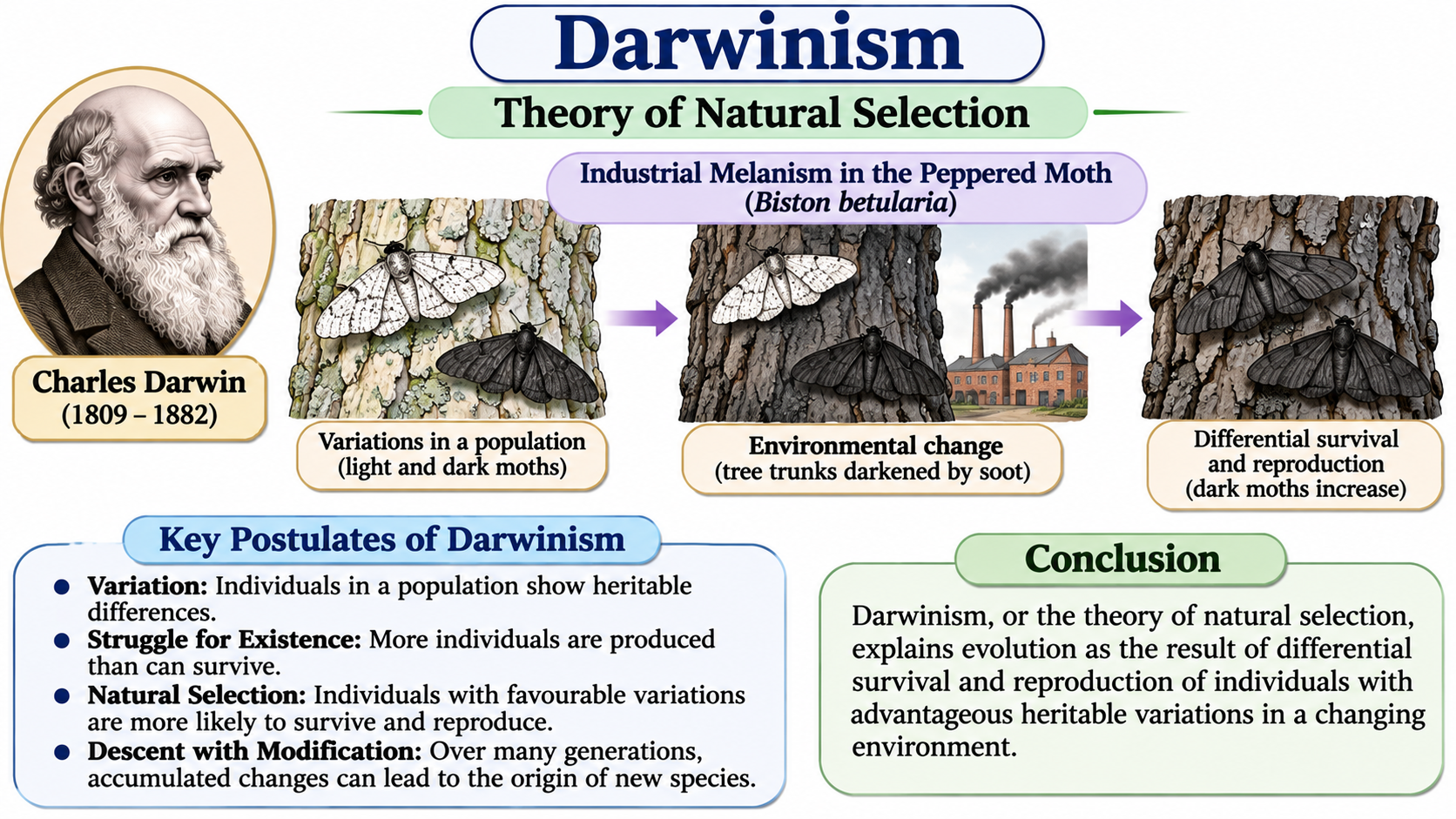
4. Darwinism – Theory of Natural Selection
Darwinism is an important evolutionary theory proposed by the English naturalist Charles Darwin (1809–1882). It explains evolution primarily through natural selection, a process in which individuals possessing advantageous heritable variations tend to survive and reproduce more successfully under particular environmental conditions.
Darwin developed his ideas through extensive observations of plants, animals, fossils and geographical distributions. His voyage aboard HMS Beagle (1831–1836) provided important observations that contributed to his understanding of biological diversity and adaptation.
In 1858, Darwin and Alfred Russel Wallace jointly presented their ideas concerning natural selection to the Linnean Society of London. Darwin subsequently published his influential book On the Origin of Species in 1859, providing extensive evidence for evolution by natural selection.
4.1 Main Principles of Darwinism
Darwin’s explanation of evolution through natural selection is based on several important principles.
4.1.1 Overproduction
Organisms generally produce more offspring than can survive and reproduce successfully.
For example, fishes, insects, amphibians and many other animals produce large numbers of eggs or offspring. However, only a proportion survive to reproductive age because resources and suitable habitats are limited.
Overproduction increases competition among organisms for food, space, shelter and reproductive opportunities.
4.1.2 Struggle for Existence
Because resources are limited and populations can produce more offspring than the environment can support, organisms face a struggle for existence.
Darwin discussed three broad forms of struggle:
A. Intraspecific struggle
This occurs between individuals belonging to the same species. They may compete for food, territory, shelter and mates.
B. Interspecific struggle
This occurs between individuals belonging to different species. Competition may arise when organisms depend on similar resources.
C. Struggle with environmental conditions
Organisms also face challenges caused by environmental factors such as temperature, drought, floods, disease and other unfavourable conditions.
4.1.3 Variations
Individuals belonging to the same species are not completely identical. They show differences in size, colour, structure, physiology, behaviour and other characteristics.
These differences are known as variations.
Variations may be classified into two broad categories:
- Heritable variations: Differences that can be transmitted from parents to offspring.
- Non-heritable variations: Differences acquired during an individual’s lifetime that are generally not transmitted genetically to offspring.
Natural selection acts on phenotypic differences, and heritable variations can contribute to evolutionary change across generations.
4.1.4 Survival and Reproduction of the Fittest
Darwin proposed that individuals possessing favourable heritable variations have a greater probability of surviving and reproducing under particular environmental conditions.
The expression survival of the fittest was introduced by Herbert Spencer and later used by Darwin.
In evolutionary biology, fitness does not necessarily mean physical strength. It refers to an organism’s relative contribution of offspring to subsequent generations.
For example, in an environment where camouflage provides protection from predators, individuals with better camouflage may have higher reproductive success than more visible individuals.
4.1.5 Natural Selection
Natural selection is the central mechanism of Darwinism.
Individuals with advantageous heritable characteristics tend to leave more surviving offspring than individuals with less advantageous characteristics under particular environmental conditions.
Over successive generations, favourable heritable characteristics may increase in frequency within a population.
Natural selection does not produce variations according to an organism’s needs. Instead, it acts on existing heritable variation.
4.1.6 Origin of New Species
Darwin suggested that the accumulation of favourable variations over long periods could lead to the gradual divergence of populations.
When populations become sufficiently different and reproductive isolation develops, new species may arise.
This process is known as speciation.
4.2 Examples of Darwinism
Several biological examples help explain natural selection and evolutionary adaptation.
4.2.1 Industrial Melanism in the Peppered Moth
The peppered moth (Biston betularia) provides a well-known example of natural selection.
Before industrialization in parts of Britain, many tree trunks were relatively light and covered with lichens. Light-coloured moths were better camouflaged, whereas dark-coloured moths were more easily detected by predators.
During industrialization, soot pollution darkened many tree surfaces and reduced lichen growth. Under these conditions, dark-coloured moths gained a camouflage advantage in many polluted areas.
As a result, the frequency of dark-coloured moths increased in several industrial populations.
When pollution levels later declined and lichens returned, the relative advantage of light-coloured moths increased again.
This example demonstrates how environmental conditions can influence the frequency of heritable characteristics through natural selection.
4.2.2 Evolution of Darwin’s Finches
Darwin observed several species of finches in the Galápagos Islands. These birds showed differences in beak size and shape, associated with differences in feeding habits and food resources.
Some species possess strong beaks suitable for cracking hard seeds, whereas others have narrower beaks adapted for feeding on insects or other food sources.
Differences in beak structure illustrate adaptive diversification and the relationship between natural selection and ecological conditions.
4.2.3 Evolution of Antibiotic Resistance
Antibiotic resistance in bacteria provides a modern example of natural selection.
Within bacterial populations, heritable variations may allow some individuals to survive exposure to a particular antibiotic. When susceptible bacteria are eliminated, resistant bacteria may survive and reproduce.
Consequently, resistance-associated genetic variants can increase in frequency in the population.
Antibiotics do not create resistance because bacteria consciously need it. Rather, they impose selection on existing variation and can also favour the spread of resistance genes through horizontal gene transfer.
4.3 Evidence Supporting Darwinism
Darwin used several forms of evidence to support evolution by natural selection. Later scientific discoveries have provided additional evidence for evolutionary explanations.
- Comparative anatomy: Similarities in structural organization among organisms indicate evolutionary relationships. Homologous organs, such as the forelimbs of humans, whales and bats, provide evidence of common ancestry.
- Palaeontology: Fossils demonstrate that organisms have changed through geological time and provide evidence of extinct and transitional forms.
- Biogeography: The geographical distribution of organisms, including island species, provides evidence of evolutionary divergence and adaptation.
- Artificial selection: Selective breeding by humans demonstrates that inherited variations can accumulate over generations.
- Embryology: Similarities in early developmental patterns among related organisms can provide evidence of common ancestry.
- Observed natural selection: Changes in bacterial antibiotic resistance and other measurable population-level changes demonstrate natural selection operating in living populations.
4.4 Limitations of Darwinism
Darwin’s theory was a major scientific advancement, but the original explanation had certain limitations because the mechanisms of heredity and genetic variation were not yet understood.
- Lack of genetic knowledge: Darwin could not explain the precise mechanism by which variations arise and are inherited.
- Origin of variations: The theory did not adequately explain the sources of new heritable variations.
- Inheritance mechanism: Mendelian genetics had not yet been integrated into evolutionary theory.
- Role of mutation: The importance of mutations as a source of new genetic variation was not understood in modern terms.
- Other evolutionary processes: The original theory did not fully explain the contributions of genetic drift, gene flow and other population-genetic processes.
These limitations were addressed through later developments in genetics and evolutionary biology.
4.5 Significance of Darwinism
Darwinism transformed the scientific understanding of biological diversity and established natural selection as a major evolutionary mechanism.
- It provided a scientific explanation for adaptation.
- It supported the concept of common ancestry among living organisms.
- It explained how heritable variations can become more or less common in populations.
- It encouraged the systematic study of evolutionary relationships.
- It established a foundation for modern evolutionary biology and the later development of the Modern Synthetic Theory.
Darwin’s contribution remains central to evolutionary biology, although modern evolutionary theory incorporates additional mechanisms and genetic explanations beyond the original formulation.
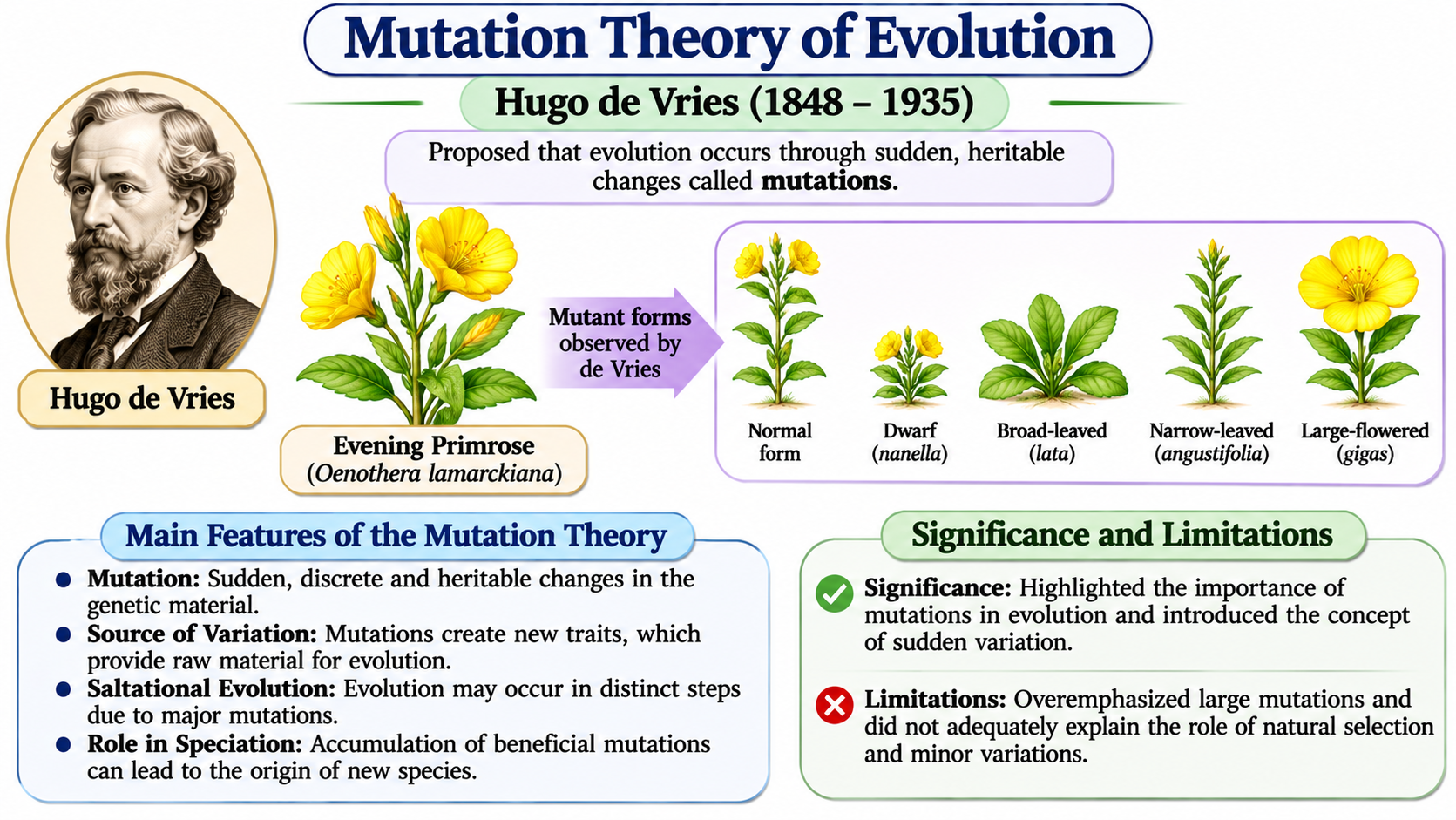
5. Mutation Theory of Evolution – Hugo de Vries
Mutation Theory was proposed by the Dutch botanist and geneticist Hugo de Vries (1848–1935) in the early twentieth century. According to this theory, evolution occurs through sudden, heritable changes known as mutations. De Vries considered these changes important sources of evolutionary variation and suggested that the accumulation of favourable mutations could contribute to the origin of new species.
De Vries developed his ideas through experiments on the evening primrose (Oenothera lamarckiana). He observed considerable variations among plants and interpreted some of these changes as sudden hereditary mutations.
He presented his evolutionary ideas in his work The Mutation Theory, published between 1901 and 1903. His proposal represented an important development in the historical understanding of heredity and evolutionary change.
5.1 Main Principles of Mutation Theory
The major principles of Mutation Theory can be explained as follows.
5.1.1 Mutations as a Source of Variation
De Vries considered mutations to be important sources of heritable variation.
Mutations are changes in the genetic material of an organism. They may affect individual genes, larger chromosome segments or chromosome numbers.
Unlike temporary modifications caused by environmental conditions, mutations occurring in reproductive cells can be transmitted to subsequent generations.
5.1.2 Sudden and Discontinuous Changes
According to De Vries, evolutionary changes could sometimes occur suddenly rather than exclusively through the gradual accumulation of small variations.
He described these sudden changes as mutations and suggested that they could produce noticeably different forms within a population.
Such changes were historically described as saltations.
5.1.3 Hereditary Nature of Mutations
De Vries emphasized that mutations could be inherited when they occurred in cells contributing genetic material to offspring.
Heritable mutations may therefore introduce new genetic characteristics into populations.
Mutations occurring only in ordinary body cells are generally not transmitted to offspring in sexually reproducing organisms.
5.1.4 Mutations Occur Spontaneously
De Vries believed that mutations could arise suddenly and independently of an organism’s immediate requirements.
Modern genetics confirms that mutations can occur spontaneously through errors in DNA replication, spontaneous chemical changes and other processes. Mutations can also be induced by certain environmental factors, including radiation and chemical mutagens.
5.1.5 Role of Mutations in the Origin of New Species
De Vries suggested that large mutations could produce distinct new forms and potentially contribute to the origin of new species.
Modern evolutionary biology recognizes mutations as an essential source of new genetic variation. However, the formation of species usually involves several interacting evolutionary processes, including natural selection, genetic drift and reproductive isolation.
5.2 Experimental Basis of Mutation Theory
De Vries conducted experiments on the evening primrose, Oenothera lamarckiana, to investigate the appearance and inheritance of variations.
During his investigations, he observed plants that differed from the parental form in several characteristics. He interpreted these unusual forms as evidence of sudden hereditary mutations.
Some of the variants appeared to maintain their distinctive characteristics in subsequent generations, leading him to suggest that sudden mutations could produce new evolutionary forms.
His experiments became historically important because they encouraged systematic investigations into mutation and heredity.
However, later genetic research showed that Oenothera has an unusual chromosomal system, including complex chromosome arrangements. Some of the variations observed by De Vries were therefore not simple gene mutations in the modern sense.
5.3 Examples of Mutations
Mutations occur in many organisms and may produce different types of genetic variation.
5.3.1 Mutations in Plants
Plant mutations may affect flower colour, leaf shape, plant height, fruit characteristics and other features.
For example, changes in genes controlling flower pigments may produce variations in flower colour. Some genetic changes can also affect plant growth and development.
Polyploidy, involving the presence of additional complete chromosome sets, is particularly important in plant evolution and has contributed to the formation of several plant species.
5.3.2 Mutations in Animals
Mutations in animals may influence pigmentation, body structure, metabolism and other biological characteristics.
For example, mutations affecting pigment-producing genes can produce differences in coat or skin colour.
Some mutations may be harmful, while others may have neutral or advantageous effects depending on the genetic background and environmental conditions.
5.3.3 Mutations in Microorganisms
Microorganisms provide important examples of genetic mutations.
Mutations in bacterial populations may alter antibiotic susceptibility. When antibiotics are used, resistant variants may gain a reproductive advantage and increase in frequency.
This illustrates how mutation supplies genetic variation upon which natural selection can act.
5.4 Types of Mutations
Mutations can be classified according to the level of genetic material affected.
| Type of mutation | Description | Example |
|---|---|---|
| Gene mutation | Change in the DNA sequence of a gene | Point mutation |
| Chromosomal mutation | Structural alteration in a chromosome | Deletion or inversion |
| Genomic mutation | Change in chromosome number | Aneuploidy or polyploidy |
Mutations may also be classified as spontaneous or induced, depending on how they arise.
5.5 Limitations of Mutation Theory
Although Mutation Theory contributed significantly to evolutionary biology, De Vries’s original explanation had several limitations.
- Overemphasis on sudden changes: Evolution does not generally occur only through large, sudden mutations. Many evolutionary changes involve the accumulation of small genetic variations over generations.
- Limited explanation of natural selection: Mutation alone cannot fully explain adaptation. Natural selection influences the frequency of heritable variations according to their effects on reproductive success.
- Complexity of speciation: The formation of new species generally involves population-level processes, including reproductive isolation, genetic divergence and ecological differentiation.
- Unusual experimental organism: The chromosome behaviour of Oenothera lamarckiana was unusual, and some of the variants observed by De Vries had complex chromosomal explanations.
- Incomplete genetic understanding: De Vries worked before the full development of modern molecular genetics and therefore could not explain the molecular mechanisms responsible for mutations.
5.6 Significance of Mutation Theory
Mutation Theory made several important contributions to the development of evolutionary biology.
- It emphasized the importance of mutations as sources of heritable variation.
- It encouraged experimental investigations into heredity and genetic change.
- It contributed to the development of mutation genetics.
- It helped establish the importance of sudden genetic changes in evolutionary studies.
- It influenced later investigations into chromosome behaviour and population genetics.
Modern evolutionary biology recognizes mutation as an essential source of new genetic variation. However, mutation operates together with natural selection, genetic drift, gene flow and recombination rather than acting as the sole mechanism of evolution.
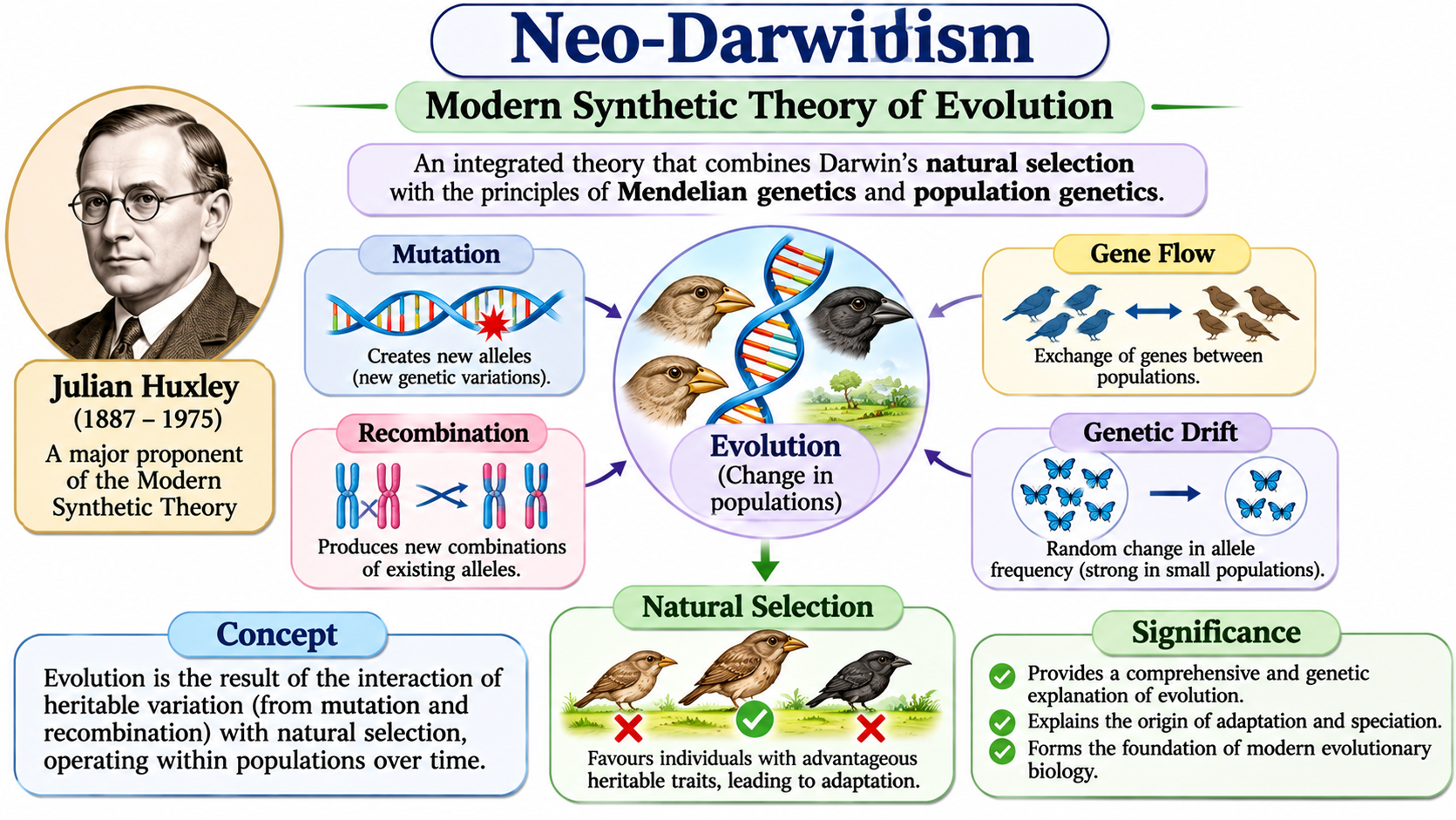
6. Neo-Darwinism – Modern Synthetic Theory of Evolution
Neo-Darwinism, also known as the Modern Synthetic Theory of Evolution or the Modern Evolutionary Synthesis, is a comprehensive explanation of evolutionary change that combines Darwin’s principle of natural selection with Mendelian genetics and population genetics.
The theory developed mainly during the 1930s and 1940s through the contributions of several evolutionary biologists, geneticists and naturalists. It explained how genetic variations arise, how they are inherited and how their frequencies change within populations over successive generations.
Unlike classical Darwinism, which could not explain the genetic basis of inheritance, Neo-Darwinism provides a genetic explanation of evolutionary processes. It recognizes that evolution occurs through changes in the genetic composition of populations over generations.
These mechanisms also help explain broader trends in evolution, which describe recognizable patterns of biological change across evolutionary time.
6.1 Historical Development of Neo-Darwinism
The development of Neo-Darwinism involved the integration of several important discoveries in genetics, natural selection and population biology.
The rediscovery of Gregor Mendel’s laws of inheritance around 1900 helped establish the genetic basis of heredity. Scientists subsequently investigated how inherited variations influenced evolutionary change.
Several researchers made major contributions to the development of the Modern Synthesis:
- Ronald A. Fisher: Demonstrated the mathematical relationship between Mendelian genetics and natural selection.
- J. B. S. Haldane: Developed mathematical models explaining natural selection and evolutionary change in populations.
- Sewall Wright: Emphasized the importance of genetic drift, population structure and inbreeding.
- Theodosius Dobzhansky: Integrated genetics with evolutionary biology through his studies of natural populations, particularly in Genetics and the Origin of Species (1937).
- Ernst Mayr: Contributed to the biological species concept and explained the importance of geographical isolation in speciation.
- George Gaylord Simpson: Integrated palaeontology with evolutionary theory and demonstrated how evolutionary patterns could be interpreted through population-level processes.
- G. Ledyard Stebbins: Applied evolutionary principles to plants and contributed to the integration of botanical genetics into the Modern Synthesis.
These contributions established a unified framework connecting heredity, variation, natural selection and the origin of species.
6.2 Main Principles of Neo-Darwinism
The Modern Synthetic Theory explains evolutionary change through several interacting genetic and population-level processes.
6.2.1 Genetic Variations
Genetic variation refers to differences in DNA sequences and inherited characteristics among individuals belonging to a population.
Such variations provide the raw material upon which evolutionary processes act.
Genetic variation may arise through:
- Gene mutations.
- Chromosomal mutations.
- Genetic recombination during meiosis.
- Independent assortment of chromosomes.
- Random fertilization during sexual reproduction.
Individuals carrying different genetic combinations may show differences in their physical characteristics, physiology and reproductive success.
6.2.2 Mutation
Mutation refers to a heritable change in genetic material.
Mutations may involve changes in individual DNA sequences, chromosome structure or chromosome number.
They introduce new genetic variants into populations and therefore contribute to evolutionary variation.
Mutations may be beneficial, harmful or neutral depending on their effects and environmental conditions.
For example, a mutation that provides resistance to a particular disease may increase the reproductive success of individuals carrying it under conditions where that disease is prevalent.
6.2.3 Genetic Recombination
Genetic recombination produces new combinations of alleles during sexual reproduction.
It occurs mainly through the following mechanisms:
A. Crossing Over
During prophase I of meiosis, homologous chromosomes exchange corresponding segments of genetic material. This process produces new combinations of alleles.
B. Independent Assortment
Homologous chromosome pairs separate independently during meiosis, resulting in different combinations of maternal and paternal chromosomes in gametes.
C. Random Fertilization
The random union of male and female gametes produces additional genetic combinations among offspring.
Genetic recombination does not normally create entirely new alleles. Instead, it rearranges existing genetic variants into new combinations.
6.2.4 Natural Selection
Natural selection remains a major mechanism of evolutionary change in Neo-Darwinism.
Individuals possessing heritable characteristics that improve reproductive success under particular environmental conditions tend to contribute more offspring to subsequent generations.
Consequently, the frequencies of advantageous alleles may increase within populations.
Natural selection may produce different patterns of evolutionary change:
- Directional selection: Favours one extreme of a phenotypic distribution.
- Stabilizing selection: Favours intermediate phenotypes.
- Disruptive selection: Favours both extreme phenotypes over intermediate forms.
6.2.5 Genetic Drift
Genetic drift refers to random changes in allele frequencies within populations due to chance events.
Its effects are particularly strong in small populations.
Genetic drift may cause certain alleles to become more common, disappear completely or become fixed, regardless of whether they provide an adaptive advantage.
Two important examples are:
A. Founder Effect
The founder effect occurs when a small number of individuals establish a new population. The genetic composition of this population may differ from that of the original population because only a limited sample of genetic variation is represented.
B. Bottleneck Effect
The bottleneck effect occurs when a population experiences a sudden reduction in size due to events such as natural disasters, disease or habitat destruction.
The surviving population may contain only a fraction of the original genetic variation.
6.2.6 Gene Flow
Gene flow refers to the transfer of alleles between populations through the movement and reproduction of individuals or through the movement of gametes.
For example, when individuals migrate from one population to another and reproduce, they introduce genetic variants into the recipient population.
Gene flow can increase genetic variation within populations and reduce genetic differences between populations.
6.2.7 Reproductive Isolation
Reproductive isolation occurs when barriers prevent or reduce successful interbreeding between populations.
Such barriers may be classified into two major categories:
- Prezygotic barriers: Prevent mating or fertilization, including geographical, behavioural, ecological and mechanical isolation.
- Postzygotic barriers: Reduce the viability or reproductive success of hybrid offspring.
Reproductive isolation allows populations to accumulate genetic differences independently and is important in the process of speciation.
6.3 Evolution According to Neo-Darwinism
According to the Modern Synthetic Theory, evolution is fundamentally associated with changes in allele frequencies within populations over successive generations.
Mutations introduce new genetic variants, while recombination produces new combinations of existing alleles. Natural selection, genetic drift and gene flow influence the distribution of these variants within populations.
When populations become genetically differentiated and reproductive isolation develops, speciation may occur.
The main evolutionary processes can therefore be represented as follows:
- Genetic variation arises through mutation and recombination.
- Variations are inherited from one generation to the next.
- Natural selection and genetic drift alter allele frequencies.
- Gene flow introduces or transfers genetic variants between populations.
- Different populations may gradually become genetically differentiated.
- Reproductive isolation may eventually result in the formation of new species.
6.4 Examples of Neo-Darwinism
Several examples demonstrate how genetic variation and evolutionary processes operate in natural populations.
6.4.1 Antibiotic Resistance in Bacteria
Antibiotic resistance provides an important example of evolution through genetic variation and natural selection.
Bacterial populations may contain genetic variants that provide resistance to particular antibiotics. Such resistance may arise through mutations or the acquisition of resistance genes from other bacteria.
When antibiotics are applied, susceptible bacteria are more likely to be eliminated, whereas resistant bacteria may survive and reproduce.
Over successive generations, resistance-associated genetic variants can become more frequent in the population.
6.4.2 Sickle-Cell Trait and Malaria Resistance
The sickle-cell allele provides an important example of how genetic variation can influence reproductive success under particular environmental conditions.
Individuals heterozygous for the sickle-cell allele generally have increased protection against severe malaria compared with individuals lacking the allele in regions where malaria is prevalent.
This advantage can maintain the allele in certain populations despite the harmful effects associated with sickle-cell disease in individuals carrying two copies of the disease-associated allele.
This phenomenon is known as heterozygote advantage and represents a form of balancing selection.
6.4.3 Founder Effect in Human Populations
The founder effect can be observed in populations established by a small number of individuals.
When a small group separates from a larger population and establishes a new community, its genetic composition may differ from that of the original population.
Some genetic variants may therefore become unusually common in the new population because of the limited genetic diversity carried by the founders.
6.5 Importance of Neo-Darwinism
The Modern Synthetic Theory has made several important contributions to evolutionary biology.
- It integrated Darwinian natural selection with Mendelian genetics.
- It established population genetics as an important foundation of evolutionary biology.
- It explained how mutations and recombination generate genetic variation.
- It incorporated genetic drift and gene flow into evolutionary explanations.
- It provided a genetic framework for understanding adaptation and speciation.
- It connected evolutionary processes with evidence from palaeontology, systematics, ecology and genetics.
6.6 Limitations and Later Developments
Although the Modern Synthesis provides a central framework for understanding evolution, later discoveries have expanded evolutionary biology beyond its original formulation.
Some important developments include:
- Molecular evolution: Advances in molecular biology have allowed scientists to investigate evolutionary relationships through DNA and protein sequences.
- Neutral theory of molecular evolution: Motoo Kimura proposed that many molecular evolutionary changes result from the fixation of selectively neutral mutations through genetic drift.
- Evolutionary developmental biology: Studies of developmental genes and regulatory mechanisms have improved understanding of how changes in development contribute to evolutionary diversity.
- Epigenetic inheritance: Research has demonstrated that certain changes in gene regulation may sometimes persist across generations, although their evolutionary importance varies.
- Horizontal gene transfer: The transfer of genetic material between organisms, particularly among microorganisms, has expanded understanding of genetic exchange beyond traditional parent-to-offspring inheritance.
These discoveries have broadened evolutionary theory without replacing the central importance of genetic variation, natural selection and population-level evolutionary change.
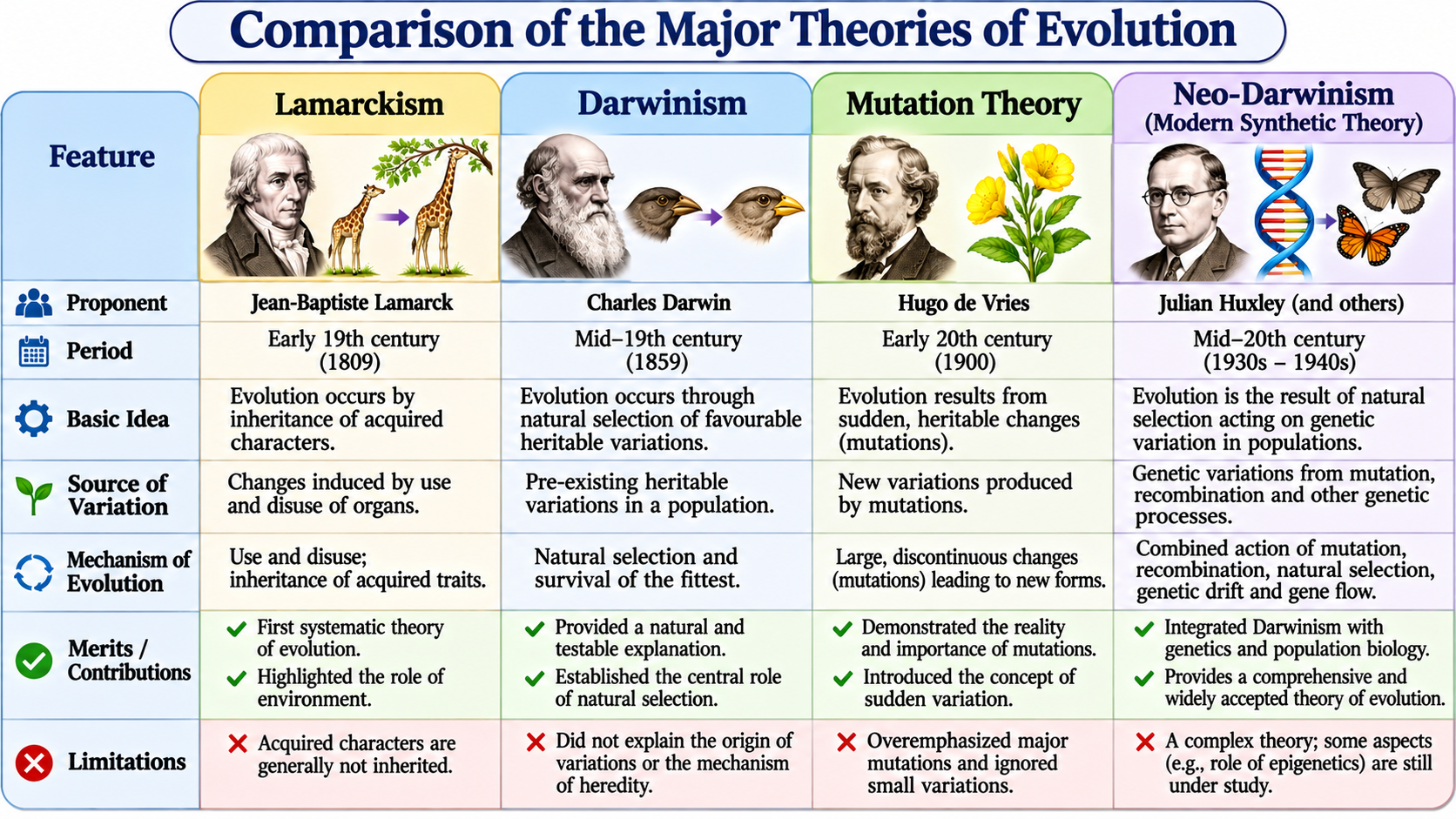
7. Comparison of the Major Theories of Evolution
The different theories of evolution were developed through scientific observations and investigations into the origin, inheritance and diversification of living organisms. Although these theories differ in their explanations of evolutionary mechanisms, each contributed to the historical development of evolutionary biology.
Lamarckism emphasized the influence of environmental conditions and the inheritance of acquired characteristics. Darwinism explained adaptation through natural selection, while Mutation Theory highlighted sudden heritable genetic changes. Neo-Darwinism integrated natural selection with genetics and population biology to provide a more comprehensive explanation of evolutionary change.
7.1 Comparative Table of Evolutionary Theories
| Basis of comparison | Lamarckism | Darwinism | Mutation Theory | Neo-Darwinism |
|---|---|---|---|---|
| Main scientist | Jean-Baptiste Lamarck | Charles Darwin and Alfred Russel Wallace | Hugo de Vries | Fisher, Haldane, Wright, Dobzhansky and others |
| Main concept | Inheritance of acquired characteristics | Natural selection | Sudden heritable mutations | Genetic variation and population-level evolutionary processes |
| Source of variation | Environmental influence, use and disuse | Pre-existing individual variations | Mutations | Mutations and genetic recombination |
| Role of environment | Directly influences the development of characteristics | Selects favourable heritable variations | Influences the survival of mutant forms | Influences selection and evolutionary change |
| Mechanism of evolution | Use and disuse and inheritance of acquired characteristics | Natural selection | Mutations and their inheritance | Mutation, recombination, natural selection, genetic drift and gene flow |
| Nature of evolutionary change | Traditionally described as gradual modification | Gradual accumulation of favourable variations | Emphasized sudden or discontinuous changes | Changes in allele frequencies over generations |
| Heredity | Acquired characteristics were considered inheritable | Mechanism of inheritance was not known | Heritable mutations were emphasized | Explained through Mendelian and population genetics |
| Speciation | Accumulation of acquired changes | Accumulation of variations and divergence | Sudden mutations were considered important | Genetic divergence and reproductive isolation |
| Major limitation | Classical inheritance of acquired anatomical changes lacks general experimental support | Original theory lacked a genetic explanation of inheritance | Overemphasized sudden mutations as an explanation of evolution | Original synthesis did not incorporate every mechanism and discovery recognized by later evolutionary biology |
7.2 Major Differences Between the Theories
7.2.1 Source of Evolutionary Variation
One of the major differences among the theories concerns the origin of variations.
Lamarck emphasized environmental influence and changes associated with the use and disuse of organs. Darwin recognized the existence of individual variations but could not explain their genetic origin.
De Vries emphasized mutations as sources of sudden heritable changes. Neo-Darwinism subsequently incorporated mutations and genetic recombination as important sources of genetic variation.
7.2.2 Role of Natural Selection
Natural selection occupies a central position in Darwinism and Neo-Darwinism.
Darwin proposed that individuals with favourable heritable variations tend to survive and reproduce more successfully under particular environmental conditions.
Neo-Darwinism retained this principle while explaining it through changes in allele frequencies within populations.
In contrast, classical Lamarckism and De Vries’s original Mutation Theory did not assign natural selection the same central explanatory role.
7.2.3 Understanding of Heredity
Lamarck proposed the inheritance of acquired characteristics but lacked a genetic explanation of heredity.
Darwin recognized the importance of inherited variations without knowing the mechanisms responsible for their transmission.
De Vries emphasized the inheritance of mutations, while Neo-Darwinism incorporated Mendelian genetics to explain how genetic characteristics pass between generations.
7.2.4 Explanation of Speciation
The theories also differ in their explanations of the origin of new species.
Lamarck proposed that accumulated acquired modifications could transform organisms over generations. Darwin emphasized gradual divergence through natural selection. De Vries considered sudden mutations important in the production of new forms.
Neo-Darwinism explains speciation through genetic divergence, evolutionary processes and the development of reproductive isolation between populations.
7.3 Evolutionary Significance of the Different Theories
The historical development of evolutionary thought demonstrates how scientific explanations become more comprehensive as new evidence and discoveries emerge.
Lamarck helped establish the idea that organisms are not necessarily fixed and unchanging. Darwin provided a powerful explanation of adaptation through natural selection. De Vries emphasized the importance of mutations in heredity and variation. Neo-Darwinism integrated genetics with natural selection and established a population-level framework for understanding evolution.
Together, these contributions explain the historical progression of evolutionary biology from early proposals of biological transformation to modern genetic explanations of evolutionary change.
8. Modern Developments and Extensions of Evolutionary Theory
The development of evolutionary biology did not stop with the establishment of the Modern Synthetic Theory. Advances in molecular biology, genetics, developmental biology, palaeontology and ecology have expanded scientific understanding of evolutionary processes.
Modern research has revealed that evolutionary change involves interactions among genetic variation, environmental conditions, developmental mechanisms and population-level processes. These discoveries have extended the understanding of evolution and provided new approaches for investigating the diversity of living organisms.
The study of molecular evolution, genetic variation and evolutionary processes also helps explain different patterns and trends in evolution at the molecular, population and organismal levels.
8.1 Neutral Theory of Molecular Evolution
The Neutral Theory of Molecular Evolution was proposed by Japanese geneticist Motoo Kimura in 1968.
According to this theory, a large proportion of evolutionary changes at the molecular level involve mutations that are selectively neutral or nearly neutral. Such mutations do not significantly affect an organism’s survival or reproductive success under particular conditions.
Their frequencies may change through genetic drift, particularly in finite populations.
The theory does not suggest that natural selection is unimportant. Rather, it emphasizes that genetic drift can play a major role in molecular evolution.
Importance:
- Explains the accumulation of many neutral genetic differences.
- Provides a framework for studying molecular evolution.
- Helps scientists investigate evolutionary relationships using DNA and protein sequences.
- Distinguishes neutral molecular changes from changes influenced by natural selection.
8.2 Evolutionary Developmental Biology (Evo-Devo)
Evolutionary developmental biology, commonly called Evo-Devo, investigates the relationship between evolutionary change and the development of organisms.
It studies how changes in developmental genes, gene regulation and developmental pathways contribute to differences in body structures and biological forms.
Developmental regulatory genes, including Hox genes, play important roles in controlling the organization and development of body structures in many animals.
Changes in the expression, regulation or function of developmental genes can contribute to evolutionary modifications.
Importance:
- Explains how developmental changes contribute to morphological evolution.
- Helps identify genetic mechanisms underlying body-plan diversity.
- Provides insights into the evolutionary relationships among organisms.
- Connects developmental biology with evolutionary genetics.
8.3 Epigenetics and Evolution
Epigenetics refers to changes in gene activity that occur without alterations in the underlying DNA sequence.
These changes may involve DNA methylation, histone modifications and other regulatory mechanisms that influence gene expression.
Certain epigenetic modifications can persist through cell divisions, and some may be transmitted across generations.
However, the stability and evolutionary significance of transgenerational epigenetic inheritance vary among organisms and biological conditions.
Importance:
- Provides additional insight into the regulation of gene expression.
- Helps explain certain environmentally influenced biological responses.
- Expands research into inheritance beyond DNA sequence variation.
- May contribute to evolutionary change in particular circumstances.
Epigenetic inheritance does not replace genetic inheritance or establish classical Lamarckism as a general evolutionary mechanism.
8.4 Horizontal Gene Transfer
Horizontal gene transfer refers to the movement of genetic material between organisms through mechanisms other than direct parent-to-offspring inheritance.
It is particularly important in bacteria and archaea.
Major mechanisms include:
- Transformation: Uptake of free DNA from the surrounding environment.
- Transduction: Transfer of genetic material through bacteriophages.
- Conjugation: Transfer of genetic material between cells through direct contact, commonly involving plasmids.
Horizontal gene transfer can spread characteristics such as antibiotic resistance among microbial populations.
It has also influenced the evolutionary history of microorganisms and contributed to genetic innovation.
8.5 Endosymbiotic Theory
The endosymbiotic theory explains the origin of mitochondria and chloroplasts in eukaryotic cells.
According to this theory, certain ancestral eukaryotic cells established permanent symbiotic relationships with bacteria that eventually became organelles.
Mitochondria are considered to have originated from an ancestral alphaproteobacterium-related lineage, while chloroplasts originated from a cyanobacterium-related lineage.
Important evidence supporting this theory includes:
- Mitochondria and chloroplasts contain their own DNA.
- Both organelles possess bacterial-type ribosomes.
- They reproduce through a process resembling binary fission.
- They have double membranes.
- Molecular comparisons support their evolutionary relationships with bacteria.
The endosymbiotic theory demonstrates the importance of symbiosis in the evolutionary history of complex cells.
8.6 Extended Evolutionary Synthesis
The Extended Evolutionary Synthesis is a developing framework that explores whether additional evolutionary processes and forms of inheritance should receive greater emphasis alongside the mechanisms recognized by the Modern Synthesis.
Areas discussed include developmental bias, phenotypic plasticity, niche construction, ecological inheritance and forms of non-genetic inheritance.
Some researchers consider these processes important extensions of evolutionary theory, while others argue that many can be incorporated within the existing evolutionary framework.
Therefore, the Extended Evolutionary Synthesis is best understood as an ongoing scientific discussion rather than a universally accepted replacement for the Modern Synthesis.
8.7 Importance of Modern Developments
Modern developments have expanded the study of evolution by connecting molecular genetics, developmental biology, ecology and palaeontology.
They have helped explain the origin of genetic variation, the evolution of complex cellular structures, the regulation of development, the movement of genes between organisms and the molecular relationships among living species.
Together, these developments provide a broader understanding of evolutionary processes and demonstrate how evolutionary biology continues to advance through new scientific discoveries.
9. Evidences Supporting Evolution
Evolution is supported by a wide range of scientific observations obtained from palaeontology, comparative anatomy, embryology, biogeography, genetics, molecular biology and direct observations of living organisms. These independent lines of evidence demonstrate that organisms have changed over geological time and that different species share common ancestry.
No single piece of evidence explains the entire evolutionary process. Instead, the combined findings from different branches of biology provide a comprehensive understanding of evolutionary history and relationships among organisms.
9.1 Palaeontological Evidence (Fossil Record)
The fossil record provides important evidence of evolutionary changes through geological time. Fossils are preserved remains, impressions or traces of organisms that lived in the past. They occur mainly in sedimentary rocks and provide information about the structure, distribution and geological age of ancient organisms.
The study of fossils reveals that:
- Many organisms that existed in the past are now extinct.
- Different groups of organisms appeared at different geological periods.
- The complexity and diversity of life changed over geological time.
- Some fossils show transitional characteristics between major groups of organisms.
Transitional fossils are particularly important because they exhibit features associated with two different evolutionary groups. They help scientists understand evolutionary relationships and the gradual modification of anatomical structures.
Examples include:
- Archaeopteryx: A Jurassic fossil possessing both reptilian features, such as teeth, a long bony tail and clawed fingers, and avian features, such as feathers and wings. It provides evidence about the evolutionary history of birds and their relationship with theropod dinosaurs.
- Tiktaalik: A Devonian fossil showing a combination of fish-like characteristics and features associated with early tetrapods, including a mobile neck and robust fin bones.
- Horse evolution: Fossils of different horse ancestors demonstrate changes in body size, limb structure, reduction of toes and development of high-crowned teeth over evolutionary time.
The fossil record is incomplete because fossilisation is a rare process and many fossils have been destroyed or remain undiscovered. Nevertheless, it provides an important historical record of evolutionary change.
9.2 Comparative Anatomical Evidence
Comparative anatomy involves the study of similarities and differences in the body structures of different organisms. It provides evidence of evolutionary relationships, common ancestry and adaptation to different environments.
The major anatomical evidences include homologous organs, analogous organs and vestigial organs.
9.2.1 Homologous Organs
Homologous organs are structures that have a similar basic anatomical organisation and evolutionary origin but may perform different functions in different organisms.
For example, the forelimbs of humans, whales, bats and horses contain similar fundamental skeletal elements, including the humerus, radius, ulna, carpals, metacarpals and phalanges.
However, these structures perform different functions:
- Human forelimbs are adapted for grasping and manipulating objects.
- Whale forelimbs are modified into flippers for swimming.
- Bat forelimbs support the elongated digits that form wings for flight.
- Horse forelimbs are adapted for running.
These similarities indicate descent from a common ancestral structure, followed by modification under different environmental conditions.
This evolutionary pattern is known as divergent evolution.
9.2.2 Analogous Organs
Analogous organs are structures that perform similar functions but differ in their basic anatomical organisation and evolutionary origin.
Examples include:
- Wings of birds and insects, both adapted for flight but developed from different structural origins.
- The streamlined swimming structures of sharks and dolphins, which evolved independently in cartilaginous fishes and mammals.
Analogous structures arise through convergent evolution, in which unrelated or distantly related organisms independently develop similar adaptations in response to comparable environmental pressures.
9.2.3 Vestigial Organs
Vestigial organs are reduced structures that have lost all or most of their original functions during the course of evolution. They are generally interpreted as remnants of structures that were functional in ancestral organisms.
Examples include:
- Vermiform appendix in humans.
- Coccyx or tailbone in humans.
- Pelvic bones in certain whales.
- Reduced hindlimb remnants in some snakes, such as pythons and boas.
- Reduced eyes in certain cave-dwelling animals.
Vestigial structures provide evidence of evolutionary modification and ancestral relationships. However, a vestigial structure may retain a reduced or modified function; therefore, vestigial does not necessarily mean completely functionless.
9.3 Embryological Evidence
Comparative embryology examines similarities and differences in the development of embryos belonging to different organisms.
Early vertebrate embryos show several common developmental features, including:
- A notochord.
- A dorsal hollow nerve cord.
- Pharyngeal arches or pouches.
- A post-anal tail.
These features are associated with the basic chordate body plan and indicate shared developmental ancestry.
For example, embryos of fishes, amphibians, reptiles, birds and mammals show similarities during early developmental stages, although they become increasingly different as development proceeds.
The similarities do not mean that the embryo of one living vertebrate passes through the adult stages of other vertebrates. Instead, they reflect the inheritance of conserved developmental mechanisms from common ancestors.
Comparative embryology therefore supports evolutionary relationships among vertebrate groups.
9.4 Biogeographical Evidence
Biogeography is the study of the geographical distribution of organisms across the Earth. The distribution of living and extinct species provides important evidence for evolution, common ancestry, geographical isolation and adaptation.
Several biogeographical observations support evolution:
1. Geographic isolation: Populations separated by geographical barriers, such as oceans, mountains or deserts, may evolve independently over generations. This can result in the formation of distinct species.
2. Island endemism: Islands frequently contain species that are found nowhere else. Their unique organisms often show relationships with species from nearby mainland regions, suggesting colonisation followed by independent evolution.
3. Continental distribution: The distribution of fossils and living organisms across continents provides evidence of historical connections between landmasses and the effects of continental drift.
4. Adaptive radiation: A common ancestral group may diversify into several species adapted to different ecological niches.
A well-known example is Darwin’s finches of the Galápagos Islands. Different finch species possess different beak shapes and sizes associated with their feeding habits. Their diversity illustrates adaptive radiation from ancestral populations.
9.5 Molecular and Biochemical Evidence
Molecular biology provides powerful evidence of evolutionary relationships through the comparison of DNA, RNA and protein sequences.
All known cellular organisms use DNA as their principal hereditary material and share fundamental features of the genetic code and protein synthesis machinery. These similarities indicate deep evolutionary relationships among living organisms.
Important molecular evidences include:
1. Similarity in DNA sequences: Closely related organisms generally possess greater similarity in their DNA sequences than distantly related organisms. Comparisons of genes help scientists reconstruct evolutionary relationships.
2. Protein sequence similarities: Proteins such as cytochrome c and haemoglobin can be compared among different species. Differences in their amino acid sequences provide information about evolutionary divergence.
3. Universal genetic code: The genetic code is nearly universal across cellular organisms, supporting the idea of common ancestry.
4. Molecular phylogeny: Comparisons of DNA and protein sequences are used to construct phylogenetic trees, which represent inferred evolutionary relationships among organisms.
5. Conserved genes: Certain genes involved in essential cellular processes are conserved across widely separated groups of organisms. Their similarities provide evidence of ancient common ancestry.
Molecular evidence is particularly valuable because it allows evolutionary relationships to be investigated even when organisms have few obvious anatomical similarities or when fossil evidence is limited.
9.6 Direct Observation of Evolution
Evolution is not merely a historical process inferred from fossils and anatomical similarities. Evolutionary changes can also be observed in living populations over relatively short periods.
Examples include:
1. Antibiotic resistance in bacteria: Bacterial populations may contain genetic variations that provide resistance to particular antibiotics. When an antibiotic is used, susceptible bacteria are eliminated more readily, while resistant bacteria survive and reproduce. Over generations, resistance can become more common in the population.
2. Insecticide resistance: Some insect populations develop resistance to insecticides because individuals carrying resistance-associated genetic variations survive treatment and reproduce.
3. Industrial melanism: The peppered moth (Biston betularia) in Britain provides a classical example of changes in the frequency of colour variants associated with environmental conditions and predation. Dark-coloured forms became more common in many industrial areas during periods of heavy pollution, while lighter forms increased again in some regions following improvements in air quality.
4. Experimental evolution: Long-term laboratory experiments with microorganisms, such as Richard Lenski’s long-term evolution experiment using Escherichia coli, have demonstrated measurable evolutionary changes across successive generations.
These examples demonstrate that natural selection and other evolutionary mechanisms can produce changes in populations over observable periods.
9.7 Evidence from Artificial Selection
Artificial selection is the process by which humans select and breed organisms possessing desirable inherited characteristics.
It demonstrates that inherited variation within populations can be modified across generations through differential reproduction.
Examples include:
- Development of different dog breeds from ancestral populations of domestic dogs.
- Selective breeding of cattle for milk or meat production.
- Development of crop varieties with improved yield, disease resistance or other desirable characteristics.
- Selective breeding of pigeons for differences in body shape, feather colour and other traits.
Artificial selection differs from natural selection because humans determine which organisms reproduce. However, both processes act on inherited variation and can change the characteristics of populations over generations.
9.8 Summary of the Major Evidences
| Evidence | Main observation | Evolutionary significance |
|---|---|---|
| Fossil record | Organisms changed through geological time | Shows evolutionary history and extinct forms |
| Homologous organs | Similar basic structures with different functions | Supports common ancestry and divergent evolution |
| Analogous organs | Similar functions with different structural origins | Demonstrates convergent evolution |
| Vestigial organs | Reduced or modified ancestral structures | Indicates evolutionary modification |
| Embryology | Similarities in early developmental patterns | Supports shared ancestry |
| Biogeography | Geographic patterns in species distribution | Explains isolation, adaptation and diversification |
| Molecular biology | Similarities in DNA, RNA and proteins | Reveals genetic relationships and common ancestry |
| Direct observation | Changes in populations across generations | Demonstrates evolution occurring today |
| Artificial selection | Human-directed changes in inherited traits | Demonstrates the effects of selection |
Together, these evidences establish evolution as a central principle of modern biology. They also demonstrate why evolutionary explanations are supported by multiple independent scientific disciplines rather than by a single observation.
10. Significance and Applications of Evolutionary Theory
Evolutionary theory provides a unifying framework for understanding the diversity, relationships and adaptations of living organisms. It explains how populations change over generations, how new species arise and how the different groups of organisms are connected through common ancestry.
The significance of evolutionary theory extends beyond understanding the history of life. It has practical applications in medicine, agriculture, conservation biology, biotechnology and the study of biodiversity.
Understanding trends in evolution helps researchers interpret long-term biological changes and understand how organisms respond to changing environmental conditions.
10.1 Understanding the Diversity of Life
Evolution explains the enormous diversity of organisms found on Earth. Differences in body structure, physiology, behaviour and ecological adaptations have developed through evolutionary changes over millions of years.
The theory of common descent explains why organisms belonging to different groups share certain fundamental characteristics while also possessing specialised features.
For example, vertebrates share a common basic body organisation, but their limbs, respiratory organs and reproductive structures have become modified according to their environments and modes of life.
10.2 Understanding Adaptation
Evolutionary theory explains how populations become adapted to their environments through natural selection and other evolutionary mechanisms.
Adaptations are inherited characteristics that improve an organism’s ability to survive and reproduce under particular environmental conditions.
Examples include:
- Thick fur and a layer of body fat in polar mammals for insulation.
- Webbed feet in aquatic birds for efficient swimming.
- Different beak shapes in finches associated with different feeding habits.
- Water-conserving adaptations in desert plants.
Adaptations develop across generations through evolutionary processes rather than because individual organisms consciously acquire the characteristics they need.
10.3 Applications in Medicine
Evolutionary principles are important in understanding the emergence and spread of infectious diseases and the development of resistance to antimicrobial drugs.
Antibiotic resistance: Bacteria can evolve resistance when genetic variations allow some individuals to survive antibiotic treatment and reproduce. Understanding this process helps researchers develop strategies to reduce the spread of resistant microorganisms.
Viral evolution: Viruses accumulate genetic changes over time. These changes may influence their transmissibility, host interactions and antigenic properties. Evolutionary analysis helps scientists monitor emerging viral variants.
Evolution of pathogens: Studying the evolutionary relationships of pathogens helps researchers investigate their origins, transmission patterns and diversification.
Cancer evolution: Cancer cells can acquire genetic changes that produce different cell populations within a tumour. Natural selection among these populations can contribute to tumour progression and resistance to treatment.
10.4 Applications in Agriculture and Animal Breeding
Evolutionary principles are widely used in crop improvement, livestock breeding and pest management.
- Crop improvement: Plant breeders select inherited variations associated with higher yield, improved nutritional quality, drought tolerance and disease resistance.
- Animal breeding: Selective breeding is used to improve desirable characteristics in livestock, including milk production, meat quality and disease resistance.
- Pest management: Knowledge of insecticide resistance helps develop more effective pest-control strategies and reduce the rapid evolution of resistant populations.
- Conservation of genetic diversity: Maintaining genetic variation in crop plants and livestock helps populations respond to changing environmental conditions and emerging diseases.
10.5 Applications in Conservation Biology
Evolutionary theory helps conservation scientists understand how species respond to environmental changes, habitat fragmentation and population decline.
Its applications include:
- Conservation of genetic diversity: Genetic variation is essential for the long-term survival and adaptive potential of populations.
- Management of endangered species: Evolutionary relationships and population structure help identify distinct conservation units.
- Understanding speciation: Knowledge of evolutionary processes helps explain how populations become genetically and reproductively isolated.
- Restoration of ecosystems: Evolutionary relationships among organisms help guide the selection and management of species in ecological restoration programmes.
- Climate change adaptation: Studying genetic variation and evolutionary responses helps predict whether populations may adapt to changing environmental conditions.
10.6 Applications in Biotechnology and Molecular Biology
Evolutionary principles are used in several modern biotechnological methods.
Directed evolution: Scientists introduce genetic variation into genes or proteins and select variants with desirable properties. Repeated rounds of mutation and selection can produce enzymes or proteins with improved characteristics.
Comparative genomics: Comparing the genomes of different organisms helps identify conserved genes, evolutionary relationships and genes associated with particular biological functions.
Phylogenetic analysis: DNA and protein sequence comparisons are used to reconstruct evolutionary relationships among organisms, including microorganisms and pathogens.
Protein engineering: Evolutionary information can help researchers identify important amino acid positions and design proteins with improved stability, activity or specificity.
10.7 Understanding Human Evolution
Evolutionary theory provides the scientific framework for understanding the origin and diversification of humans.
Comparative anatomy, fossil discoveries, archaeological evidence and molecular genetics have helped reconstruct important stages of human evolutionary history.
Studies of human evolution investigate:
- The evolutionary relationships between humans and other primates.
- The development of bipedal locomotion.
- Changes in brain size and cranial structure.
- The evolution of tool use and complex behaviour.
- The migration and diversification of ancient human populations.
Modern humans (Homo sapiens) share common ancestry with other living primates, although humans did not evolve from any of the present-day monkey or ape species.
11. Conclusion
The study of the Theories of Evolution explains how scientific understanding of the origin, diversification and modification of living organisms has developed over time. Early evolutionary ideas, particularly Lamarckism, introduced the concept that species are not necessarily fixed and may change in response to environmental conditions. Darwinism provided a powerful explanation through natural selection, while Hugo de Vries highlighted the importance of mutations in evolutionary change.
The development of Neo-Darwinism, or the Modern Synthetic Theory of Evolution, integrated natural selection with Mendelian genetics, population genetics and other biological disciplines. It established that evolution involves changes in the genetic composition of populations through mutation, recombination, natural selection, genetic drift and gene flow.
Modern discoveries in molecular biology, genomics, developmental biology and palaeontology have further expanded our understanding of evolutionary processes. Evidence from fossils, comparative anatomy, embryology, biogeography and molecular genetics strongly supports common ancestry and evolutionary relationships among organisms.
Thus, evolution is not explained by a single mechanism or historical theory. It is a complex and continuing biological process that accounts for the unity, diversity and adaptations of life on Earth. The Theories of Evolution remain fundamental to modern biology because they provide a scientific framework for understanding both the history of life and the ongoing changes occurring in living populations.
12. References
- OpenStax. (2018). Biology 2e – Chapter 18: Evolution and the Origin of Species. Rice University.
https://openstax.org/books/biology-2e/pages/18-1-understanding-evolution - OpenStax. (2018). Biology 2e – Chapter 19: The Evolution of Populations. Rice University.
https://openstax.org/books/biology-2e/pages/19-introduction - Darwin, C. (1859). On the Origin of Species by Means of Natural Selection, or the Preservation of Favoured Races in the Struggle for Life. John Murray, London.
https://darwin-online.org.uk/content/contentblock?basepage=1&itemID=F373&viewtype=text - Lamarck, J. B. (1809). Philosophie Zoologique. Dentu, Paris.
https://fr.wikisource.org/wiki/Philosophie_zoologique_(1809) - de Vries, H. (1901–1903). Die Mutationstheorie: Versuche und Beobachtungen über die Entstehung von Arten im Pflanzenreich. Veit & Comp., Leipzig.
https://www.biodiversitylibrary.org/item/43179 - Smithsonian Institution. Evidence of Evolution – Human Origins Program.
https://humanorigins.si.edu/evidence - Smithsonian Institution. Introduction to Human Evolution.
https://humanorigins.si.edu/education/introduction-human-evolution - OpenStax. (2018). Biology 2e – 19.1 Population Evolution. Rice University.
https://openstax.org/books/biology-2e/pages/19-1-population-evolution - OpenStax. (2018). Biology 2e – 19.2 Population Genetics. Rice University.
https://openstax.org/books/biology-2e/pages/19-2-population-genetics
What are the major theories of evolution?
What is Lamarckism?
What is Darwinism?
What is the difference between Lamarckism and Darwinism?
What is Mutation Theory of Evolution?
Who proposed Mutation Theory?
What is Neo-Darwinism?
What are the main mechanisms of Neo-Darwinism?
Which theory of evolution is accepted by modern science?
What are the major evidences supporting evolution?
What is the role of mutations in evolution?
Why are the theories of evolution important?
Discover more from Zoologyverse
Subscribe to get the latest posts sent to your email.