
Exponential vs Logistic Population Growth is an important topic in population ecology because it explains how populations increase under different environmental conditions. Exponential population growth produces a J-shaped growth curve, while logistic population growth slows near carrying capacity, and both are core population growth models in ecology.
Population growth depends on factors such as birth rate, death rate, resource availability, competition, and environmental resistance. Understanding these factors helps ecologists predict population changes and interpret the dynamics of natural communities.
Exponential population growth occurs when resources are sufficiently abundant and limiting factors have little effect on population growth. Under these conditions, the population increases at a rate proportional to its existing size, producing a characteristic J-shaped growth curve.
In contrast, logistic population growth describes a situation in which population growth slows as resources become limited and environmental resistance increases. The population may eventually fluctuate around the carrying capacity, which is the maximum population size an environment can sustain over time under particular conditions. Logistic growth typically produces an S-shaped curve.
Studying exponential vs logistic population growth helps explain why populations may increase rapidly under favourable conditions but experience slower growth as they approach environmental limits. These models are also useful in wildlife conservation, pest management, fisheries, and the sustainable management of natural resources.
Definition of Population Growth
Population growth refers to the change in the number of individuals in a population over a specific period. In ecology, a population consists of individuals of the same species living in a particular area at a given time.
Population size changes through four main processes: births, deaths, immigration, and emigration. Births and immigration increase population size, whereas deaths and emigration decrease it.
The basic relationship is:
Population change = (Births + Immigration) − (Deaths + Emigration)
When births and immigration exceed deaths and emigration, the population increases. When deaths and emigration exceed births and immigration, the population decreases. If these processes balance one another, population size remains relatively stable.
Population Growth Rate
The population growth rate describes how quickly a population increases or decreases over time. It can be expressed as the change in population size per unit time or, when comparing populations of different sizes, as a per capita growth rate.
For a population in which births and deaths are the only processes considered, the per capita growth rate is commonly represented as:
r = b − d
Where:
- r = Per capita population growth rate
- b = Per capita birth rate
- d = Per capita death rate
If (r) is positive, the population grows; if (r) is negative, the population declines; and if (r) is zero, population size remains constant under the stated assumptions.
Major Population Growth Models
Ecologists commonly use two basic models to describe population growth:
- Exponential population growth: Population size increases at a rate proportional to the number of individuals when limiting factors are negligible.
- Logistic population growth: Population growth slows as density-dependent limitations become stronger and the population approaches the environment’s carrying capacity.
These models provide a foundation for understanding population dynamics and comparing how populations respond to resource availability and environmental resistance.
Exponential Population Growth
Exponential population growth occurs when a population increases at a rate proportional to its current size, assuming that the per capita growth rate remains constant. This model is most applicable when resources are abundant and environmental limitations have little effect on population growth.
In the study of Exponential vs Logistic Population Growth, exponential population growth represents the situation in which a population can grow without the density-dependent restrictions included in the logistic model.
During exponential growth, each individual contributes to population increase according to a constant per capita growth rate. As the population becomes larger, the total number of individuals added per unit time also increases.
Characteristics of Exponential Population Growth
- Abundant resources: Food, water, space, and other essential resources are assumed to be sufficiently available.
- Constant per capita growth rate: The difference between per capita birth and death rates remains constant.
- Rapid increase in population size: The total number of individuals added per unit time increases as the population grows.
- J-shaped growth curve: When population size is plotted against time, the curve rises increasingly steeply.
- No carrying-capacity limit in the basic model: The model does not include an upper population limit imposed by resource availability.
- Idealised conditions: It assumes that environmental conditions remain suitable and that limiting factors do not substantially reduce the growth rate.
Examples of Exponential Population Growth
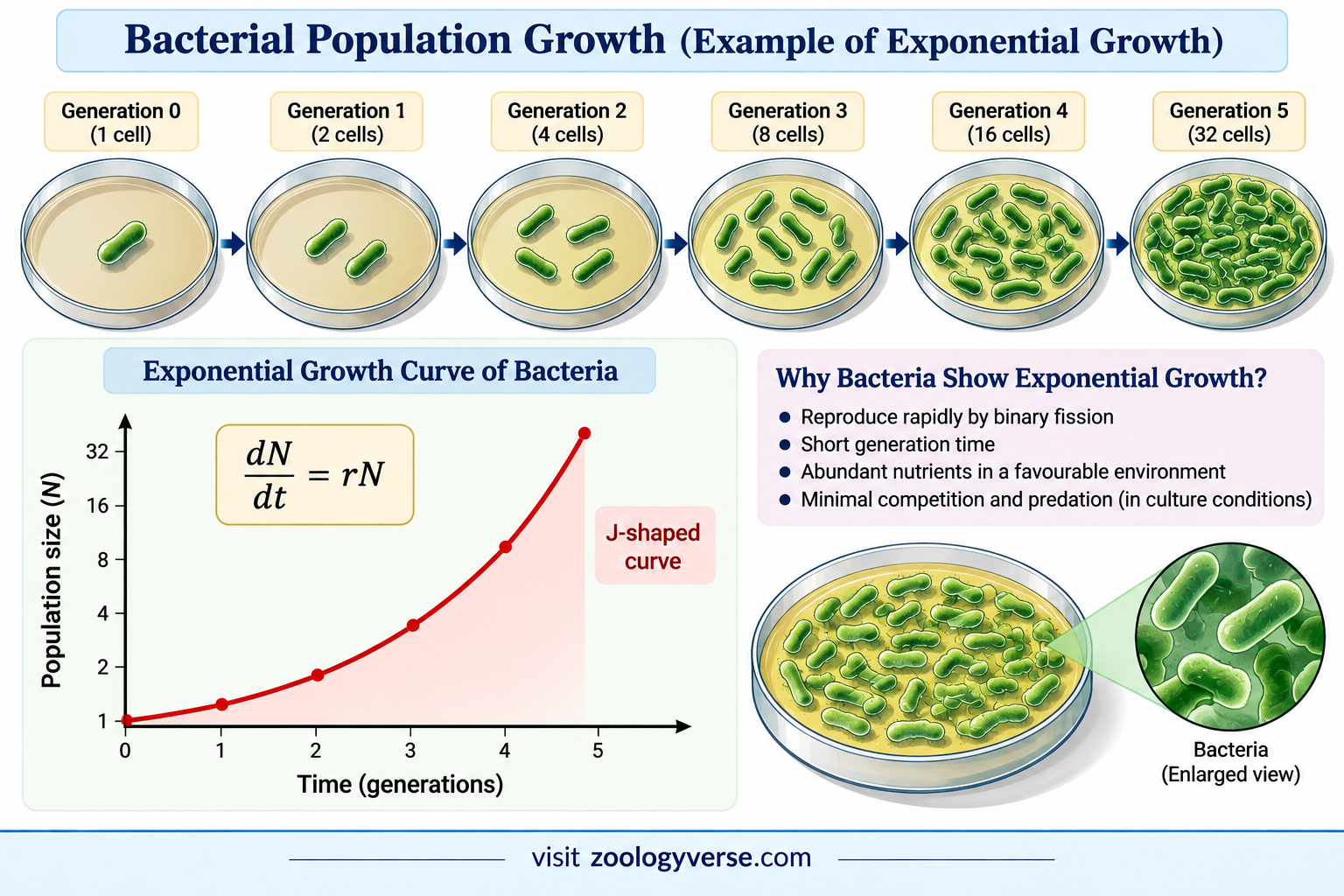
- Bacterial populations: Bacteria can multiply rapidly when nutrients, temperature, and other conditions are favourable, particularly during the early phase of growth.
- Introduced species: A species entering a suitable habitat with abundant resources and few natural enemies may initially show rapid population increase.
- Seasonal insect populations: Some insects may experience rapid growth when food is plentiful and environmental conditions favour survival and reproduction.
- Populations recovering from low numbers: Under favourable conditions, a small population may grow rapidly if reproductive rates are high and mortality is low.
These examples are not necessarily exponential indefinitely. In natural environments, food shortages, competition, disease, predation, and other limiting factors eventually change population growth rates.
Exponential population growth is therefore a useful model for understanding rapid population increase under favourable conditions, although its assumptions are rarely maintained over long periods in nature.
Exponential Growth Equation and the J-Shaped Curve
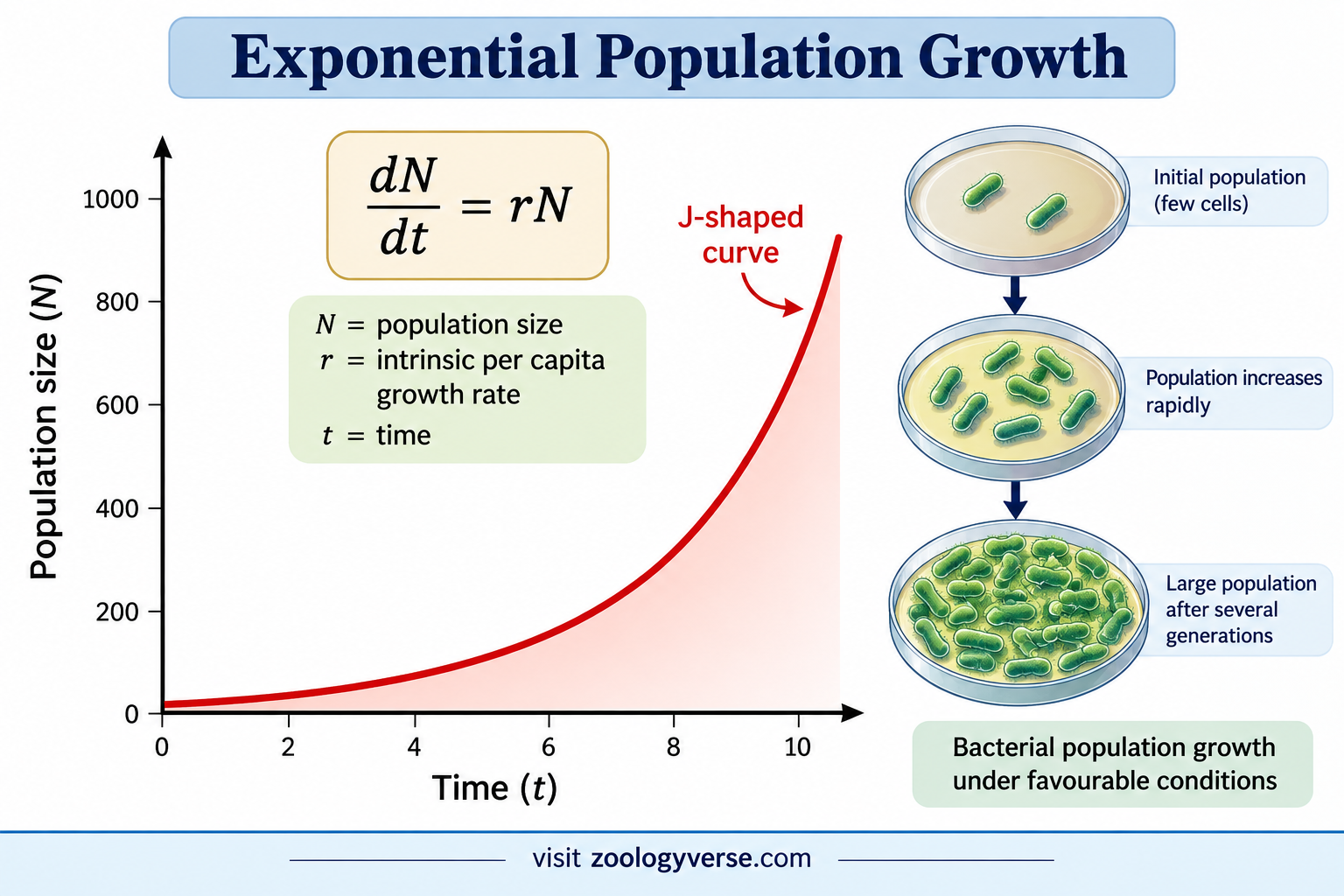
Exponential population growth occurs when a population increases at a rate proportional to its existing size. When resources are abundant and environmental conditions are favourable, individuals can reproduce without major limitations, allowing the population to grow rapidly over time. In the study of Exponential vs Logistic Population Growth, the exponential model produces the J-shaped growth curve and represents growth under ideal or resource-unlimited conditions.
1. Exponential Growth Equation
The differential equation for exponential population growth is:
dN/dt = rN
Where:
- dN/dt = Rate of change in population size over time
- N = Population size at a given time
- r = Intrinsic per capita growth rate
- t = Time
When the birth rate exceeds the death rate, the value of r is positive and the population increases. When the birth rate equals the death rate, r is zero and the population remains approximately stable under the simplified model. When the death rate exceeds the birth rate, r is negative and the population declines.
The integrated form of the exponential growth equation is:
N(t) = N₀eʳᵗ
Where:
- N(t) = Population size after time t
- N₀ = Initial population size
- e = Mathematical constant approximately equal to 2.718
- r = Intrinsic per capita growth rate
- t = Time elapsed
This equation shows that population size increases exponentially when the intrinsic growth rate remains positive and constant.
2. Numerical Example of Exponential Growth
Suppose a bacterial population initially contains 100 individuals and grows continuously at a rate of 0.2 per unit of time.
Using the equation:
N(t) = N₀eʳᵗ
After five time units:
N(5) = 100 × e⁽⁰·² × ⁵⁾
N(5) = 100 × e¹
N(5) ≈ 272 individuals
Thus, the population increases from 100 to approximately 272 individuals, assuming ideal conditions and a constant growth rate.
3. J-Shaped Growth Curve
The exponential growth curve is called a J-shaped growth curve because its shape resembles the letter J. Initially, population growth may be slow because the population is small. As the population becomes larger, the number of individuals added per unit of time increases, producing a steep upward curve.
Characteristics of the J-shaped growth curve:
- Population size increases exponentially under favourable conditions.
- The growth rate depends on the existing population size.
- Resources are assumed to be sufficiently available.
- Environmental resistance is assumed to have little or no limiting effect during the period considered.
- The curve rises sharply as the population becomes larger.
4. Examples of Exponential Population Growth
- Bacterial populations: Bacteria may multiply rapidly when nutrients, moisture and temperature are favourable.
- Newly introduced species: A species entering a suitable habitat may initially increase rapidly when resources are plentiful and natural enemies are limited.
- Populations recovering after disturbance: Some populations may show rapid growth when competition or other limiting factors temporarily decrease.
However, exponential growth cannot usually continue indefinitely in natural ecosystems. Food shortages, competition, predation, disease and other environmental limitations eventually restrict population growth.
Key point: Exponential population growth is an idealised model that explains rapid population increase under favourable conditions. It provides a useful basis for understanding the difference between exponential and logistic population growth.
Logistic Population Growth
Logistic population growth is a model that describes how a population grows when resources are limited and environmental resistance increases as population size rises. Unlike exponential growth, logistic growth does not continue indefinitely. Instead, the population growth rate gradually decreases as the population approaches the carrying capacity of its environment.
In the study of Exponential vs Logistic Population Growth, the logistic model is important because it represents population growth under conditions where food, space, water and other essential resources impose limitations.
1. Definition of Logistic Population Growth
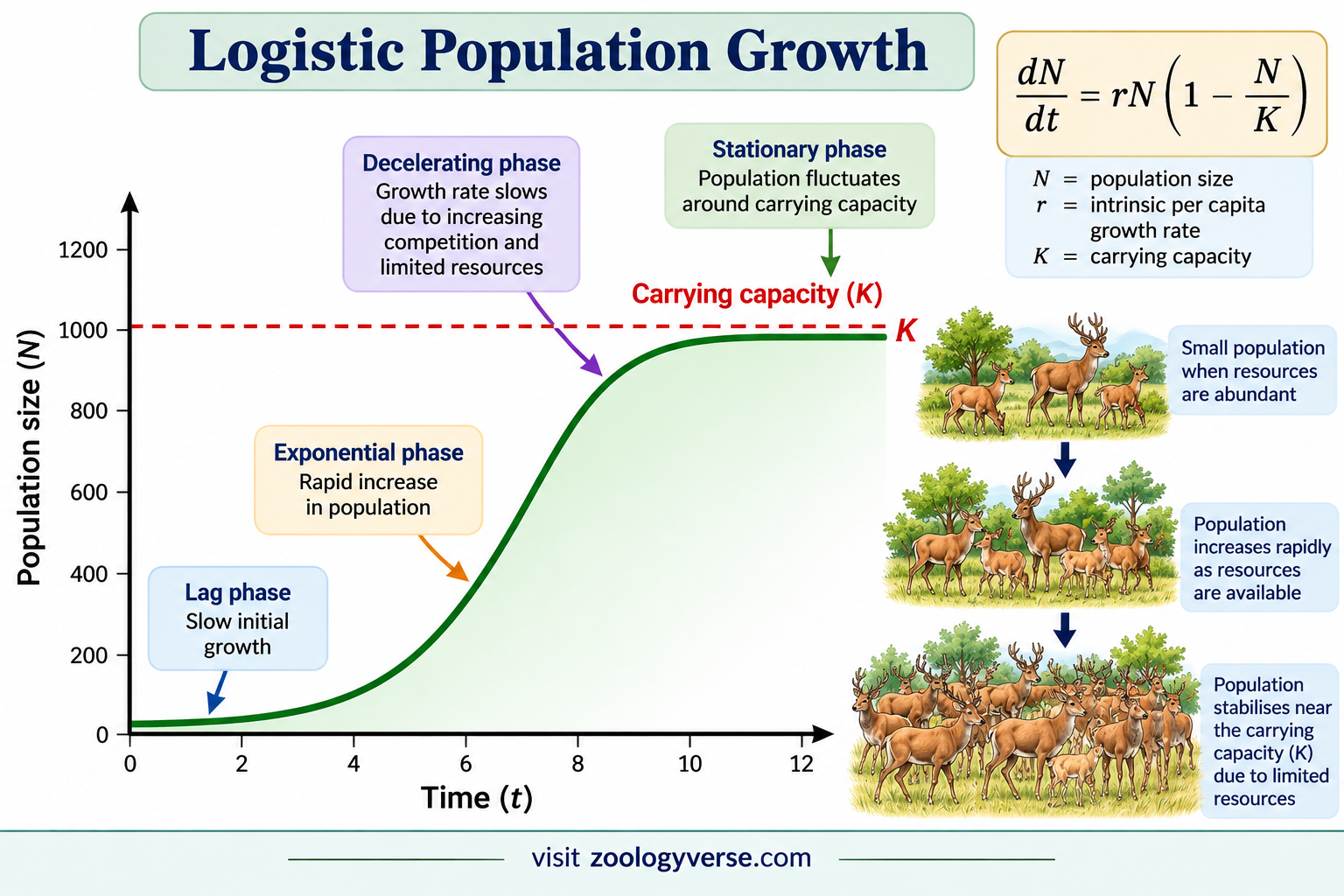
Logistic population growth is the pattern in which a population initially grows rapidly, but its growth rate decreases as population density increases. Eventually, the population may stabilise around the carrying capacity of the environment.
This model is commonly associated with the Belgian mathematician Pierre François Verhulst, who introduced the logistic growth model in the nineteenth century.
2. Characteristics of Logistic Population Growth
The major characteristics of logistic population growth are:
- Initial slow growth: Population growth may begin slowly when the number of individuals is small.
- Rapid population increase: Growth accelerates when resources are readily available and the population increases.
- Declining growth rate: Competition and other density-dependent factors become more influential as population density increases.
- Environmental resistance: Limited food, space, water and other resources restrict further population growth.
- Carrying capacity: The population approaches the maximum size that the environment can sustain under prevailing conditions.
- S-shaped growth curve: The curve rises, gradually slows and eventually levels off near carrying capacity.
3. Phases of Logistic Population Growth
Logistic population growth can be divided into the following phases:
Phase I: Initial or lag phase
The population is relatively small, so the total increase in individuals may be limited. Growth gradually accelerates as the population becomes established.
Phase II: Exponential phase
Resources are still sufficiently available, allowing the population to increase rapidly. During this phase, the population may temporarily grow in a manner similar to exponential growth.
Phase III: Decelerating phase
As population density increases, competition for resources becomes stronger. The rate of population growth decreases because environmental resistance increases.
Phase IV: Stationary or equilibrium phase
The population approaches the carrying capacity of its environment. Under stable conditions, births and immigration may approximately balance deaths and emigration, resulting in little net population change.
These phases describe the typical pattern of logistic growth. Real populations may fluctuate around carrying capacity rather than remain perfectly stable.
4. Examples of Logistic Population Growth
- Deer in a restricted habitat: A deer population may initially increase when food and space are abundant, but competition can limit further growth as the habitat becomes crowded.
- Yeast populations in a closed culture: Yeast may multiply rapidly at first, but nutrient depletion and waste accumulation can slow growth.
- Animal populations in protected reserves: Populations may increase after protection improves survival, but food availability, habitat size and other ecological factors can limit their long-term growth.
5. Importance of Logistic Population Growth
The logistic model helps ecologists understand how populations respond to limited resources. It is useful in wildlife management, conservation planning, fisheries management and the study of competition within ecosystems.
It also demonstrates that the relationship between population size and environmental resources is central to population regulation.
Key point: Logistic population growth describes population increase under environmental limitations. Its characteristic S-shaped curve illustrates how growth slows as the population approaches carrying capacity.
Logistic Growth Equation and the S-Shaped Curve
The logistic growth equation explains how a population grows when resources are limited and environmental resistance increases with population density. Unlike exponential growth, logistic growth accounts for the carrying capacity of the environment.
Understanding this equation is essential when comparing Exponential vs Logistic Population Growth, because it shows mathematically why population growth slows as population size approaches the environmental limit.
1. Logistic Growth Equation
The differential equation for logistic population growth is:
dN/dt = rN (1 − N/K)
Where:
- dN/dt = Rate of change in population size over time
- N = Population size at a given time
- r = Intrinsic per capita growth rate
- K = Carrying capacity of the environment
- (1 − N/K) = Factor representing the effect of population size relative to carrying capacity
The equation contains two important components:
- rN: Represents the potential for population growth under favourable conditions.
- (1 − N/K): Represents the reduction in growth caused by limited resources and increasing environmental resistance.
When the population is small compared with carrying capacity, the limiting effect is relatively weak. As population size approaches K, the limiting factor becomes stronger and the growth rate decreases.
2. Understanding the Logistic Equation
The behaviour of the logistic equation changes according to population size.
When N is much smaller than K: The value of (1 − N/K) is close to 1. Population growth can therefore be rapid and may resemble exponential growth.
When N approaches K: The value of (1 − N/K) approaches zero. Population growth slows because resources and other environmental factors increasingly restrict population increase.
When N equals K: The growth rate becomes zero under the model, because (1 − N/K) equals zero. The population remains at carrying capacity if conditions remain constant.
If population size exceeds K, the model predicts a negative growth rate, causing the population to decline towards carrying capacity.
3. S-Shaped Growth Curve
The logistic growth curve is known as the S-shaped curve or sigmoid curve because it resembles the letter S. It represents population growth that begins slowly, accelerates, and then gradually slows as environmental limitations become stronger.
The curve typically has three broad stages:
- Initial phase: Population size is small, and total population increase is relatively slow.
- Rapid growth phase: Population growth accelerates as the population becomes established and resources remain available.
- Deceleration and plateau phase: Growth slows as the population approaches carrying capacity, producing a relatively stable upper portion of the curve.
The population does not necessarily remain perfectly constant at carrying capacity in nature. Changes in climate, food availability, disease, predation and habitat conditions may cause fluctuations.
4. Carrying Capacity and Population Regulation
Carrying capacity, represented by K, is the population size that an environment can sustain over time under particular ecological conditions.
It depends on factors such as:
- Availability of food and water
- Suitable habitat and shelter
- Space for reproduction and survival
- Competition within and between species
- Predation and disease
- Environmental conditions and seasonal changes
Carrying capacity is not always fixed. For example, an improvement in food availability may increase the number of animals a habitat can support, whereas drought or habitat destruction may reduce it.
5. Example of Logistic Population Growth
Suppose a grassland can sustainably support approximately 500 deer under its current environmental conditions. If the deer population initially contains 50 individuals, it may grow rapidly while food and space are abundant.
As the population increases, competition for vegetation, water and shelter becomes stronger. The growth rate gradually decreases as the population approaches 500 deer.
In this simplified example, the population may eventually stabilise near the carrying capacity, provided environmental conditions remain relatively stable.
Key point: The logistic growth equation incorporates carrying capacity to explain why population growth slows under limited resources. Its S-shaped curve is a fundamental model in population ecology.
Carrying Capacity in Ecology
Carrying capacity is a fundamental concept in population ecology that describes the ability of an environment to support a population over time. It is represented by the letter K in the logistic population growth equation.
When studying Exponential vs Logistic Population Growth, carrying capacity explains why a population cannot continue increasing indefinitely in a habitat with limited resources. As population size increases, competition and other environmental pressures may reduce the rate of population growth.
1. Definition of Carrying Capacity
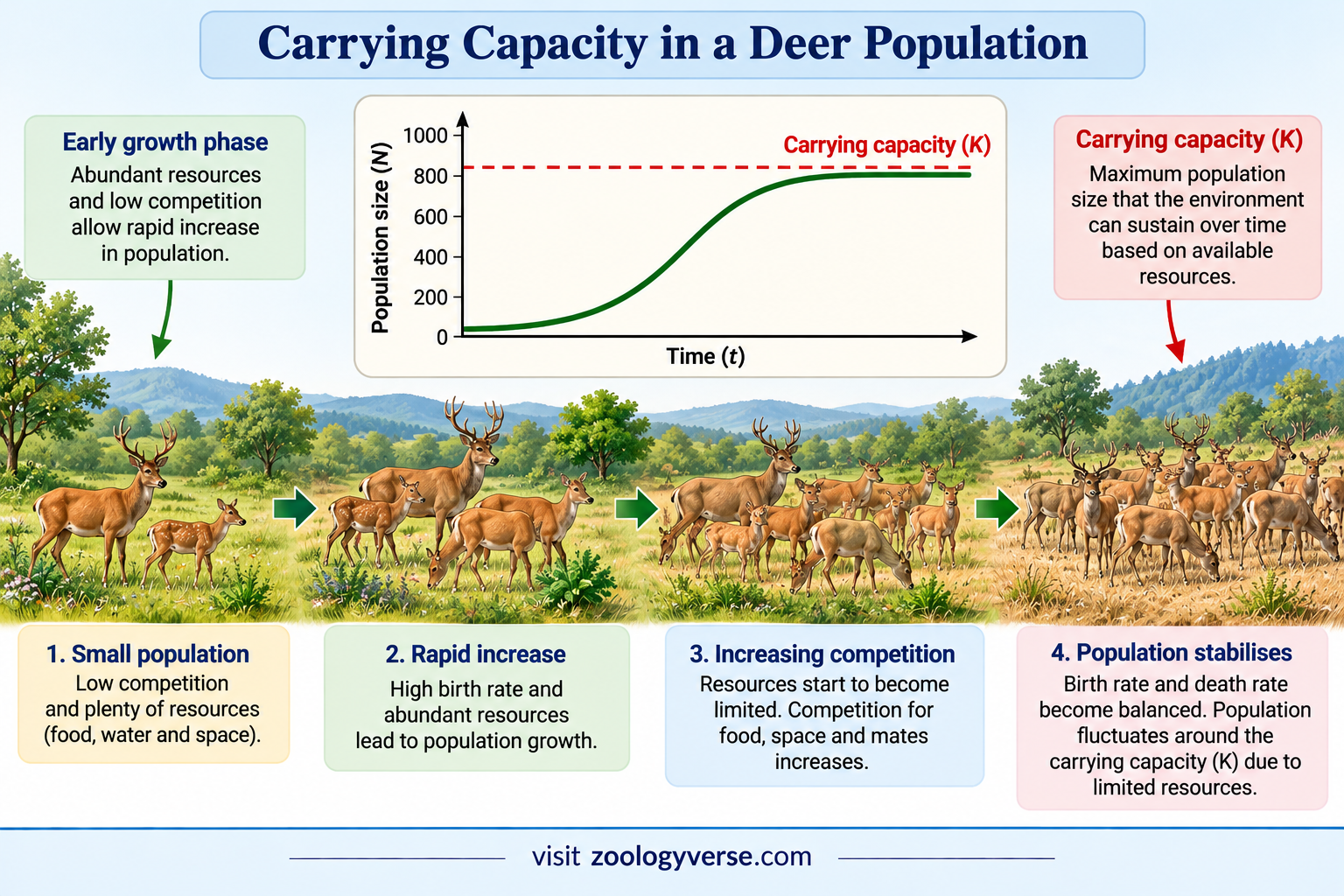
Carrying capacity is the population size that an environment can sustain over a given period under particular environmental conditions, considering the available resources and ecological limitations.
For example, a grassland may support a certain number of deer based on the availability of vegetation, water, shelter and suitable space. If the deer population exceeds the habitat’s capacity, competition may increase, and survival or reproduction may decline.
Carrying capacity is not necessarily constant. It can change with climate, seasonal food availability, habitat quality and human activities.
2. Factors Affecting Carrying Capacity
Several biotic and abiotic factors determine the carrying capacity of an environment.
A. Food availability
Food is essential for growth, reproduction and survival. A shortage of food may reduce reproductive success and increase mortality, lowering the population an environment can sustain.
B. Water availability
Water availability affects the distribution and abundance of terrestrial animals and plants. Drought can reduce the carrying capacity of grasslands and other habitats.
C. Space and shelter
Organisms require suitable space for feeding, nesting, breeding and protection. Habitat loss and overcrowding may reduce the number of individuals that can survive successfully.
D. Competition
As population density increases, individuals may compete more intensely for food, mates, nesting sites and other resources. Competition can restrict population growth.
E. Predation and disease
Predators may limit prey populations, while infectious diseases can spread more readily under some high-density conditions. These factors can influence the size of a population supported by a habitat.
F. Climate and environmental conditions
Temperature, rainfall, soil quality and natural disturbances can affect resource availability and survival. For example, prolonged drought may reduce vegetation and the carrying capacity of a grassland.
G. Human activities
Deforestation, pollution, hunting and urbanisation may reduce carrying capacity by degrading habitats. Conversely, habitat restoration and responsible conservation can improve environmental conditions.
3. Relationship Between Carrying Capacity and Logistic Growth
Carrying capacity is central to the logistic population growth model.
- When population size is far below K, resources may be sufficiently available for rapid growth.
- As population size increases towards K, competition and other limiting factors become more influential.
- When population size reaches K, the model predicts zero net population growth.
- When population size exceeds K, the model predicts a decline towards K, assuming stable conditions and the model’s other assumptions hold.
In the logistic equation, this relationship is expressed as:
dN/dt = rN (1 − N/K)
The term (1 − N/K) represents how the population’s proximity to carrying capacity reduces its potential growth rate.
4. Examples of Carrying Capacity in Nature
Deer in a forest: The number of deer a forest can support depends on vegetation, water, shelter and available habitat. If deer numbers increase beyond sustainable levels, food shortages may become more severe.
Fish in a lake: A lake can support only a limited fish population based on food organisms, dissolved oxygen, water quality and habitat. Pollution or oxygen depletion may lower its carrying capacity.
Plants in a grassland: Plant growth is affected by soil nutrients, moisture, sunlight and space. Competition for these resources can limit plant abundance.
Microorganisms in a culture vessel: Bacteria may initially multiply rapidly, but nutrient depletion and the accumulation of waste products can eventually restrict population growth.
5. Why Is Carrying Capacity Important?
Carrying capacity helps ecologists understand population regulation and the effects of resource limitations. It is useful for:
- Managing wildlife populations and protected areas.
- Establishing sustainable harvesting limits for fisheries.
- Assessing the ecological effects of habitat destruction.
- Understanding competition and density-dependent regulation.
- Planning conservation strategies and habitat restoration.
However, carrying capacity should be treated as an estimate that depends on environmental conditions, rather than an unchanging numerical limit.
Key point: Carrying capacity (K) represents the population size an environment can sustain under specified conditions. It is the central limiting factor that distinguishes the logistic model from the idealised exponential growth model.
Exponential vs Logistic Population Growth: Differences
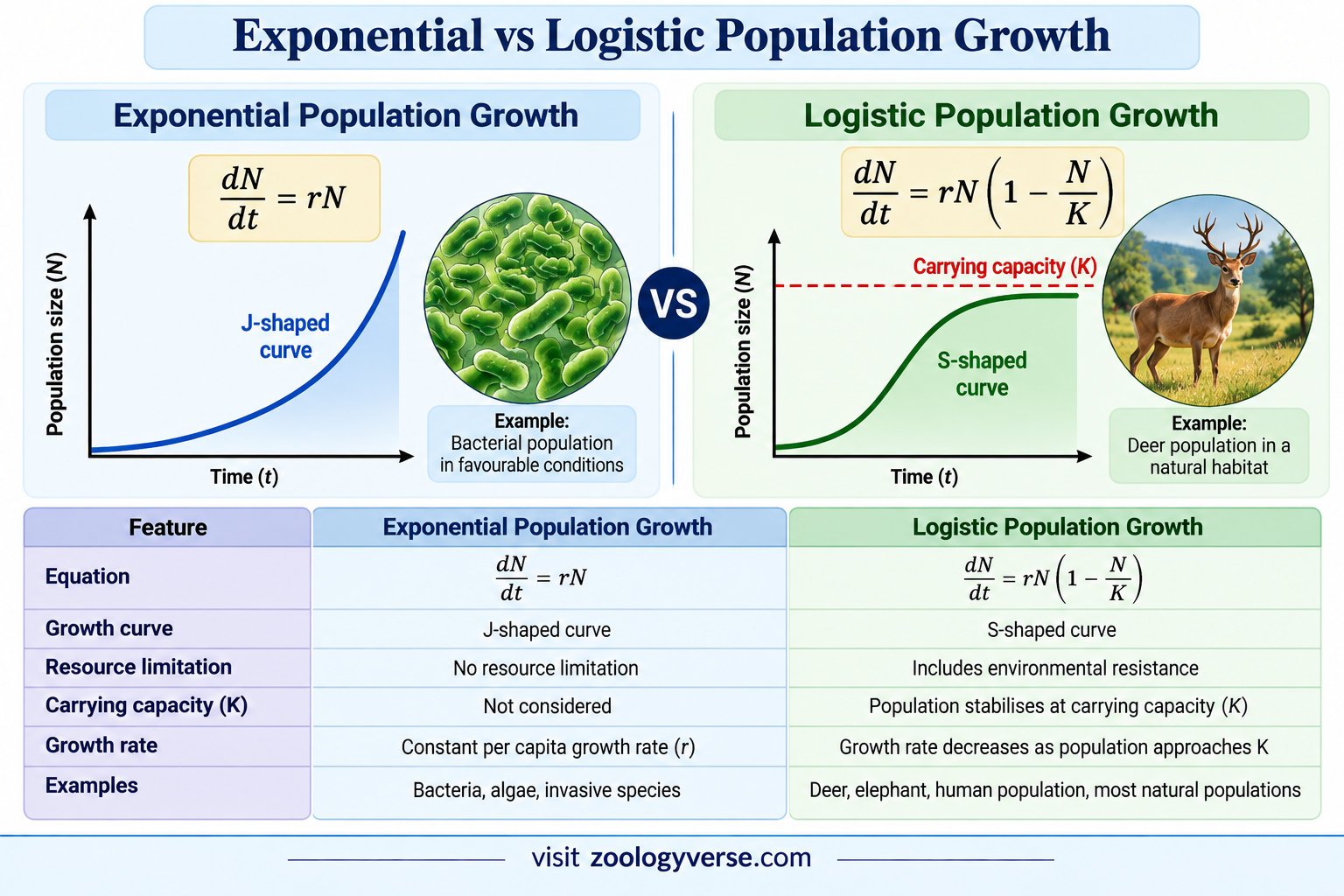
In the exponential vs logistic population growth comparison, the two models explain changes in population size over time. Both describe how populations increase, but they differ in their assumptions about resource availability, environmental resistance and carrying capacity.
The main difference in Exponential vs Logistic Population Growth is that exponential growth assumes ideal conditions with no density-related limitation on growth, whereas logistic growth accounts for limited resources and the carrying capacity of the environment.
Comparison Table: Exponential vs Logistic Population Growth
| Basis of Comparison | Exponential Population Growth | Logistic Population Growth |
|---|---|---|
| Definition | Population grows at a rate proportional to its existing size under idealised conditions. | Population growth slows as environmental limitations become stronger. |
| Resource availability | Assumes resources are sufficiently available. | Accounts for limited resources. |
| Environmental resistance | Assumed to be negligible or absent in the model. | Increases as population size rises relative to carrying capacity. |
| Growth rate | Increases in absolute terms as population size increases, provided the per capita rate remains constant. | Initially increases, then decreases as the population approaches carrying capacity. |
| Growth equation | dN/dt = rN | dN/dt = rN (1 − N/K) |
| Growth curve | J-shaped curve | S-shaped or sigmoid curve |
| Carrying capacity | Not included in the basic model. | Explicitly included as K. |
| Population density | Density-related limitations are not included in the basic model. | Density-dependent limitations influence growth. |
| Long-term pattern | Predicts continued increase when the growth rate remains positive. | Predicts growth slowing towards carrying capacity under stable conditions. |
| Natural occurrence | May approximate short periods of rapid growth under favourable conditions. | May approximate populations regulated by resource limitations. |
| Example | Rapid bacterial multiplication in a nutrient-rich environment during early growth. | A deer population approaching the sustainable capacity of its habitat. |
| Main limitation | Does not account for resource limitations and other factors that eventually restrict growth. | Simplifies complex ecological processes and assumes a relatively stable carrying capacity. |
Key Differences Explained
1. Growth pattern
Exponential growth produces a J-shaped curve because the population continues to increase rapidly when the per capita growth rate remains positive. Logistic growth produces an S-shaped curve because the rate of increase eventually slows.
2. Role of resources
The exponential model assumes that resources do not limit growth during the period being considered. The logistic model accounts for resource limitations and increasing competition as population density rises.
3. Carrying capacity
Carrying capacity is absent from the basic exponential growth equation. In logistic growth, K represents the population size the environment can sustain under specified conditions.
4. Ecological significance
The exponential model helps explain rapid population increases under favourable conditions. The logistic model helps explain how environmental resistance regulates population growth.
Similarities Between Exponential and Logistic Population Growth
Despite their differences, both models share several features:
- Both describe changes in population size over time.
- Both use the population size and a growth-rate parameter.
- Both can be used to study population dynamics in ecology.
- Both are mathematical models that simplify real ecological systems.
- Both assume conditions that may not remain constant in natural populations.
In exponential vs logistic population growth, exponential population growth describes idealised, unrestricted increase and the J-shaped growth curve, whereas logistic population growth incorporates environmental limitations and carrying capacity. Comparing these population growth models helps ecologists understand both rapid population expansion and the regulation of populations in nature.
Factors Affecting Population Growth
Population growth is influenced by several biological and environmental factors that determine how quickly a population increases, decreases or remains stable. Although exponential and logistic models describe different growth patterns, actual populations are affected by the combined effects of reproduction, mortality, migration and environmental conditions.
Understanding these factors is essential when studying Exponential vs Logistic Population Growth, because they explain why some populations grow rapidly while others experience slow growth or approach the carrying capacity of their habitat.
Population growth is influenced by several biotic and abiotic factors, including food availability, competition, temperature and water supply.
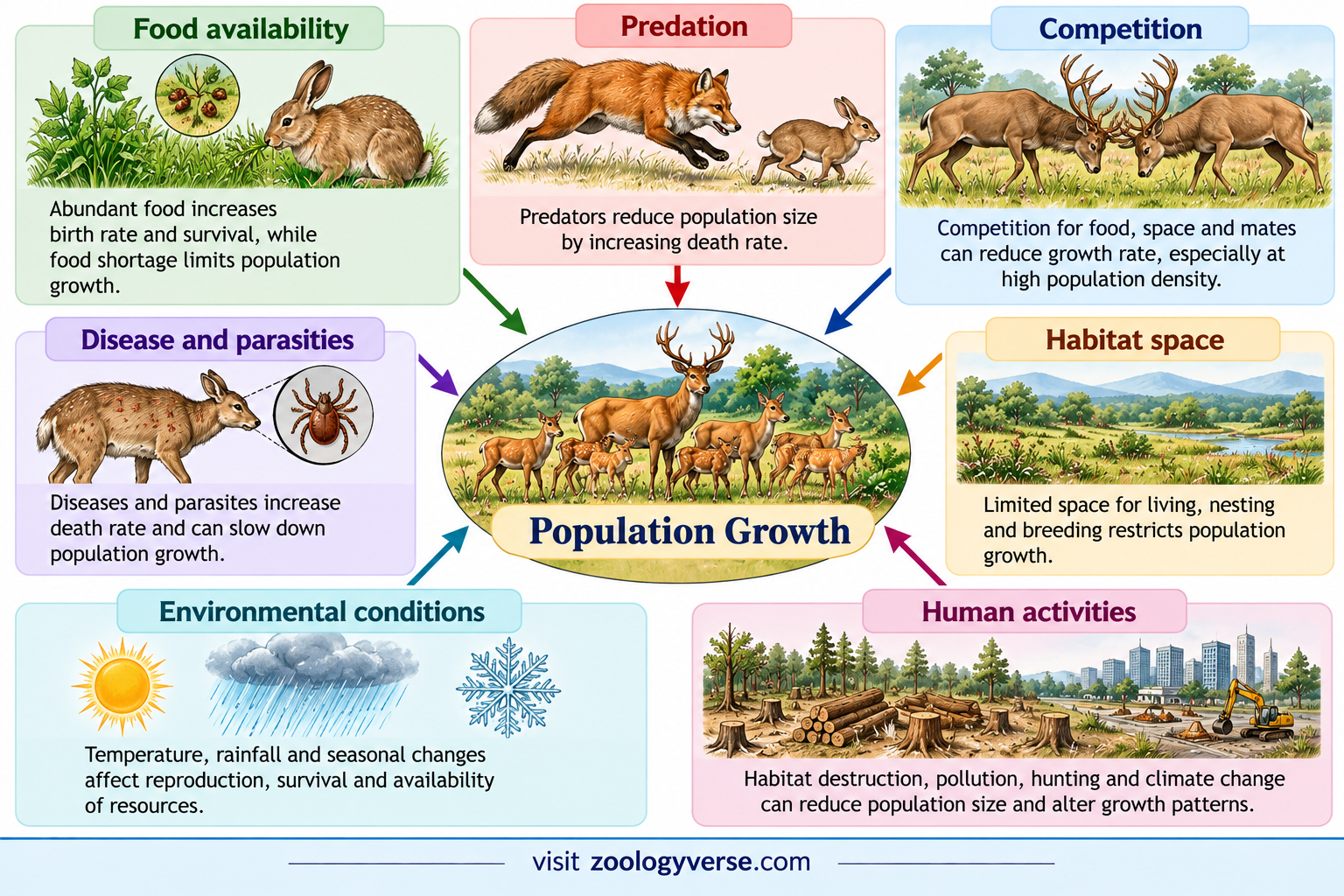
1. Birth Rate (Natality)
Natality refers to the production of new individuals through reproduction within a population.
A high birth rate generally increases population size, provided other factors remain unchanged. Species with short generation times and high reproductive rates, such as many insects and bacteria, may increase rapidly under favourable conditions.
For example, bacteria can multiply quickly when sufficient nutrients, moisture and suitable temperatures are available.
2. Death Rate (Mortality)
Mortality refers to the death of individuals in a population over a given period.
A high death rate reduces population size, whereas a low death rate can contribute to population growth. Mortality may increase because of disease, predation, starvation, extreme weather and old age.
For example, a prolonged drought may increase mortality among herbivores by reducing the availability of food and water.
3. Immigration and Emigration
Migration affects population size when individuals move into or out of a population.
- Immigration: The movement of individuals into a population, increasing its size.
- Emigration: The movement of individuals out of a population, decreasing its size.
For example, birds may immigrate into an area during a season when food is abundant and emigrate when environmental conditions become less favourable.
Population change can be represented as:
Population change = Births + Immigration − Deaths − Emigration
This simplified relationship describes the numerical change in population size over a specified period.
4. Availability of Resources
Food, water, nutrients, shelter and space are essential for the survival and reproduction of organisms.
When resources are abundant, populations may grow rapidly. As resources become scarce, competition increases and reproductive success or survival may decline.
Resource availability is especially important in logistic population growth because it contributes to the environmental limits represented by carrying capacity.
5. Competition
Competition occurs when organisms require the same limited resources.
Intraspecific competition occurs between individuals of the same species, whereas interspecific competition occurs between individuals of different species.
As population density increases, competition for food, territory, nesting sites and mates may become stronger. This can slow population growth and contribute to population regulation.
6. Predation
Predation occurs when one organism captures and consumes another organism.
Predators can influence prey population size by increasing mortality. Changes in prey abundance may also affect predator populations, creating interactions that influence population dynamics.
However, predation does not always reduce population growth to the same extent; its effects depend on the species involved and the ecological conditions.
7. Disease and Parasitism
Diseases and parasites can reduce survival, reproductive success and population growth. Their effects may become more pronounced in dense populations when contact between individuals increases transmission.
For example, an infectious disease may spread through a crowded animal population and cause a temporary decline in its size.
8. Climatic and Abiotic Factors
Abiotic factors are non-living components of the environment that affect organism survival and reproduction.
Important examples include:
- Temperature
- Rainfall and water availability
- Light intensity
- Soil quality and nutrient availability
- Dissolved oxygen in aquatic habitats
- Natural disturbances such as floods, droughts and fires
Extreme environmental conditions may reduce population size or prevent reproduction, while favourable conditions may support population expansion.
9. Habitat Quality and Human Activities
Habitat quality influences the availability of food, shelter, breeding sites and other essential resources.
Deforestation, pollution, urbanisation and overexploitation may reduce population size by destroying habitats or increasing mortality. Conservation measures, habitat restoration and effective wildlife protection may improve survival and allow populations to recover.
10. Density-Dependent and Density-Independent Factors
Population-regulating factors can also be classified according to whether their effects depend on population density.
Density-dependent factors have effects that often become stronger as population density increases. Examples include competition, some infectious diseases and resource depletion.
Density-independent factors can affect populations regardless of their density. Examples include severe storms, floods, fires and extreme temperature events, although the actual impact may still vary among populations.
How These Factors Influence Exponential and Logistic Growth
Under favourable conditions, high reproductive rates and abundant resources may allow a population to show approximately exponential growth for a limited period.
As population density increases, competition, resource shortages and other limiting factors may reduce the growth rate. This pattern is represented by the logistic model, in which the population approaches carrying capacity.
Key point: Population growth is determined by the balance between births, deaths and migration, together with the influence of biotic and abiotic environmental factors. These influences help explain why real populations rarely maintain unrestricted exponential growth indefinitely.
Examples of Exponential and Logistic Population Growth in Nature
Population growth models help ecologists understand how populations respond to favourable conditions, resource availability and environmental limitations. In exponential vs logistic population growth, the two patterns are represented by different mathematical equations, but natural populations may shift between these patterns as environmental conditions change.
Changes in environmental conditions during ecological succession can influence resource availability and the growth of populations over time.
The examples below illustrate how Exponential vs Logistic Population Growth can be observed in microorganisms, animals and other organisms.
1. Examples of Exponential Population Growth
Exponential growth may occur when resources are abundant and limiting factors have little effect on population growth over a particular period.
A. Bacterial growth in a nutrient-rich medium
Bacteria can reproduce rapidly by binary fission when nutrients, moisture and temperature are favourable. During the early phase of growth in a suitable culture medium, the population may increase approximately exponentially.
However, exponential growth does not continue indefinitely in a closed culture. Nutrient depletion, waste accumulation and other environmental changes eventually slow growth.
B. Invasive species in a newly colonised habitat
An introduced species may initially increase rapidly if the new habitat provides abundant resources and relatively few predators or competitors. Under these conditions, population growth may temporarily approximate the exponential model.
As the species becomes established, competition, disease and other environmental limitations may slow its growth.
C. Population recovery after a disturbance
A population may recover rapidly after a disturbance reduces competition or when conditions become favourable again. If survival and reproduction are high and resources are plentiful, the recovering population may show approximately exponential growth for a limited period.
D. Rapid multiplication of yeast
Yeast populations can increase quickly when suitable nutrients, moisture and temperature are available. During a period of abundant resources, their growth may approximate exponential growth before environmental limitations become significant.
2. Examples of Logistic Population Growth
Logistic growth may occur when a population initially increases rapidly but later experiences stronger resource limitations.
A. Deer population in a forest
A deer population may grow when food and suitable habitat are abundant. As deer numbers increase, competition for vegetation, water and shelter may become stronger. If environmental conditions remain relatively stable, the population may approach the carrying capacity of the forest.
B. Fish population in a lake
A lake provides fish with food, oxygen and suitable breeding habitats. When fish numbers increase, competition for food and space may intensify. Water quality, oxygen availability and habitat conditions can limit the population that the lake supports.
C. Yeast growth in a closed culture
Yeast may initially multiply rapidly in a culture vessel. As nutrients become depleted and waste products accumulate, growth slows. This pattern can resemble logistic growth, although real microbial growth curves may differ from the ideal S-shaped model.
D. Plant populations in a restricted habitat
Plants compete for sunlight, water, nutrients and space. As the number or density of plants increases, competition may limit the establishment and survival of additional individuals. Under suitable conditions, this may produce a pattern resembling logistic population growth.
3. Comparison of Examples
| Feature | Exponential Growth | Logistic Growth |
|---|---|---|
| Typical situation | Initial growth when resources are abundant | Growth under increasing resource limitations |
| Population pattern | Rapid increase without a built-in upper limit | Increase followed by slowing growth |
| Environmental resistance | Assumed to be negligible in the model | Incorporated into the model |
| Carrying capacity | Not included | Included as K |
| Example | Early bacterial multiplication in a nutrient-rich medium | A deer population approaching the sustainable capacity of its habitat |
4. Do Natural Populations Always Follow These Models?
No. Exponential and logistic growth are simplified mathematical models rather than exact descriptions of every natural population.
Real populations may fluctuate because of seasonal reproduction, migration, predation, disease, changing climate and unpredictable disturbances. Some populations may overshoot carrying capacity and then decline, while others may show irregular or cyclic patterns.
Furthermore, carrying capacity can change over time as food availability, habitat quality and environmental conditions change.
Key point: Exponential growth is useful for understanding rapid population increase under favourable conditions, while logistic growth explains how population growth may slow as environmental limitations become stronger. Natural populations may approximate either model for a period without following it perfectly.
Ecological Importance of Population Growth Models
Population growth models are important tools in ecology because they help explain how populations change over time and how organisms respond to environmental conditions. Exponential and logistic growth models provide a foundation for understanding population dynamics, resource limitations and the regulation of populations in ecosystems.
The study of Exponential vs Logistic Population Growth is particularly useful because it explains both the potential for rapid population increase and the environmental factors that restrict unlimited growth.
Population changes can alter feeding relationships, which are represented by food chains and food webs.
Changes in population size can affect energy flow in ecosystems and the feeding relationships between organisms.
1. Understanding Population Dynamics
Population growth models help ecologists understand whether a population is increasing, decreasing or approaching a relatively stable size.
By examining population growth rates, scientists can investigate how reproduction, mortality, immigration and emigration influence changes in population size.
2. Explaining Resource Limitations
The logistic growth model demonstrates how limited food, water, shelter and space can restrict population growth.
As population density increases, competition and other environmental pressures may become stronger. Understanding these limitations helps explain why populations cannot usually increase indefinitely in a finite habitat.
The availability of energy and nutrients influences primary productivity and the resources available to organisms within an ecosystem.
3. Estimating Carrying Capacity
The logistic model introduces carrying capacity (K), which represents the population size an environment can sustain under specified conditions.
Estimating carrying capacity can help wildlife managers assess habitat suitability, plan conservation measures and evaluate whether a population is placing excessive pressure on available resources.
However, carrying capacity estimates may change with climate, habitat quality and resource availability.
4. Wildlife Conservation and Management
Population growth models help conservation biologists evaluate the status of threatened and endangered species.
They can support decisions about habitat restoration, captive breeding, reintroduction programmes and wildlife population monitoring. Understanding population growth also helps identify populations that may be vulnerable to environmental changes or excessive mortality.
5. Sustainable Fisheries and Natural Resource Management
Fisheries managers use population data and growth models to assess how fish populations respond to harvesting and environmental changes.
Although exponential and logistic models alone cannot determine a sustainable catch, they provide useful background for understanding population growth, resource limitations and the need to maintain breeding populations.
6. Understanding Invasive Species
Invasive species may initially increase rapidly when they enter a suitable habitat with abundant resources and few limiting factors.
Exponential growth provides a useful model for understanding this early expansion. As the population becomes established, competition and other environmental pressures may slow growth.
These models help researchers study invasion patterns and evaluate possible management strategies.
7. Studying Population Regulation
Population regulation refers to the processes that influence population size over time.
The logistic model illustrates how density-dependent factors, such as competition for resources, can reduce population growth as population density increases. Density-independent factors, including severe droughts and storms, can also affect population size, although they are not explicitly represented in the basic logistic equation.
8. Predicting Population Trends
Mathematical models allow ecologists to explore possible future population trends under specified assumptions.
For example, researchers can investigate how changes in reproductive rates, mortality or resource availability might influence population size. Such predictions are useful for planning, but their accuracy depends on the quality of the data and whether the model’s assumptions remain appropriate.
9. Understanding Ecosystem Stability
Population changes can influence food webs, competition, predator–prey relationships and resource use.
A rapid increase in herbivores, for example, may place additional pressure on vegetation. A decline in prey populations may affect predators that depend on them. Population growth models help ecologists investigate these relationships and their consequences for ecosystem functioning
Exponential vs logistic population growth models are fundamental to population ecology. The exponential model explains idealised rapid growth, whereas the logistic model incorporates environmental limitations and carrying capacity. Together, they provide a valuable foundation for studying population regulation, conservation biology, wildlife management and ecosystem dynamics.
Frequently Asked Questions (FAQs)
What is the difference between exponential and logistic population growth?
What is the equation for exponential population growth?
dN/dt = rN
The integrated form is:
N(t) = N₀eʳᵗ
Here, N is population size, r is the intrinsic per capita growth rate, t is time, and N₀ is the initial population size.
What is the equation for logistic population growth?
dN/dt = rN (1 − N/K)
Here, N represents population size, r is the intrinsic per capita growth rate, and K is the carrying capacity of the environment.
Why is exponential population growth represented by a J-shaped curve?
Why is logistic population growth represented by an S-shaped curve?
What is carrying capacity in ecology?
Which model is more realistic for natural populations?
Can exponential growth continue indefinitely?
What are examples of exponential population growth?
What are examples of logistic population growth?
What is the difference between r and K in population ecology?
Why are population growth models important in ecology?
Conclusion
Exponential and logistic population growth are two fundamental models used to understand population dynamics in ecology. Exponential population growth describes rapid population increase under idealised conditions when resources do not limit growth, producing a J-shaped curve. In contrast, logistic population growth incorporates environmental resistance and carrying capacity, producing an S-shaped curve as population growth slows.
Understanding Exponential vs Logistic Population Growth helps explain how reproductive rates, resource availability, competition and environmental conditions influence population size. Although these models simplify complex ecological processes, they provide a valuable foundation for studying population regulation, wildlife conservation, sustainable resource management and ecosystem dynamics.
In natural ecosystems, populations do not always follow either model precisely. Changes in climate, disease, predation, migration and habitat quality can cause population sizes to fluctuate. Therefore, these models are best used alongside ecological observations and population data to understand real-world population trends.
References
The following reliable educational resources provide further information on exponential population growth, logistic population growth, carrying capacity and population regulation.
- OpenStax. Biology 2e: Environmental Limits to Population Growth.
https://openstax.org/books/biology-2e/pages/45-3-environmental-limits-to-population-growth - OpenStax. Concepts of Biology: Population Growth and Regulation.
https://openstax.org/books/concepts-biology/pages/19-2-population-growth-and-regulation - OpenStax. Biology 2e: Population Dynamics and Regulation.
https://openstax.org/books/biology-2e/pages/45-4-population-dynamics-and-regulation - Khan Academy. Exponential and Logistic Growth.
https://www.khanacademy.org/science/biology/ecology/population-ecology/a/exponential-logistic-growth - OpenStax. Calculus Volume 2: The Logistic Equation.
https://openstax.org/books/calculus-volume-2/pages/4-4-the-logistic-equation
Discover more from Zoologyverse
Subscribe to get the latest posts sent to your email.