
Types of Giraffe: An Overview
The main types of giraffe are the Northern giraffe, Reticulated giraffe, Masai giraffe, and Southern giraffe. These giraffe species are mainly found in different regions of Africa.
Giraffes are the tallest living land animals and are easily recognized by their long necks, long legs, and unique coat patterns. Although all giraffes belong to the same genus, modern research recognizes four giraffe species. Each species has its own geographic range, coat pattern, and smaller taxonomic groups.
How many species of giraffe are there?
If you are wondering how many types of giraffe species are there, the currently recognized classification includes four species:
- Northern giraffe (Giraffa camelopardalis)
- Reticulated giraffe (Giraffa reticulata)
- Masai giraffe (Giraffa tippelskirchi)
- Southern giraffe (Giraffa giraffa)
These 4 species of giraffe can be distinguished mainly by their geographic distribution and coat patterns. Some species are further divided into subspecies.
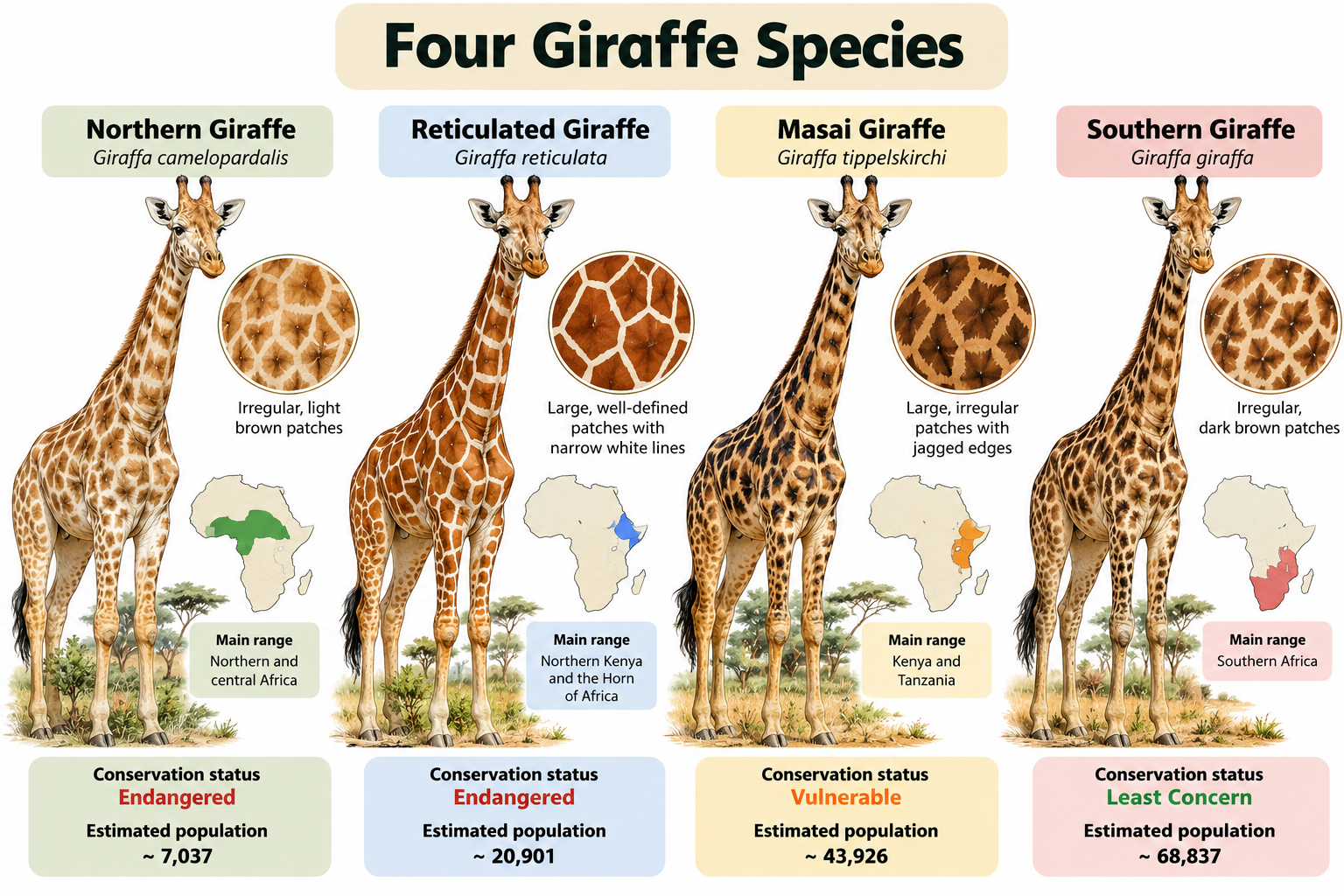
Giraffe species and subspecies
The classification of giraffes has changed over time. Older sources commonly treated all giraffes as one species, Giraffa camelopardalis, with several subspecies.
Genetic and morphological studies have provided evidence for recognizing four separate species.
The different types of giraffe do not all have the same distribution.
For example, Northern giraffes occur mainly in parts of northern and central Africa, while Southern giraffes are found mainly in southern Africa. Reticulated and Masai giraffes also have their own distinct geographic ranges.
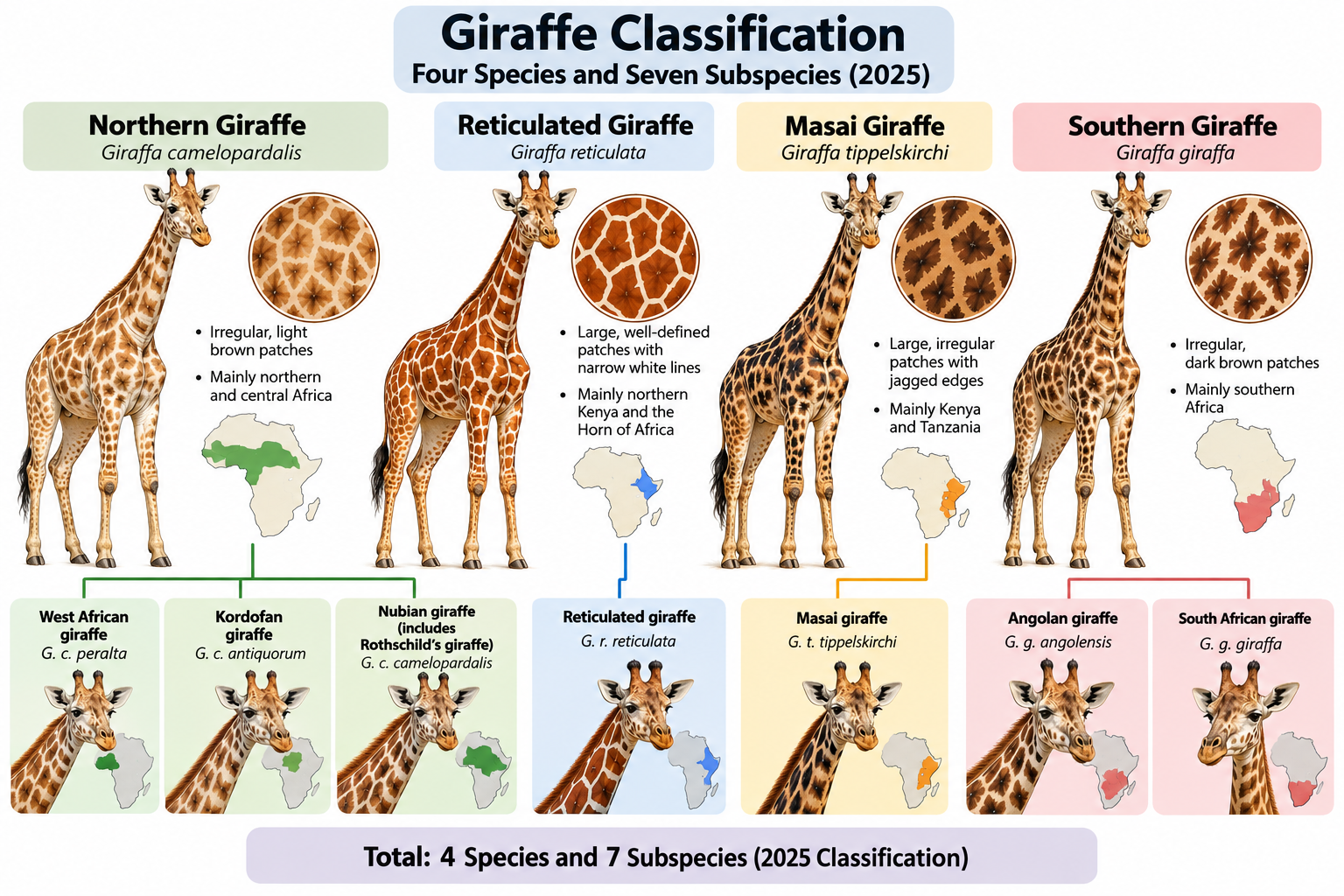
What Are the 4 Types of Giraffe?
There are four recognized types of giraffe species in the modern classification of giraffes.
Although they share the same general body shape and lifestyle, each species has a characteristic geographic range and coat pattern.
The 4 species of giraffe are:
| Giraffe species | Scientific name | Main distribution |
|---|---|---|
| Northern giraffe | Giraffa camelopardalis | Northern and central Africa |
| Reticulated giraffe | Giraffa reticulata | Kenya and parts of the Horn of Africa |
| Masai giraffe | Giraffa tippelskirchi | Kenya and Tanzania |
| Southern giraffe | Giraffa giraffa | Southern Africa |
1. Northern Giraffe
The Northern giraffe is mainly found in parts of northern and central Africa.
Its coat usually has irregular patches separated by lighter-colored lines.
This group includes several recognized subspecies, including the Nubian, Kordofan, and West African giraffes.
2. Reticulated Giraffe
The Reticulated giraffe is best known for its striking coat pattern.
It has large, clearly defined polygonal patches separated by narrow white lines, giving the coat a net-like appearance.
It is mainly found in northern Kenya.
3. Masai Giraffe
The Masai giraffe occurs mainly in Kenya and Tanzania.
Its coat contains large, irregular, jagged-edged patches that are often darker than those of some other giraffe species.
The Masai giraffe is particularly associated with savanna and woodland habitats.
4. Southern Giraffe
The Southern giraffe is native to southern parts of Africa.
Its patches are generally irregular and may vary in shape and color.
This group includes the Angolan giraffe and South African giraffe.
These four types of giraffe represent the major species recognized today.
Their differences become easier to identify when their coat patterns, distribution, and subspecies are compared individually.
Northern Giraffe
The Northern giraffe (Giraffa camelopardalis) is one of the four recognized giraffe species.
It occurs mainly in parts of northern and central Africa and is divided into several recognized subspecies.
Scientific name: Giraffa camelopardalis
Common name: Northern giraffe
Family: Giraffidae
Order: Artiodactyla
Where Is the Northern Giraffe Found?
Northern giraffes occur in scattered populations across parts of Chad, Niger, Cameroon, the Central African Republic, South Sudan, Uganda, and Ethiopia.
Their populations are separated geographically, so their distribution is not continuous.
They live in habitats such as savannas, grasslands, open woodlands, and areas with scattered trees.
Their long necks and prehensile tongues allow them to feed on leaves high above the ground.
Characteristics of the Northern Giraffe
The Northern giraffe can be identified by several features:
- It has a very long neck and tall body.
- Its coat contains irregular patches separated by lighter lines.
- The color and shape of the patches vary among its subspecies.
- It has two main ossicones on the head, with an additional central knob in some individuals.
- Its long tongue helps it browse on leaves and young shoots.
- It is mainly a browser, feeding on leaves, flowers, and shoots of woody plants.
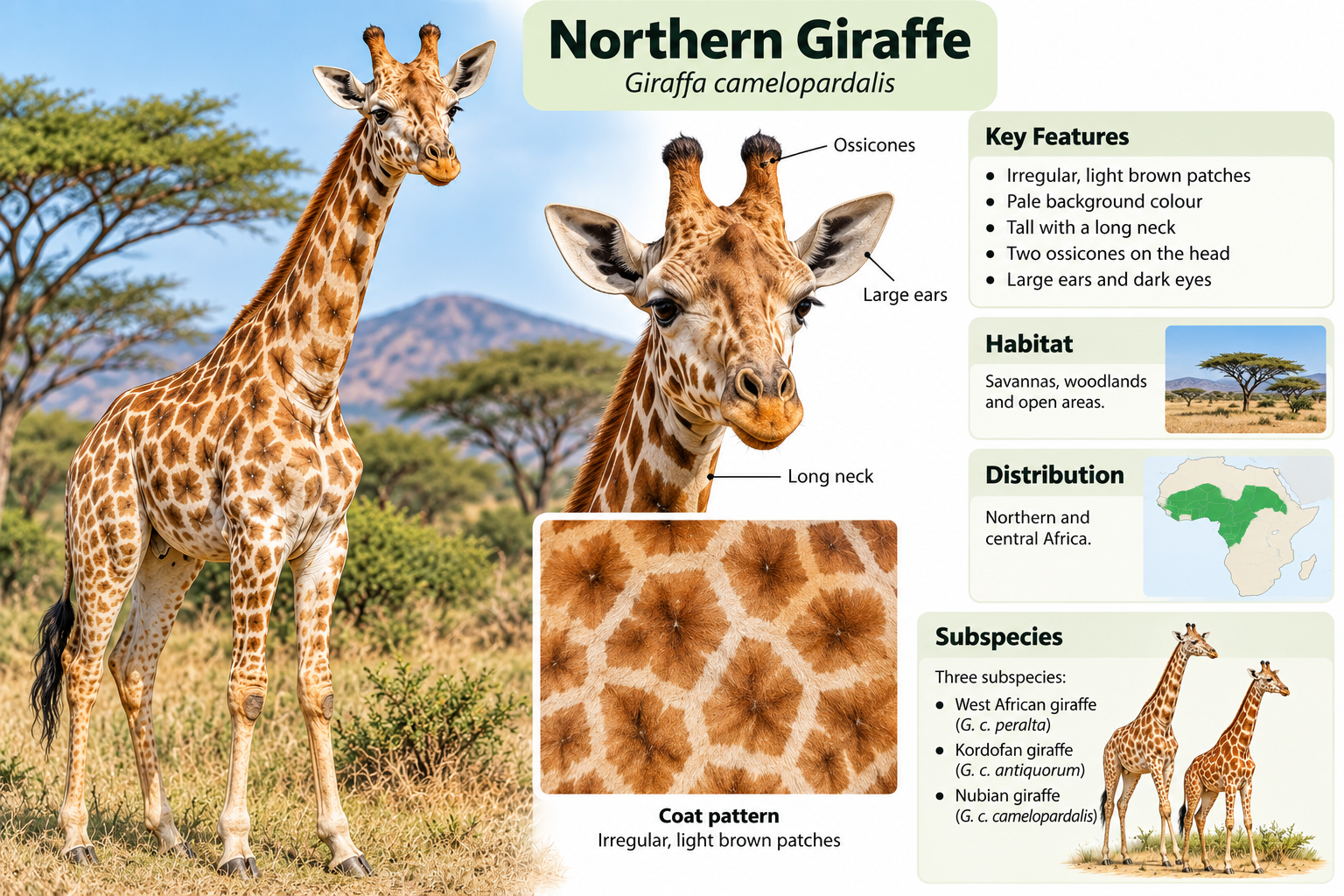
Northern Giraffe Subspecies
The Northern giraffe group includes three commonly recognized subspecies:
- Nubian giraffe (Giraffa camelopardalis camelopardalis)
- Kordofan giraffe (Giraffa camelopardalis antiquorum)
- West African giraffe (Giraffa camelopardalis peralta)
Each has a different geographic range and some differences in coat pattern and appearance.
- Nubian Giraffe :- The Nubian giraffe is found mainly in parts of Uganda and South Sudan, with populations also associated with protected areas in the region. It has large, irregular patches that are surrounded by relatively light areas.
- Kordofan Giraffe :- The Kordofan giraffe occurs mainly in parts of Cameroon, Chad, the Central African Republic, and South Sudan. It generally has irregular, uneven patches that extend across much of the body.
- West African Giraffe :- The West African giraffe is now concentrated mainly in Niger. It has a relatively light coat with irregular reddish-brown patches. Conservation efforts have helped this population recover from its historically very small numbers.
These three subspecies show why giraffe species can have considerable variation in appearance and geographic distribution even within the same species.
Reticulated Giraffe
The Reticulated giraffe (Giraffa reticulata) is one of the four recognized giraffe species. It is particularly well known for its distinctive coat pattern, which makes it one of the easiest giraffes to identify.
Scientific name: Giraffa reticulata
Common name: Reticulated giraffe
Family: Giraffidae
Order: Artiodactyla
Where Is the Reticulated Giraffe Found?
The Reticulated giraffe is found mainly in northern Kenya, with smaller populations occurring in parts of the Horn of Africa.
It inhabits dry and semi-dry environments, including savannas, shrublands, and open woodlands.
Its distribution is more restricted than that of some other types of giraffe, making its geographic range an important feature for identification.
Reticulated Giraffe Coat Pattern
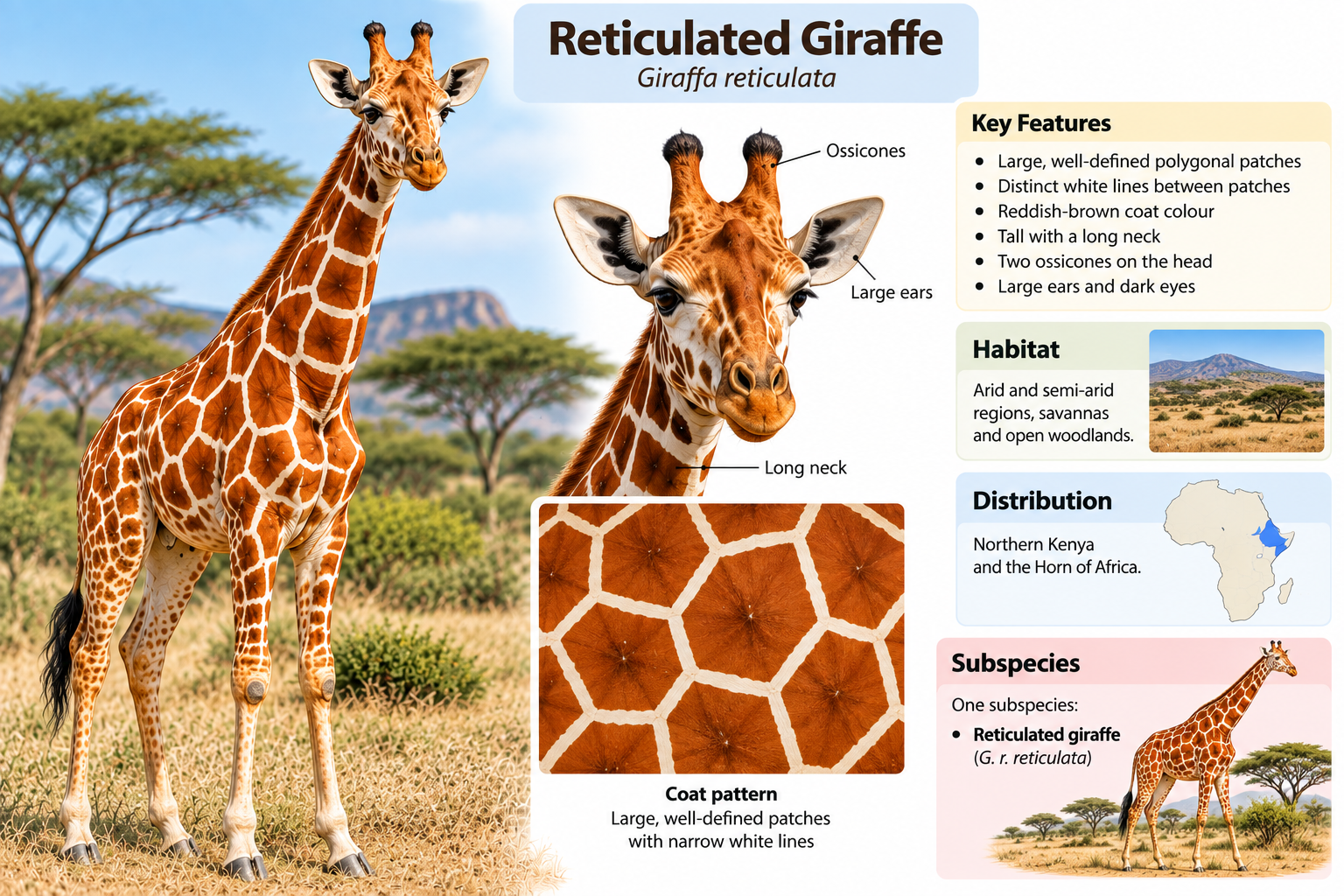
The most noticeable feature of the Reticulated giraffe is its net-like coat pattern.
It has large, reddish-brown or orange-brown patches that are separated by narrow, clearly defined white lines.
The lines form a regular network across much of the body, giving the animal its name.
This pattern differs from the irregular, jagged patches seen in the Masai giraffe.
Characteristics of the Reticulated Giraffe
Important characteristics include:
- Very long neck and legs.
- Large, clearly defined polygonal body patches.
- Narrow white lines separating the darker patches.
- Long, prehensile tongue adapted for browsing.
- Feeds mainly on leaves, shoots, flowers, and other plant material.
- Adapted to relatively dry habitats.
- Mainly associated with northern Kenya in its present-day range.
How to Identify a Reticulated Giraffe
The easiest way to identify this species is by looking at its coat pattern.
The patches are relatively regular and are surrounded by bright, narrow lines, producing a reticulated or net-like appearance.
This distinctive pattern is useful when comparing the different types of giraffe found in Africa.
The Reticulated giraffe is currently recognized as a species in its own right rather than simply a regional form of another giraffe.
Masai Giraffe
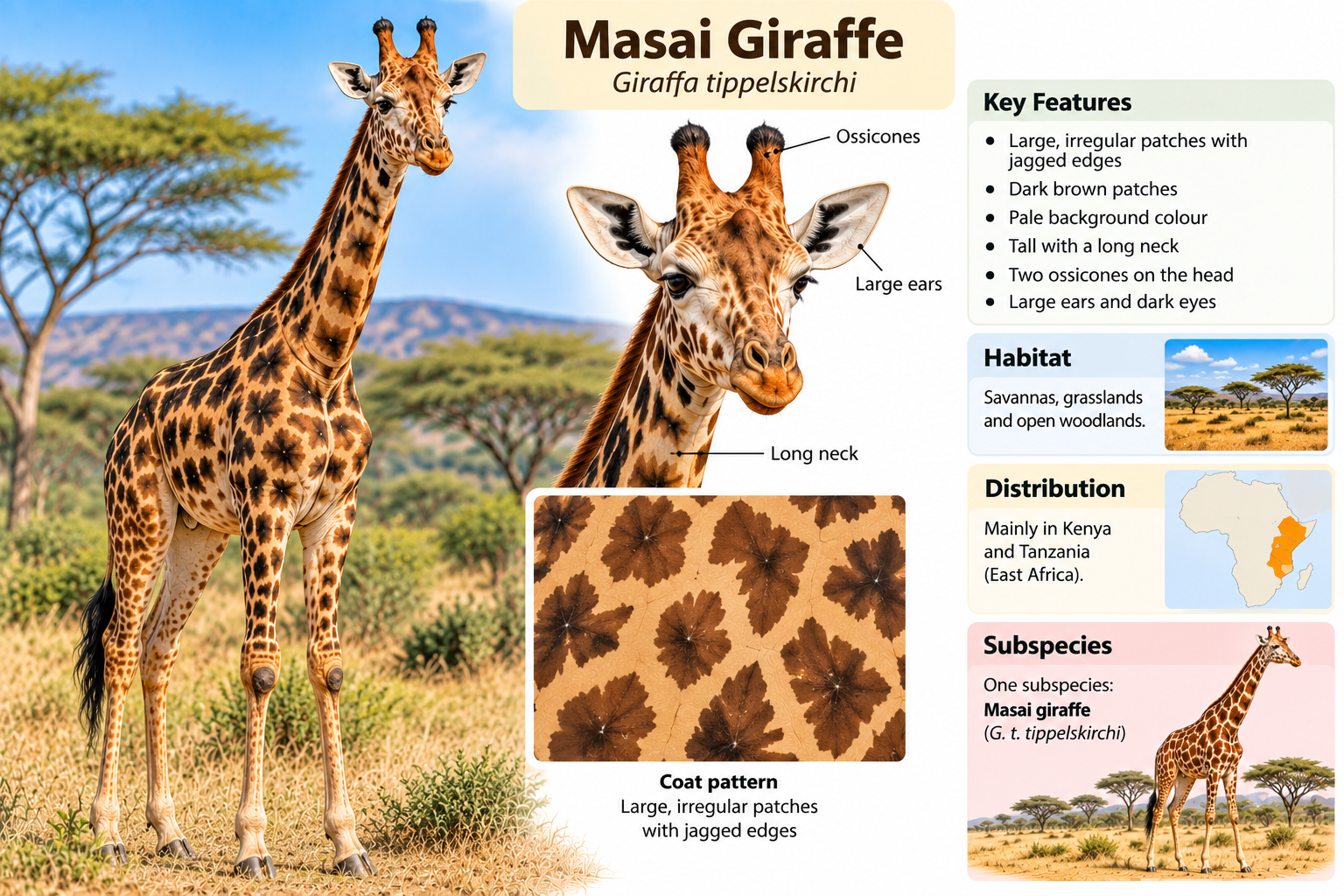
The Masai giraffe (Giraffa tippelskirchi) is one of the four recognized giraffe species.
It is native mainly to Kenya and Tanzania and is commonly associated with savannas, grasslands, and open woodlands.
Scientific name: Giraffa tippelskirchi
Common name: Masai giraffe
Family: Giraffidae
Order: Artiodactyla
Where Is the Masai Giraffe Found?
The Masai giraffe occurs mainly in Kenya and Tanzania. It can live in a variety of habitats, including open savannas, grasslands, woodland areas, and regions with scattered trees.
Its range overlaps with some other giraffe species, but its characteristic coat pattern helps distinguish it from them.
Masai Giraffe Coat Pattern
The Masai giraffe has one of the most distinctive coat patterns among the types of giraffe.
Its body is covered with large, irregular patches with jagged or uneven edges.
The patches are usually darker brown against a lighter background.
Unlike the Reticulated giraffe, the patches do not form a regular net-like pattern.
The shape of these patches is one of the most useful features for identifying the Masai giraffe.
Characteristics of the Masai Giraffe
Important characteristics include:
- Tall body with a very long neck and legs.
- Large, irregular patches with jagged edges.
- Darker patches separated by lighter-colored areas.
- Long prehensile tongue adapted for browsing.
- Feeds mainly on leaves, shoots, flowers, and other vegetation.
- Found mainly in Kenya and Tanzania.
- Adapted to savanna and woodland environments.
Masai Giraffe Subspecies
Modern giraffe taxonomy recognizes two subspecies within the Masai giraffe:
- Masai giraffe (Giraffa tippelskirchi tippelskirchi)
- Luangwa giraffe (Giraffa tippelskirchi thornicrofti)
The Luangwa giraffe is also known as Thornicroft’s giraffe and has a naturally restricted distribution in Zambia’s Luangwa Valley region.
Masai Giraffe vs Reticulated Giraffe
The easiest way to distinguish these two different types of giraffe is their coat pattern.
- Masai giraffe: irregular, jagged-edged patches.
- Reticulated giraffe: large, more regular patches separated by narrow white lines.
This difference is especially useful when identifying giraffes from photographs or wildlife observations.
Southern Giraffe
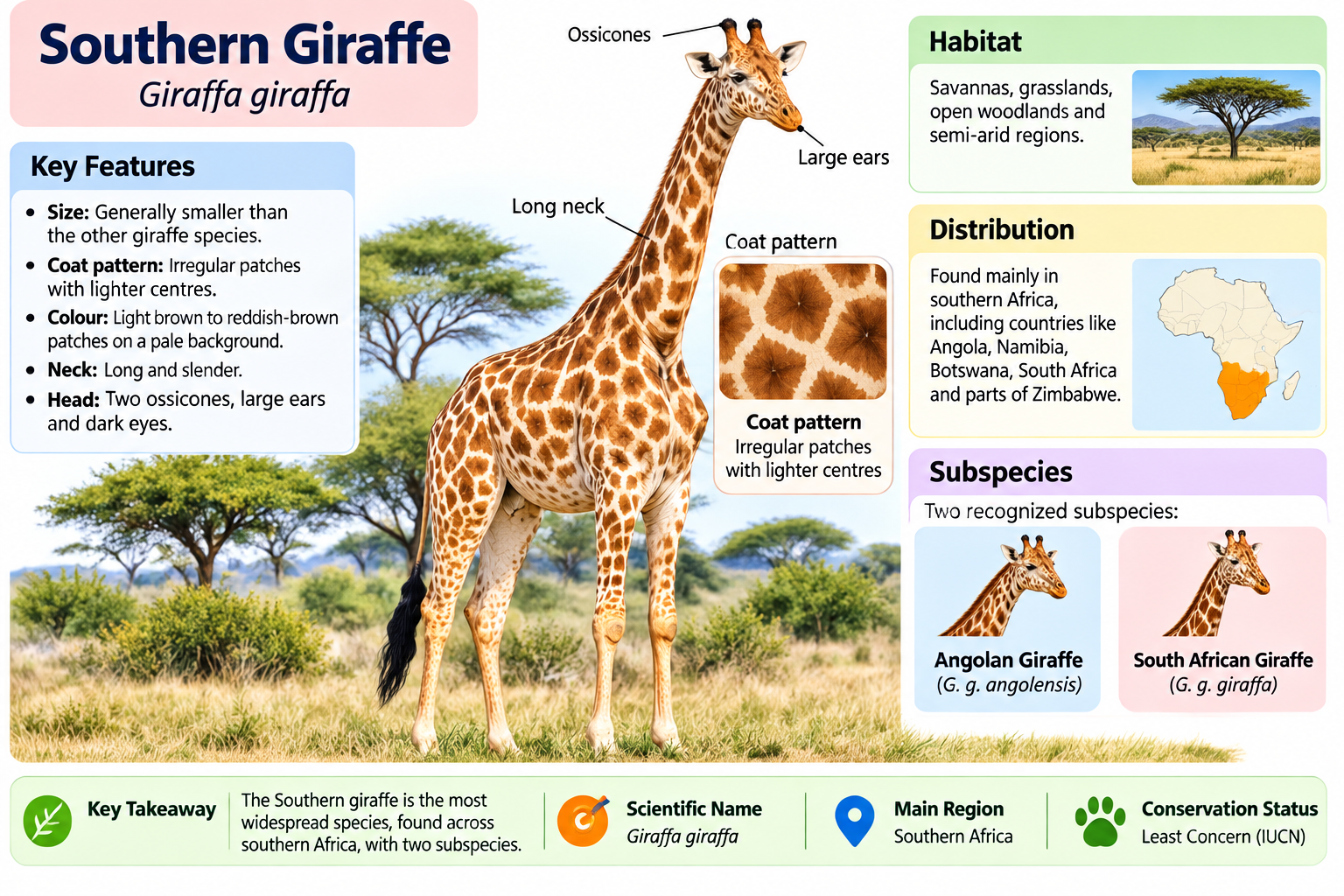
The Southern giraffe (Giraffa giraffa) is one of the four recognized giraffe species.
It is native to southern Africa and occurs mainly in countries such as South Africa, Namibia, Botswana, Zimbabwe, and parts of southern Angola.
Scientific name: Giraffa giraffa
Common name: Southern giraffe
Family: Giraffidae
Order: Artiodactyla
Where Is the Southern Giraffe Found?
Southern giraffes are distributed across several countries in southern Africa. Their habitats include savannas, grasslands, dry woodland, bushland, and areas with scattered trees.
They are well adapted to seasonal environments and can survive in relatively dry regions where suitable trees and shrubs provide food.
Southern Giraffe Coat Pattern
The Southern giraffe generally has irregular reddish-brown or orange-brown patches surrounded by lighter areas. The exact shape and color of the patches can vary between individuals and subspecies.
Its coat pattern is different from the highly regular network-like pattern of the Reticulated giraffe and the strongly jagged patches of the Masai giraffe.
Characteristics of the Southern Giraffe
Important characteristics include:
- Very long neck and legs.
- Irregular brown or reddish-brown patches.
- Long, prehensile tongue used to collect leaves.
- Mainly feeds on leaves, shoots, flowers, and other plant material.
- Commonly found in savanna and woodland habitats.
- Distributed widely across southern Africa.
Southern Giraffe Subspecies
The Southern giraffe is commonly divided into two recognized subspecies:
- Angolan giraffe (Giraffa giraffa angolensis)
- South African giraffe (Giraffa giraffa giraffa)
The Angolan giraffe occurs mainly in parts of Namibia, Botswana, and southern Angola, while the South African giraffe is found mainly in South Africa and neighboring areas.
Angolan Giraffe
The Angolan giraffe has large, irregular reddish-brown patches with relatively lighter areas between them. Despite its name, its present distribution extends beyond Angola into neighboring parts of southern Africa.
South African Giraffe
The South African giraffe occurs mainly in South Africa, with populations also found in neighboring countries. It has irregularly shaped patches that can vary in size and color. The Southern giraffe therefore represents a distinct group among the 4 species of giraffe, with its own geographic range and recognizable coat characteristics.
Key Differences Between Giraffe Species
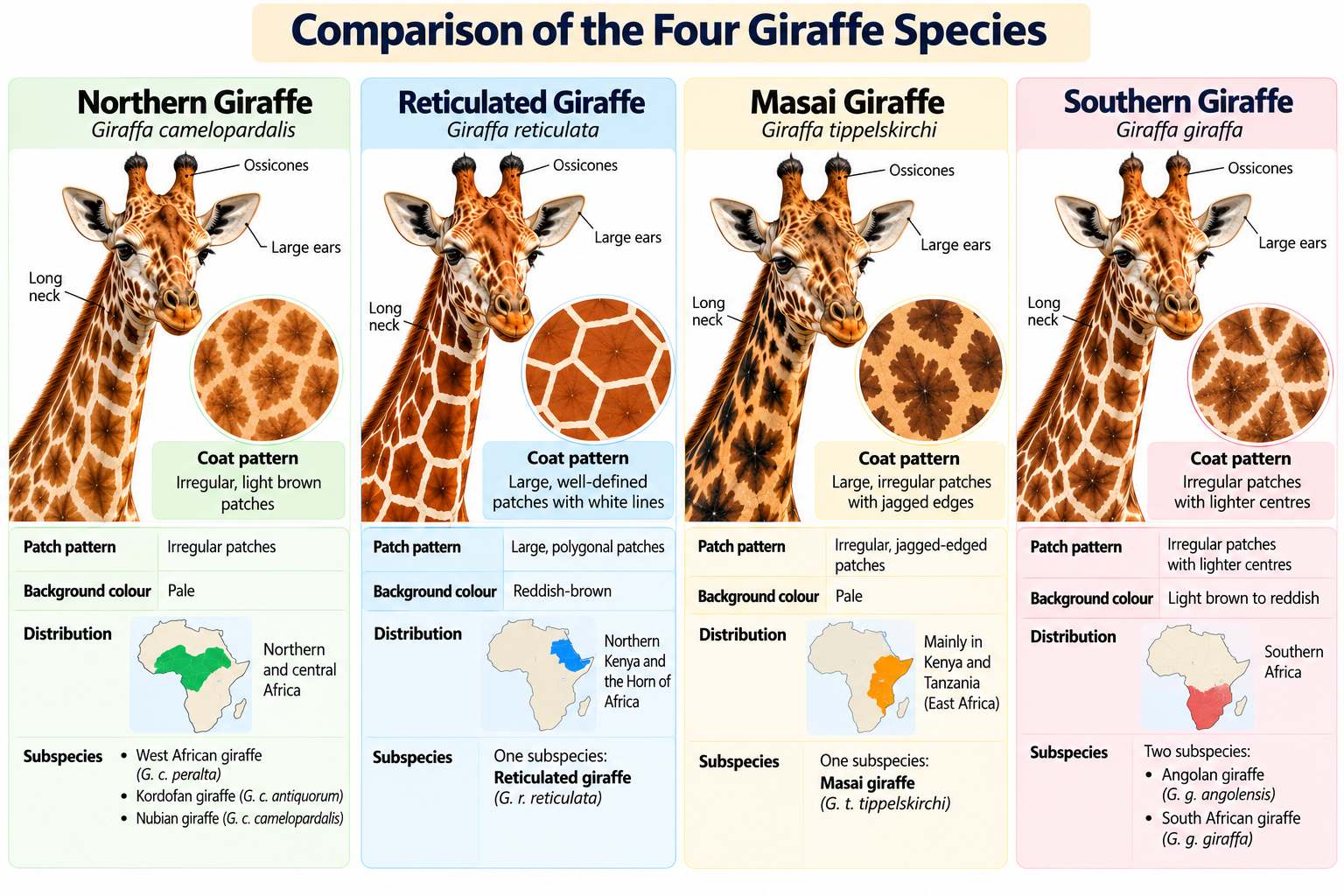
The easiest way to distinguish the different types of giraffe is to consider three main features:
1. Coat pattern:
The shape and arrangement of the patches are particularly useful for identification. Reticulated giraffes have a distinctive network-like pattern, while Masai giraffes have irregular patches with jagged edges.
2. Geographic distribution:
Each species occupies a different main region of Africa. Northern giraffes occur mainly in northern and central Africa, while Southern giraffes are concentrated farther south.
3. Subspecies:
Some species are further divided into subspecies based on geographic and morphological differences.
This comparison also helps answer the common question, “how many types of giraffe species are there?” The modern classification recognizes four, although the taxonomy of giraffes has changed as genetic and morphological research has developed.
The 4 species of giraffe have a similar overall body structure, but they can be distinguished by their coat patterns and geographic distribution. These differences are especially useful when identifying giraffes in photographs or in the wild.
Northern Giraffe vs Reticulated Giraffe
The Northern giraffe generally has irregular patches with lighter areas between them. The Reticulated giraffe, in contrast, has large, clearly defined patches separated by narrow white lines.
The reticulated pattern gives the latter a more regular, net-like appearance.
Reticulated Giraffe vs Masai Giraffe
These two species can be distinguished easily by their coat markings.
- Reticulated giraffe: large, relatively regular patches with narrow white lines.
- Masai giraffe: large, irregular patches with jagged edges.
Their geographic ranges also differ, although both occur in eastern Africa.
Masai Giraffe vs Southern Giraffe
The Masai giraffe is mainly found in Kenya and Tanzania, while the Southern giraffe occurs primarily in southern Africa.
Masai giraffes usually have strongly irregular, jagged-edged patches. Southern giraffes generally have irregular reddish-brown patches with lighter areas between them.
Northern Giraffe vs Southern Giraffe
The main difference is their geographic distribution. Northern giraffes occur mainly in northern and central Africa, whereas Southern giraffes are found mainly in southern Africa.
Their coat patterns can overlap in general appearance, so geographic location can be helpful when identifying these two giraffe species.
Understanding these differences makes it easier to identify the types of giraffe without relying only on their size or overall body shape.
Are Rothschild’s Giraffe a Separate Species?
Rothschild’s giraffe is a name that often appears in older articles and wildlife references, which can make giraffe classification confusing. It is important to understand its current taxonomic placement when studying the different types of giraffe.
Rothschild’s giraffe is generally treated today as the Nubian giraffe, a subspecies of the Northern giraffe. Its scientific name is Giraffa camelopardalis camelopardalis.
Why Was Rothschild’s Giraffe Listed Separately?
In older classifications, giraffes were commonly divided into several subspecies based mainly on differences in their coat patterns and geographic distribution. Rothschild’s giraffe was one of the names used for a particular population.
As genetic and taxonomic research developed, the classification of giraffes was revised. Rothschild’s giraffe is now generally included within the Nubian giraffe rather than being recognized as a separate species.
Where Is the Nubian Giraffe Found?
The Nubian giraffe occurs mainly in parts of Uganda and South Sudan. It has also been reintroduced into some protected areas within its historical range.
Is Rothschild’s Giraffe Still a Type of Giraffe?
The name Rothschild’s giraffe is still widely used in conservation and wildlife contexts, particularly when referring to specific populations. However, it should not automatically be counted as a fifth giraffe species.
Therefore, when asking how many species of giraffe are there, the current types of giraffe species classification does not add Rothschild’s giraffe as a separate species.
Why Taxonomy Can Be Confusing
Different websites and older textbooks may show different numbers of giraffe species or subspecies. This is because giraffe taxonomy has changed over time as scientists have used new genetic and morphological evidence.
Where Do Giraffes Live?
Giraffes are native to Africa, where they occur in a variety of habitats. Their distribution is not uniform, and each of the four recognized species has a different geographic range.
Giraffes are mainly associated with areas that provide enough trees and shrubs for browsing. Common habitats include savannas, grasslands, open woodlands, shrublands, and dry woodland regions.
Where Do the Different Giraffe Species Live?
The main distribution of the giraffe species can be summarized as follows:
| Species | Main geographic region |
|---|---|
| Northern giraffe | Northern and central Africa |
| Reticulated giraffe | Mainly northern Kenya and parts of the Horn of Africa |
| Masai giraffe | Kenya and Tanzania |
| Southern giraffe | Southern Africa |
Northern Giraffe Distribution
Northern giraffes occur in scattered populations across parts of Chad, Niger, Cameroon, the Central African Republic, South Sudan, Uganda, and Ethiopia. Individual populations may be separated by large areas without giraffes.
Reticulated Giraffe Distribution
Reticulated giraffes are found mainly in northern Kenya. They are adapted to dry and semi-dry environments, including savannas, shrublands, and open woodland.
Masai Giraffe Distribution
Masai giraffes occur mainly in Kenya and Tanzania. They use a range of habitats, including savannas, grasslands, and woodland areas.
Southern Giraffe Distribution
Southern giraffes are distributed across parts of South Africa, Namibia, Botswana, Zimbabwe, and southern Angola.
They commonly inhabit savannas, bushlands, and open woodland.
Giraffe Habitat
Giraffes depend heavily on vegetation, particularly trees and shrubs that provide leaves, shoots, and flowers.
Their long necks allow them to reach vegetation that is difficult for many other herbivores to access.
However, habitat availability varies across Africa. Habitat loss, changes in land use, hunting, and fragmentation of populations can affect giraffe populations in different regions.
The geographic distribution of each types of giraffe species is therefore an important part of understanding the types of giraffe found across Africa.
Are All Giraffe Species Endangered?
Not all types of giraffe species have the same conservation status. Their population sizes and trends differ considerably, so it is more useful to consider each species separately rather than treating all giraffes as one group.
The Giraffe Conservation Foundation (GCF) State of Giraffe 2025 estimates that about 140,000 giraffes remain in the wild across Africa. Its species-level assessment shows that the four species have very different population sizes.
Conservation Status of the 4 Giraffe Species
| Species | 2025 conservation assessment |
|---|---|
| Northern giraffe | Endangered |
| Reticulated giraffe | Endangered |
| Masai giraffe | Vulnerable |
| Southern giraffe | Least Concern |
*Population estimates from the GCF State of Giraffe 2025 report.
The updated species-level assessments are important because the IUCN formally recognized four distinct giraffe species in 2025, replacing the previous approach that treated giraffes as one species with several subspecies.
Major Threats to Giraffes
The different types of giraffe face several threats across their ranges. Important threats include:
- Habitat loss caused by changes in land use
- Habitat fragmentation, which separates populations
- Illegal hunting and poaching
- Loss of natural vegetation
- Human-wildlife conflict
- Changes in land use and agricultural expansion
The severity of these threats varies between regions and populations.
Are Giraffe Populations Increasing?
There are also positive developments. The GCF’s 2025 assessment reports increasing or stable trends for several populations.
Southern giraffes, for example, are estimated at nearly 68,837 individuals, while Masai giraffes are estimated at about 43,926.
This shows why the question “how many species of giraffe are there?” should be followed by another important question: how is each types of giraffe species doing in the wild? Population size and conservation status can be very different from one giraffe species to another.
Frequently Asked Questions
How many species of giraffe are there?
There are four types of giraffe species: Northern giraffe, Reticulated giraffe, Masai giraffe, and Southern giraffe. Research using genetic and morphological evidence supports this four-species classification.
What are the 4 species of giraffe?
The 4 species of giraffe are:
- Northern giraffe (Giraffa camelopardalis)
- Reticulated giraffe (Giraffa reticulata)
- Masai giraffe (Giraffa tippelskirchi)
- Southern giraffe (Giraffa giraffa)
What are the different types of giraffe?
The different types of giraffe recognized as species are the Northern, Reticulated, Masai, and Southern giraffe. Some of these species are further divided into subspecies based on geographic and genetic differences.
What is the rarest giraffe species?
The Northern giraffe currently has the smallest estimated wild population among the four recognized species. The Giraffe Conservation Foundation estimates approximately 7,037 Northern giraffes in the wild.
Which giraffe has the most distinctive coat pattern?
The Reticulated giraffe is particularly easy to recognize because it has large, well-defined patches separated by narrow, light-colored lines. These markings create a distinctive net-like or reticulated appearance.
What is the difference between giraffe species?
The main differences occur in their geographic distribution, coat patterns, genetics, and subspecies. For example, Reticulated giraffes have a net-like pattern, while Masai giraffes have large patches with irregular, jagged edges.
Is Rothschild’s giraffe a separate species?
No. Rothschild’s giraffe is generally treated as part of the Nubian giraffe, which is a subspecies of the Northern giraffe. Genetic research found Rothschild’s giraffe to be genetically identical to the Nubian giraffe.
Are there 4 or 9 species of giraffe?
Older classifications commonly treated giraffes as one species with nine subspecies. Modern research supports four distinct species and seven subspecies. This difference explains why older books and websites may give a different number.
Where are the four giraffe species found?
All four species are native to Africa, but their ranges differ. Northern giraffes occur mainly in northern and central Africa, Reticulated giraffes mainly in northern Kenya, Masai giraffes mainly in Kenya and Tanzania, and Southern giraffes mainly in southern Africa.
References for types of giraffe
- International Union for Conservation of Nature (IUCN) — Four giraffe species officially recognised in major conservation reclassification.
- Giraffe Conservation Foundation — Giraffe Species.
- Giraffe Conservation Foundation — State of Giraffe 2025.
- IUCN SSC Giraffe and Okapi Specialist Group — An Evaluation of the Taxonomic Status of Giraffe.
Discover more from Zoologyverse
Subscribe to get the latest posts sent to your email.