
Every living cell needs proteins to grow, maintain its structure, carry out chemical reactions, and respond to its surroundings.
But how does a cell make these proteins from the information stored in its genes? The answer begins with the ribosome.
Ribosomes are tiny, non-membrane-bound cellular structures that act as the main sites of protein synthesis.
They read the information carried by messenger RNA (mRNA) and use it to assemble amino acids into a polypeptide chain. This process is called translation.
Ribosomes are found in both prokaryotic and eukaryotic cells. Although their detailed structures differ, their basic organization and function are remarkably similar.
Each ribosome consists of a small subunit and a large subunit, both made mainly of ribosomal RNA (rRNA) and proteins.
Understanding the structure and functions of ribosome is therefore important for understanding how genetic information is converted into functional proteins.
What is a Ribosome?
A ribosome is a small, non-membranous ribonucleoprotein complex responsible for protein synthesis.
Unlike membrane-bound organelles such as the endoplasmic reticulum or Golgi apparatus, ribosomes do not have a surrounding lipid membrane. Instead, they are composed of rRNA and ribosomal proteins.
Ribosomes work by bringing three important components together:
- mRNA, which carries the genetic instructions
- tRNA, which brings specific amino acids
- Ribosome, which coordinates the process and catalyzes peptide-bond formation
The small subunit helps position and decode the mRNA, while the large subunit contains the main catalytic center responsible for forming peptide bonds between amino acids.
Ribosome = rRNA + proteins + large subunit + small subunit + protein synthesis
Structure of Ribosome
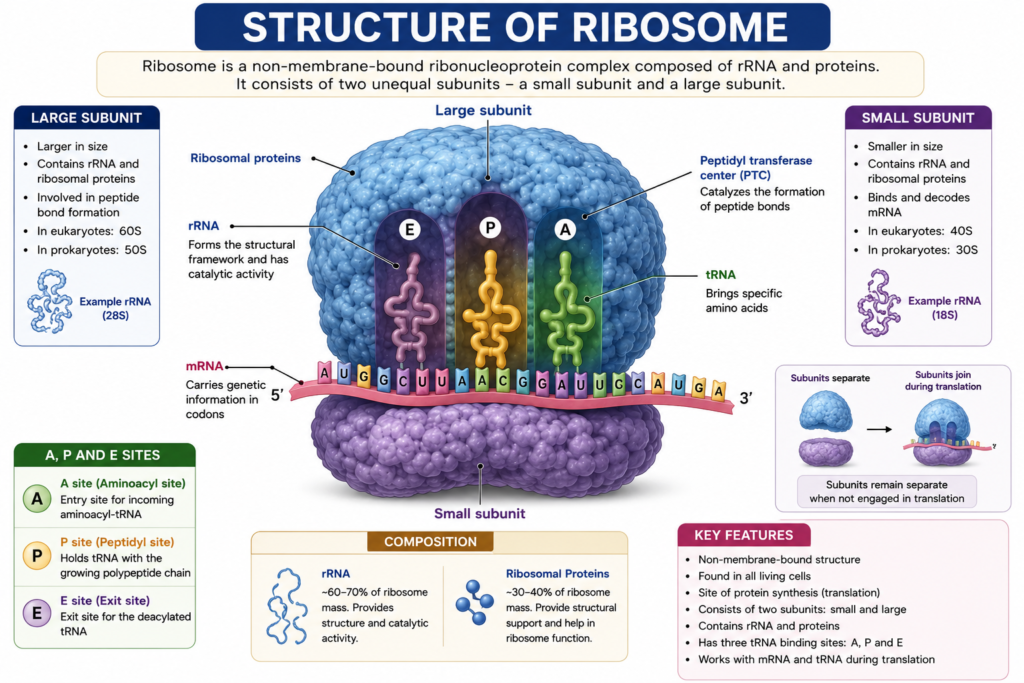
Ribosomes are made of two unequal subunits: a small subunit and a large subunit. These subunits remain separate when the ribosome is not actively translating an mRNA molecule and come together during protein synthesis.
1. Small Subunit
- The small subunit is mainly involved in binding and positioning the mRNA.
- It helps the ribosome read the nucleotide sequence of mRNA correctly so that the appropriate tRNAs can recognize the mRNA codons.
- In bacteria, the small subunit is called the 30S subunit and contains 16S rRNA along with ribosomal proteins.
- In eukaryotic cytoplasmic ribosomes, the small subunit is called the 40S subunit and contains 18S rRNA and ribosomal proteins.
2. Large Subunit
- The large subunit contains the catalytic center responsible for forming peptide bonds between amino acids.
- In bacteria, the large subunit is 50S and contains 23S and 5S rRNAs along with ribosomal proteins.
- In eukaryotic cytoplasmic ribosomes, the large subunit is 60S and contains 28S, 5.8S, and 5S rRNAs, together with ribosomal proteins.
3. Ribosomal RNA and Proteins
- Ribosomes contain both rRNA and proteins, but rRNA has a particularly important structural and catalytic role.
- The rRNA molecules form much of the ribosome’s functional core, while ribosomal proteins help stabilize and organize the structure.
- The peptide-bond-forming activity is associated with rRNA, making the ribosome a well-known example of a ribozyme.
4. A, P and E Sites
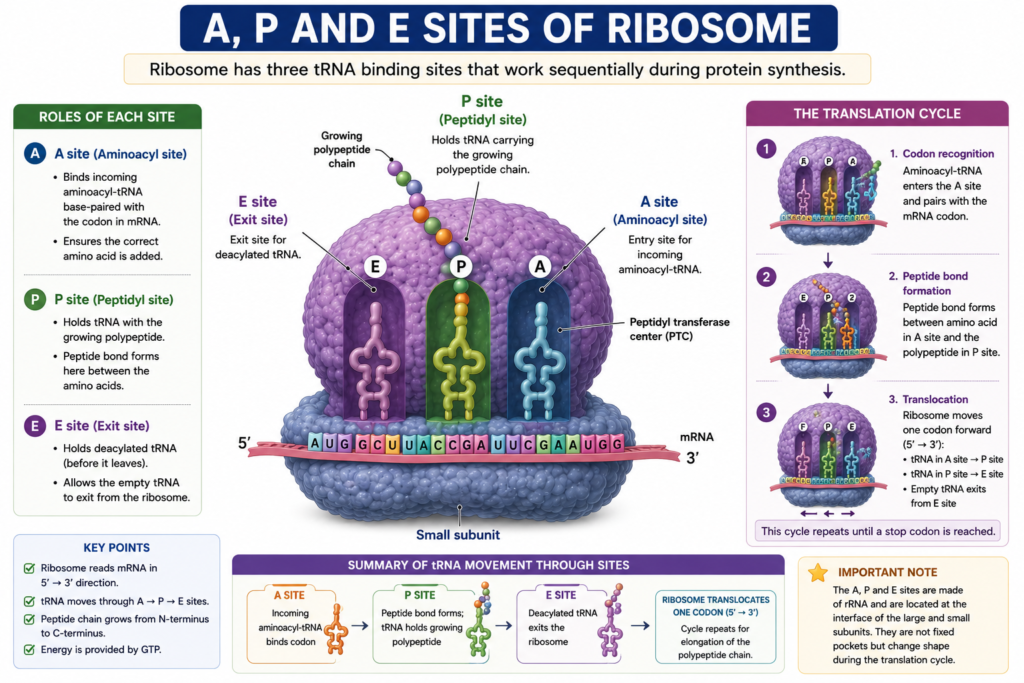
During translation, the ribosome contains three important tRNA-binding sites:
- A site (aminoacyl site): receives an incoming aminoacyl-tRNA.
- P site (peptidyl site): holds the tRNA carrying the growing polypeptide chain.
- E site (exit site): allows the empty tRNA to leave the ribosome.
These sites work together as the ribosome moves along the mRNA and builds the growing protein chain.
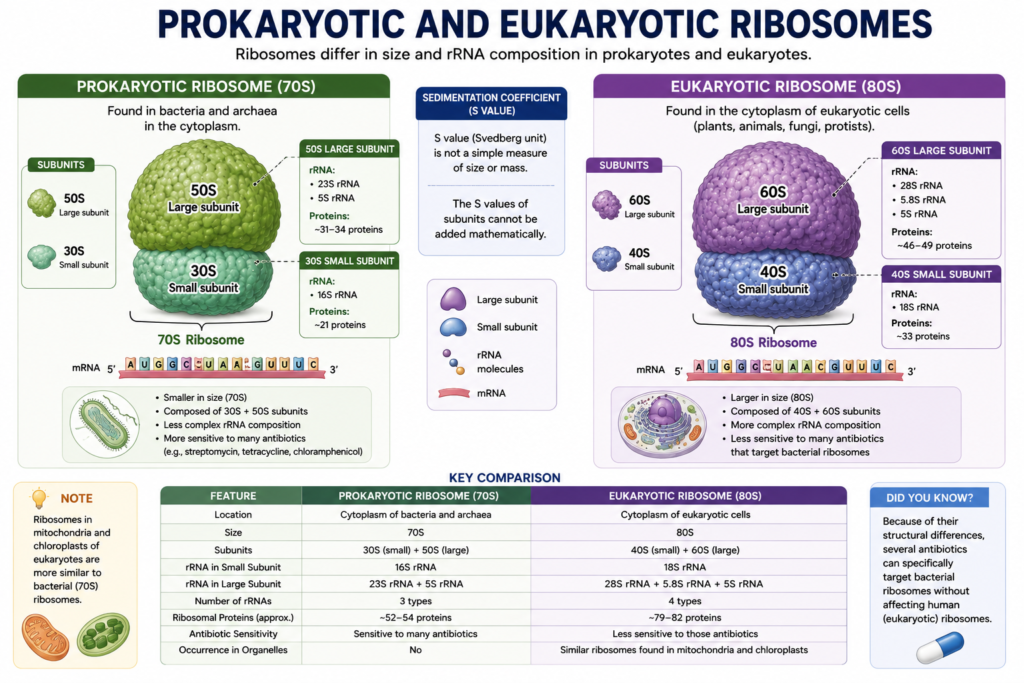
Important: The terms 30S, 50S, 70S, 40S, 60S, and 80S refer to Svedberg sedimentation coefficients. They are not simple measurements of size or mass, so the values of the two subunits cannot simply be added mathematically.
Types of Ribosomes
Ribosomes can be broadly compared according to the type of cell or cellular location in which they occur.
Prokaryotic Ribosomes
Bacteria have 70S ribosomes, composed of:
- 30S small subunit
- 50S large subunit
The 30S subunit contains 16S rRNA, while the 50S subunit contains 23S and 5S rRNAs.
These ribosomes are found in the cytoplasm of bacterial cells.
Eukaryotic Cytoplasmic Ribosomes
The main ribosomes found in the cytoplasm of eukaryotic cells are 80S ribosomes, composed of:
- 40S small subunit
- 60S large subunit
The 40S subunit contains 18S rRNA, while the 60S subunit contains 28S, 5.8S, and 5S rRNAs.
Ribosomes in Mitochondria and Chloroplasts
Eukaryotic cells can also contain ribosomes inside mitochondria and, in plants and algae, chloroplasts.
These organelles contain their own protein-synthesis machinery, reflecting their evolutionary history and endosymbiotic origins. Their ribosomes are more similar in several respects to bacterial ribosomes than to the main cytoplasmic ribosomes of eukaryotic cells.
Functions of Ribosome
The ribosome has one central role—protein synthesis—but this involves several coordinated activities.
1. Protein Synthesis
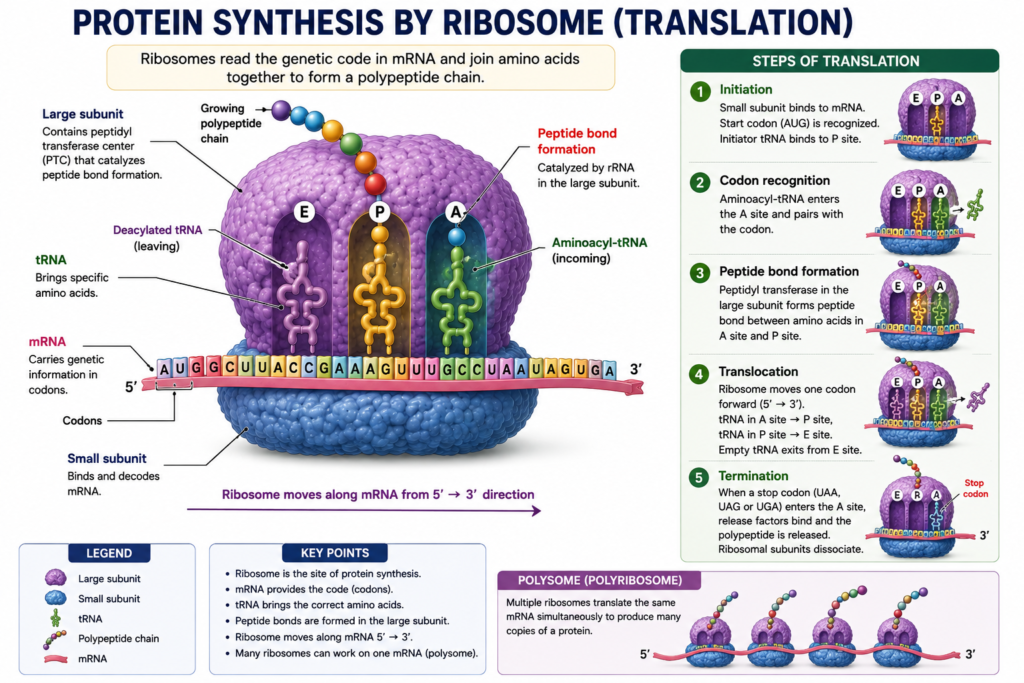
The primary function of the ribosome is to synthesize proteins through the process of translation.
The ribosome reads the codons of an mRNA molecule and uses tRNAs to add the appropriate amino acids in the correct order. The amino acids are then joined together to form a polypeptide chain.
2. Decoding mRNA
The small ribosomal subunit helps position the mRNA and ensures that its codons are correctly read.
Each codon consists of three nucleotides and specifies an amino acid or a termination signal. The ribosome coordinates codon–anticodon interactions between mRNA and tRNA during translation.
3. Binding tRNA
Ribosomes provide specific binding sites for tRNA molecules.
The tRNA carrying an amino acid enters the A site, while the tRNA holding the growing polypeptide occupies the P site. After its amino acid has been transferred, the empty tRNA moves through the E site and leaves the ribosome.
4. Peptide Bond Formation
The ribosome catalyzes the formation of peptide bonds between amino acids.
This activity occurs in the large subunit and is largely carried out by ribosomal RNA rather than by a conventional protein enzyme. This is why the ribosome is described as a ribozyme.
5. Movement Along mRNA
During translation, the ribosome moves along the mRNA in the 5′ to 3′ direction.
As it advances by one codon at a time, new tRNAs enter, peptide bonds are formed, and empty tRNAs leave. This repeated cycle allows the polypeptide chain to grow in the correct sequence.
6. Formation of Polypeptide Chains
The ribosome links amino acids together in the sequence specified by the mRNA.
The resulting chain is called a polypeptide. After translation, the polypeptide can fold and may undergo additional modifications before becoming a functional protein.
7. Formation of Polysomes
A single mRNA molecule can be translated simultaneously by multiple ribosomes.
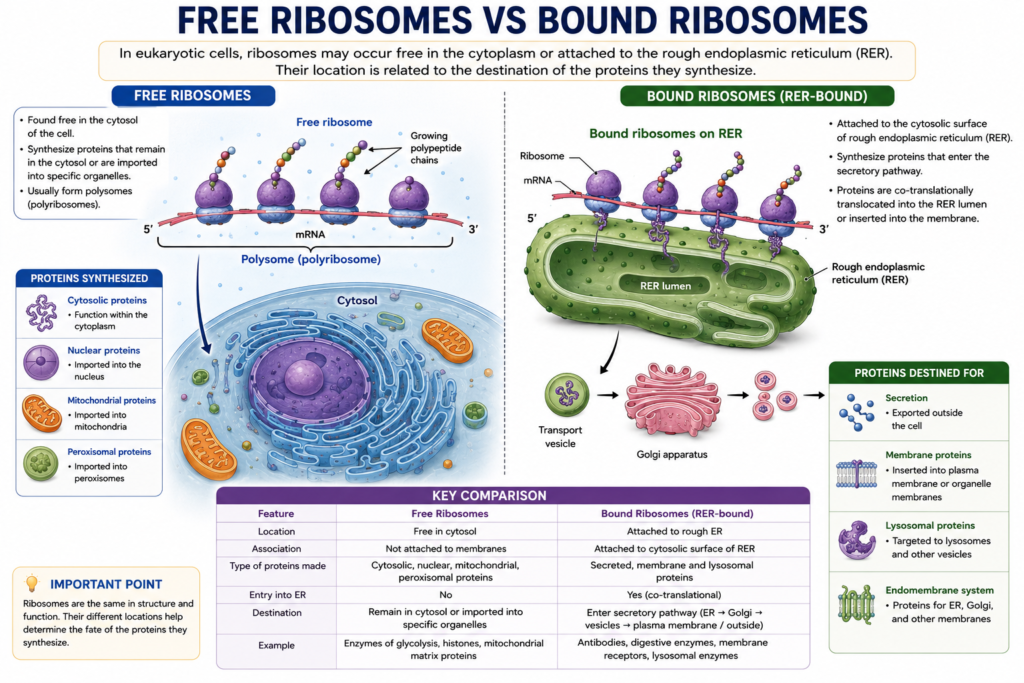
This group of ribosomes attached to one mRNA molecule is called a polysome or polyribosome. Polysomes allow a cell to produce multiple copies of a protein from the same mRNA efficiently.
Free Ribosomes and Bound Ribosomes
In eukaryotic cells, ribosomes may occur free in the cytoplasm or attached to the outer surface of the rough endoplasmic reticulum (RER).
The important difference is not that the ribosomes themselves are fundamentally different. Rather, their location is related to the destination of the proteins they synthesize.
Free Ribosomes
Free ribosomes generally produce proteins that remain in the cytosol or are targeted to certain internal compartments such as the nucleus, mitochondria, or peroxisomes.
Bound Ribosomes
Ribosomes attached to the These include many proteins destined for secretion, membranes, or further processing through the Golgi apparatus.
Therefore, free and ER-bound ribosomes are functionally specialized according to the destination of the proteins they produce.
Importance of Ribosomes in Cells
Ribosomes are essential for life because proteins perform a huge variety of cellular functions. They form structural components, act as enzymes, participate in signaling, transport molecules, regulate cellular processes, and help maintain cell organization.
Without ribosomes, the genetic information stored in DNA could not be efficiently converted into functional proteins.
Ribosomes therefore form an important link between genetic information and cellular activity. The information is first transcribed into mRNA, and ribosomes then translate that mRNA into a specific amino acid sequence.
The structure of the ribosome is closely suited to this task. Its small subunit helps decode the mRNA, while its large subunit coordinates tRNAs and catalyzes peptide-bond formation.
Conclusion
The ribosome is a small but highly organized cellular structure that plays a central role in protein synthesis. It is made of rRNA and proteins and consists of a small subunit and a large subunit that work together during translation.
The small subunit helps read and position the mRNA, while the large subunit provides the catalytic center for peptide-bond formation. The A, P, and E sites coordinate the movement of tRNAs as the ribosome travels along the mRNA and builds a polypeptide chain.
Prokaryotic cells generally contain 70S ribosomes, whereas the main cytoplasmic ribosomes of eukaryotic cells are 80S. Eukaryotic cells may also contain specialized ribosomes within mitochondria and chloroplasts.
In simple terms, the ribosome can be considered the protein-making machinery of the cell. Its structure allows genetic information carried by mRNA to be converted into proteins that support almost every aspect of cellular life.
Key Takeaways
- Ribosomes are non-membrane-bound structures responsible for protein synthesis.
- They are composed mainly of ribosomal RNA (rRNA) and proteins.
- Each ribosome has a small subunit and a large subunit.
- The small subunit helps bind and decode mRNA.
- The large subunit contains the main center for peptide-bond formation.
- Ribosomes contain three major tRNA-binding sites: A, P and E.
- Bacterial ribosomes are generally 70S, with 30S and 50S subunits.
- Main eukaryotic cytoplasmic ribosomes are 80S, with 40S and 60S subunits.
- Free and ER-bound ribosomes synthesize proteins destined for different cellular locations.
- Multiple ribosomes can translate the same mRNA simultaneously, forming a polysome.
- Ribosomal RNA plays a direct catalytic role in peptide-bond formation, making the ribosome a ribozyme.
Frequently Asked Questions
What is a ribosome?
A ribosome is a non-membrane-bound ribonucleoprotein complex that synthesizes proteins by translating the information contained in mRNA.
What are the main components of a ribosome?
A ribosome consists mainly of ribosomal RNA (rRNA) and ribosomal proteins and is organized into a large subunit and a small subunit.
What is the main function of ribosome?
The main function of a ribosome is protein synthesis. It reads mRNA and joins amino acids together to form a polypeptide.
What are the two subunits of a ribosome?
The two subunits are the small subunit and the large subunit. The small subunit helps decode mRNA, while the large subunit is mainly responsible for peptide-bond formation.
What are the A, P and E sites of a ribosome?
The A site receives incoming tRNA, the P site holds the tRNA carrying the growing polypeptide, and the E site is where the empty tRNA exits.
What is the difference between 70S and 80S ribosomes?
A typical bacterial ribosome is 70S, consisting of 30S and 50S subunits. The main cytoplasmic ribosome of a eukaryotic cell is 80S, consisting of 40S and 60S subunits. The S values are sedimentation coefficients and are not simple measures of mass.
Are ribosomes present in both prokaryotic and eukaryotic cells?
Yes. Ribosomes occur in both prokaryotic and eukaryotic cells, although their structures differ in several details.
Are ribosomes membrane-bound?
No. Ribosomes are non-membranous structures. In eukaryotic cells, some ribosomes can temporarily attach to the rough ER during the synthesis of proteins entering the secretory pathway.
What is a polysome?
A polysome, or polyribosome, is a group of ribosomes simultaneously translating the same mRNA molecule.
Why are ribosomes called ribozymes?
Ribosomes are called ribozymes because ribosomal RNA performs the catalytic activity involved in peptide-bond formation.
References
- Alberts, B. et al. Molecular Biology of the Cell. — The Ribosome and Translation.
- Cooper, G. M. The Cell: A Molecular Approach. — The Role of the Ribosome in Protein Synthesis.
- Biology 2e — Ribosomes and Protein Synthesis.
- Concepts of Biology — Translation.
- Biochemistry, Protein Synthesis.
- Ramakrishnan, V. “Ribosome structure and the mechanism of translation.” Cell, 2002.
Discover more from Zoologyverse
Subscribe to get the latest posts sent to your email.