
Gyps bengalensis, commonly known as the White-rumped Vulture, is one of South Asia’s most iconic but critically endangered raptors. Once abundant across the Indian subcontinent, this species experienced a dramatic population collapse due to veterinary drug contamination, habitat loss, and food scarcity. Known for its broad wings, pale rump, and soaring flight, Gyps bengalensis plays a vital ecological role as a scavenger, rapidly disposing of animal carcasses and maintaining environmental hygiene. Today, it stands as a flagship species for vulture conservation efforts in India, Nepal, and Bangladesh.
For Practical Study 🧪
The following notes are arranged in a practical examination format for easy study and identification.
Classification of Gyps bengalensis (Vulture)
| Rank | Classification | Characteristic |
|---|---|---|
| Kingdom | Animalia | Multicellular, heterotrophic animals |
| Phylum | Chordata | Dorsal tubular nerve cord, notochord and gill-slits present. |
| Group | Craniata | Definite head, Cranium with brain present. |
| Sub-phylum | Vertebrata | Vertebral column present. |
| Division | Gnathostomata | Jaws and paired appendages present |
| Super Class | Tetrapoda | Paired limbs, lungs, cornified skin and bony skeleton. |
| Class | Aves | Biped and feathered vertebrates. |
| Sub-Class | Neornithes | True birds. Metacarpals fused. |
| Super-Order | Neognathae | Modern birds. no teeth. sternum keeled. |
| Order | Accipitriformes | Bill stout and hooked at tip. |
| Genus | Gyps | Old World vultures adapted for scavenging |
| Species | Gyps bengalensis | White-rumped Vulture |
Geographical Distribution
Gyps bengalensis is native to South Asia and occurs mainly in India, Nepal, Bangladesh and parts of mainland Southeast Asia.
It is associated with open landscapes, agricultural areas, grasslands and regions where livestock are present.
Habit and Habitat
Gyps bengalensis is a diurnal, social scavenging bird that feeds mainly on the carcasses of livestock and other animals.
It commonly inhabits open countryside, grasslands, agricultural landscapes and areas around human settlements. It often roosts and nests in tall trees and may gather in groups around feeding sites.
Comments
- Commonly called as Vulture.
- It is dirty, blackish brown and repulsive-looking bird with massive body, very graceful and majestic when soaring and circling high up in the sky.
- Flight is strong. White lower back visible when the bird is at rest or banks in flight.
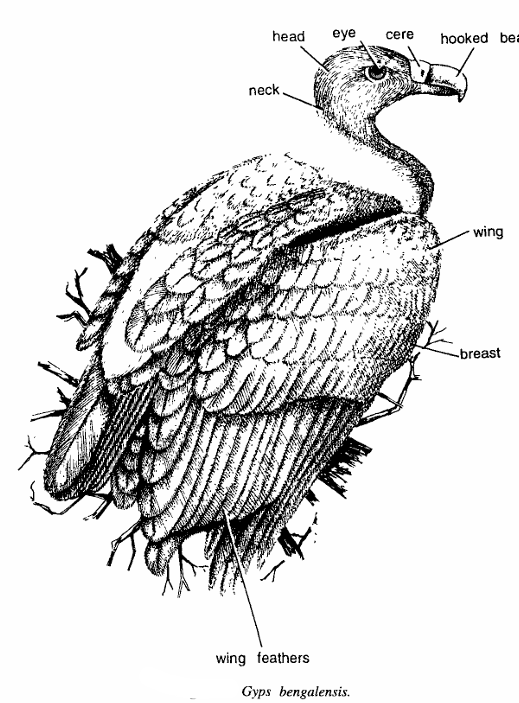
- Body is divided into head, neck, back and abdomen. breast and head is naked and contains large eyes, beak or bill.
- Behind head is short neck. Bill stout, hooked at the tip with soft naked cere at its base.
- Mandible sharp edged. Beak adopted for tearing muscles from dead animals.
- Feet usually adapted for grasping with sharp claws.
- Vultures nest in large trees near the road or village sides.
- At rest wings are folded over the trunk.
Special Features
Gyps bengalensis has a large body, broad wings, a relatively long neck, and a strongly hooked bill adapted for tearing flesh.
The white feathers on the lower back and rump contrast with its darker wings and body. Its broad wings allow efficient soaring, helping it search large areas for carrion.
Like other vultures, it plays an important role as a scavenger in terrestrial ecosystems.
Identification
Since this bird contains hooked beak, white back and above features, hence it is Gyps.
Quick Identification of Gyps bengalensis
| Feature | Identification |
|---|---|
| Common name | White-rumped Vulture |
| Scientific name | Gyps bengalensis |
| Class | Aves |
| Order | Accipitriformes |
| Family | Accipitridae |
| Body | Large scavenging bird with broad wings |
| Plumage | Mostly dark with a contrasting white rump |
| Bill | Strong and hooked |
| Feeding habit | Mainly scavenges animal carcasses |
| Key identifying character | White rump contrasting with the dark body |
Physical Characteristics of Gyps bengalensis
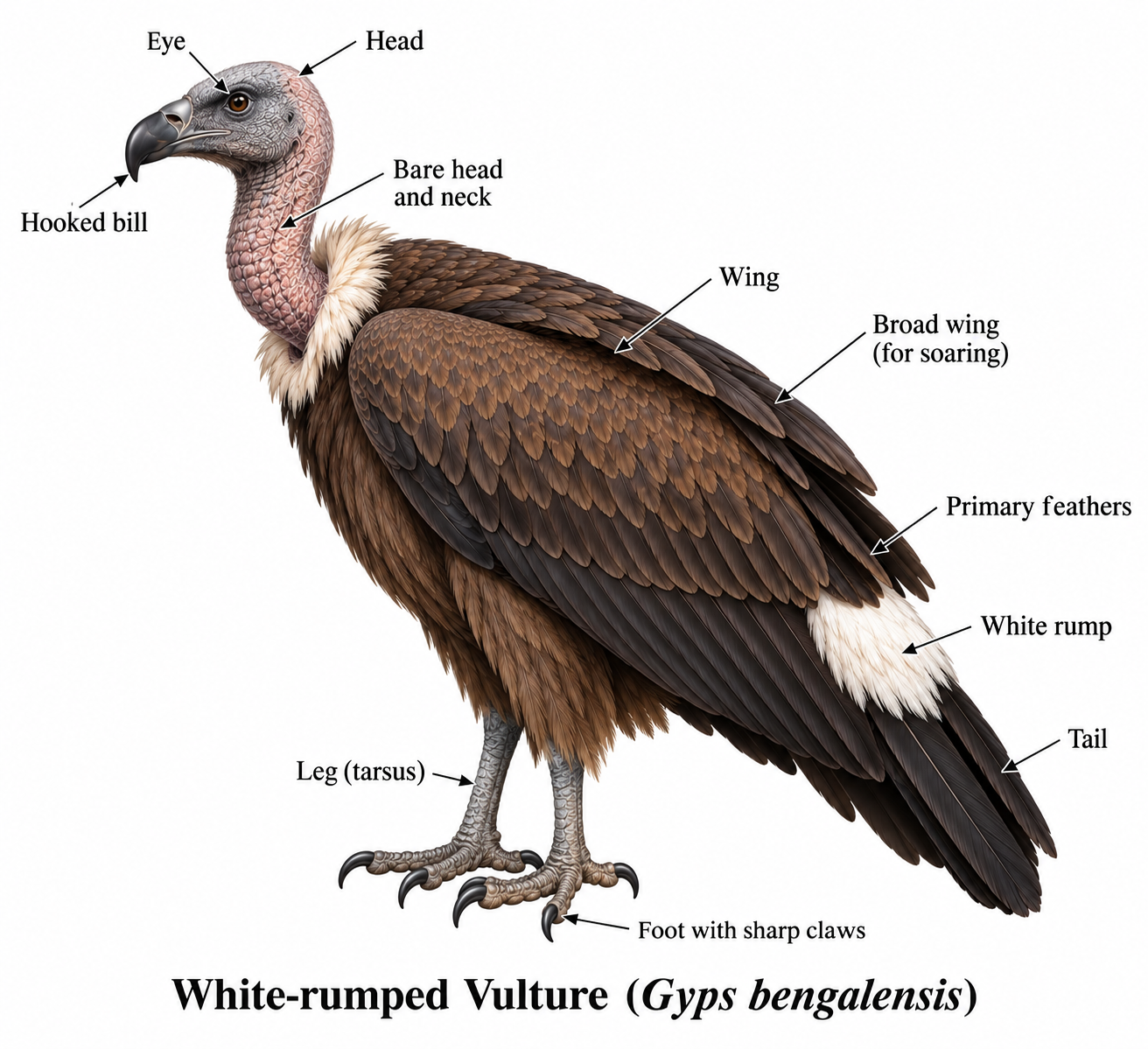
Gyps bengalensis, or the White-rumped Vulture, is a medium-to-large Old World vulture with broad wings and a relatively short tail.
Its body is predominantly dark, while the white rump and lower back create a distinctive contrast.
The head and neck are relatively bare, an adaptation commonly associated with feeding on carrion.
The bill is strong and hooked, allowing the bird to tear flesh efficiently.
Its broad wings are adapted for soaring over open landscapes while searching for food.
- Body: Large and robust
- Wings: Broad and well adapted for soaring
- Head and neck: Relatively bare
- Bill: Strong and hooked
- Rump: Distinctive white rump
- Tail: Relatively short
- Feet: Strong feet with sharp claws
Feeding and Scavenging Adaptations of Gyps bengalensis
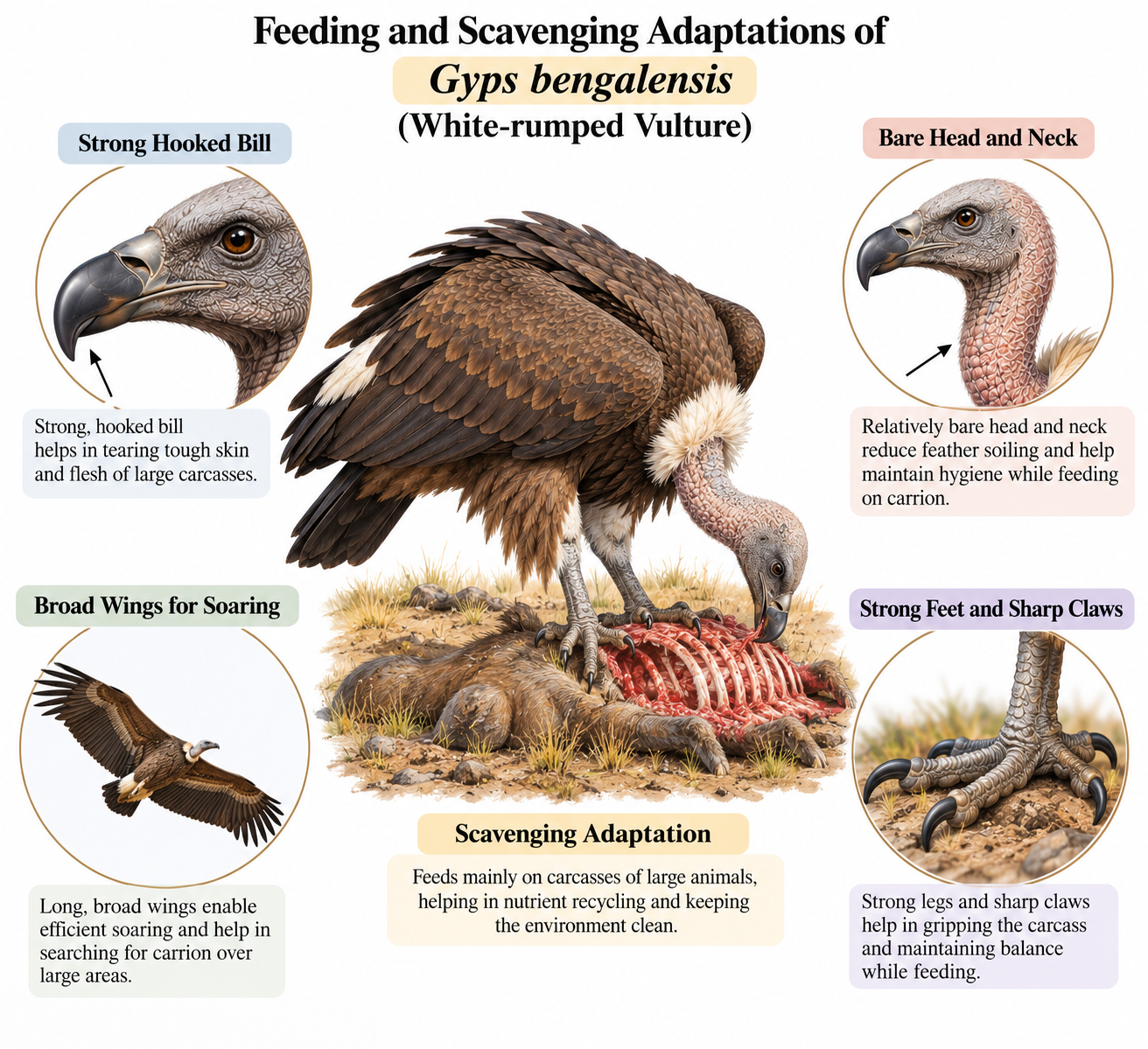
Gyps bengalensis is primarily a scavenger and feeds mainly on carrion. Its feeding anatomy and behaviour are adapted for locating and consuming animal carcasses.
The strong, hooked bill helps tear flesh, while the relatively bare head and neck reduce the accumulation of feathers and tissues during feeding.
Broad wings allow the vulture to soar efficiently while searching large areas for food.
Its highly developed scavenging behaviour also allows it to exploit carcasses that may be difficult for many other animals to access.
| Adaptation | Function |
|---|---|
| Strong hooked bill | Tears flesh from carcasses |
| Broad wings | Efficient soaring while searching for food |
| Relatively bare head and neck | Helps reduce contamination while feeding |
| Keen visual ability | Helps locate carcasses from the air |
| Social feeding behaviour | Allows individuals to exploit available carrion efficiently |
| Strong feet and claws | Help grip and handle food |
Behaviour of Gyps bengalensis
Gyps bengalensis is mainly diurnal and is well adapted for a soaring lifestyle.
It often uses rising air currents to travel long distances while searching for carrion. Individuals may gather around food sources, particularly when a large carcass is available.
The species commonly roosts in trees and may form communal roosting groups. Its scavenging behaviour contributes to the rapid removal of animal remains from the environment.
- Activity: Mainly diurnal
- Flight: Soars using rising air currents
- Feeding: Often gathers around carcasses
- Roosting: Frequently roosts in trees
- Social behaviour: May form groups at feeding and roosting sites
- Ecological role: Important scavenger
Reproduction in Gyps bengalensis
Gyps bengalensis is an oviparous bird that generally breeds once a year.
The breeding season is mainly from October to March. Breeding pairs build nests on large trees or cliffs, often in loose colonies. Usually, a single egg is laid, and both parents participate in incubation.
Incubation generally lasts about 45–52 days. After hatching, the chick remains dependent on its parents, which provide food until it develops sufficiently to leave the nest.
| Reproductive feature | Details |
|---|---|
| Reproduction | Sexual |
| Type | Oviparous |
| Breeding season | Mainly October–March |
| Nest | Built on large trees or cliffs |
| Eggs | Usually one egg |
| Incubation | About 45–52 days |
| Parental care | Both parents care for the chick |
| Young | Remain in the nest for about 2–3 months |
Conservation Status of Gyps bengalensis
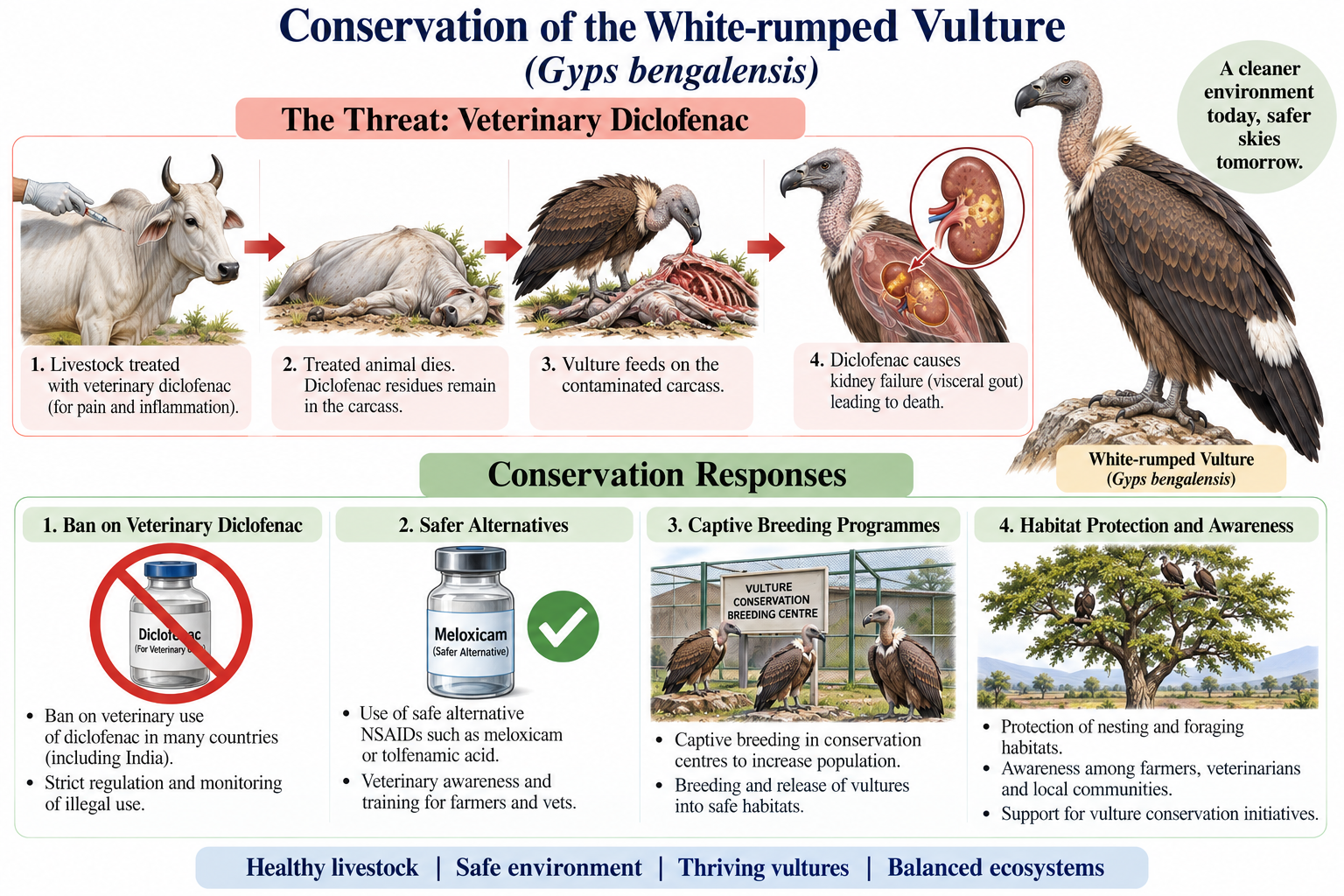
Gyps bengalensis has undergone a severe population decline across South Asia, particularly since the 1990s. The decline was strongly associated with exposure to the veterinary drug diclofenac in livestock carcasses, which caused fatal kidney failure in vultures that consumed treated carcasses.
Conservation measures include restrictions on veterinary diclofenac, use of safer alternatives such as meloxicam, captive breeding, and protection of important vulture habitats.
The species is currently classified as Critically Endangered (CR) on the IUCN Red List.
| Conservation point | Details |
|---|---|
| IUCN status | Critically Endangered (CR) |
| Major historical threat | Veterinary diclofenac |
| Main impact | Severe population decline |
| Important conservation action | Restriction of veterinary diclofenac |
| Safer alternative | Meloxicam and other vulture-safe NSAIDs |
| Conservation approach | Captive breeding, monitoring and habitat protection |
White-rumped Vulture vs Other Vultures
| Feature | White-rumped Vulture | Indian Vulture | Slender-billed Vulture |
|---|---|---|---|
| Scientific name | Gyps bengalensis | Gyps indicus | Gyps tenuirostris |
| Family | Accipitridae | Accipitridae | Accipitridae |
| Body colour | Mostly dark with white rump | Mainly pale brown with darker flight feathers | Mainly pale with darker flight feathers |
| Key feature | Distinctive white rump | Long, slender neck and bill | Slender bill and neck |
| Feeding habit | Mainly scavenging | Mainly scavenging | Mainly scavenging |
| Conservation status | Critically Endangered | Critically Endangered | Critically Endangered |
These three Gyps vultures are closely related Old World vultures found in South Asia. Their identification should be based on a combination of plumage, body proportions, bill shape and distribution rather than a single character.
Frequently Asked Questions
What is the common name of Gyps bengalensis?
Gyps bengalensis is commonly known as the White-rumped Vulture.
What does the White-rumped Vulture eat?
It mainly feeds on the carcasses of livestock and other animals and is an important scavenger.
Why is Gyps bengalensis called the White-rumped Vulture?
It has a conspicuous white area on the rump and lower back that contrasts with its darker body.
Is Gyps bengalensis endangered?
Yes. It is classified as Critically Endangered (CR) on the IUCN Red List.
What caused the major decline of White-rumped Vultures?
Exposure to the veterinary drug diclofenac through contaminated livestock carcasses was a major cause of the population crash.
What is the ecological importance of Gyps bengalensis?
As a scavenger, it helps remove animal carcasses and contributes to nutrient cycling and ecosystem sanitation.
Recommended Study Resource
A Manual of Practical Zoology – Chordates
by P S Verma (Author)
INTEGRATED PRINCIPLES OF ZOOLOGY (COLLEGE IE OVERRUNS)
by Hickman Al (Author)
As an Amazon Associate I earn from qualifying purchases.
References
- Animal Diversity Web — Gyps bengalensis
- IUCN Red List information — Gyps bengalensis
- ITIS — Gyps bengalensis
- India Biodiversity Portal — Gyps bengalensis
- Himalayan Raptors — White-rumped Vulture
Discover more from Zoologyverse
Subscribe to get the latest posts sent to your email.