
Protein synthesis is the biological process through which cells use genetic information to produce proteins. It is one of the most important processes in molecular biology because proteins perform a huge variety of functions, including catalysis, transport, structural support, signaling, defense, movement, and regulation.
The information required to make a protein is stored in DNA. In cells, this information is expressed through a sequence of events in which a gene is transcribed into RNA and the information in messenger RNA (mRNA) is translated into a specific sequence of amino acids. The resulting polypeptide then folds and may undergo additional modifications before becoming a functional protein.
In simple terms:
DNA → RNA → Protein
This flow of genetic information is commonly described as the central dogma of molecular biology. Transcription converts DNA information into RNA, whereas translation converts the nucleotide sequence of mRNA into an amino-acid sequence.
Protein synthesis is therefore much more than simply joining amino acids. It requires the coordinated activity of DNA-derived information, mRNA, tRNA, rRNA, ribosomes, aminoacyl-tRNA synthetases, initiation and elongation factors, release factors, and several quality-control mechanisms.
What Is Protein Synthesis?
Protein synthesis is the process by which cells manufacture polypeptide chains according to genetic instructions encoded in DNA.
A protein is composed of amino acids arranged in a particular sequence. The order of these amino acids determines how the polypeptide folds and ultimately influences its structure and function.
Protein synthesis can be broadly understood as two connected stages:
1. Transcription
During transcription, information in a DNA gene is copied into RNA. In eukaryotic cells, transcription of protein-coding genes occurs in the nucleus, producing a precursor mRNA that is processed before mature mRNA reaches the cytoplasm.
2. Translation
During translation, the ribosome reads the codons of mRNA and uses tRNAs to bring the corresponding amino acids. These amino acids are joined together to form a growing polypeptide chain.
Thus:
DNA → transcription → mRNA → translation → polypeptide → functional protein
The uploaded source emphasizes that protein production requires the coordinated participation of a very large molecular machinery, including ribosomal components, RNA molecules, enzymes, and accessory factors.
Why Is Protein Synthesis Important?
Proteins are essential for virtually every major cellular activity.
They function as:
- Enzymes that accelerate biochemical reactions
- Structural proteins that support cells and tissues
- Transport proteins that move molecules and ions
- Receptors that receive cellular signals
- Hormones and signaling molecules that regulate physiological processes
- Antibodies involved in immune defense
- Motor proteins involved in movement
- Regulatory proteins that control gene expression and metabolism
- Membrane proteins involved in transport and communication
Cells continually synthesize proteins according to their current requirements. Proteins may also be transported to specific cellular compartments and eventually degraded when they are damaged or no longer required.
Because protein production is energetically expensive and highly regulated, cells have developed multiple mechanisms to ensure that the correct amino-acid sequence is produced.
Overview of Protein Synthesis
Protein synthesis can be summarized in the following sequence:
DNA gene
↓
Transcription
↓
mRNA formation and processing
↓
mRNA reaches ribosome
↓
Amino acids are attached to specific tRNAs
↓
Translation begins
↓
Initiation
↓
Elongation
↓
Termination
↓
Polypeptide release
↓
Protein folding and processing
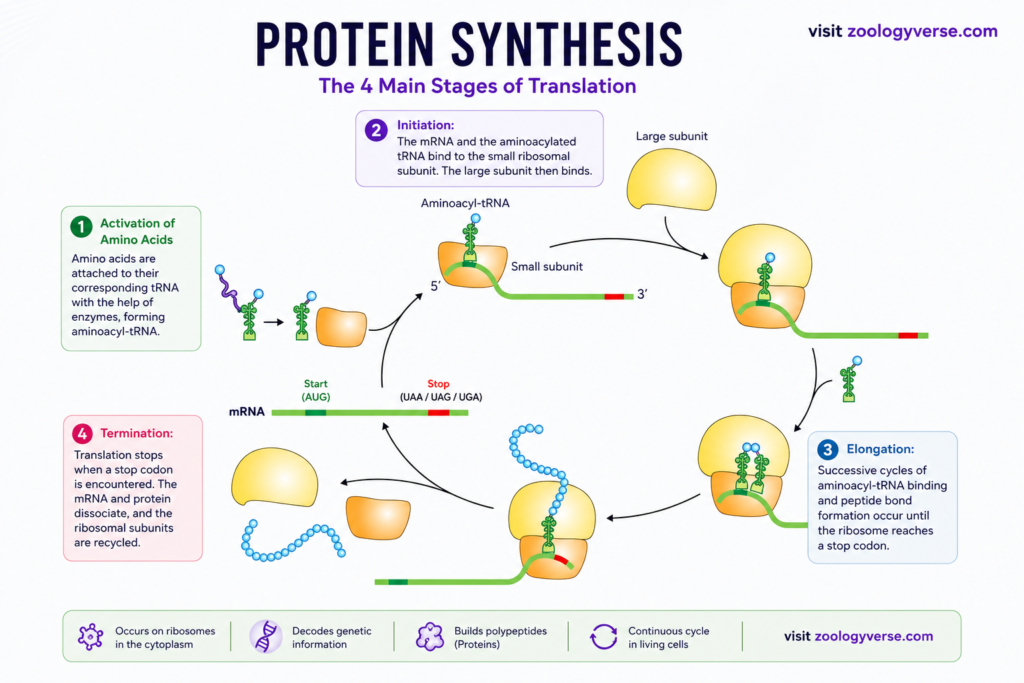
Translation itself is generally divided into three major stages:
- Initiation
- Elongation
- Termination
Before translation begins, however, amino acids must be correctly attached to their corresponding tRNAs. This amino-acid activation or tRNA charging is crucial for translation accuracy.
The Genetic Code
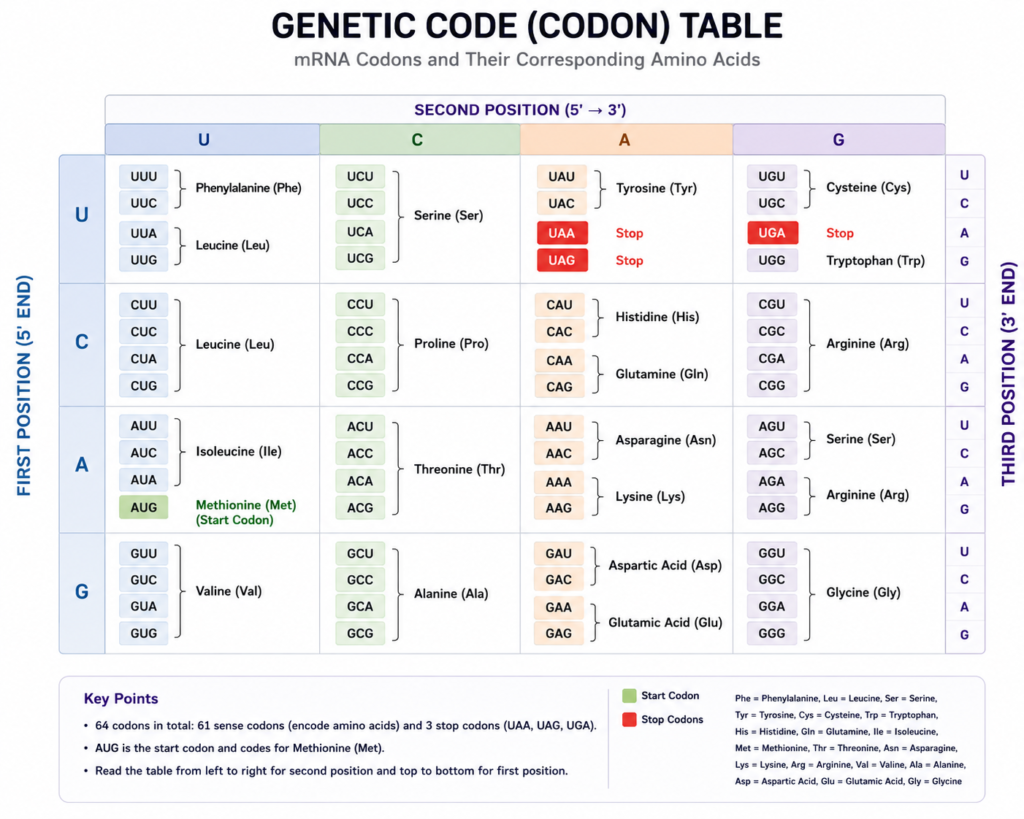
The genetic code is the set of rules used to convert the nucleotide sequence of mRNA into the amino-acid sequence of a protein.
mRNA contains four possible bases:
- Adenine (A)
- Uracil (U)
- Guanine (G)
- Cytosine (C)
Because three nucleotides are read together, there are:
4³ = 64 possible codons
Of these:
- 61 codons specify amino acids
- 3 codons function as stop signals
The three stop codons are:
- UAA
- UAG
- UGA
The usual start codon is:
AUG
AUG specifies methionine and establishes the reading frame for translation.
The genetic code is described as degenerate because most amino acids are specified by more than one codon. For example, phenylalanine is encoded by UUU and UUC.
Properties of the Genetic Code
The genetic code has several important characteristics.
Triplet Code
A codon consists of three consecutive nucleotides.
For example:
AUG → Methionine
Degenerate
More than one codon can specify the same amino acid.
This does not mean that a single codon specifies multiple amino acids. Instead, several different codons may have the same amino-acid meaning.
Unambiguous
Each standard codon has only one meaning: it specifies a particular amino acid or a termination signal.
Non-overlapping
In the standard reading frame, one nucleotide belongs to only one codon.
For example:
AUG-CCA-GUU
The bases are read as separate groups of three.
Nearly Universal
The standard genetic code is shared by almost all organisms, although some exceptions occur, particularly in certain mitochondrial genomes and a few other biological systems.
Commaless
Codons are read continuously without punctuation between individual codons.
Start and Stop Signals
AUG commonly establishes the beginning of translation, while UAA, UAG, and UGA signal termination.
Wobble Hypothesis
The wobble hypothesis explains why a relatively limited collection of tRNAs can recognize multiple codons.
Codon-anticodon pairing is highly specific at the first two positions, but pairing at the third position of the codon is more flexible.
This third codon position corresponds to the first position of the tRNA anticodon when the two sequences are aligned antiparallel.
This flexibility is called wobble.
One important example involves inosine (I), a modified base that can participate in pairing with more than one nucleotide. Wobble pairing therefore allows certain tRNAs to recognize multiple synonymous codons.
Why is wobble important?
Wobble:
- Reduces the number of different tRNAs required
- Allows efficient decoding of synonymous codons
- Helps explain the degeneracy of the genetic code
- Increases flexibility during translation
Importantly, wobble does not mean that codon recognition becomes random. The permitted pairings remain constrained by molecular structure and base-pairing rules.
Messenger RNA (mRNA)
Messenger RNA (mRNA) carries the protein-coding information from a gene to the ribosome.
The coding region of an mRNA contains an open reading frame (ORF), which is a continuous sequence of codons that can be translated into a polypeptide.
Translation proceeds along the mRNA in the:
5′ → 3′ direction
The resulting polypeptide is synthesized from its:
N-terminal end → C-terminal end
The source material describes ORFs as contiguous, non-overlapping codon sequences beginning with an initiation site and ending at a termination codon.
Important features of eukaryotic mRNA
Mature eukaryotic mRNA generally contains:
- A 5′ cap
- A 5′ untranslated region (UTR)
- A coding region
- A 3′ untranslated region (UTR)
- A poly(A) tail
The 5′ cap and poly(A) tail contribute to mRNA stability, processing, transport, and efficient translation.
Before mature mRNA is exported from the nucleus, precursor RNA commonly undergoes processing that includes:
- 5′ capping
- RNA splicing
- 3′ polyadenylation
This creates a mature transcript suitable for translation.
Transfer RNA (tRNA)
Transfer RNA (tRNA) acts as an adaptor between the nucleotide language of mRNA and the amino-acid language of proteins.
A tRNA has two especially important regions:
Anticodon
The anticodon is a three-nucleotide sequence that recognizes a complementary codon on mRNA.
Amino-Acid Attachment Site
The amino acid is attached to the 3′ end of tRNA, which contains the conserved terminal sequence:
CCA
A tRNA carrying an amino acid is called a:
charged tRNA or aminoacyl-tRNA
An uncharged tRNA lacks its amino acid.
tRNAs have characteristic secondary structures often represented as a cloverleaf, although their functional three-dimensional structure is more compact.
Ribosomes and Their Role in Protein Synthesis
The ribosome is the molecular machine where translation occurs.
Ribosomes consist of:
- Ribosomal RNA (rRNA)
- Ribosomal proteins
Both prokaryotic and eukaryotic ribosomes contain a small and a large subunit.
Prokaryotic ribosome
70S = 30S + 50S
Eukaryotic cytoplasmic ribosome
80S = 40S + 60S
The S values represent sedimentation coefficients and are not simple arithmetic measurements of molecular mass.
The ribosome contains three important tRNA-binding sites:
| Site | Name | Main function |
|---|---|---|
| A site | Aminoacyl site | Receives incoming aminoacyl-tRNA |
| P site | Peptidyl site | Holds the tRNA carrying the growing peptide |
| E site | Exit site | Releases uncharged tRNA |
The ribosome is not merely a passive platform. Its rRNA contributes directly to peptide-bond formation, making the ribosome a remarkable ribonucleoprotein machine.
Activation of Amino Acids
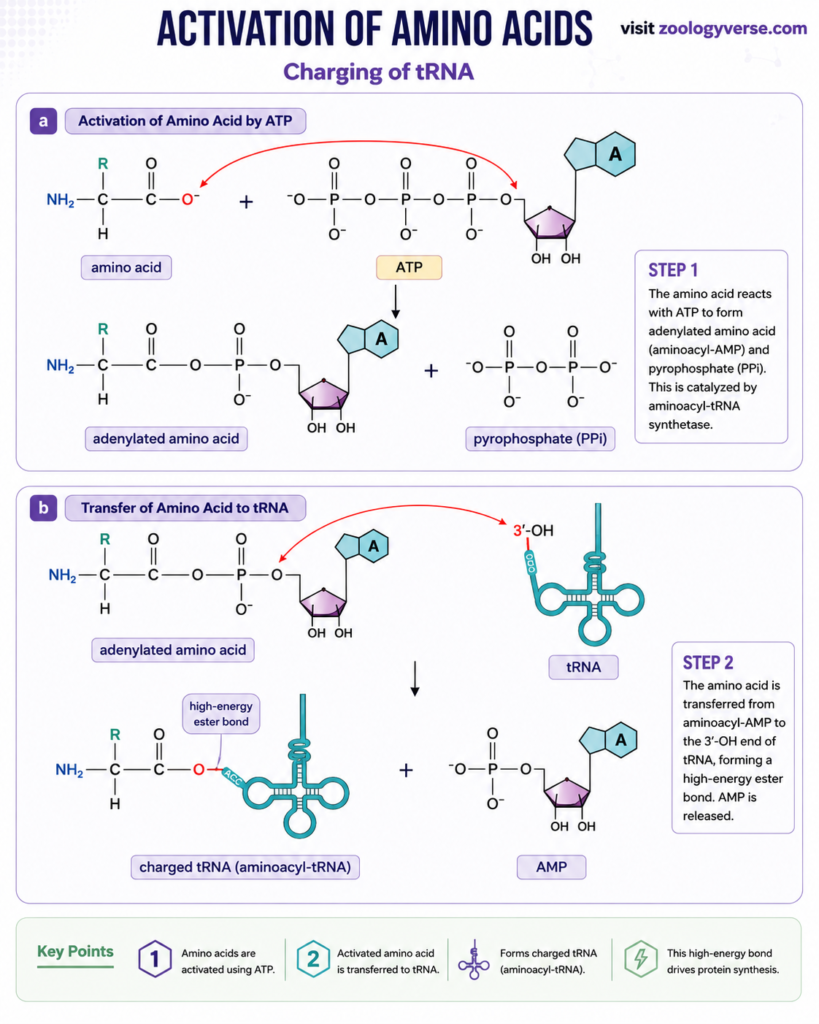
Before an amino acid can participate in translation, it must be attached to its correct tRNA.
This process is known as:
tRNA charging or aminoacylation
The reaction is catalyzed by an enzyme called:
aminoacyl-tRNA synthetase
There are generally specific synthetases corresponding to the standard amino acids.
Step 1: Amino Acid Activation
The amino acid reacts with ATP to form an activated intermediate called:
aminoacyl-AMP
Pyrophosphate (PPi) is released.
Step 2: Transfer to tRNA
The activated amino acid is transferred to the 3′ end of its appropriate tRNA.
The result is:
Amino acid + tRNA → aminoacyl-tRNA
The uploaded source describes these two steps and emphasizes that aminoacyl-tRNA synthetases are responsible for correctly attaching amino acids to their corresponding tRNAs.
This reaction is one of the most important accuracy checkpoints in protein synthesis. Many aminoacyl-tRNA synthetases also possess proofreading or editing mechanisms that help prevent incorrect amino acids from being attached to tRNAs.
Process of Translation
Translation converts the nucleotide sequence of mRNA into an amino-acid sequence.
It occurs in three main stages:
- Initiation
- Elongation
- Termination
Initiation
Initiation determines where translation begins.
The process differs between bacteria and eukaryotes, but the basic goal is the same: position the ribosome correctly at the start codon.
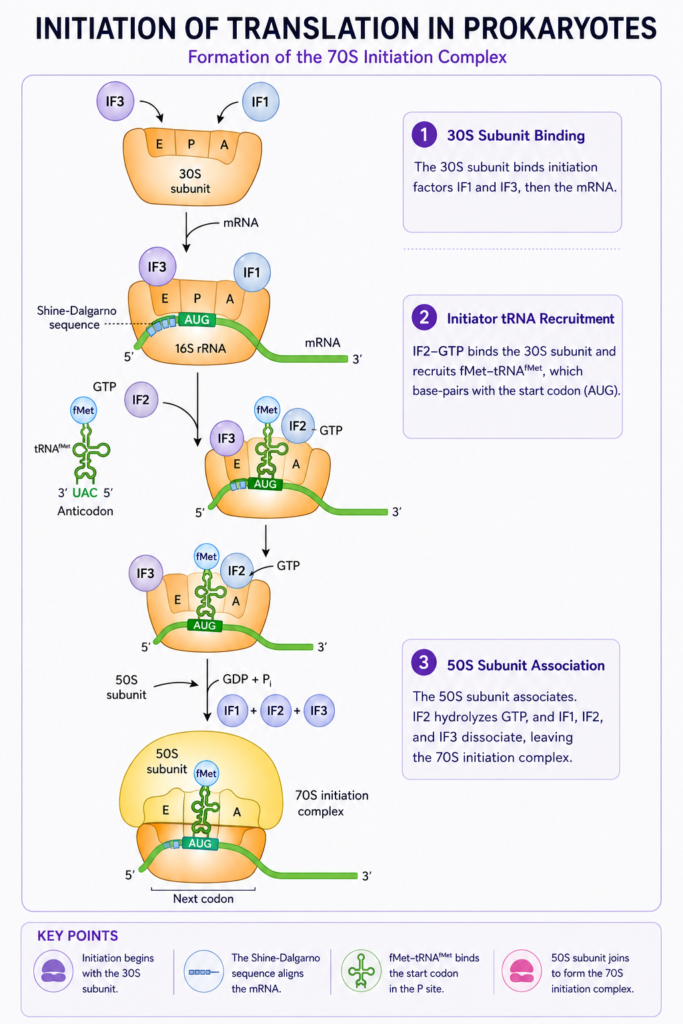
Initiation in bacteria
The bacterial small ribosomal subunit is the 30S subunit.
The mRNA associates with the small subunit, and a sequence called the Shine-Dalgarno sequence helps position the start codon.
The initiator tRNA carries N-formylmethionine (fMet) in bacteria.
The initiator tRNA pairs with the AUG start codon and occupies the P site.
The 50S large subunit then joins the complex to form the functional 70S initiation complex.
The bacterial initiation factors include:
- IF1
- IF2
- IF3
GTP hydrolysis helps drive assembly of the initiation complex.
The source document provides a detailed bacterial initiation sequence involving the Shine-Dalgarno sequence, 30S and 50S subunits, initiation factors, and fMet-tRNA.
Initiation in eukaryotes
Eukaryotic initiation involves the 40S small subunit, initiation factors, initiator Met-tRNA, and recognition of the mRNA 5′ end.
The 40S subunit scans the mRNA until it identifies an appropriate AUG initiation site in a favorable sequence context.
The 60S large subunit then joins to form the 80S ribosome.
Thus, bacterial and eukaryotic initiation share the same fundamental objective but use different molecular recognition mechanisms.
Elongation
Once the ribosome has been assembled at the start codon, the polypeptide chain begins to grow.
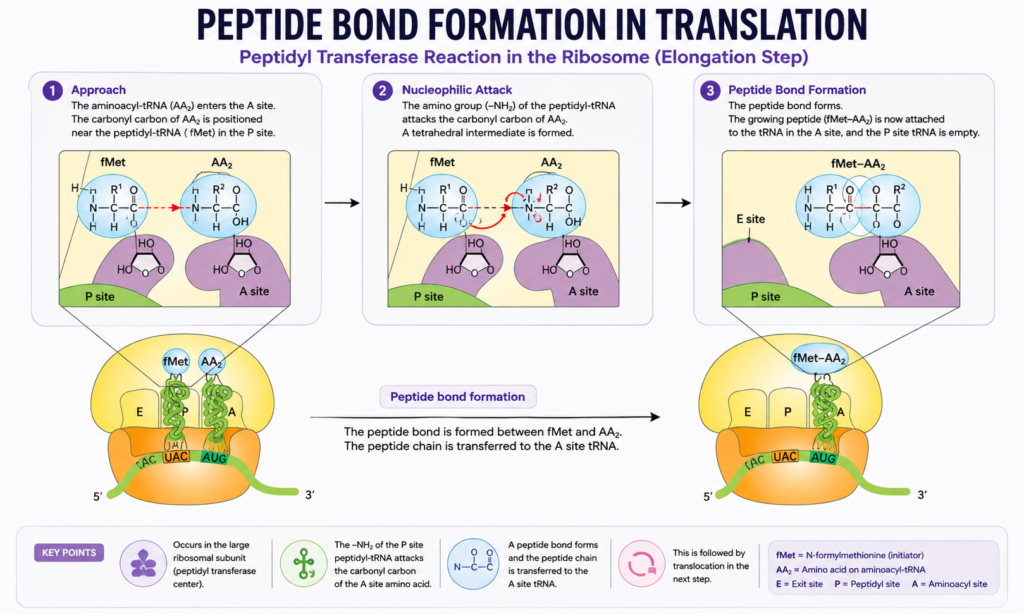
Each elongation cycle involves three major events:
- Aminoacyl-tRNA entry
- Peptide-bond formation
- Translocation
Step 1: Aminoacyl-tRNA entry
An aminoacyl-tRNA carrying the amino acid specified by the next mRNA codon enters the A site.
Its anticodon pairs with the corresponding mRNA codon.
In bacteria, EF-Tu-GTP helps deliver the incoming aminoacyl-tRNA to the ribosome.
Step 2: Peptide-bond formation
The growing peptide is transferred from the tRNA in the P site to the amino acid attached to the tRNA in the A site.
This produces a new peptide bond.
The catalytic activity is associated primarily with ribosomal RNA in the large subunit, making the ribosome a ribozyme.
Step 3: Translocation
The ribosome moves along the mRNA by one codon in the 5′ → 3′ direction.
The tRNAs shift:
A → P
and
P → E
The uncharged tRNA exits through the E site.
The newly formed peptidyl-tRNA occupies the P site, leaving the A site ready for the next aminoacyl-tRNA.
In bacteria, EF-G and GTP participate in this translocation step. The source document describes these elongation cycles and the requirement for GTP and bacterial elongation factors.
The cycle repeats until a stop codon enters the A site.
Termination
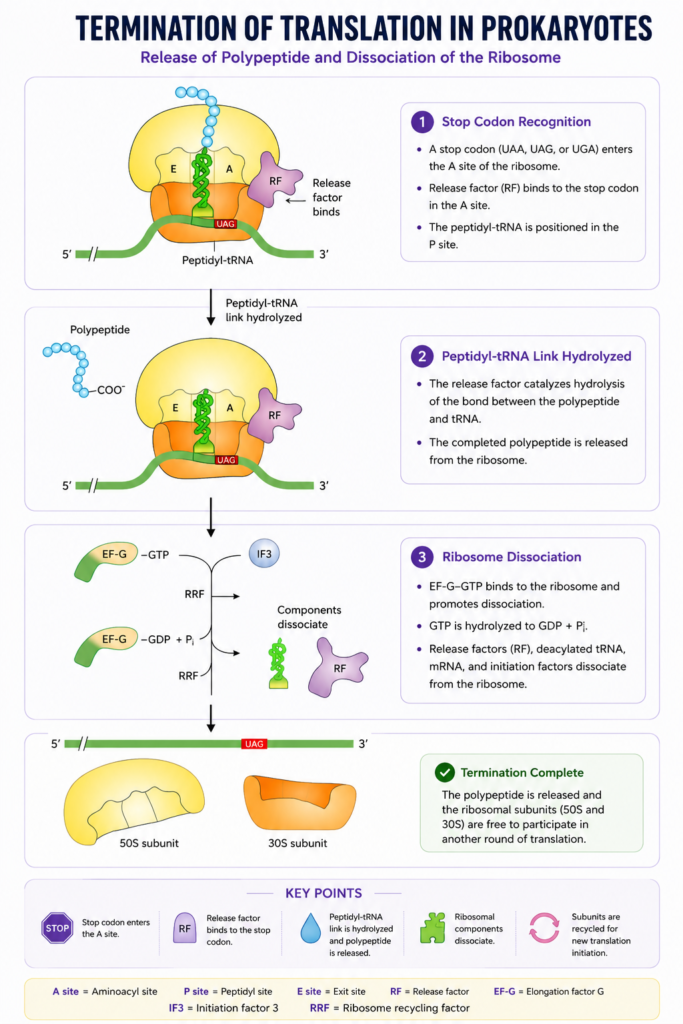
Translation ends when the ribosome encounters one of the three stop codons:
- UAA
- UAG
- UGA
Stop codons do not normally specify amino acids.
Instead, they are recognized by release factors.
When a release factor enters the A site, it promotes hydrolysis of the bond connecting the completed polypeptide to its tRNA.
The newly synthesized polypeptide is released.
The ribosomal complex then dissociates and its components can participate in another round of translation.
In bacteria, different release factors recognize different stop codons, whereas eukaryotic termination uses eukaryotic release-factor machinery capable of recognizing the standard stop signals.
Protein Synthesis in Prokaryotes vs Eukaryotes
Although the basic mechanism of translation is conserved, important differences exist between prokaryotic and eukaryotic cells.
| Feature | Prokaryotes | Eukaryotes |
|---|---|---|
| Main cytoplasmic ribosome | 70S | 80S |
| Small subunit | 30S | 40S |
| Large subunit | 50S | 60S |
| Initiator amino acid | fMet | Met |
| mRNA organization | Often polycistronic | Usually monocistronic |
| Ribosome recruitment | Often Shine-Dalgarno sequence | 5′ cap-dependent mechanisms and scanning |
| Transcription and translation | Can be coupled | Spatially separated |
| RNA processing | More limited | Extensive mRNA processing |
A major difference is cellular compartmentalization.
In bacteria, transcription and translation can occur in close temporal association because there is no membrane-bound nucleus.
In eukaryotes, transcription occurs primarily in the nucleus, whereas translation occurs mainly in the cytoplasm or on ribosomes associated with the rough endoplasmic reticulum.
Energy Requirement of Protein Synthesis
Protein synthesis requires substantial energy.
ATP is consumed during amino-acid activation, while GTP is used during several stages of translation.
Energy expenditure is associated with:
- Amino-acid activation
- Delivery of aminoacyl-tRNAs
- Ribosomal translocation
- Initiation
- Termination
- Recycling of translation machinery
For each amino acid incorporated into a growing polypeptide, the cell makes a significant energetic investment.
This energy requirement is not wasteful. High-energy reactions help drive the molecular machinery and contribute to the fidelity and directionality of protein synthesis.
Accuracy and Quality Control
Protein synthesis must be highly accurate because even a single incorrect amino acid can alter protein folding or function.
Quality control occurs at several levels.
Aminoacyl-tRNA synthetases
These enzymes select the correct amino acid and attach it to the appropriate tRNA.
Some synthetases possess editing mechanisms that remove incorrectly attached amino acids.
Codon-Anticodon Recognition
The ribosome checks whether the incoming tRNA appropriately matches the mRNA codon.
Translation Quality Control
Cells possess mechanisms that detect stalled or abnormal translation complexes.
Protein Quality Control
After synthesis, proteins can be:
- Folded
- Modified
- Transported
- Assembled
- Refolded
- Degraded if defective
The fidelity of aminoacyl-tRNA formation is particularly important because the ribosome largely relies on the identity of the charged tRNA presented to it.
Protein Folding and Post-Translational Processing
Translation produces a polypeptide, but a newly synthesized polypeptide is not necessarily a fully functional protein immediately.
The polypeptide must often acquire its correct three-dimensional structure.
Protein folding can occur during and after translation.
Some proteins require molecular chaperones to assist proper folding.
Proteins may also undergo post-translational modifications, including:
- Phosphorylation
- Glycosylation
- Acetylation
- Methylation
- Proteolytic cleavage
- Lipid modification
- Disulfide-bond formation
Some proteins must also be transported to specific locations such as:
- Nucleus
- Mitochondria
- Lysosomes
- Plasma membrane
- Endoplasmic reticulum
- Extracellular space
Therefore, the complete pathway is better represented as:
DNA → RNA → polypeptide → folding/modification → functional protein
Protein maturation after translation is an essential part of producing functional cellular proteins.
Ribosomal Rescue
Translation does not always proceed normally.
A ribosome can become stalled if an mRNA is damaged, incomplete, or lacks an appropriate termination signal.
One important bacterial rescue mechanism is trans-translation.
During trans-translation:
- The stalled ribosome is recognized.
- tmRNA and SmpB participate in rescuing the ribosome.
- Translation can resume using the tmRNA template.
- A termination signal allows the ribosome to complete the rescue process.
- The defective translation product can be targeted for degradation.
- The ribosome is recycled.
The uploaded source specifically describes the bacterial tmRNA-SmpB system and its role in rescuing ribosomes from non-stop complexes.
Ribosomal rescue is an important example of cellular quality control because stalled ribosomes can otherwise become trapped and reduce the efficiency of protein synthesis.
Regulation of Protein Synthesis
Cells do not produce every protein at the same rate.
Protein synthesis is regulated according to:
- Nutrient availability
- Energy status
- Developmental stage
- Cell type
- Environmental conditions
- Hormonal signals
- Cellular stress
- Growth requirements
One of the most important control points is translation initiation.
If initiation is increased, more ribosomes can translate a particular mRNA, resulting in greater protein production.
Translation can also be regulated through:
- RNA-binding proteins
- microRNAs
- mRNA stability
- Ribosome availability
- Initiation-factor activity
- Cellular signaling pathways
- Amino-acid availability
This allows cells with the same genome to produce different sets and quantities of proteins.
Biological Importance of Protein Synthesis
Protein synthesis is essential for life because proteins are involved in virtually every aspect of cellular organization and physiology.
Growth :- New proteins are required for cell growth and division.
Development :- Changes in gene expression and protein production help determine developmental patterns.
Metabolism :- Most metabolic pathways depend on enzymes, which are proteins.
Repair :- Damaged cellular structures require newly synthesized proteins for repair and replacement.
Movement :- Motor proteins such as myosin and related proteins contribute to cellular and organismal movement.
Defense :- Antibodies and numerous components of innate immunity are proteins.
Cell Communication :- Receptors, channels, signaling proteins, and transcription regulators coordinate cellular responses.
Adaptation :- Changes in protein expression allow organisms to respond to environmental changes.
Protein synthesis therefore connects genetic information with the observable characteristics and physiological functions of cells.
Key Takeaways
- Protein synthesis is the process of producing polypeptides according to genetic instructions.
- DNA information is expressed through transcription and translation.
- mRNA carries coding information to the ribosome.
- tRNA acts as an adaptor between mRNA codons and amino acids.
- rRNA and ribosomal proteins form the molecular machinery of the ribosome.
- The genetic code contains 64 codons, including 61 sense codons and 3 stop codons.
- AUG commonly functions as the start codon.
- UAA, UAG, and UGA are stop codons.
- Wobble pairing allows some tRNAs to recognize more than one codon.
- Amino acids are attached to tRNAs by aminoacyl-tRNA synthetases.
- Translation occurs through initiation, elongation, and termination.
- The ribosome reads mRNA in the 5′ → 3′ direction.
- The polypeptide grows from its N-terminal end toward its C-terminal end.
- Translation requires both ATP and GTP.
- Release factors terminate translation at stop codons.
- A newly synthesized polypeptide may require folding and post-translational modification before becoming functional.
- Ribosomal rescue mechanisms help cells recover stalled translation complexes.
- Accurate protein synthesis is essential for normal cellular function.
Frequently Asked Questions
What is protein synthesis?
Protein synthesis is the cellular process through which genetic information is used to produce a specific polypeptide. It involves transcription of DNA into RNA and translation of mRNA into an amino-acid sequence at the ribosome.
What are the main steps of protein synthesis?
The major stages of protein synthesis include transcription, amino-acid activation, translation initiation, elongation, termination, and the subsequent folding and processing of the newly synthesized polypeptide.
What is the role of mRNA in protein synthesis?
Messenger RNA (mRNA) carries genetic information from DNA to the ribosome. Its nucleotide sequence is read in groups of three called codons, which determine the order of amino acids in the growing polypeptide.
What is the role of tRNA in protein synthesis?
Transfer RNA (tRNA) acts as an adaptor between mRNA codons and amino acids. Its anticodon recognizes a complementary codon on mRNA while the tRNA carries the corresponding amino acid to the ribosome.
What is the genetic code?
The genetic code is the set of rules by which mRNA codons specify amino acids or translation termination signals. There are 64 possible codons, including 61 sense codons and three stop codons.
What are the three stages of translation?
Translation occurs through three major stages: initiation, elongation, and termination. During initiation, the ribosome assembles at the start codon; during elongation, amino acids are added to the growing polypeptide; and during termination, the completed polypeptide is released at a stop codon.
What is the start codon in protein synthesis?
AUG is the standard start codon. It specifies methionine and establishes the reading frame for translation.
What are the stop codons in protein synthesis?
The three standard stop codons are UAA, UAG, and UGA. They signal the end of translation and are recognized by release factors rather than ordinary tRNAs.
What is the wobble hypothesis?
The wobble hypothesis explains flexible base pairing between the third nucleotide of an mRNA codon and the corresponding position of a tRNA anticodon. This allows some tRNAs to recognize more than one codon.
What happens after translation is completed?
After translation, the newly synthesized polypeptide may fold into its functional three-dimensional structure and undergo post-translational modifications, processing, assembly, or transport to its appropriate cellular location.
Conclusion
Protein synthesis is a highly coordinated molecular process that connects genetic information with cellular structure and function. The information stored in DNA is first expressed through RNA and then decoded by ribosomes to produce a specific sequence of amino acids.
The process depends on the coordinated functions of mRNA, tRNA, rRNA, ribosomes, aminoacyl-tRNA synthetases, translation factors, and release factors. The genetic code provides the rules for converting nucleotide information into amino-acid sequences, while wobble pairing allows efficient recognition of synonymous codons.
Translation proceeds through initiation, elongation, and termination. However, protein production does not necessarily end when the ribosome releases a polypeptide. The newly synthesized chain may need to fold, undergo post-translational modifications, assemble with other proteins, and reach the correct cellular destination before it becomes fully functional.
Protein synthesis is therefore best understood as a complete pathway of information transfer, molecular decoding, polypeptide assembly, quality control, and protein maturation.
Understanding this pathway provides a foundation for studying genetics, molecular biology, biochemistry, developmental biology, physiology, evolution, biotechnology, and many aspects of disease biology.
References
- NCBI Bookshelf. Biochemistry, Protein Synthesis.
- NCBI Bookshelf. The Cell: A Molecular Approach – Translation of mRNA.
- NCBI Bookshelf. The Cell: A Molecular Approach – Expression of Genetic Information.
- NCBI Bookshelf. Molecular Biology of the Cell – From RNA to Protein.
- NCBI Bookshelf – From DNA to RNA
- Nelson DL, Cox MM. Lehninger Principles of Biochemistry.
- Alberts B, et al. Molecular Biology of the Cell.
- Watson JD, et al. Molecular Biology of the Gene.
Discover more from Zoologyverse
Subscribe to get the latest posts sent to your email.