
Phylum Porifera
Phylum Porifera is a group of simple aquatic animals commonly known as sponges. The name Porifera means “pore-bearing”, referring to the numerous small openings present throughout their body.
Sponges are among the simplest animals in terms of body organization. They have a cellular level of organization and do not possess true tissues, organs, or organ systems. Their body is adapted for a continuous flow of water through a system of pores, canals, and chambers.
Most poriferans are marine, although some species some species occur in freshwater sponges such as Spongilla. They are generally sessile as adults and remain attached to rocks, shells, submerged surfaces, or other suitable substrates.
The water current passing through their body helps them obtain food, exchange gases, remove wastes, and carry out other essential functions.
At a Glance: Phylum Porifera
| Feature | Description |
|---|---|
| Kingdom | Animalia |
| Phylum | Porifera |
| Common name | Sponges |
| Habitat | Mostly marine; some freshwater |
| Organization | Cellular level |
| Symmetry | Mostly asymmetrical; some are radially symmetrical |
| Body | Porous with canals and chambers |
| Digestion | Intracellular |
| Nutrition | Filter feeding |
| Skeleton | Spicules and/or spongin |
| Respiration | By diffusion |
| Circulation | No specialized circulatory system |
| Excretion | Mainly by diffusion |
| Reproduction | Sexual and asexual |
| Adult condition | Generally sessile |
What is Phylum Porifera?
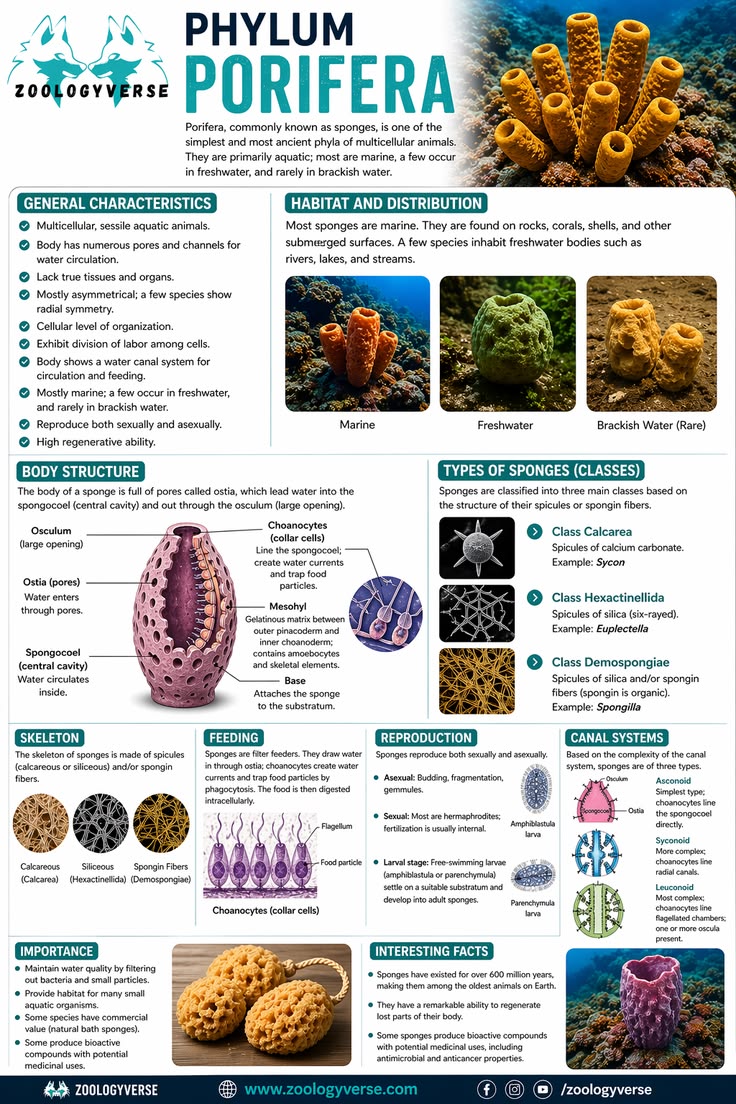
Phylum Porifera comprises aquatic, pore-bearing animals commonly called sponges. Their body contains numerous small openings called ostia, through which water enters. Water eventually leaves through one or more larger openings called oscula.
Poriferans have a cellular level of organization. Unlike animals with well-developed organs, their body functions are performed by specialized cells working together.
One of the most important cell types in sponges is the choanocyte or collar cell. The beating of its flagellum helps generate water currents and contributes to filter feeding.
Are Sponges Animals?
Yes, sponges are animals. They belong to Kingdom Animalia and are classified under Phylum Porifera.
Although they are very simple compared with most other animals, sponges are multicellular organisms with specialized cell types. Adult sponges are generally attached to a substrate and obtain food by filtering particles from water.
General Characteristics of Phylum Porifera
The major characteristics of Porifera are as follows:
1. Aquatic Animals
All poriferans are aquatic. Most species are found in marine environments, while some, such as Spongilla, occur in freshwater.
2. Sessile Adults
Adult sponges are generally sessile, meaning they remain attached to a suitable surface rather than moving freely from place to place.
3. Cellular Level of Organization
Poriferans have a cellular level of organization. Their cells are specialized for different functions, but they do not form true tissues and organs.
4. Porous Body
The body contains numerous small pores called ostia. These openings allow water to enter the canal system.
5. Canal System
A characteristic feature of sponges is their water-current or canal system. Water enters through ostia, passes through canals and chambers, and generally leaves through the osculum.
6. Choanocytes
Choanocytes, or collar cells, line the appropriate chambers or internal surfaces of the sponge. Their flagella produce water currents and help trap food particles.
7. Digestion Is Intracellular
Sponges do not possess a digestive tract. Food is captured and digested inside cells.
8. Filter Feeders
Sponges obtain food by filtering suspended particles from water. Their food may include bacteria, microscopic organisms, organic particles, and other small materials.
9. No Nervous System
Poriferans do not possess a true nervous system. Coordination occurs through local cellular and chemical interactions.
10. No Specialized Circulatory System
There is no specialized circulatory system. The movement of water through the canal system helps transport nutrients and gases.
11. Respiration by Diffusion
Gas exchange occurs mainly through diffusion as water moves through the body.
12. Excretion by Diffusion
Nitrogenous wastes and other metabolic waste products are released mainly by diffusion into the surrounding water.
13. Skeleton
The skeleton may consist of calcareous spicules, siliceous spicules, spongin fibers, or combinations of these, depending on the group.
14. Reproduction
Sponges reproduce by both asexual and sexual methods.
Asexual reproduction may occur through:
- Budding
- Fragmentation
- Gemmule formation
Sexual reproduction generally involves the formation of sperm and eggs.
15. Regeneration
Many sponges have a remarkable ability to regenerate damaged or separated parts of their body.
Body Structure of Porifera
The body of a sponge may appear simple externally, but it contains a specialized system through which water continuously flows.
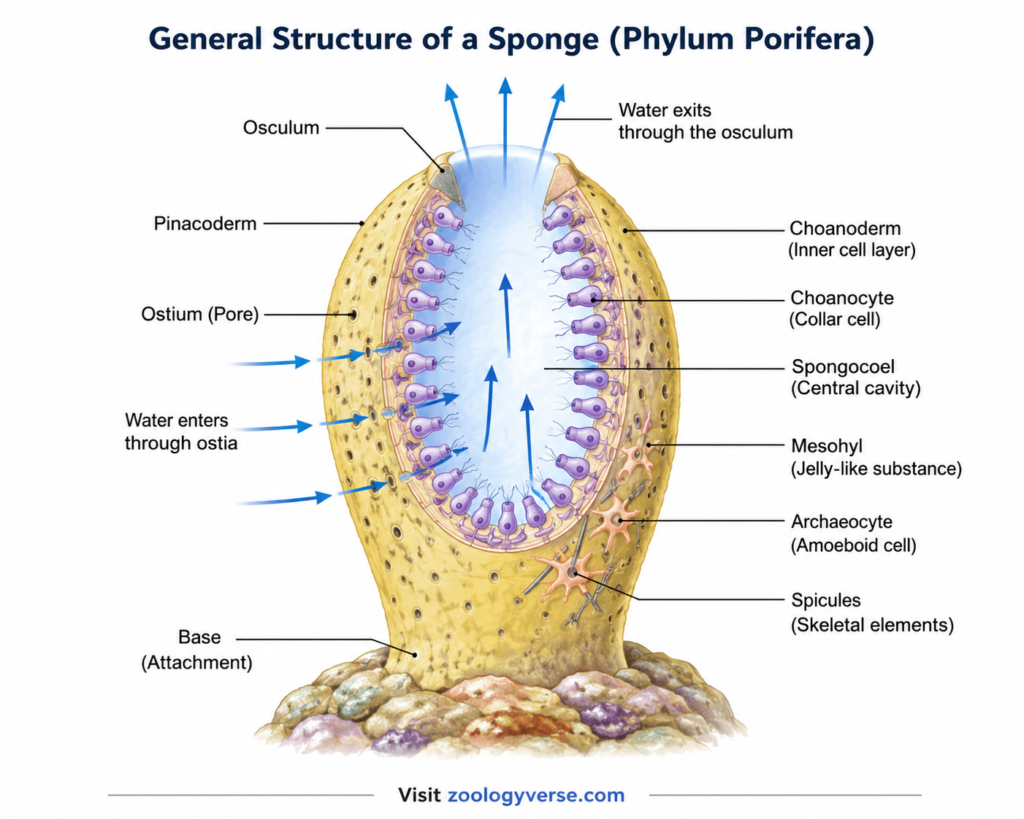
Important structures include:
- Ostia
- Incurrent canals
- Radial canals or flagellated chambers
- Spongocoel
- Osculum
- Mesohyl
- Pinacocytes
- Choanocytes
- Archaeocytes or amoeboid cells
- Skeletal elements
Ostia
Ostia are small pores through which water enters the sponge.
They may occur directly on the body surface or may connect with an internal canal system.
Osculum
The osculum is a relatively large opening through which water leaves the sponge.
Thus, in a simple form:
Water enters through ostia → passes through the canal system → exits through the osculum.
Spongocoel
The spongocoel is the central cavity in simple sponge body plans. Its structure and importance vary with the type of canal system.
Mesohyl
The mesohyl is a gelatinous matrix located between the outer and inner cellular layers. It contains various cells and skeletal components.
Pinacocytes
Pinacocytes are flattened cells forming much of the outer covering of the sponge.
Choanocytes
Choanocytes are specialized flagellated cells characterized by a flagellum surrounded by a collar.
They play an important role in:
- Generating water currents
- Capturing food particles
- Filter feeding
Archaeocytes
Archaeocytes, also called amoeboid cells in many zoological descriptions, occur in the mesohyl and perform several functions, including nutrient distribution and regeneration.
Canal System in Porifera
The canal system is one of the most important adaptations of sponges.
It allows water to move continuously through the body. This water current provides food and oxygen and helps remove metabolic wastes.
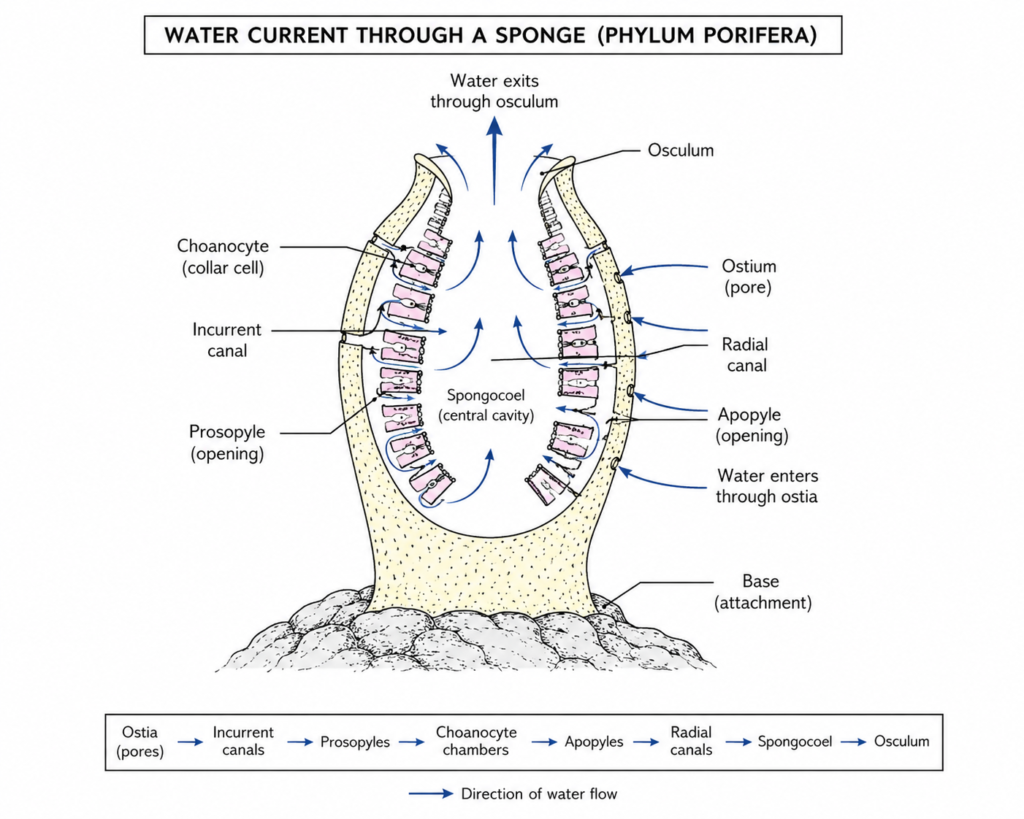
Three classical types of canal organization are commonly described:
- Asconoid
- Syconoid
- Leuconoid
1. Asconoid Canal System
The asconoid condition represents the simplest type of sponge canal organization.
Water follows a relatively direct pathway:
Ostia → Spongocoel → Osculum
The spongocoel is lined by choanocytes in the classical asconoid arrangement.
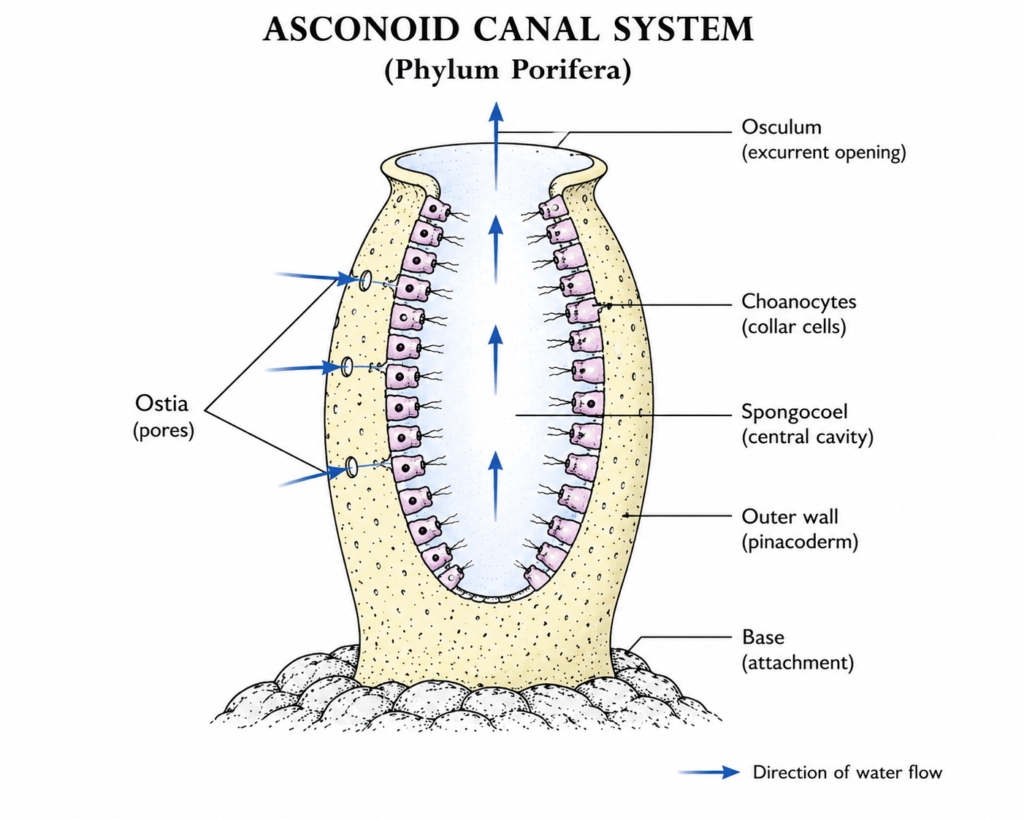
Example: Leucosolenia
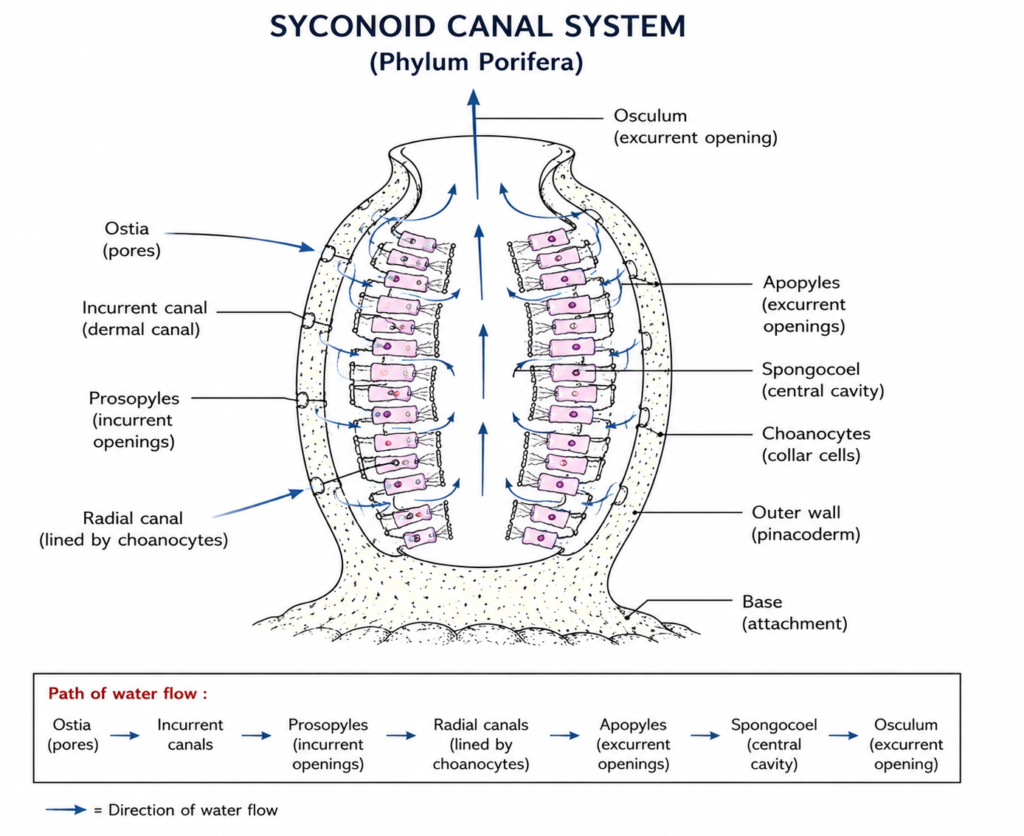
2. Syconoid Canal System
The syconoid condition is more complex than the asconoid type.
The body wall is folded to form canals, increasing the area available for choanocytes.
A simplified pathway is:
Ostia → Incurrent canals → Prosopyles → Radial canals → Apopyles → Spongocoel → Osculum
Example: Sycon
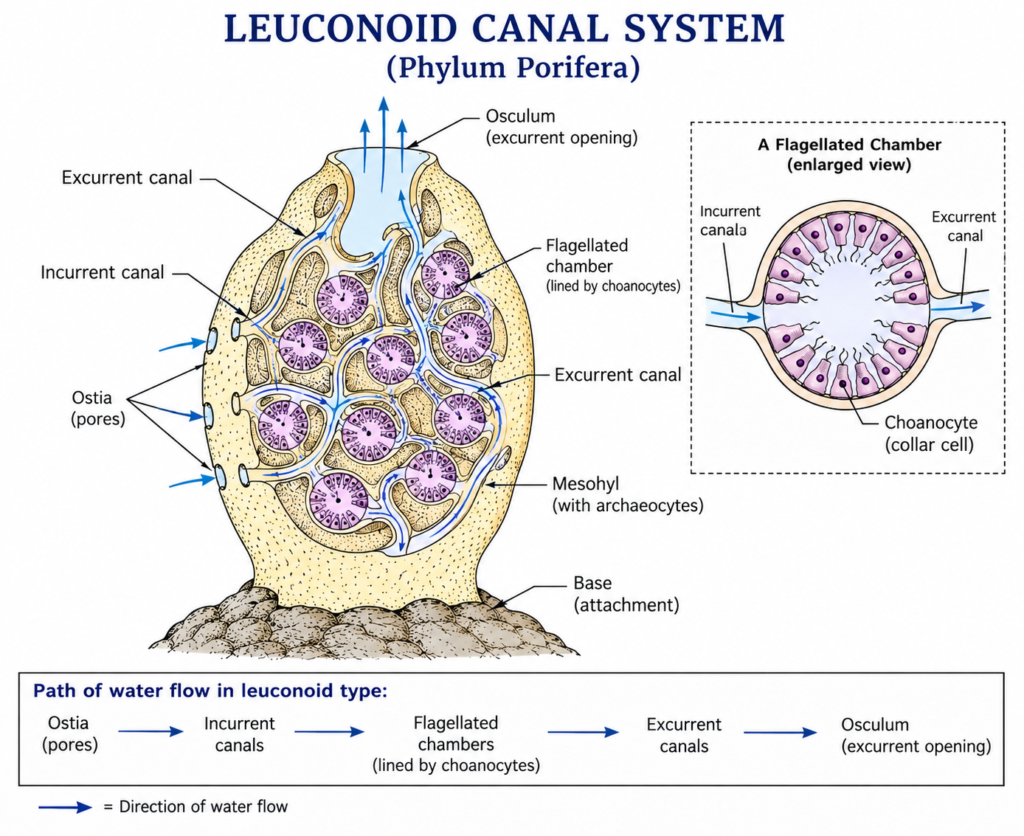
3. Leuconoid Canal System
The leuconoid condition is the most complex of the three classical canal arrangements.
The body contains numerous small flagellated chambers lined with choanocytes. These chambers increase the filtering surface and allow a highly efficient water-current system.
A simplified pathway is:
Ostia → Incurrent canals → Flagellated chambers → Excurrent canals → Osculum
Examples: Spongilla and Euspongia
Canal Systems Compared
| Feature | Asconoid | Syconoid | Leuconoid |
|---|---|---|---|
| Complexity | Simplest | Intermediate | Most complex |
| Body wall | Thin | Folded | Highly folded |
| Choanocyte location | Spongocoel | Radial canals | Flagellated chambers |
| Spongocoel | Large | Reduced | Highly reduced/modified |
| Example | Leucosolenia | Sycon | Spongilla, Euspongia |
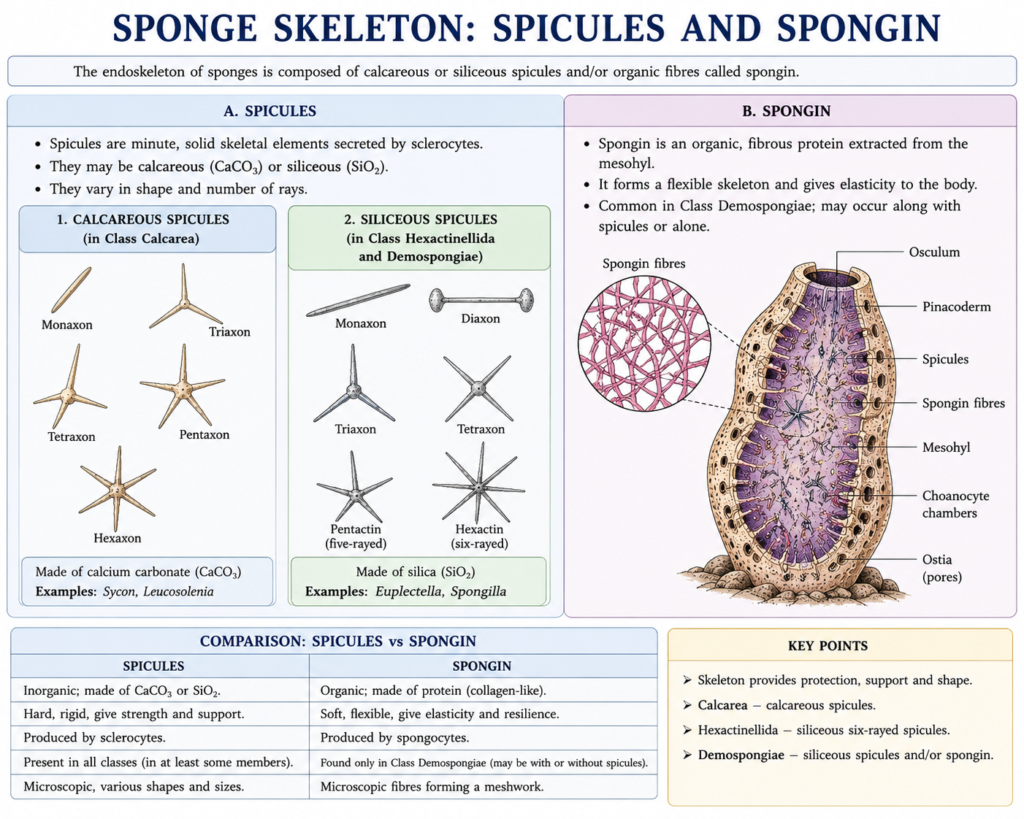
Skeleton of Porifera
The skeleton provides support and helps maintain the shape of the sponge.
It may consist of:
Spicules
Spicules are microscopic skeletal structures that may be composed mainly of:
- Calcium carbonate
- Silica
Their shape and arrangement vary among different groups.
Spongin
Spongin is a proteinaceous skeletal material forming a network of fibers in many demosponges.
The composition of the skeleton is an important feature used in the classification of sponges.
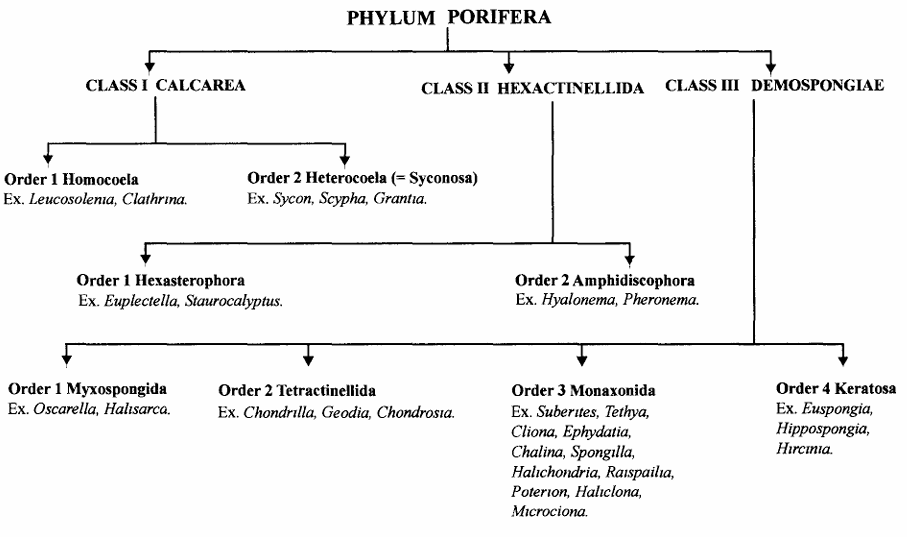
Classification of Phylum Porifera
In the traditional zoological classification commonly used in undergraduate studies, Porifera is divided into three major classes:
- Calcarea
- Hexactinellida
- Demospongiae
Class Calcarea
Calcarea includes calcareous sponges whose skeleton contains calcium carbonate spicules.
Important features
- Mostly marine
- Usually small
- Skeleton composed of calcareous spicules
- Spicules may be one-, three-, or four-rayed
Examples
Class Hexactinellida
Hexactinellids are commonly called glass sponges.
Important features
- Mostly marine
- Many occur in deeper waters
- Skeleton consists mainly of siliceous spicules
- Spicules are characteristically six-rayed in the classical description
Examples
Class Demospongiae
Demospongiae is a large and diverse group of sponges.
Important features
- Mostly marine
- Some freshwater species occur
- Skeleton may contain siliceous spicules, spongin fibers, or both
- Body forms are highly diverse
Examples
Classification at a Glance
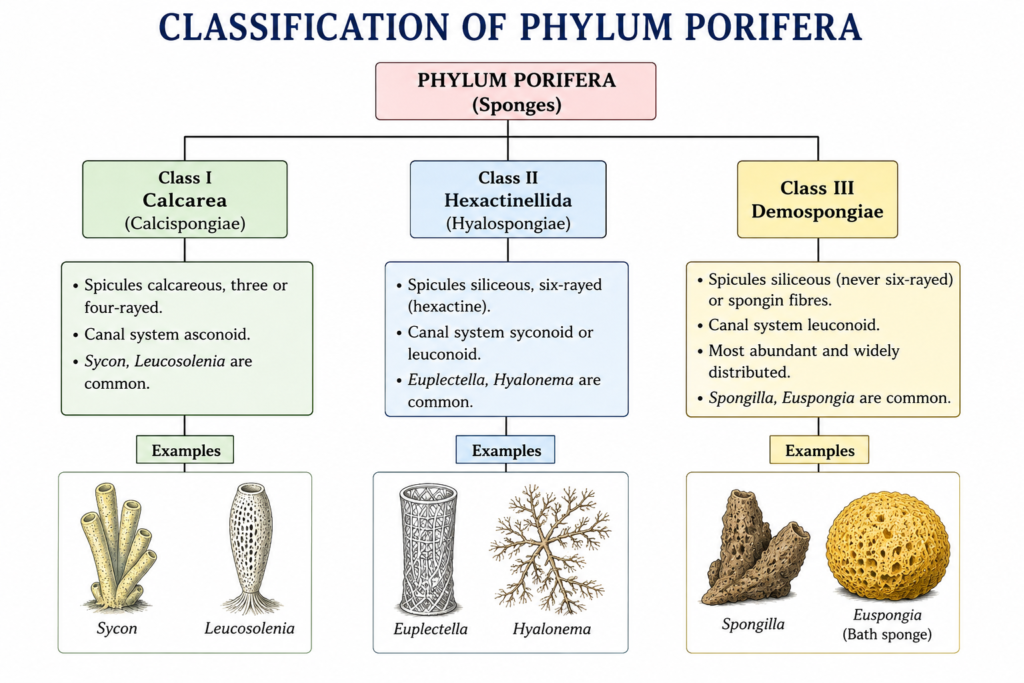
| Class | Main skeletal feature | Habitat | Examples |
|---|---|---|---|
| Calcarea | Calcareous spicules | Marine | Sycon, Leucosolenia |
| Hexactinellida | Siliceous spicules | Mainly marine/deep water | Euplectella, Hyalonema |
| Demospongiae | Siliceous spicules and/or spongin | Mostly marine; some freshwater | Spongilla, Euspongia |
Examples of Phylum Porifera
Important examples of Porifera include:
A calcareous sponge commonly used as an example of the syconoid canal system.
A simple calcareous sponge commonly associated with the asconoid canal system.
A well-known freshwater sponge belonging to Demospongiae.
Commonly known as a bath sponge and traditionally used as an example of Demospongiae.
Known as the Venus’ flower basket, it is a glass sponge belonging to Hexactinellida.
Another example of a glass sponge.
Nutrition in Porifera
Sponges are mainly filter feeders.
Water continuously enters the body through the ostia. Suspended food particles are trapped by cells, particularly choanocytes.
The food is then taken into cells and digested intracellularly.
Simplified feeding process
Water enters → food particles are filtered → particles are captured → food is digested inside cells → nutrients are distributed
The continuous water current is therefore essential to the life of a sponge.
Respiration in Porifera
Sponges do not possess specialized respiratory organs.
Oxygen dissolved in the incoming water reaches cells mainly through diffusion.
Carbon dioxide produced during cellular respiration diffuses into the surrounding water.
The continuous movement of water through the canal system helps maintain this exchange.
Excretion in Porifera
Poriferans also lack specialized excretory organs.
Metabolic waste products are released mainly by diffusion into the water passing through the body.
Reproduction in Porifera
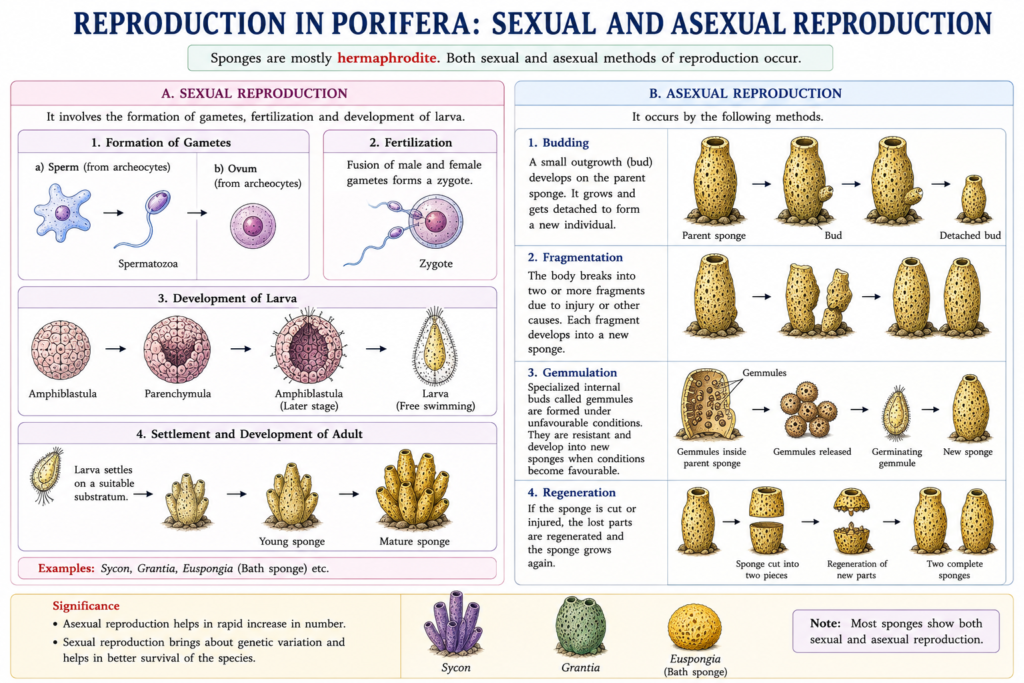
Porifera reproduce by both asexual and sexual methods.
Asexual Reproduction
Budding
A small outgrowth develops from the parent body and may eventually separate to form a new individual.
Fragmentation
A fragment separated from the parent may develop into a new sponge under suitable conditions.
Gemmule Formation
Some freshwater sponges form resistant structures called gemmules.
Gemmules help the organism survive unfavorable environmental conditions and can later develop into new sponges when conditions become favorable.
Sexual Reproduction
Many sponges are hermaphroditic, meaning the same individual may produce both sperm and eggs, although their maturation may occur at different times.
Sperm are generally released into the water and may enter another sponge with the incoming water current.
Fertilization occurs internally in many sponges.
The resulting embryo develops into a larval stage. The larva is capable of swimming and eventually settles on a suitable surface, where it develops into an adult sponge.
Evolutionary Significance of Porifera
Poriferans are important in studies of animal evolution because they possess a relatively simple body organization while having several specialized cell types.
Their cellular organization, feeding mechanisms, reproduction, and developmental biology provide important information for understanding the early evolution and diversification of animals.
Rather than describing sponges simply as “living fossils,” it is more accurate to discuss them as an important early-diverging lineage of animals whose biology helps researchers study animal evolution.
Ecological Importance of Porifera
Sponges play important roles in aquatic ecosystems.
1. Water Filtration
Their filter-feeding activity removes suspended particles and microorganisms from water.
2. Habitat
Some organisms live in or around sponge tissues and use them as shelter.
3. Nutrient Cycling
Sponges participate in the movement and recycling of nutrients within aquatic ecosystems.
4. Food-Web Interactions
Sponges interact with other organisms as competitors, hosts, prey, or habitat-forming organisms.
Economic and Scientific Importance of Porifera
Sponges are also important from economic and scientific perspectives.
Bath Sponges
Some sponges have historically been harvested and used as natural bath sponges.
Biomedical Research
Marine sponges have attracted scientific interest because they produce a wide range of biologically active chemical compounds.
Research Organisms
Sponges are useful organisms for studying:
- Cell specialization
- Regeneration
- Development
- Animal evolution
- Symbiotic relationships
Difference Between Ostia and Osculum
| Ostia | Osculum |
|---|---|
| Small pores | Larger opening |
| Water generally enters through them | Water generally leaves through it |
| Numerous in most sponges | Usually fewer in number |
| Located on the body surface or associated with incurrent pathways | Opens to the exterior |
Key Takeaways
- Porifera are commonly called sponges.
- They are aquatic animals.
- Most species are marine.
- Some species are freshwater.
- They have a cellular level of organization.
- They lack true tissues and organs.
- Their body contains numerous ostia.
- Water generally leaves through the osculum.
- Choanocytes generate water currents and help in filter feeding.
- Digestion is mainly intracellular.
- The skeleton contains spicules and/or spongin.
- Classical canal systems are asconoid, syconoid, and leuconoid.
- Reproduction is sexual and asexual.
- Examples include Sycon, Spongilla, Euspongia, and Euplectella.
Frequently Asked Questions
What is Phylum Porifera?
Phylum Porifera is a group of aquatic animals commonly called sponges. They have a porous body, cellular level of organization, and a specialized water-current system.
Why are sponges called Porifera?
Phylum Porifera is a group of aquatic animals commonly called sponges. They have a porous body, cellular level of organization, and a specialized water-current system.
Are sponges animals?
Yes. Sponges are multicellular animals belonging to Kingdom Animalia and Phylum Porifera.
What are the main characteristics of Porifera?
Major characteristics include a porous aquatic body, cellular level of organization, absence of true tissues and organs, filter feeding, choanocytes, a canal system, intracellular digestion, and sexual and asexual reproduction.
What are the three types of canal systems in Porifera?
The three classical types are:
- Asconoid
- Syconoid
- Leuconoid
What are choanocytes?
Choanocytes, or collar cells, are specialized flagellated cells that generate water currents and help capture food particles.
What is the function of the osculum?
The osculum is an opening through which water generally exits the sponge.
What is the skeleton of Porifera made of?
Depending on the group, the skeleton may contain calcium carbonate spicules, siliceous spicules, spongin fibers, or combinations of these.
What are examples of Porifera?
Examples include Sycon, Leucosolenia, Spongilla, Euspongia, Euplectella, and Hyalonema.
Where do Porifera live?
Most poriferans are marine, but some species, such as Spongilla, occur in freshwater.
How do sponges reproduce?
Sponges reproduce both sexually and asexually. Asexual reproduction may occur through budding, fragmentation, and gemmule formation, while sexual reproduction involves sperm, eggs, fertilization, and larval development.
Conclusion
Phylum Porifera includes the simple aquatic animals commonly known as sponges. Their porous body, cellular level of organization, choanocytes, canal system, intracellular digestion, and specialized skeleton distinguish them from more complex animal groups.
The three classical canal systems—asconoid, syconoid, and leuconoid—illustrate increasing structural complexity in sponge organization. Poriferans also show diverse methods of reproduction and possess important ecological and scientific significance.
Because of their simple yet highly specialized cellular organization, sponges remain important organisms in the study of animal biology, evolution, development, regeneration, and aquatic ecosystems.
References
- Porifera – Overview on ScienceDirect
- Borchiellini et al., Porifera (Sponges): Recent Knowledge and New Perspectives – Wiley
- Phylum Porifera | manoa.hawaii.edu
- Hooper J.N.A. et al., Zootaxa 20 years: Phylum Porifera (2021)
- Yang et al., Development of a multilocus-based approach for sponge phylogeny – PMC
- Wörheide, Deep Phylogeny and Evolution of Sponges – ScienceDirect
Recommended Study Resource
Rastogi Publications MODERN TEXT BOOK OF ZOOLOGY: INVERTEBRATES
Useful for broader study of Porifera, invertebrate classification, structure, and related zoological topics.
A Textbook of Zoology Invertebrate
A helpful reference for studying invertebrate zoology, including Porifera, animal diversity, classification, structure, and other major invertebrate groups.
As an Amazon Associate I earn from qualifying purchases.
Discover more from Zoologyverse
Subscribe to get the latest posts sent to your email.