
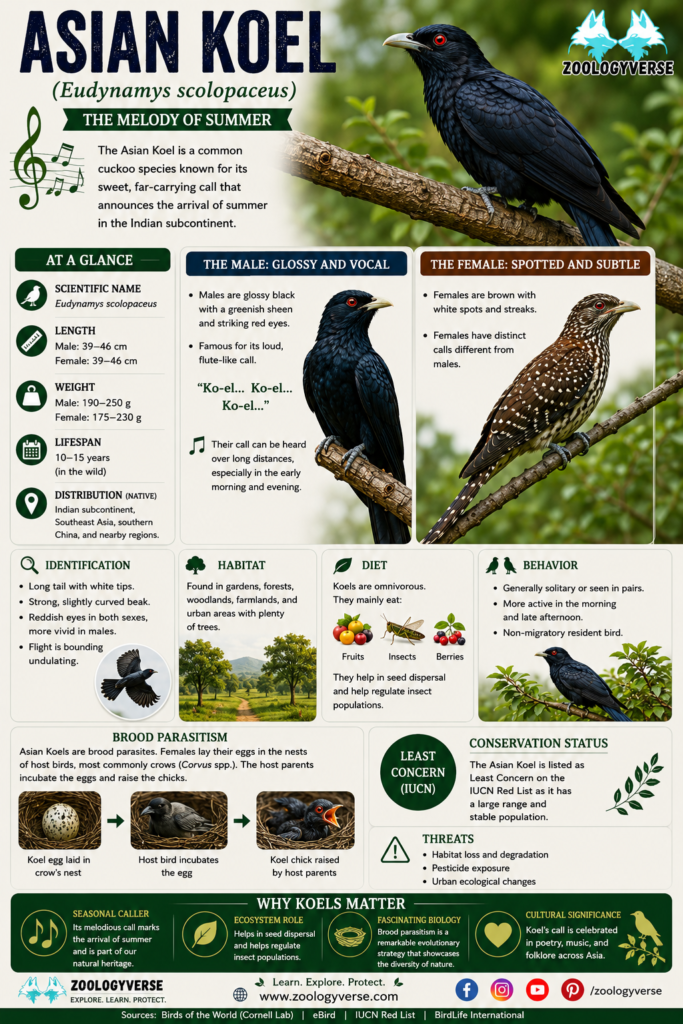
Eudynamys scolopaceus, commonly known as the Asian Koel, is a widely distributed cuckoo species found across South Asia, Southeast Asia, and parts of Australia.
Famous for its loud, melodious “koo-ooo” call, the Asian Koel is a familiar sound in summer and breeding seasons.
This species is well known for brood parasitism, where females lay eggs in the nests of crows and other host birds, leaving them to raise the chicks.
The Asian Koel thrives in forests, orchards, gardens, and urban areas due to its adaptability and fruit-based diet.
With its glossy plumage, striking red eyes, and distinctive vocalizations, Eudynamis scolopaceus holds cultural, ecological, and behavioral significance throughout its range.
For Practical Study 🧪
Classification of Eudynamys scolopaceus
| Rank | Classification | Characteristic |
|---|---|---|
| Kingdom | Animalia | Multicellular, heterotrophic animals |
| Phylum | Chordata | Dorsal tubular nerve cord, notochord and gill-slits present. |
| Group | Craniata | Definite head, Cranium with brain present. |
| Sub-phylum | Vertebrata | Vertebral column present. |
| Division | Gnathostomata | Jaws and paired appendages present |
| Super Class | Tetrapoda | Paired limbs, lungs, cornified skin and bony skeleton. |
| Class | Aves | Biped and feathered vertebrates. |
| Sub-Class | Neornithes | True birds. Metacarpals fused. |
| Super-Order | Neognathae | Modern birds. no teeth. sternum keeled. |
| Order | Cuculiformes | Toes 2 infront and 2 behind. |
| Family | Cuculidae | Cuckoos and related birds |
| Genus | Eudynamys | Koels |
| Species | Eudynamys scolopaceus | Asian Koel |
Geographical Distribution
Eudynamys scolopaceus is commonly found in India, Pakistan, China, Philippines and Australia.
Habit and Habitat
It lives on trees of gardens, groves, large leafy trees and their frequent voice kuoo kuoo is often heard during mango season.
It feeds on banyan and peepul figs, berries, and also insects and caterpillars.
The bird has the habit of laying its eggs in the nests of crows and throwing on them the responsibility of raising its young.
Comments
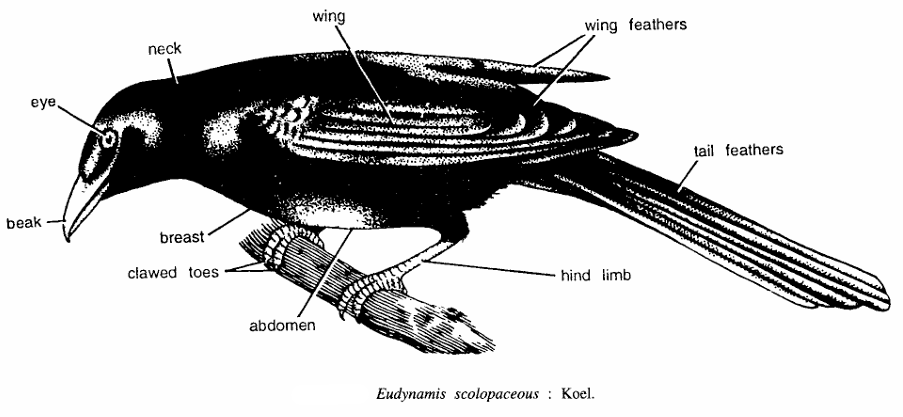
- Commonly called as Koel.
- Body divisible into head, neck, breast and abdomen.
- Head contains eyes and beak.
- Beak adapted for seed eating.
- Sexual dimorphism is conspicuous.
- Male is black all over having glistening metalic colour with blood red eyes and pale bill.
- Female is brown with white spots.
- Beak tip pointed and curved downwards.
- Eyes small with rounded pupil. Tail long.
- Hind limbs contain reversible toes with 2 toes in front and 2 toes behind.
- Wing feathers folded over the body and tail feathers long.
- In summer months the call of male bird is very familiar kuoo-kuoo-kuoo. Female does not sing.
Special Features
- Koel amuses the ears of mankind by its beautiful and sweet voice.
- The poets have often associated koel in their romantic poems.
- The female nestling Koel is much darker than adult female, an adaptation to deceive foster parents, i.e., crows.
Identification
Since this bird has pale bill, red eyes and above features, hence it is male Eudynamys scolopaceus.
Quick Identification of Eudynamys scolopaceus
| Feature | Description |
|---|---|
| Common name | Asian Koel |
| Scientific name | Eudynamys scolopaceus |
| Class | Aves |
| Order | Cuculiformes |
| Family | Cuculidae |
| Body | Medium-to-large cuckoo with a long tail |
| Male | Glossy blue-black plumage, crimson-red eyes and pale greenish bill |
| Female | Brown plumage with prominent white spotting and streaking |
| Wings | Broad, rounded wings adapted for strong, sustained flight |
| Bill | Pale, slightly curved and pointed |
| Eyes | Bright crimson-red in adults |
| Feet | Zygodactyl feet, with two toes directed forward and two backward |
| Diet | Mainly fruits, with insects and other food items also taken |
| Key feature | Strong sexual dimorphism and distinctive calls |
| Reproductive strategy | Obligate brood parasite that lays eggs in the nests of other birds |
Physical Characteristics of Eudynamys scolopaceus
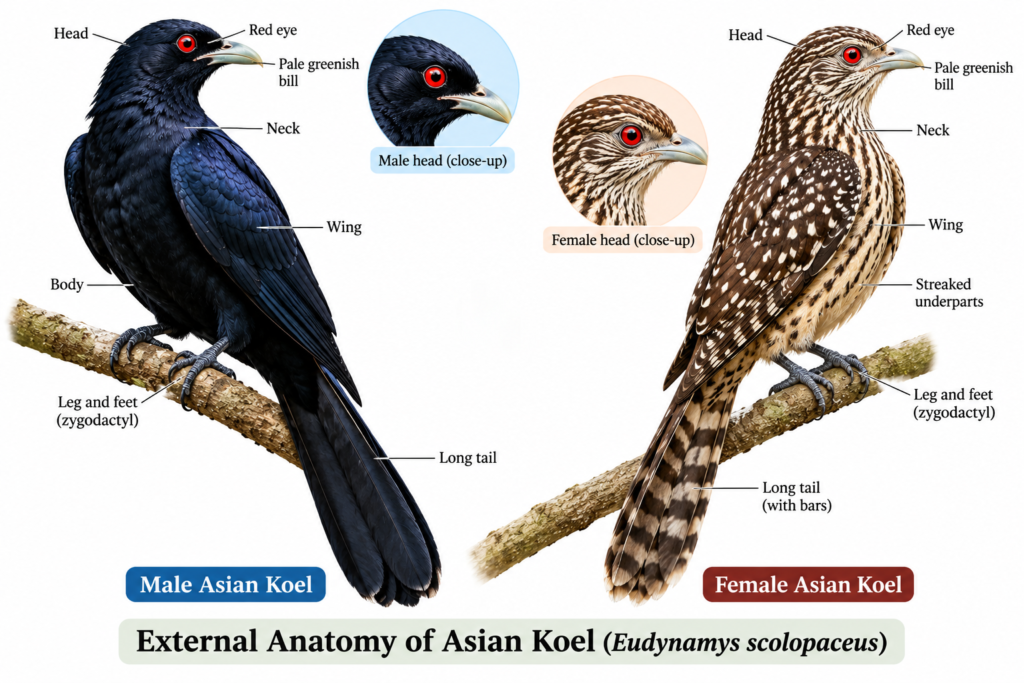
The Asian Koel is a large, long-tailed cuckoo measuring roughly 39–46 cm. It shows striking sexual dimorphism, with males and females having very different plumage.
- Body: Slender, elongated body with a notably long tail.
- Male plumage: Glossy bluish-black to black body and wings.
- Female plumage: Dark brown upperparts with white or buff spots; the underparts are pale with dense brown streaking and barring.
- Head: The male has a dark head, while the female has a brownish head with rufous streaks.
- Eyes: Adults have distinctive crimson to ruby-red eyes.
- Bill: Pale greenish, grey-green or dull lime-green bill; relatively long and slightly curved.
- Wings: Long, rounded wings adapted for strong flight through woodland and tree canopies.
- Tail: Long tail, an important identifying characteristic of the species.
- Legs and feet: Grey legs and feet.
- Juveniles: Young birds can differ from adults and may resemble females in overall plumage as they develop.
The combination of long tail, red eyes, pale bill and strongly contrasting male and female plumage makes the Asian Koel relatively distinctive among cuckoos.
Sexual Dimorphism in Eudynamys scolopaceus
The Asian Koel shows striking differences between males and females in plumage coloration and pattern.
The glossy black male and heavily spotted brown female are so different in appearance that the sexes can usually be distinguished readily in the field.
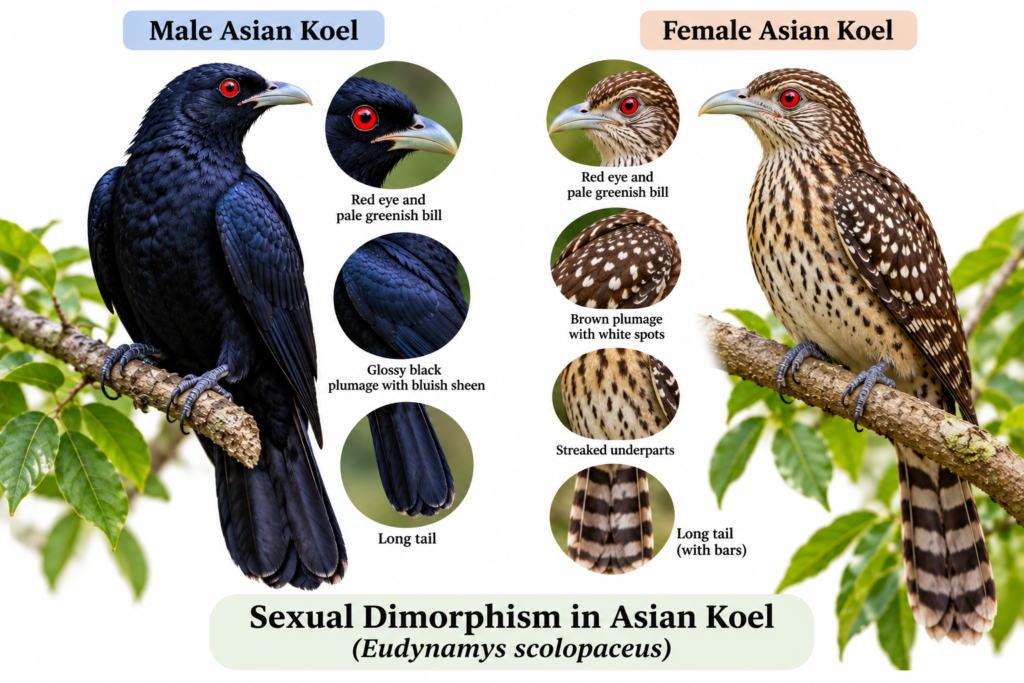
| Feature | Male | Female |
|---|---|---|
| Overall plumage | Glossy bluish-black to black | Brown with prominent white or buff spots |
| Head | Dark and glossy | Brownish with streaking |
| Back and wings | Mostly glossy dark | Brown with numerous pale spots |
| Underparts | Generally dark | Pale with heavy brown streaks and barring |
| Eyes | Crimson-red | Crimson-red |
| Bill | Pale greenish | Pale greenish |
| Tail | Long and dark | Long, brownish and spotted/banded |
Feeding and Dietary Adaptations of Eudynamys scolopaceus
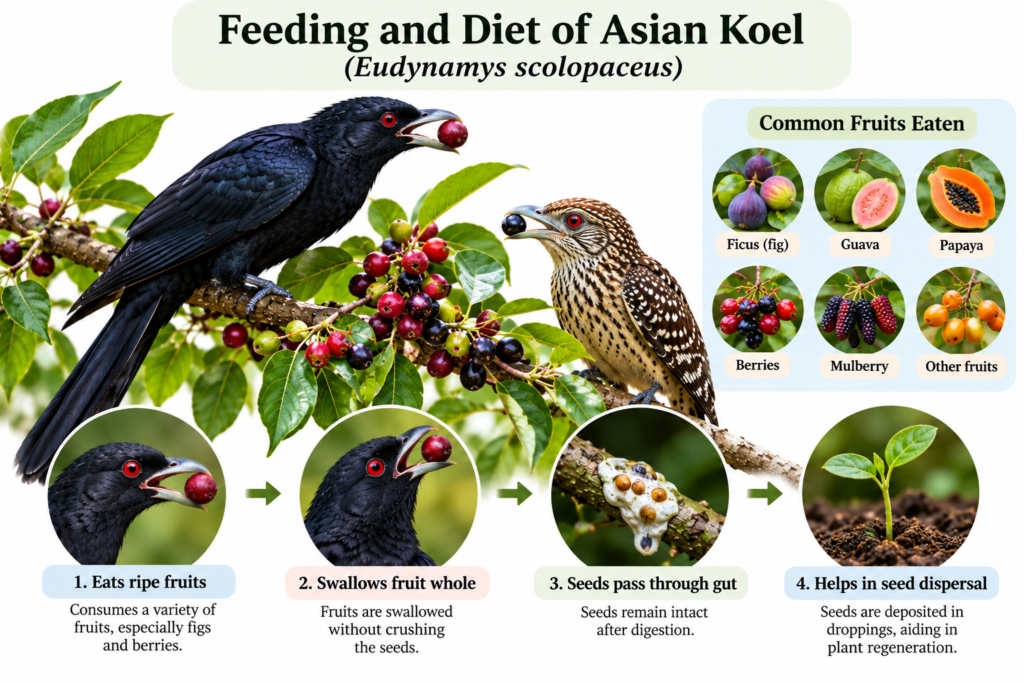
The Asian Koel is primarily a fruit-eating bird, although its diet can also include insects and other animal food. Its feeding habits vary with food availability and habitat.
- Fruits: Fruits form an important part of the adult diet, including fruits from several trees and shrubs.
- Seeds: Seeds contained within fruits may be swallowed and later dispersed through droppings.
- Insects: Insects and other small invertebrates may also be eaten, particularly when available.
- Feeding in trees: The Koel commonly searches for food among branches and foliage.
- Bill adaptation: Its pale, slightly curved bill is useful for picking and handling fruits.
- Fruit dispersal: By consuming fruits and subsequently moving between trees, the Koel can contribute to the dispersal of seeds.
Dietary Adaptation
Its predominantly frugivorous diet allows the Asian Koel to exploit fruiting trees in woodlands, gardens, orchards and urban green spaces. This dietary flexibility also helps it coexist closely with human-modified environments.
Brood Parasitism in Asian Koel
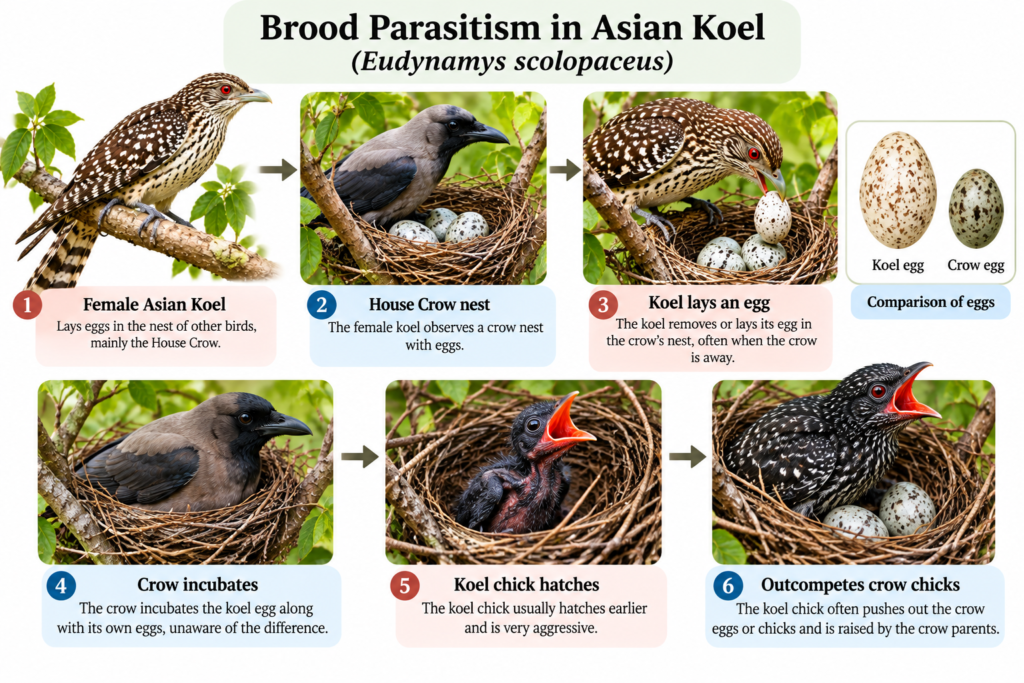
The Asian Koel is an obligate brood parasite. Instead of building and raising its own brood in a conventional nest, the female lays her eggs in the nests of other bird species, leaving the host parents to incubate the eggs and provide care for the young.
- Host nests: Asian Koels use the nests of other birds as sites for laying their eggs.
- Important hosts: The House Crow (Corvus splendens) is one of the best-known hosts, while Common Mynas and other birds may also be parasitized.
- Egg laying: The female lays an egg in a suitable host nest, often during the host’s breeding period.
- Incubation and care: The host bird generally incubates the egg and subsequently feeds the Koel chick.
- Adaptation: Brood parasitism allows the Koel to avoid the energetic costs of nest construction, incubation and direct parental care.
Relationship With the House Crow
The relationship between the Asian Koel and House Crow is particularly interesting. The Koel may lay its eggs in a House Crow nest, and the crow can subsequently incubate the egg and raise the young Koel.
This makes the Asian Koel an excellent example of brood parasitism in birds.
Behaviour and Vocalizations of Eudynamys scolopaceus
The Asian Koel is an arboreal, mostly diurnal bird that spends much of its time in trees searching for fruit. During the breeding season, it becomes particularly noticeable because of its loud and distinctive vocalizations.
- Arboreal lifestyle: It commonly moves through trees and dense vegetation while feeding and resting.
- Fruit searching: It actively searches tree canopies for ripe fruits.
- Secretive behaviour: Females can be less conspicuous than males because their brown, spotted plumage provides effective camouflage among branches and foliage.
- Breeding-season activity: Males become especially vocal during the breeding period.
- Territorial interactions: Males may call repeatedly and interact with other males around breeding territories.
- Flight: It has strong, direct flight between trees and feeding areas.
- Roosting: Individuals commonly rest in trees, particularly in dense foliage.
Distinctive Call
The Asian Koel is particularly famous for the loud, repetitive calls of the male, often heard during the breeding season. The familiar “ko-el” or “koo-oo” type call has made the bird culturally recognizable across much of its range.
The female produces different vocalizations, including harsher calls, so male and female calls can be distinguished.
Ecological Role and Seed Dispersal of Asian Koel
The Asian Koel plays an important ecological role, particularly through its fruit-eating behaviour and movement between trees.
- Fruit consumption: The Koel consumes fruits from a variety of trees and shrubs.
- Seed dispersal: Seeds that pass through the digestive tract can be deposited away from the parent plant, potentially helping plants colonize new areas.
- Movement between trees: Its mobility allows it to transport seeds between different feeding locations.
- Food-web role: The Koel forms part of woodland and urban food webs as a fruit-eating bird and as prey for larger predators.
- Host interactions: Its brood-parasitic relationship with birds such as the House Crow creates an additional ecological interaction.
- Urban ecosystems: The species can use fruiting trees in gardens, parks and other green spaces within human settlements.
Why the Koel Is Ecologically Interesting
The Asian Koel demonstrates how feeding ecology and reproduction can interact with other species. Its frugivorous diet connects it with plants through seed dispersal, while its brood-parasitic strategy creates a close reproductive relationship with host birds.
Conservation Status of Eudynamys scolopaceus
The Asian Koel is currently classified as Least Concern (LC) by the IUCN Red List, reflecting its wide distribution and adaptability across diverse habitats, from forests to urban gardens.
Frequently Asked Questions
What is the scientific name of the Asian Koel?
The scientific name of the Asian Koel is Eudynamys scolopaceus.
How can you identify a male Asian Koel?
The male has glossy bluish-black plumage, crimson-red eyes and a pale greenish bill.
How can you identify a female Asian Koel?
The female is brown with prominent white or buff spotting and streaked underparts, making her quite different from the male.
What does the Asian Koel eat?
It mainly feeds on fruits, but it can also consume insects and other available food.
Is the Asian Koel a brood parasite?
Yes. It is an obligate brood parasite, meaning it lays its eggs in the nests of other birds rather than raising its own chicks in a conventional nest.
Which bird commonly hosts Asian Koel eggs?
The House Crow (Corvus splendens) is one of its important and well-known hosts. Other host species may also be used.
Why does the Asian Koel call loudly?
Its loud calls are particularly associated with breeding-season communication, especially among males.
What is the difference between a male and female Asian Koel?
The male is glossy bluish-black, whereas the female is brown with prominent pale spots and streaks. Both sexes have characteristic red eyes.
What is the main ecological role of the Asian Koel?
As a fruit-eating bird, it can contribute to seed dispersal, while its brood-parasitic behaviour creates ecological interactions with host birds.
Recommended Study Resource
Practical Zoology Vertebrate 12/Ed
by Ss Lal (Author)
Rastogi Publications MODERN TEXT BOOK OF ZOOLOGY: VERTEBRATES (Z-3)
by Prof. R. L. Kotpal (Author)
As an Amazon Associate I earn from qualifying purchases.
References
- Integrated Taxonomic Information System (ITIS)
- NCBI Taxonomy Browser — Eudynamys scolopaceus
- Eudynamys scolopaceus chinensis (Asian Koel)
Discover more from Zoologyverse
Subscribe to get the latest posts sent to your email.