
There are only eight living species of bear in the world.
That number surprises most people. Bears feel like a large, varied group of animals, and lists of “types of bears” often run to twelve or fifteen entries. But almost every list longer than eight is quietly counting subspecies, regional populations or animals that are not bears at all.
All eight species belong to a single family, Ursidae, within the order Carnivora.
Between them, these eight mammals occupy an extraordinary range of habitats: Arctic sea ice, Himalayan forests, Andean cloud forest, Southeast Asian rainforest and the bamboo slopes of central China.
This article covers all eight species of bear, their scientific names, distribution, distinguishing features and conservation status — along with the animals that are commonly mistaken for separate bear species.
What Makes an Animal a Bear?
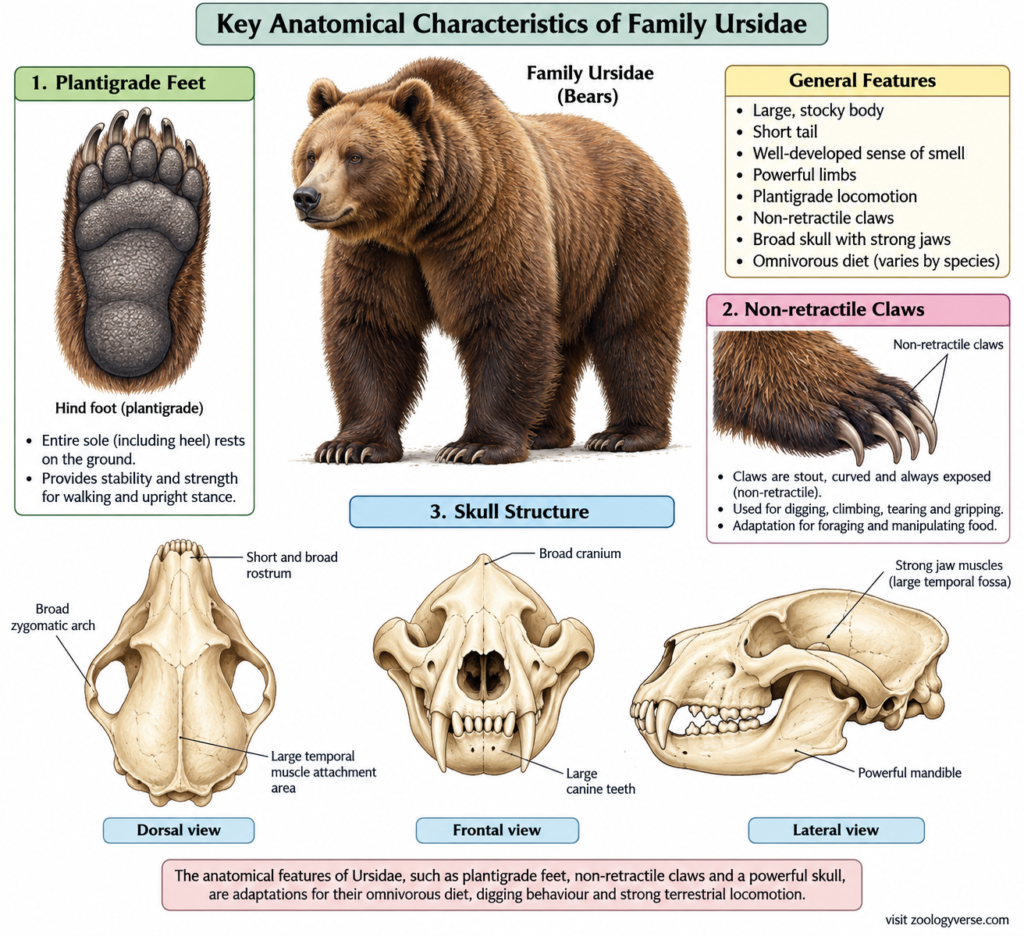
Bears share a distinctive set of anatomical characters that separate them from other carnivorans such as dogs, cats and mustelids.
The most important features of family Ursidae are:
- Large, heavily built body with stocky limbs and a short tail
- Plantigrade locomotion — bears walk on the entire sole of the foot, unlike the digitigrade cats and dogs
- Five non-retractile claws on each foot
- Long snout with small, rounded ears set well back on the skull
- Reduced, flattened molars suited to crushing rather than shearing — the carnassial teeth typical of carnivores are poorly developed
- An exceptional sense of smell, among the most acute of any land mammal
That dentition is the key to understanding bears.
Although bears are placed in the order Carnivora, most species are omnivorous. Only the polar bear is predominantly carnivorous, and the giant panda is almost entirely herbivorous. The remaining six species eat a mixed diet of fruit, vegetation, insects, fish and carrion, with the proportions varying by season and region.
Membership of Carnivora reflects evolutionary ancestry, not diet.
Bears are distinguished by plantigrade feet, five non-retractile claws, a long snout and crushing molars adapted to an omnivorous diet.
Classification of Bears (Family Ursidae)
The eight species are distributed across three subfamilies and five genera.
| Subfamily | Genus | Species | Common name |
|---|---|---|---|
| Ailuropodinae | Ailuropoda | A. melanoleuca | Giant panda |
| Tremarctinae | Tremarctos | T. ornatus | Andean (spectacled) bear |
| Ursinae | Helarctos | H. malayanus | Sun bear |
| Ursinae | Melursus | M. ursinus | Sloth bear |
| Ursinae | Ursus | U. arctos | Brown bear |
| Ursinae | Ursus | U. americanus | American black bear |
| Ursinae | Ursus | U. thibetanus | Asiatic black bear |
| Ursinae | Ursus | U. maritimus | Polar bear |
The subfamily Ailuropodinae contains only the giant panda, and Tremarctinae contains only the Andean bear. Both are the last survivors of once more diverse lineages.
The remaining six species fall within Ursinae, and four of those belong to the single genus Ursus.
The 8 Types of Bears in the World
1. Polar Bear (Ursus maritimus)
The polar bear is the largest living bear and the largest land carnivore on Earth.
Adult males typically weigh 350–600 kg, with exceptional individuals exceeding that range. Females are roughly half the size.
Polar bears are circumpolar in distribution, occurring across the Arctic in Canada, Alaska, Greenland, Norway and Russia. They are the most carnivorous of all bears, feeding chiefly on ringed and bearded seals hunted from the sea ice.
Several adaptations suit them to the Arctic. The skin beneath the coat is black, the guard hairs are hollow and unpigmented — the fur appears white by light scattering rather than by pigment — and a thick subcutaneous fat layer provides insulation. The feet are broad with papillae on the soles for traction on ice.
Polar bears are so dependent on sea ice for hunting that the IUCN classifies them as Vulnerable, with sea-ice loss identified as the principal threat.
2. Brown Bear (Ursus arctos)
The brown bear has the widest distribution of any bear species, occurring across North America, Europe and Asia.
It is also the most variable. Body size differs enormously between populations, from relatively small European brown bears to the very large coastal forms of Alaska.
The most recognisable feature is a prominent muscular hump over the shoulders, which powers the forelimbs for digging.
Brown bears are opportunistic omnivores. Diet varies with season and locality and may include roots, tubers, berries, insects, ungulates, and — in coastal populations — spawning salmon.
Despite regional declines and local extirpations, the species remains numerous across its global range and is listed as Least Concern.
Grizzly bears and Kodiak bears are subspecies of the brown bear, not separate species. This is discussed further below.
3. American Black Bear (Ursus americanus)
The American black bear is the most abundant bear species in the world.
Its population is estimated in the hundreds of thousands across Canada, the United States and parts of Mexico — greater than all other bear species combined.
Despite the name, coat colour is variable and includes black, brown, cinnamon, blond and, in a small population on the coast of British Columbia, a rare cream-white form known as the Kermode or “spirit” bear.
Black bears lack the shoulder hump of the brown bear, have a straighter facial profile, and possess shorter, more strongly curved claws — an adaptation for climbing. They are accomplished tree-climbers throughout life.
The species is listed as Least Concern and is the only bear considered secure throughout its range.
4. Asiatic Black Bear (Ursus thibetanus)
Also called the moon bear or Himalayan black bear, this species is named for the conspicuous pale crescent-shaped patch on its chest.
It occurs across a broad band of Asia from Iran and Afghanistan through the Himalaya — including northern India, Nepal and Bhutan — and east to China, Korea, Japan and parts of Russia.
Asiatic black bears are largely forest-dwelling and highly arboreal, with a diet dominated by fruit, nuts, vegetation and insects.
They are classified as Vulnerable. Habitat loss and poaching for the trade in bear parts are the principal threats, and the species is heavily affected by bile farming in parts of its range.
5. Sun Bear (Helarctos malayanus)
The sun bear is the smallest bear species in the world, with adults typically weighing only 30–70 kg.
It is found in the tropical forests of Southeast Asia, including Sumatra and Borneo.
Sun bears have several unusual features. The coat is short and sleek — an adaptation to a hot, humid climate rather than a cold one. A pale orange or cream chest patch gives the species its name. The claws are long and strongly curved, and the tongue is exceptionally long, used to extract honey, termites and insect larvae from cavities in wood.
The species is listed as Vulnerable, threatened primarily by deforestation, poaching and the illegal pet trade.
6. Sloth Bear (Melursus ursinus)
The sloth bear is native to the Indian subcontinent, occurring in India, Sri Lanka and Nepal.
It is the most specialised insectivore among bears, and its anatomy reflects this clearly.
Sloth bears are myrmecophagous — ant- and termite-eating. The inner pair of upper incisors is absent, creating a gap through which the animal can suck insects. The lips are mobile and protrusible, the palate is domed, and the nostrils can be closed voluntarily. Together these form an effective suction apparatus, and the noise of a feeding sloth bear can be heard from a considerable distance.
The coat is long and shaggy, usually black with a pale V- or Y-shaped chest marking. Cubs are frequently carried on the mother’s back — behaviour uncommon among bears.
The species was named Bradypus ursinus by Shaw in 1791 under the mistaken belief that it was related to the tree sloths, which is how it acquired its misleading common name.
Sloth bears are listed as Vulnerable.
7. Andean Bear (Tremarctos ornatus)
Also known as the spectacled bear, this is the only bear species native to South America and the only bear found in the Southern Hemisphere.
It occurs along the Andes, from Venezuela and Colombia south through Ecuador and Peru to Bolivia, chiefly in montane and cloud forest.
The common name comes from the pale markings around the eyes, which in many individuals resemble spectacles. The pattern varies between animals and can be used to identify individuals.
The Andean bear is largely herbivorous, feeding heavily on bromeliads, palm hearts and fruit, and is a capable climber that constructs feeding platforms in trees.
It is the sole surviving member of the subfamily Tremarctinae, a lineage that also included the extinct giant short-faced bears.
The species is listed as Vulnerable.
8. Giant Panda (Ailuropoda melanoleuca)
The giant panda is a true bear, a point that was debated for more than a century before molecular evidence settled it.
It is restricted to temperate montane forest in central China, principally in Sichuan, Shaanxi and Gansu.
The panda presents a striking biological paradox. It retains the digestive tract of a carnivore — short, simple, and lacking the fermentation chambers of true herbivores — yet its diet is almost entirely bamboo. It compensates by consuming very large quantities each day and passing food through rapidly, extracting a modest proportion of the available nutrients.
The panda’s “thumb” is equally notable. It is not a digit but an enlarged radial sesamoid bone of the wrist, which opposes the true digits and allows the animal to grip bamboo stems.
Following decades of habitat protection and a census that recorded 1,864 wild individuals, the giant panda was downlisted from Endangered to Vulnerable on the IUCN Red List in 2016.
The eight living bear species and their distribution across North America, South America, Europe and Asia.
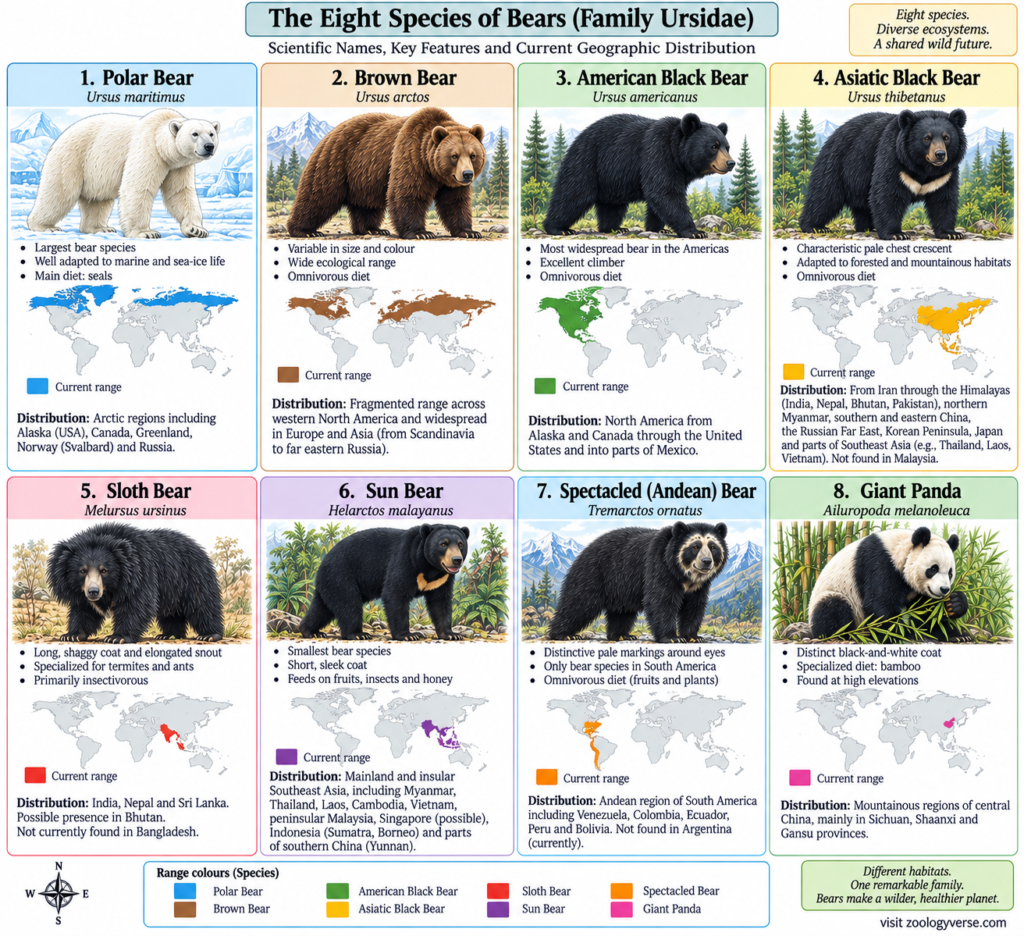
Comparison of All 8 Bear Species
| Species | Scientific name | Distribution | Main diet | IUCN status |
|---|---|---|---|---|
| Polar bear | Ursus maritimus | Arctic | Seals (carnivorous) | Vulnerable |
| Brown bear | Ursus arctos | N. America, Europe, Asia | Omnivorous | Least Concern |
| American black bear | Ursus americanus | North America | Omnivorous | Least Concern |
| Asiatic black bear | Ursus thibetanus | Asia, Himalaya | Fruit, nuts, insects | Vulnerable |
| Sun bear | Helarctos malayanus | Southeast Asia | Insects, honey, fruit | Vulnerable |
| Sloth bear | Melursus ursinus | Indian subcontinent | Termites, ants, fruit | Vulnerable |
| Andean bear | Tremarctos ornatus | Andes, South America | Largely herbivorous | Vulnerable |
| Giant panda | Ailuropoda melanoleuca | Central China | Bamboo | Vulnerable |
Animals Commonly Mistaken for Separate Bear Species
This is where most confusion about the number of bear species arises.
Grizzly bear
The grizzly is a subspecies of brown bear (Ursus arctos horribilis), referring to inland North American populations. It is not a distinct species.
Kodiak bear
Another brown bear subspecies (Ursus arctos middendorffi), restricted to the Kodiak Archipelago in Alaska. Its exceptional size reflects rich coastal food resources, not separate species status.
Kermode or “spirit” bear
A colour variant of the American black bear caused by a recessive allele. The animals are not albino — the pigmentation of eyes and skin is normal.
Red panda
Despite the shared name and a similar bamboo diet, the red panda (Ailurus fulgens) is not a bear. It is placed in its own family, Ailuridae, within Carnivora. The resemblance in feeding adaptations is a case of convergent evolution.
Koala
The koala is not a bear at all. It is a marsupial in the family Phascolarctidae, only distantly related to the placental Ursidae. The name “koala bear” is a misnomer.
Grolar or pizzly bear
A hybrid between a polar bear and a grizzly, documented both in captivity and in the wild. Hybrids are not separate species, though their occurrence in the wild is of interest as Arctic ranges shift.
Conservation Status of Bears
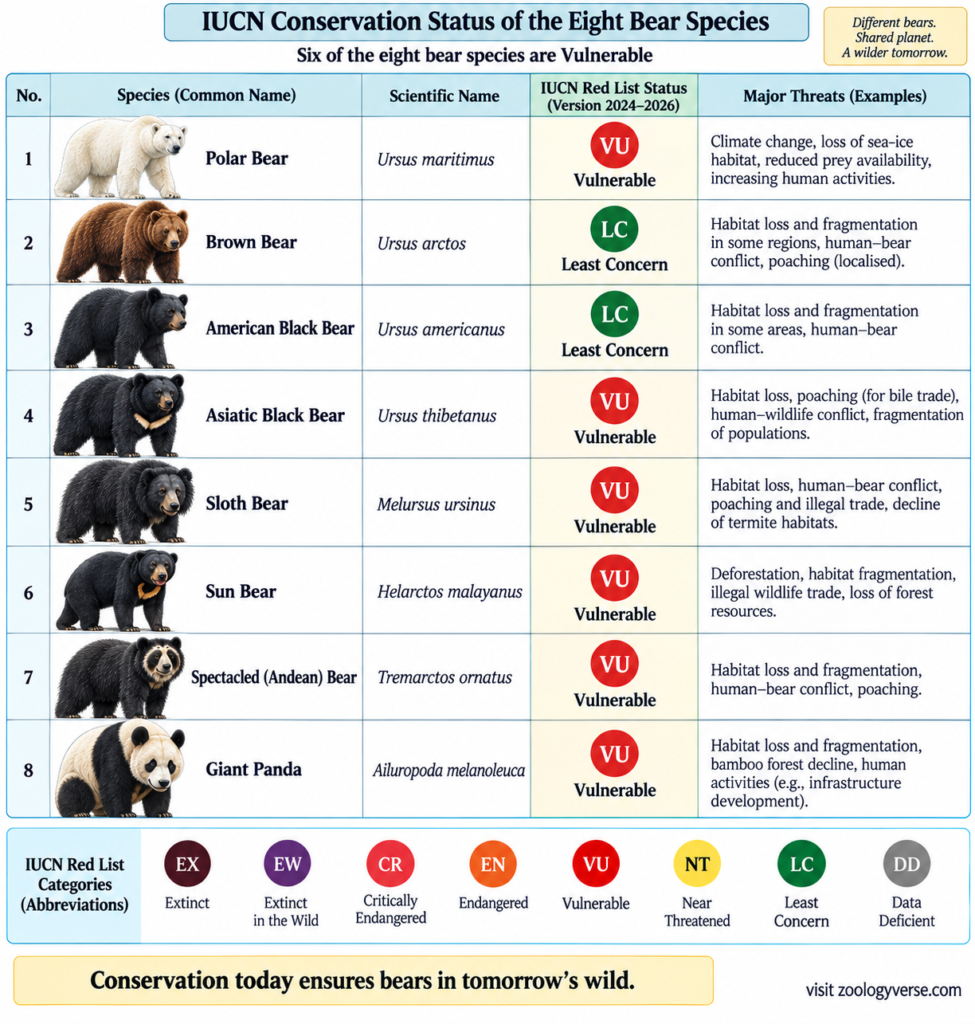
The overall picture is concerning.
Six of the eight bear species — 75% — are listed as Vulnerable on the IUCN Red List.
Only the brown bear and the American black bear are classed as Least Concern, and both of those occur largely in North America and Eurasia where monitoring and funding are comparatively well established.
The species under greatest pressure are concentrated in Asia and South America, where conservation resources are far more limited.
The principal threats are:
- Habitat loss and fragmentation from logging, agriculture and infrastructure
- Poaching for the trade in gall bladders, paws and other body parts
- Bile farming, which particularly affects Asiatic black bears and sun bears
- Human–wildlife conflict and retaliatory killing near crops and settlements
- Climate change, most acutely for the polar bear through loss of sea ice
The giant panda offers a genuine conservation success story. Sustained habitat protection and reserve expansion produced a measurable population increase and a downlisting in 2016 — evidence that decline is not inevitable where resources are committed.
Six of the eight bear species are listed as Vulnerable; only the brown bear and American black bear are Least Concern.
Evolution of Bears
Bears belong to the suborder Caniformia — the “dog-like” branch of Carnivora — placing them closer to dogs, seals and mustelids than to cats.
The family is thought to have originated from small, raccoon-sized ancestors during the Oligocene, with the modern genera diversifying considerably later.
Two points are worth noting for anyone studying evolution and systematics.
First, the giant panda diverged early from the rest of the family. Its classification was contested for over a century, with some authors allying it with the raccoons, until molecular data confirmed it as a member of Ursidae — but on a long, independent branch.
Second, the polar bear is evolutionarily very young. It diverged from brown bear ancestry relatively recently, and the two species remain close enough to produce fertile hybrids. Its extreme specialisation for Arctic life therefore evolved over a short period — which is part of why sea-ice loss is so serious a threat.
Bears also show delayed implantation, in which the fertilised blastocyst remains dormant before implanting in the uterine wall. This synchronises birth with the winter denning period and is a notable feature of mammalian reproduction.
Do All Bears Hibernate?
No — and the bears that do are not true hibernators in the strict physiological sense.
Sun bears and sloth bears live in tropical climates with year-round food availability and do not undergo winter dormancy at all. Among polar bears, generally only pregnant females den for an extended period.
Brown bears, American black bears and Asiatic black bears in cold regions enter a state better described as winter dormancy or carnivoran lethargy.
During this period, heart rate and metabolic rate fall substantially, but body temperature drops only a few degrees — unlike the deep hibernation of ground squirrels, where body temperature approaches ambient. Bears can also be roused relatively quickly.
Remarkably, a denning bear does not eat, drink, urinate or defecate for months, recycling urea to synthesise protein and losing very little muscle mass. This physiology is an active subject of biomedical research.
Frequently Asked Questions
How many types of bears are there in the world?
There are eight living species of bear, all belonging to the family Ursidae: the polar bear, brown bear, American black bear, Asiatic black bear, sun bear, sloth bear, Andean bear and giant panda.
Which is the largest bear in the world?
The polar bear is the largest living bear and the largest land carnivore. Large coastal brown bears, such as the Kodiak, approach it closely in size.
Which is the smallest bear species?
The sun bear (Helarctos malayanus) of Southeast Asia, with adults typically weighing only 30–70 kg.
Is the giant panda really a bear?
Yes. Molecular evidence confirms the giant panda as a member of the family Ursidae, placed in its own subfamily Ailuropodinae. The red panda, by contrast, is not a bear.
Is a grizzly bear a separate species?
No. The grizzly is a subspecies of the brown bear, Ursus arctos horribilis, referring to inland North American populations.
Which bears are found in India?
Four bear species occur in India: the sloth bear, the Asiatic black bear (Himalayan black bear), the brown bear in the Himalaya, and the sun bear in parts of the north-east.
Is a koala a bear?
No. The koala is a marsupial in the family Phascolarctidae and is not closely related to bears.
How many bear species are endangered?
No bear species is currently listed as Endangered. However, six of the eight are listed as Vulnerable, including the giant panda, which was downlisted from Endangered in 2016.
Conclusion
Eight species, three subfamilies, four continents.
Family Ursidae is small by mammalian standards, but its members span an exceptional ecological range — from a seal-hunting Arctic specialist to a bamboo-feeding montane herbivore to a termite-sucking insectivore of the Indian subcontinent.
That diversity rests on a shared body plan: a plantigrade, heavily built carnivoran with crushing molars and a remarkable nose, flexible enough to be redirected toward almost any food source.
It is also a family under pressure. With six of eight species classed as Vulnerable, the bears illustrate a broader pattern in large-mammal conservation: wide-ranging species with slow reproductive rates are especially sensitive to habitat loss and targeted hunting.
The recovery of the giant panda shows that the trend can be reversed where the commitment exists.
References
- IUCN Red List of Threatened Species — Ursidae assessments.
View the IUCN Red List - IUCN Bear Specialist Group — species accounts and status reviews.
Read the IUCN statement on bear conservation status - IUCN/SSC Bear Specialist Group. Bears: Status Survey and Conservation Action Plan.
View the publication - Giant panda downlisting to Vulnerable (2016 IUCN Red List assessment).
View the assessment on the IUCN Red List
Recommended Study Resource
Bear Almanac: A Comprehensive Guide to the Bears of the World
by Gary Brown (Author)
Bears of the World: Ecology, Conservation and Management
by Vincenzo Penteriani (Author, Editor), Mario Melletti (Editor)
As an Amazon Associate I earn from qualifying purchases.
Discover more from Zoologyverse
Subscribe to get the latest posts sent to your email.