
Bdellostoma is a marine jawless vertebrate belonging to the hagfish group. It has an elongated, eel-like body, a persistent notochord, a cartilaginous skull, and no true jaws or paired fins. It is mainly associated with the sea floor and is adapted for scavenging and feeding on animal tissues.
Among the important characteristics of Bdellostoma are its single median nasal opening, reduced eyes, oral tentacles, horny tooth structures, numerous slime glands, and specialized respiratory apparatus. These features distinguish it from many other aquatic vertebrates and make it an important specimen in practical zoology.
The classification of Bdellostoma places it within the jawless vertebrate lineage traditionally studied under Cyclostomata. Its simple yet specialized organization provides useful examples of vertebrate structural adaptations, particularly in feeding, respiration, osmoregulation, and defense.
The identification of Bdellostoma is mainly based on its elongated jawless body, single nasal opening, oral tentacles, reduced eyes, absence of paired fins, and characteristic slime-producing glands.
Practical Study
The following notes are arranged in a practical examination format for easy study and identification.
Classification of Bdellostoma
| Rank | Classification | Characteristic |
|---|---|---|
| Kingdom | Animalia | Multicellular, heterotrophic animals |
| Phylum | Chordata | Notochord and dorsal hollow nerve cord present |
| Subphylum | Vertebrata | Vertebrate lineage; a persistent notochord forms the main axial support |
| Class | Myxini | Jawless hagfishes with elongated bodies and slime glands |
| Order | Myxiniformes | Marine hagfishes with a single nasal opening and specialized feeding structures |
| Family | Myxinidae | Hagfishes characterized by slime production and a worm-like body |
| Genus | Bdellostoma | Traditional hagfish genus with elongated body and multiple gill openings |
Geographical Distribution
Bdellostoma is a marine hagfish traditionally represented by Bdellostoma stoutii, now accepted as Eptatretus stoutii. It occurs mainly in the northeastern Pacific Ocean along the Pacific coast of North America, where it inhabits benthic marine environments.
Habit and Habitat
Bdellostoma is a marine, benthic and mainly scavenging hagfish. It lives near the sea floor and feeds chiefly on dead or weakened animals. Its elongated flexible body and abundant slime production are important adaptations for its benthic mode of life.

Comments / Characteristics of Bdellostoma
- Body elongated, cylindrical and eel-like.
- Body is soft, flexible and without scales.
- True jaws and paired fins are absent.
- A persistent notochord provides the main axial support.
- Cartilaginous skull is present.
- Mouth is surrounded by sensory tentacles.
- Horny tooth structures are present around the feeding apparatus.
- A single median nasal opening is present.
- Eyes are highly reduced and covered by skin.
- Numerous slime glands occur along the sides of the body.
- Gill openings are present on the sides of the body.
- The animal is mainly benthic and scavenging.
- The flexible body can form knots, helping the animal during feeding and removal of slime.
Special Features
Bdellostoma is distinguished by its jawless mouth, persistent notochord, single nasal opening, oral tentacles, reduced eyes, horny teeth, absence of paired fins, and numerous slime glands. Its flexible body and knot-forming ability are important adaptations for feeding and defense.
Identification
Identified as Bdellostoma (Hagfish) by its elongated jawless body, single median nasal opening, oral tentacles, reduced eyes, horny teeth, numerous slime glands, absence of paired fins, and persistent notochord.
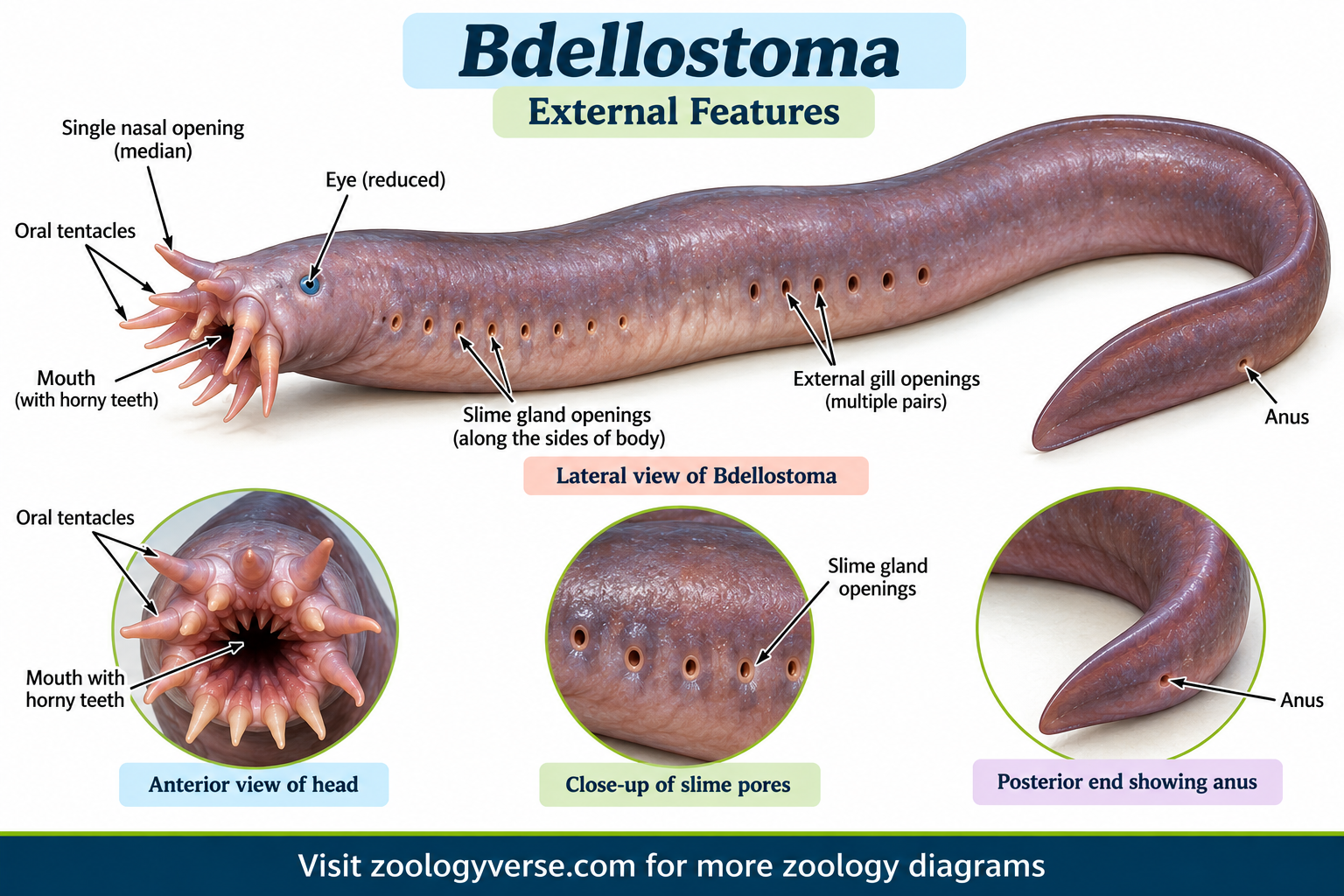
External Features
Bdellostoma has a long, slender and flexible body adapted for a benthic marine life. The body is soft, scaleless and generally cylindrical, with a tapering posterior region.
- Body: Elongated, cylindrical and eel-like.
- Head: Not sharply separated from the trunk.
- Mouth: Terminal and surrounded by sensory oral tentacles.
- Feeding structures: Horny tooth structures are present and assist in grasping and tearing food.
- Nasal opening: A single median nasal aperture occurs on the dorsal surface of the head.
- Eyes: Highly reduced and covered by the skin.
- Fins: Paired fins are absent.
- Skin: Soft and scaleless, with numerous slime-producing glands.
- Gill openings: External branchial openings occur laterally.
- Notochord: Persists throughout life and provides the principal axial support.
Digestive System of Bdellostoma
The digestive system of Bdellostoma is adapted for its scavenging and predatory feeding habit. Its jawless feeding apparatus is particularly suited for grasping and removing pieces of animal tissue.
Main Parts :- Mouth → Buccal cavity → Pharynx → Oesophagus → Intestine → Anus
- Mouth: A jawless, terminal opening surrounded by oral tentacles.
- Buccal cavity: Contains horny tooth structures used for grasping and tearing food.
- Tongue: Muscular and associated with tooth-like structures that help pull food into the mouth.
- Pharynx: Serves as a passage for food and is closely associated with the respiratory apparatus.
- Oesophagus: Conducts food toward the intestine.
- Intestine: Digestion and absorption of nutrients occur here.
- Anus: Opens near the posterior end of the body.
Feeding Mechanism
Bdellostoma mainly feeds on dead or weakened marine animals. Its flexible body and specialized feeding apparatus allow it to enter or attach to animal tissues and remove pieces of food. The tooth-bearing feeding structures provide the necessary grip during feeding.
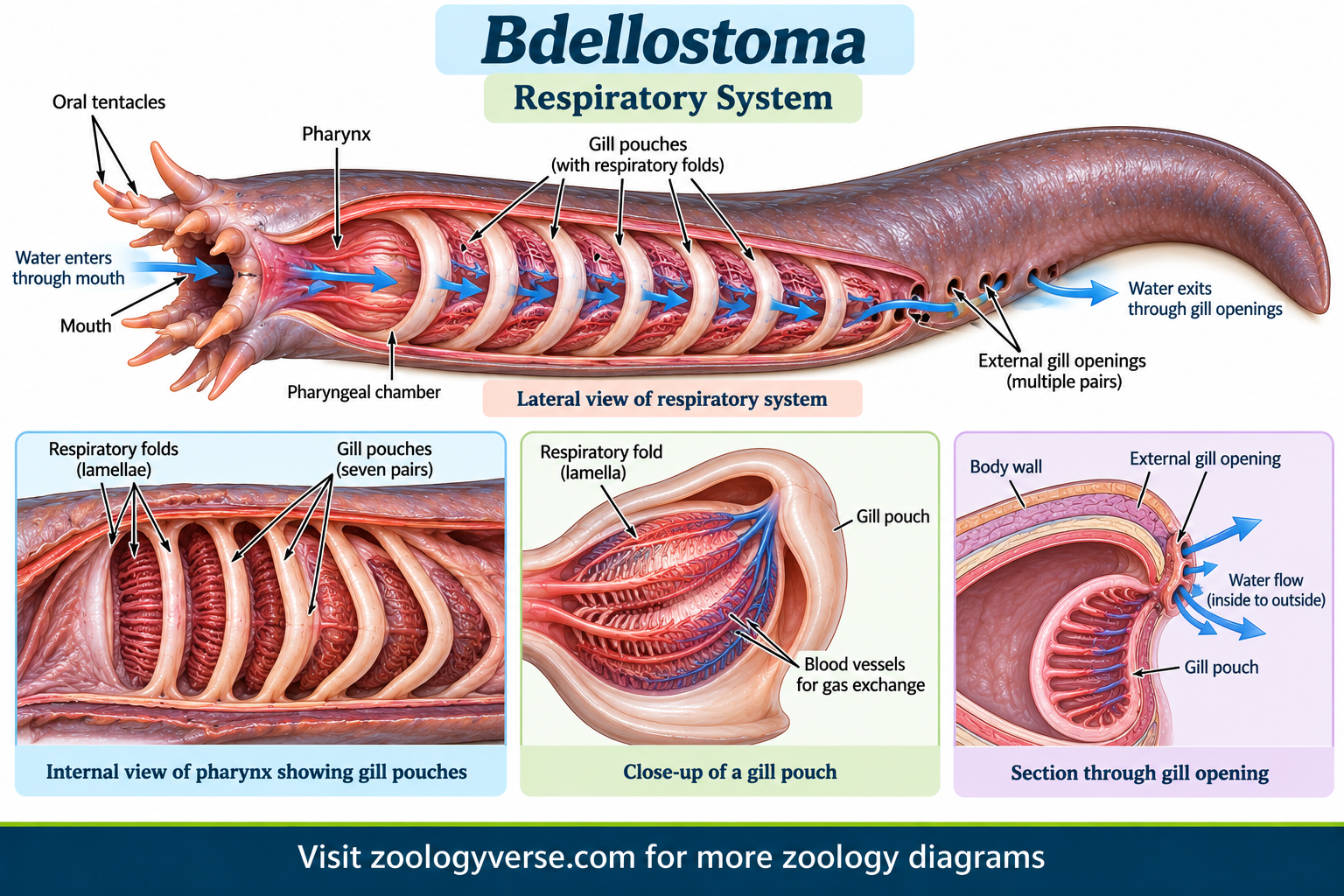
Respiratory System of Bdellostoma
The respiratory system of Bdellostoma is adapted for aquatic respiration and consists of a series of pharyngeal gill pouches supplied with blood vessels.
- Respiration occurs through gill pouches located in the pharyngeal region.
- The gill pouches contain highly vascularized respiratory surfaces where gaseous exchange occurs.
- Water passes through the respiratory chambers, allowing oxygen uptake and carbon dioxide removal.
- The external branchial openings provide communication between the respiratory apparatus and the surrounding seawater.
- The respiratory apparatus is closely associated with the pharynx but is functionally specialized for respiration.
- Blood flowing through the gill vessels picks up oxygen from the water and transports it to the tissues.
Water Flow :- Seawater → Nasal opening → Pharyngeal region → Gill pouches → External branchial openings
Circulatory System of Bdellostoma
Bdellostoma possesses a closed circulatory system in which blood circulates through arteries, veins and capillaries. The system is adapted to support respiration and the metabolic requirements of the marine animal.
- The principal heart is situated in the anterior ventral region.
- The main heart includes a sinus venosus, atrium and ventricle.
- The ventricle pumps blood into the ventral aorta.
- Blood is carried through branchial vessels associated with the gill pouches.
- At the gills, blood becomes oxygenated through gaseous exchange.
- Oxygenated blood is distributed to the body through the dorsal aorta and its branches.
- Accessory hearts occur in different parts of the vascular system and assist the circulation of blood.
Blood Flow :- Body tissues → Venous vessels → Sinus venosus → Atrium → Ventricle → Ventral aorta → Gill circulation → Dorsal aorta → Body tissues
Excretory System of Bdellostoma
The excretory system of Bdellostoma consists of paired kidneys that remove nitrogenous wastes and help regulate the water and salt balance of the body.
- A pair of elongated opisthonephric kidneys extends along the dorsal region of the body.
- The kidneys contain numerous renal tubules associated with blood vessels.
- The renal tubules filter wastes from the blood and contribute to urine formation.
- The kidneys play an important role in osmoregulation, maintaining the internal balance of water and dissolved salts.
- Urine is carried toward the posterior region through urinary ducts and discharged to the exterior.
- As a marine animal, Bdellostoma must regulate the movement of water and salts between its body and the surrounding seawater.
Nervous System of Bdellostoma
The nervous system of Bdellostoma consists of a brain, dorsal spinal cord, cranial nerves, and peripheral nerves. It coordinates sensory information, feeding, movement, and other body functions.
- The brain is relatively simple and is differentiated into major regions corresponding to the forebrain, midbrain, and hindbrain.
- A dorsal spinal cord extends posteriorly from the brain.
- Cranial and spinal nerves connect the central nervous system with different regions of the body.
- The olfactory system is important for detecting chemical stimuli in the marine environment.
- The eyes are highly reduced and provide limited visual function.
- Sensory receptors associated with the skin and oral region help detect mechanical and chemical stimuli.
- The nervous system coordinates the animal’s feeding, locomotion, and defensive responses.
Bdellostoma possesses a relatively simple brain, dorsal spinal cord, cranial nerves, and peripheral nerves. The olfactory system and other sensory receptors are important for detecting environmental stimuli, while the eyes are highly reduced.
Reproductive System and Life Cycle of Bdellostoma
Bdellostoma reproduces sexually and has a relatively simple reproductive system compared with many other vertebrates. Reproduction takes place in the marine environment.
Reproductive System
- Reproduction is sexual, with male and female reproductive conditions occurring in the population.
- The gonad is an elongated structure situated within the body cavity.
- Reproductive cells are released into the surrounding seawater.
- Fertilization is external.
- Hagfishes produce relatively few, large and yolk-rich eggs.
- The eggs possess protective coverings that help protect the developing embryo in the marine environment.
Life Cycle :- Egg → Embryonic development → Young hagfish → Adult
Unlike lampreys, Bdellostoma does not pass through an ammocoete larval stage. Development is essentially direct, with the young developing into adults without the characteristic larval metamorphosis seen in lampreys.
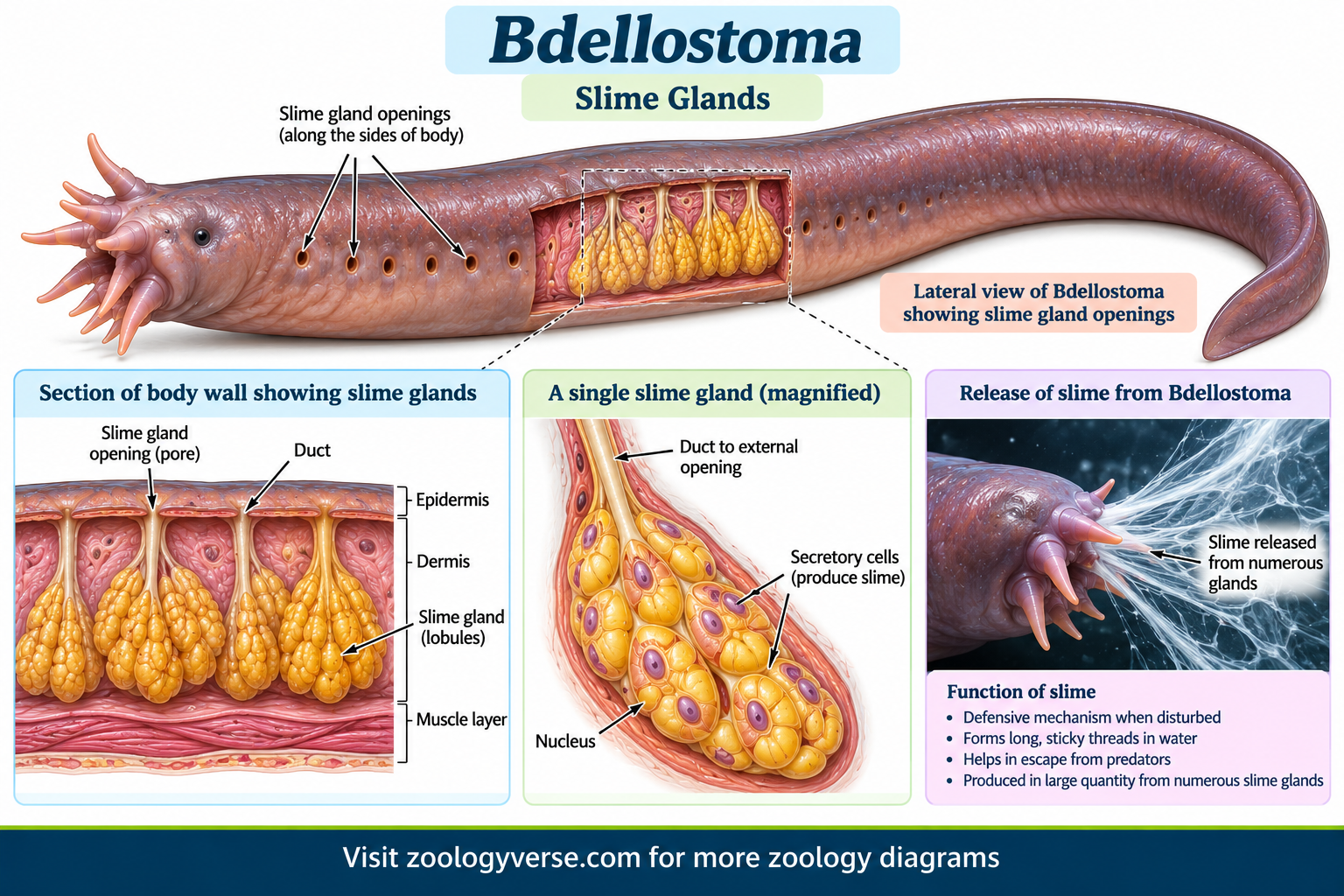
Slime Glands and Defensive Adaptation of Bdellostoma
One of the most characteristic adaptations of Bdellostoma is its ability to produce large quantities of slime when disturbed. This defensive mechanism is especially important for a soft-bodied animal lacking jaws and paired fins.
- Numerous slime glands occur along the sides of the body.
- When stimulated, these glands release mucus and protein-rich slime into the surrounding seawater.
- The slime rapidly expands and forms a thick gelatinous material.
- This can interfere with the feeding apparatus or respiratory surfaces of potential predators.
- The flexible body can form a knot, which helps the animal remove excess slime from its body.
- Slime production therefore provides an important defensive adaptation.
Ecological Importance of Bdellostoma
Bdellostoma plays an important role in marine benthic ecosystems, particularly through its scavenging activity.
- Scavenging: It feeds mainly on dead or weakened marine animals and helps remove animal remains from the sea floor.
- Nutrient cycling: By consuming and breaking down animal tissues, it contributes to the recycling of organic matter.
- Benthic food web: It forms part of marine food webs and interacts with other organisms living on or near the sea floor.
- Organic matter processing: Its feeding activity helps transfer nutrients from animal remains back into the marine ecosystem.
- Benthic adaptation: Its flexible body, sensory structures, and slime-producing ability are specialized for life close to the substrate.
Frequently Asked Questions
What is Bdellostoma?
Bdellostoma is a traditional zoological name associated with marine hagfishes, which are jawless vertebrates with elongated bodies and prominent slime glands.
What are the main characteristics of Bdellostoma?
The main characteristics include an elongated body, absence of jaws and paired fins, a single median nasal opening, reduced eyes, oral tentacles, horny teeth, persistent notochord, and numerous slime glands.
What is the habitat of Bdellostoma?
It is a marine, benthic animal, generally associated with the sea floor and soft substrates.
Does Bdellostoma have jaws?
No. It is a jawless vertebrate and lacks true jaws.
Does Myxine have jaws?
No. Myxine is jawless and lacks true paired fins.
Does Bdellostoma have paired fins?
No. Paired fins are absent.
How does Bdellostoma defend itself?
It produces large quantities of slime from specialized slime glands when disturbed.
Does Bdellostoma have an ammocoete larva?
No. Hagfishes do not have the characteristic ammocoete larval stage found in lampreys.
How can Bdellostoma be identified?
The identification of Bdellostoma is based mainly on its elongated jawless body, single nasal opening, oral tentacles, reduced eyes, slime glands, absence of paired fins, and persistent notochord.
What does Bdellostoma feed on?
It is mainly a scavenger, feeding on dead or weakened marine animals and animal tissues.
What is the relationship between Bdellostoma and Myxine?
Both are hagfishes and share important features such as a persistent notochord, single nasal opening, reduced eyes, oral feeding structures, and prominent slime production. Modern taxonomy, however, treats them as distinct genera.
Recommended Study Resource
Fishes of the World
by Joseph S. Nelson (Author), Terry C. Grande (Author), Mark V. H. Wilson (Author)
Vertebrates: Comparative Anatomy, Function, Evolution
by Kenneth Kardong (Author)
As an Amazon Associate I earn from qualifying purchases.
References
- Nelson, J. S., Grande, T. C., & Wilson, M. V. H. Fishes of the World. Wiley.
- Kardong, K. V. Vertebrates: Comparative Anatomy, Function, Evolution. McGraw-Hill.
- Hickman, C. P. et al. Integrated Principles of Zoology. McGraw-Hill.
- Genus Bdellostoma – Hierarchy
- Bdellostoma stoutii Lockington, 1878
Discover more from Zoologyverse
Subscribe to get the latest posts sent to your email.
Thanks a lot! 🎉
Pingback: MYXINE - HAG FISH | Zoologyverse