
1. Introduction to Zoological Nomenclature
Zoological nomenclature is an essential branch of biological taxonomy concerned with the scientific naming of animals. It provides a standardized system through which animal species and other taxonomic groups are assigned internationally recognized scientific names. These names enable zoologists, taxonomists, researchers and students to identify and communicate about organisms accurately, irrespective of differences in geographical regions, languages or local naming traditions.
The scientific naming of animals is regulated by the International Code of Zoological Nomenclature (ICZN), which establishes internationally accepted rules and recommendations for the formation, publication and use of zoological names. The Code aims to promote universality and continuity in scientific names while allowing taxonomists the freedom to classify animals according to scientific evidence.
The importance of Zoological Nomenclature and ICZN becomes particularly clear when studying the enormous diversity of the animal kingdom. Thousands of animal species have been described, and many organisms possess several common names. A standardized nomenclatural system is therefore necessary to avoid confusion and maintain consistency in zoological communication.
1.1 Need for a Standard System of Animal Naming
Animals are known by different common names in different geographical regions and languages. Sometimes, the same animal has several local names, while a single common name may be used for entirely different species. Such variations can create confusion in scientific communication, biodiversity documentation, ecological research and conservation programmes.
For example, the Indian peafowl is commonly called the peacock, but its internationally recognized scientific name is Pavo cristatus. This scientific name provides a consistent reference that can be understood by zoologists throughout the world.
A standardized system of scientific naming is necessary for the following reasons:
- Universal communication: Scientific names provide a common language for zoologists and researchers working in different countries and linguistic communities.
- Accurate identification: Scientific names help distinguish closely related species and reduce confusion caused by similarities in common names.
- Scientific organization: Standardized names facilitate the arrangement of animals into taxonomic categories such as species, genera, families and orders.
- Research and documentation: Scientific names are essential for recording observations, publishing research, maintaining museum collections and organizing biodiversity databases.
- Conservation applications: Accurate identification and naming help researchers monitor threatened species, document geographical distributions and communicate conservation priorities.
- Nomenclatural stability: Internationally accepted rules provide procedures for dealing with competing names, spelling variations, synonyms and homonyms.
Thus, Zoological Nomenclature and ICZN provide a common framework that makes scientific communication about animal diversity more precise and consistent.
1.2 Development of Scientific Naming in Zoology
The development of modern scientific naming is closely associated with the work of the Swedish naturalist Carl Linnaeus, who played a major role in establishing binomial nomenclature during the eighteenth century. His influential work Systema Naturae helped popularize the use of two-part scientific names for species.
Under binomial nomenclature, every species is assigned a name consisting of two components: the generic name and the specific name. For example, the scientific name of the tiger is Panthera tigris. Here, Panthera represents the genus, whereas tigris is the specific name.
As zoological research expanded, the number of scientific names increased considerably. Different researchers sometimes assigned different names to the same animal, while identical names were occasionally proposed for different animal groups. Variations in naming practices created difficulties in identifying the correct names and maintaining consistency in scientific literature.
The need for internationally accepted rules became increasingly apparent during the nineteenth century. Early attempts to establish common principles eventually contributed to the development of international zoological nomenclature rules. The first edition of the modern International Code of Zoological Nomenclature was published in 1961. The current online Code is based on the fourth edition, published in 1999, incorporating subsequent amendments and declarations.
The development of Zoological Nomenclature and ICZN represents an important step towards establishing a consistent international system for animal naming.
1.3 Relationship Between Nomenclature and Taxonomy
Nomenclature and taxonomy are closely related but represent different aspects of biological classification. Taxonomy deals with the description, identification and classification of organisms, whereas nomenclature deals with the scientific names assigned to recognized taxonomic groups.
The distinction between these two concepts is important because the International Code of Zoological Nomenclature regulates the application of scientific names but does not determine how animals must be classified.
| Basis of comparison | Nomenclature | Taxonomy |
|---|---|---|
| Meaning | System and rules of scientific naming | Science of describing, identifying and classifying organisms |
| Main objective | Establish consistent and internationally accepted names | Recognize and organize biological diversity |
| Main concern | Formation, publication and application of names | Identification and classification of taxa |
| Governing framework | International Code of Zoological Nomenclature for animals | Scientific evidence and taxonomic methods |
| Example | Determining the correct available name for a species | Deciding whether two populations represent separate species |
Taxonomists use different types of evidence, including morphological, anatomical, embryological, cytological, biochemical and molecular characters, to recognize and classify animal groups. Once a taxonomic group is recognized, nomenclatural rules help determine which scientific name should be applied to it.
For example, molecular evidence may indicate that a previously recognized species contains two distinct evolutionary lineages. The decision to recognize these lineages as separate species is a taxonomic judgment. The selection and application of their scientific names, however, must follow the relevant nomenclatural rules.
Therefore, Zoological Nomenclature and ICZN complement taxonomy by providing a standardized naming framework without restricting scientific decisions about evolutionary relationships or classification.
2. Meaning and Definition of Zoological Nomenclature
Zoological nomenclature refers to the formal system of scientific naming used for animals. It establishes internationally recognized names for animal taxa and provides rules for creating, publishing and applying those names. The primary purpose of Zoological Nomenclature is to ensure that each recognized animal group can be referred to consistently in scientific communication.
The word nomenclature is derived from Latin words associated with naming. In biology, it refers to the regulated system through which organisms receive scientific names. Zoological Nomenclature specifically deals with the names of animals, both living and extinct, and is governed by the International Code of Zoological Nomenclature.
The system is not simply a collection of scientific names. It is a structured framework that determines how names are formed, when they become available for use, how competing names are treated and which name should generally be accepted under the applicable rules. Consequently, Zoological Nomenclature plays an important role in maintaining consistency in zoological literature and biodiversity records.
2.1 Definition of Zoological Nomenclature
Zoological Nomenclature may be defined as the branch of biological nomenclature concerned with the formation, publication, interpretation and application of scientific names for animal taxa according to internationally accepted rules.
Under this system, scientific names are assigned to taxonomic groups at different ranks, including species, genera, families and other regulated categories. The International Code of Zoological Nomenclature provides the rules that govern these names and their use.
For example, Panthera leo is the scientific name of the lion. The name consists of two parts: Panthera, the generic name, and leo, the specific name. Its standardized form allows researchers to identify the same species in scientific publications, museum records and biodiversity databases.
Zoological Nomenclature therefore provides a common naming framework, but it does not itself determine whether a particular population should be classified as a separate species or whether two species should be placed in the same genus. Such decisions belong to taxonomy and are based on scientific evidence.
2.2 Meaning of a Zoological Name
A zoological name is a scientific name established for an animal taxon under the applicable nomenclatural rules. Its status depends on compliance with the relevant provisions of the International Code of Zoological Nomenclature.
A name is not automatically accepted merely because it appears in a book, article or database. It must satisfy the Code’s requirements for availability, and its correct application depends on factors such as priority, typification and homonymy.
The principal characteristics of zoological names include:
- International recognition: Zoological names are intended for use by the international scientific community.
- Standardized formation: Names follow established conventions concerning their composition, spelling and grammatical form.
- Regulated publication: The Code specifies conditions under which a name becomes available.
- Connection with type material: Names are anchored to name-bearing types, which provide an objective reference for their application.
- Priority-based selection: When competing available names apply to the same taxon, the Principle of Priority generally determines which name takes precedence, subject to the Code’s provisions and exceptions.
These characteristics distinguish Zoological Nomenclature from informal naming practices and help maintain stability in scientific records.
2.3 Scope of Zoological Nomenclature
Zoological Nomenclature applies to the scientific names of animals and regulates names at the family, genus and species groups, along with certain other provisions described in the Code. It covers animals that are living as well as those known from fossils.
The Code establishes rules for several important aspects of naming:
- Formation and spelling of scientific names.
- Publication and availability of new names.
- Selection of correct names when multiple names exist.
- Treatment of synonyms and homonyms.
- Designation and interpretation of name-bearing types.
- Determination of authorship and date of publication.
- Procedures for maintaining nomenclatural stability.
The scope of Zoological Nomenclature should be distinguished from the broader study of biological classification. It regulates the naming of animals rather than prescribing a particular taxonomic system or evolutionary hypothesis.
2.4 Importance of Zoological Nomenclature in Biological Sciences
Zoological Nomenclature is important in taxonomy, systematics, evolutionary biology, ecology, conservation biology and biodiversity research. Standard scientific names make it possible to compare research findings, organize biological information and communicate species identities accurately.
In museums and research institutions, zoological names help organize preserved specimens and associated collection records. In biodiversity databases, standardized names support the integration of information collected by different researchers and institutions. In conservation programmes, correct names help identify threatened animals and coordinate research and management activities.
The Rules of Zoological Nomenclature also provide procedures for resolving naming conflicts, reducing uncertainty when different names have been proposed for the same animal taxon. By establishing consistent naming practices, Zoological Nomenclature supports the reliable documentation and study of animal diversity.
3. History and Development of Zoological Nomenclature
The development of Zoological Nomenclature reflects the gradual growth of biological knowledge and the need for a standardized system of naming animals. Early naturalists used descriptive phrases and local names to identify organisms, but these methods became increasingly difficult as the number of known species expanded. The establishment of common naming conventions eventually led to the development of internationally accepted rules and the International Code of Zoological Nomenclature.
3.1 Early Systems of Animal Naming
Before the development of modern scientific nomenclature, animals were commonly identified through descriptive names based on their appearance, habitat, behaviour or geographical distribution. These descriptions were often lengthy and varied between authors and regions.
Naturalists frequently used Latin descriptions because Latin was widely employed in scholarly communication. However, descriptive phrases were not always consistent. Different researchers could use different expressions for the same animal, making comparisons between publications difficult.
As zoological exploration increased, the number of described animals grew rapidly. A more concise and stable naming system became necessary. This historical need contributed to the development of binomial nomenclature and the later regulation of Zoological Nomenclature.
3.2 Contribution of Carl Linnaeus
A major turning point in the history of scientific naming was the work of Swedish naturalist Carl Linnaeus (1707–1778). In the tenth edition of Systema Naturae, published in 1758, Linnaeus applied binomial names extensively to animals. This work is especially important because the year 1758 is generally recognized as the starting point of zoological nomenclature under the modern Code.
Binomial nomenclature assigns each species a two-part scientific name consisting of a generic name and a specific name. For example, Homo sapiens is the scientific name of modern humans. Homo is the genus name, while sapiens is the specific name.
The adoption of this system made scientific naming shorter, more practical and more consistent. It also provided an essential foundation for the later development of formal Rules of Zoological Nomenclature.
3.3 Need for International Rules
During the nineteenth century, zoological research expanded through exploration, specimen collection, museum studies and scientific publications. As a result, different names were sometimes assigned to the same animal, while identical names were occasionally used for different taxa.
These problems created uncertainty about which name should be used. Researchers needed common procedures to resolve competing names, determine the correct authorship and publication date, and establish stable references for applying names.
Several international zoological congresses and committees contributed to efforts to standardize animal naming. These developments gradually produced a more coordinated system of Zoological Nomenclature, based on principles such as priority and typification.
3.4 Development of the International Code of Zoological Nomenclature
International efforts to regulate animal names led to successive editions of formal nomenclatural rules. The first edition of the International Code of Zoological Nomenclature was published in 1961. Later editions revised and expanded the rules to address developments in zoological research and publication practices.
The fourth edition was published in 1999 and came into force on 1 January 2000. It remains the basis of the current Code, with subsequent amendments and declarations incorporated into its provisions. The Code is maintained by the International Commission on Zoological Nomenclature.
The development of Zoological Nomenclature has also required adaptation to changing methods of scientific communication. For example, the fourth edition introduced provisions addressing electronic publication, which were subsequently amended to clarify requirements for electronic works and the registration of new names.
3.5 Modern Developments in Zoological Nomenclature
Modern Zoological Nomenclature operates in a period of rapid scientific and technological change. Molecular systematics, DNA sequencing, digital repositories and online scientific journals have greatly expanded the information available to taxonomists.
These developments have increased the importance of reliable nomenclatural records. Digital resources such as ZooBank support the registration and documentation of zoological nomenclatural acts, while the online Code makes the rules accessible to researchers worldwide.
Despite these technological changes, the fundamental purpose of Zoological Nomenclature remains the same: to promote universal and stable scientific names for animals. Its historical development demonstrates how international cooperation and standardized rules have helped zoologists document and communicate the diversity of animal life.
4. International Commission on Zoological Nomenclature (ICZN)
The International Commission on Zoological Nomenclature (ICZN) is the international body responsible for developing, maintaining and interpreting the rules that regulate the scientific naming of animals. It plays a central role in ensuring that animal names are used consistently in scientific literature and that nomenclatural problems are addressed through internationally recognized procedures.
The Commission administers the International Code of Zoological Nomenclature, commonly called the ICZN Code. This Code provides the framework for Zoological Nomenclature by establishing rules for the formation, publication and application of scientific names. The Commission also issues formal rulings when exceptional nomenclatural problems require an authoritative decision.
4.1 Establishment and Purpose of the Commission
The International Commission on Zoological Nomenclature developed from international efforts to bring consistency to animal naming. As zoological research expanded during the nineteenth and early twentieth centuries, disagreements over scientific names became increasingly common. Different authors sometimes used competing names for the same species, while identical names were occasionally applied to unrelated animal groups.
These problems demonstrated the need for an international authority that could maintain common rules and help resolve difficult cases. The Commission was established in the early twentieth century as part of this international effort.
The main purpose of the Commission is to promote stability and universality in Zoological Nomenclature. It does not classify animals or decide their evolutionary relationships. Instead, it ensures that scientific names are governed by consistent nomenclatural principles.
4.2 Composition and Organization of the Commission
The Commission consists of zoological nomenclature specialists who serve in an individual capacity rather than as representatives of particular countries or institutions. Its members contribute expertise in taxonomy, systematics, nomenclature and related areas of zoological research.
The Commission operates internationally and works with zoological researchers, scientific societies, publishers and museums. Its activities include maintaining the Code, considering proposals concerning nomenclatural problems and publishing formal decisions.
The Commission’s work is supported by the International Union of Biological Sciences (IUBS). Its official website provides information about the Code, Commission activities, published rulings and resources for researchers.
4.3 Major Functions of the ICZN
The Commission performs several important functions to maintain consistency in Zoological Nomenclature.
- Administration of the Code: It maintains the International Code of Zoological Nomenclature and oversees its interpretation and development.
- Resolution of nomenclatural problems: It considers exceptional cases involving competing names, long-established usage and potential instability.
- Publication of formal opinions: The Commission publishes decisions on cases submitted for consideration, helping researchers apply the Code consistently.
- Maintenance of nomenclatural stability: Where the strict application of an ordinary rule could cause serious instability, the Commission may use its special powers under the Code to preserve established usage.
- Guidance for zoologists: It provides information and guidance on the correct application of nomenclatural rules.
- Support for electronic nomenclatural resources: It supports modern documentation practices, including the use of ZooBank for recording relevant zoological nomenclatural information.
4.4 Role of the Commission in Maintaining Nomenclatural Stability
One of the most important responsibilities of the ICZN is to maintain stability in scientific names. In some cases, a name that has been used widely for many years may conflict with an older available name. Applying the Principle of Priority without considering the circumstances could result in a sudden change that disrupts scientific communication.
The Code provides procedures for dealing with such exceptional situations. The Commission may, under its plenary power, set aside the normal application of certain provisions when necessary to promote nomenclatural stability and universality.
These decisions are particularly important when a proposed change could affect scientific publications, biodiversity databases, conservation records and educational resources. Through these procedures, the Commission helps ensure that Zoological Nomenclature remains a practical and dependable system.
4.5 Difference Between the ICZN and the ICZN Code
The terms ICZN and ICZN Code are closely related, but they refer to different things. The International Commission on Zoological Nomenclature is the organization, whereas the International Code of Zoological Nomenclature is the set of rules administered by that organization.
| Basis | International Commission (ICZN) | International Code (ICZN Code) |
|---|---|---|
| Nature | International scientific body | Set of nomenclatural rules |
| Main role | Administers and interprets the Code | Regulates scientific naming of animals |
| Activities | Issues opinions and addresses exceptional cases | Establishes principles and procedures |
| Example | Commission ruling on a disputed name | Rule governing priority or typification |
The distinction is essential for understanding Zoological Nomenclature. The Commission provides the institutional authority for administering the system, while the Code supplies the rules that zoologists follow when establishing and applying scientific names.
5. International Code of Zoological Nomenclature
The International Code of Zoological Nomenclature is the internationally accepted set of rules governing the scientific naming of animals. It provides a uniform framework for establishing, publishing and applying zoological names, helping researchers maintain consistency in scientific communication. The Code is administered by the International Commission on Zoological Nomenclature (ICZN) and is commonly referred to as the ICZN Code.
The main objective of the Code is to promote stability and universality in animal names. Zoological Nomenclature would become confusing without common rules because different researchers might use different names for the same animal or apply the same name to unrelated organisms. The Code provides procedures for addressing such problems and maintaining reliable scientific names.
5.1 Meaning and Objectives of the Code
The International Code of Zoological Nomenclature is a set of provisions that regulates the names of animals at specified taxonomic ranks. It establishes the conditions under which names are made available, determines how competing names are treated and provides guidance for their correct application.
The major objectives of the Code are:
- Universality: To encourage the use of internationally accepted scientific names across countries and languages.
- Stability: To reduce unnecessary changes in established names and promote continuity in scientific literature.
- Uniqueness: To avoid the use of identical names for different taxa within the same regulated group.
- Consistency: To establish common procedures for forming, publishing and applying zoological names.
- Clarity: To provide rules for resolving nomenclatural problems involving priority, synonymy, homonymy and typification.
These objectives make Zoological Nomenclature a dependable system for the scientific documentation of animal diversity.
5.2 Editions and Development of the Code
The Code has developed through successive editions to address changes in zoological research and scientific publishing. Its historical development reflects the increasing need for internationally coordinated naming practices.
The first edition of the International Code of Zoological Nomenclature was published in 1961. Subsequent editions revised and expanded its provisions. The fourth edition was published in 1999 and came into force on 1 January 2000. It remains the basis of the current Code, together with later amendments and declarations.
The Code has also adapted to developments in electronic publishing. Amendments introduced provisions for works published electronically, including requirements relating to publication and registration. These changes allow Zoological Nomenclature to function within modern scientific publishing while retaining its fundamental principles.
5.3 Structure of the International Code
The Code is organized into articles, chapters, recommendations and examples. These components explain the rules and demonstrate how they should be applied.
- Articles: Establish the formal rules and requirements that govern zoological names.
- Recommendations: Provide guidance on preferred practices that promote clarity and stability.
- Examples: Illustrate how particular provisions operate in practical nomenclatural situations.
- Glossary: Explains important technical terms used throughout the Code.
The Code covers several major areas, including the availability of names, publication requirements, formation and spelling of names, authorship, priority, typification and the treatment of homonyms and synonyms.
5.4 Application of the Code
The International Code applies to scientific names of animals within its defined scope, including names for living and extinct animal taxa. It governs names at the family, genus and species groups, along with other provisions specified in the Code.
For example, when two available names have been established for the same animal taxon, the Principle of Priority generally helps determine which name should be used. When identical names have been established for different taxa within the same group, the rules of homonymy help resolve the conflict.
Zoological Nomenclature also uses name-bearing types to provide objective references for the application of names. These types connect names to taxonomic material and help maintain consistency when the classification of an animal changes.
5.5 Importance of the Code in Zoological Research
The Code is essential for zoologists, taxonomists, museum researchers, biodiversity scientists and scientific publishers. It provides a common framework for describing new animal species, revising classifications and maintaining accurate nomenclatural records.
By following the Code, researchers can communicate scientific names consistently even when they work in different countries or study different groups of animals. The Code also helps prevent confusion in scientific databases, museum catalogues, conservation documents and research publications.
Thus, the International Code of Zoological Nomenclature forms the regulatory foundation of modern Zoological Nomenclature and supports the accurate and stable naming of animal diversity.
6. Scope and Application of the ICZN
The International Code of Zoological Nomenclature establishes the rules governing scientific names assigned to animals. Its scope includes the naming of living and extinct animal taxa and the application of nomenclatural principles at different taxonomic ranks. Understanding the scope of Zoological Nomenclature is important because the Code determines which names fall under its authority and how those names should be established and used.
The Code does not regulate every aspect of biological classification. Instead, it focuses on the nomenclatural aspects of animal taxonomy, including the availability, formation, spelling, priority and application of scientific names. Taxonomic decisions about the recognition and classification of animal groups remain the responsibility of individual researchers and the scientific community.
6.1 Taxonomic Groups Covered by the Code
The ICZN Code regulates scientific names of animals at three principal nomenclatural groups: the family group, genus group and species group. Each group includes particular taxonomic ranks and follows specific rules for name formation and application.
| Nomenclatural group | Important taxonomic ranks | Examples |
|---|---|---|
| Family group | Superfamily, family, subfamily and tribe | Felidae, Pantherinae |
| Genus group | Genus and subgenus | Panthera, Panthera (Leo) |
| Species group | Species and subspecies | Panthera leo, Panthera leo persica |
The rules governing these groups are not identical. For example, family-group names are generally formed from the stem of a type genus with an appropriate suffix, whereas species-group names follow different grammatical and formation requirements.
Zoological Nomenclature therefore applies specific provisions according to the nomenclatural group and rank of the name concerned.
6.2 Living and Extinct Animals
The Code applies to scientific names of both living and extinct animals. It is therefore important in the study of modern biodiversity as well as palaeontology and evolutionary history.
Living animals are named through the examination of available specimens, morphological characteristics, molecular evidence and other relevant information. Fossil animals, however, are often known from preserved remains such as bones, teeth, shells, impressions or other traceable structures.
For example, the dinosaur Tyrannosaurus rex and the modern tiger Panthera tigris are both covered by zoological nomenclatural rules, although they belong to very different periods of geological history.
The application of Zoological Nomenclature to extinct animals allows palaeontologists to establish and maintain scientific names for fossil taxa. The Code also provides provisions concerning the designation and interpretation of name-bearing types, including fossil specimens.
6.3 Names Regulated by the Code
The Code regulates scientific names at specified taxonomic ranks and establishes requirements for their availability and correct application. It also addresses certain nomenclatural matters involving names proposed before the modern Code came into force.
The main categories of names governed by the Code include:
- Family-group names: Names of families and other included ranks, such as subfamilies and tribes.
- Genus-group names: Names assigned to genera and subgenera.
- Species-group names: Names assigned to species and subspecies.
- Names of fossil animal taxa: Scientific names established for extinct animals under the applicable provisions.
The Code also regulates the formation of names, their spelling, authorship and publication details. These provisions help maintain consistency when names are used in taxonomic revisions and scientific databases.
6.4 Limitations and Exclusions of the Code
Although the Code has a broad application in zoology, it does not regulate all biological names or classification systems. Certain groups and types of names are governed by separate nomenclatural systems or are outside the Code’s scope.
Important limitations include:
- Plants, algae and fungi: Their scientific naming is governed by the International Code of Nomenclature for algae, fungi, and plants rather than the ICZN.
- Prokaryotes: The nomenclature of bacteria and archaea follows separate rules and systems.
- Viruses: Virus naming and classification are handled through the International Committee on Taxonomy of Viruses (ICTV).
- Taxonomic classification: The Code does not decide which species belong to a genus or whether a particular population should be recognized as a separate species.
- Common names: Ordinary names such as tiger, lion and peacock are not regulated as scientific names by the Code.
These distinctions are important because Zoological Nomenclature applies specifically to animal scientific names within the Code’s defined scope.
6.5 Application in Taxonomic Research
The ICZN Code is applied whenever zoologists establish, revise or evaluate scientific names. It is particularly important during the description of new species, taxonomic revisions, synonymization of names and resolution of nomenclatural conflicts.
For example, when a researcher describes a new animal species, the proposed name must satisfy the relevant requirements for publication and availability. The researcher must also follow applicable provisions concerning the type specimen, description, authorship and publication details.
When two available names are considered to refer to the same taxon, the Principle of Priority generally guides the selection of the correct name. When identical names create a conflict, the rules of homonymy are applied.
The proper application of Zoological Nomenclature ensures that taxonomic research produces names that can be interpreted and used consistently by other researchers. It also supports the organization of museum collections, biodiversity databases and scientific publications.
7. Fundamental Principles of Zoological Nomenclature
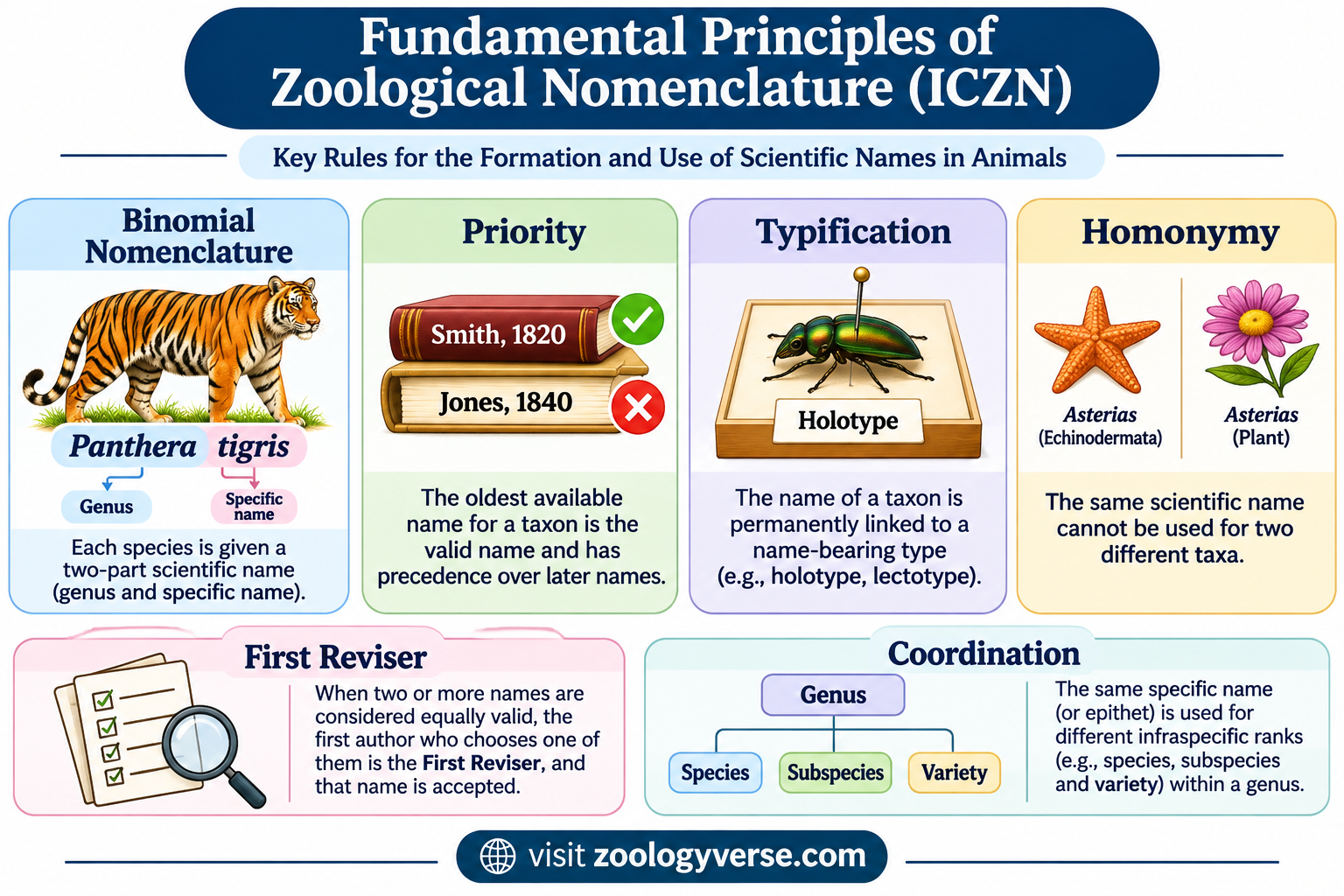
Zoological Nomenclature is governed by a set of internationally accepted principles that promote stability, consistency and universality in animal scientific names. These principles guide the formation, publication and application of names and help taxonomists resolve conflicts when different names have been proposed for the same animal group. The International Code of Zoological Nomenclature provides the formal rules through which these principles are applied.
7.1 Principle of Binominal Nomenclature
The Principle of Binominal Nomenclature requires that the scientific name of a species be composed of two words: a generic name and a specific name. For example, Panthera leo is the scientific name of the lion. Panthera is the genus name, while leo is the specific name.
The generic name begins with a capital letter, whereas the specific name begins with a lowercase letter. Both words are conventionally written in italics in printed text. This format provides a consistent way of identifying species and distinguishing them from other members of the same genus. These conventions make Zoological Nomenclature recognizable across scientific publications and databases. Consistent use of Zoological Nomenclature also helps distinguish formal scientific names from informal common names.
In Zoological Nomenclature, the specific name is not normally used alone as the complete scientific name of a species. It is combined with the generic name to form the binomen. This principle supports clear and standardized scientific naming. Within Zoological Nomenclature, the binomen identifies a species through its placement in a named genus.
7.2 Principle of Priority
The Principle of Priority states that, when two or more available names are considered to apply to the same taxon, the oldest available name is generally given precedence, subject to the conditions and exceptions established by the Code.
This principle helps prevent multiple competing names from being used for the same animal. It also provides an objective method for selecting names when historical publications contain different names for one taxon.
For example, if two authors independently describe the same animal species under different available names, the earlier name will generally have priority. However, the Code provides exceptions and mechanisms for preserving prevailing usage when strict application of priority would threaten nomenclatural stability.
The Principle of Priority is therefore a central element of Zoological Nomenclature, although it must be applied together with the Code’s provisions concerning availability, synonymy and conservation of names. Correct application of Zoological Nomenclature requires checking whether a proposed name is available under the Code. Priority is applied within the framework of Zoological Nomenclature rather than simply by choosing the oldest word ever used. This approach allows Zoological Nomenclature to recognize historical publication while protecting established usage where the Code permits.
7.3 Principle of Typification
The Principle of Typification connects a scientific name to a name-bearing type. A type is an objective reference that fixes the application of a name, helping researchers understand which taxon the name denotes.
For a species-group name, the name-bearing type is usually a specimen. For a genus-group name, it is a nominal species, while for a family-group name it is a nominal genus. A type does not necessarily represent the average appearance or every characteristic of the taxon; its function is to provide a permanent reference for the name.
Typification is particularly important when taxonomists disagree about the identity or limits of a species. By referring to the name-bearing type, researchers can evaluate how a scientific name should be applied under the Code. Typification is a defining feature of Zoological Nomenclature because it links a name to an objective nomenclatural reference. Through this connection, Zoological Nomenclature remains interpretable even when scientific ideas about relationships change.
7.4 Principle of Homonymy
The Principle of Homonymy deals with identical scientific names established for different animal taxa within the same nomenclatural group. Such identical names are called homonyms.
The Code generally does not permit two different taxa within the same group to have the same available name. When homonymy occurs, the junior homonym is normally rejected and must be replaced by an available synonym or, where appropriate, a new replacement name.
For example, if a genus name has already been established for one animal group, the same name cannot ordinarily be made available for a different genus within the same group. The rules of homonymy help prevent ambiguity and confusion in Zoological Nomenclature. The rules of Zoological Nomenclature specify how homonyms are identified and treated. By controlling homonymy, Zoological Nomenclature reduces the possibility that one scientific name will refer ambiguously to different taxa.
7.5 Principle of the First Reviser
The Principle of the First Reviser applies when two or more names or nomenclatural acts are published simultaneously and the Code does not otherwise establish which one takes precedence. In such cases, the first subsequent author who chooses between the competing names or acts may determine their precedence.
This principle is useful when priority alone cannot resolve a naming conflict because the competing names were published at the same time. The first reviser must make a clear choice in accordance with the relevant provisions of the Code.
The principle provides a practical method for resolving certain cases of simultaneous publication and contributes to consistent application of Zoological Nomenclature. The first-reviser provisions give Zoological Nomenclature a method for resolving certain cases that priority cannot separate.
7.6 Principle of Coordination
The Principle of Coordination applies to names within the family group, genus group and species group. Under this principle, a name established at one rank within a particular group is deemed to have been established simultaneously at the other ranks included in that same group, with the same author and date.
For example, establishing a family-group name at the rank of family has consequences for its use at other family-group ranks, such as subfamily or tribe, according to the provisions of the Code. Similar coordination applies within the genus and species groups.
This principle helps maintain consistency when taxonomic ranks are changed during classification revisions. Coordination ensures that changes in rank do not unnecessarily disrupt Zoological Nomenclature within a nomenclatural group.
7.7 Importance of the Fundamental Principles
The fundamental principles provide the basis for applying Zoological Nomenclature consistently. Binominal nomenclature standardizes species names, priority helps select between competing names, typification anchors names to objective references, and homonymy prevents the same name from being used for different taxa within the same group.
The principles of the first reviser and coordination address additional situations that arise during publication and taxonomic revision. Together, these principles support stable scientific communication and provide a common framework for zoologists working with living and extinct animals. These principles operate together, so Zoological Nomenclature must be applied by considering the relevant Code provisions as a whole. Understanding these principles is essential for using Zoological Nomenclature accurately in taxonomic descriptions and revisions.
Zoological Nomenclature thus provides the shared foundation for reliable animal naming.
8. Binomial Nomenclature and Scientific Names of Animals
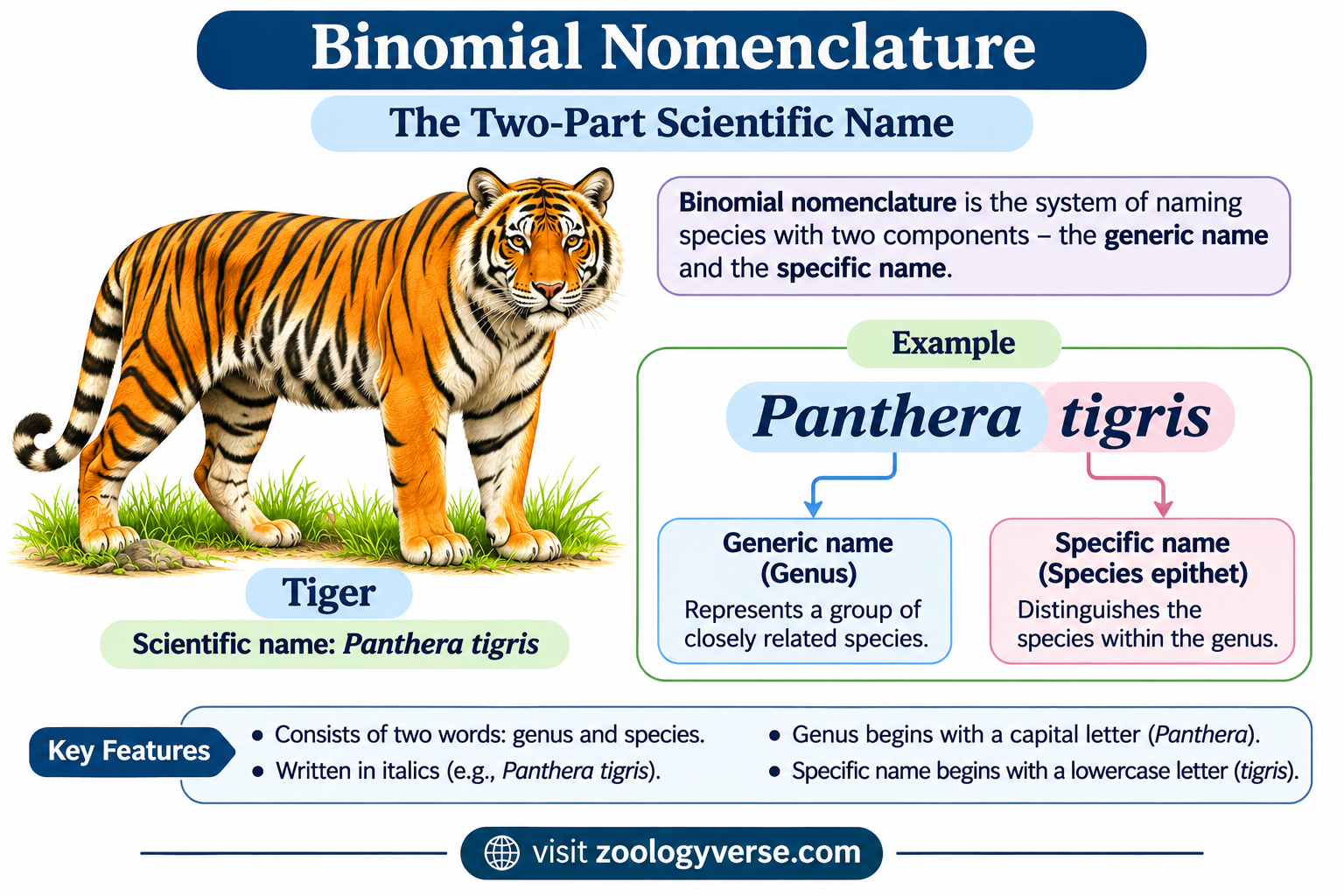
Binomial nomenclature is the system in which every species is given a two-part scientific name. It is a central feature of Zoological Nomenclature because it provides a standardized way to identify animal species across languages and geographical regions. The system was popularized by Carl Linnaeus and is used in modern zoological classification under the rules of the International Code of Zoological Nomenclature. In this way, Zoological Nomenclature provides a common naming framework for animal species.
8.1 Meaning of Binomial Nomenclature
The term binomial means “two names.” In this system, the scientific name of a species consists of a generic name followed by a specific name. For example, the scientific name of the lion is Panthera leo. Panthera is the generic name, while leo is the specific name.
The two components together form the binomen. Their standardized combination is one of the defining conventions of Zoological Nomenclature. The specific name should not normally be used alone because it does not uniquely identify a species without its generic name. This format is fundamental to Zoological Nomenclature and distinguishes formal species names from common names such as lion, tiger or peacock. It ensures that a species can be referred to consistently in Zoological Nomenclature even when its common name varies.
The binomial system is therefore a basic tool through which Zoological Nomenclature identifies species in a uniform manner.
8.2 Components of a Binomial Name
A binomial scientific name has two components:
- Generic name: The first word identifies the genus to which the species is assigned. It begins with a capital letter and is written in italics, for example, Panthera.
- Specific name: The second word distinguishes the species within its genus. It begins with a lowercase letter and is also written in italics, for example, leo.
Together, Panthera leo identifies the lion. Other examples include Homo sapiens (human), Canis lupus (grey wolf), Felis catus (domestic cat) and Pavo cristatus (Indian peafowl). These examples demonstrate how Zoological Nomenclature gives each species a consistent scientific name. The correct use of these names is essential to Zoological Nomenclature in scientific communication.
8.3 Rules for Writing Scientific Names
Scientific names must be presented according to established conventions. These conventions improve readability and help readers distinguish scientific names from ordinary words.
- The generic name begins with a capital letter.
- The specific name begins with a lowercase letter.
- Both words are italicized when printed or typed.
- When handwritten, each word is underlined separately rather than italicized.
- The generic name may be abbreviated after it has been written in full, provided the meaning remains unambiguous; for example, P. leo after Panthera leo.
- The specific name is not written by itself as the complete species name.
- The scientific name should be reproduced with its correct spelling.
These conventions are widely followed in Zoological Nomenclature and are important in academic writing, research papers, museum catalogues and biodiversity databases. Following them carefully helps preserve consistency in Zoological Nomenclature.
8.4 Binomial Nomenclature and Common Names
Common names vary between languages and geographical regions. A species may have several local names, and the same common name may be used for different animals. Scientific names reduce these ambiguities by providing a standardized reference.
This distinction between informal and formal names illustrates the practical value of Zoological Nomenclature.
| Common name | Scientific name |
|---|---|
| Lion | Panthera leo |
| Tiger | Panthera tigris |
| Domestic cat | Felis catus |
| Grey wolf | Canis lupus |
| Indian peafowl | Pavo cristatus |
The scientific name is especially useful when researchers communicate internationally or combine information from different sources. Zoological Nomenclature therefore supports accurate species identification and reliable exchange of biological information. It allows Zoological Nomenclature to function across international research communities.
8.5 Relationship Between Binomial and Trinomial Nomenclature
Binomial nomenclature is used for species, whereas a third component may be added when a subspecies is named. This three-part form is called trinomial nomenclature.
For example, Panthera tigris tigris is a trinomen used for a subspecies of tiger. The first word indicates the genus, the second is the specific name, and the third is the subspecific name. Under the Code, names of subspecies belong to the species group.
The distinction between binomial and trinomial forms is important when applying Zoological Nomenclature to classifications that recognize subspecies. Both forms are handled through the relevant provisions of Zoological Nomenclature. The addition of a subspecific name provides a way to identify an infraspecific taxon without changing the basic structure of the species name.
8.6 Importance of Binomial Nomenclature in Zoology
Binomial nomenclature provides a concise and internationally recognizable method of naming species. It helps organize animal diversity, supports scientific publications and allows information about a species to be compared across research studies.
It is also important in conservation biology, where accurate identification is needed to document threatened species, monitor populations and coordinate conservation activities. In museums and biodiversity databases, standardized names allow specimens and observations to be catalogued and retrieved consistently.
As a result, binomial nomenclature remains an essential practical foundation of Zoological Nomenclature. By using a consistent two-part name for each species, zoologists can communicate more precisely and maintain continuity in the scientific study of animal diversity. The system continues to make Zoological Nomenclature useful in both traditional taxonomy and modern biodiversity research. Accurate binomial usage remains central to Zoological Nomenclature.
9. Formation and Writing of Zoological Names
The formation of scientific names follows established conventions that make animal names recognizable, consistent and suitable for international use. Zoological Nomenclature regulates how names are formed and written at the family, genus and species groups. These conventions help taxonomists communicate clearly and preserve the identity of names when classifications are revised. Correct formation is therefore an important practical part of Zoological Nomenclature. These naming conventions form the practical starting point for applying Zoological Nomenclature.
9.1 General Requirements for Scientific Names
Scientific names governed by the International Code of Zoological Nomenclature must meet the requirements applicable to their nomenclatural group. Names are generally formed using Latin or latinized words, although they may be derived from many languages, personal names, geographical locations or descriptive features. Zoological Nomenclature also governs how these names are presented in formal descriptions.
A zoological name should be written in the form required for its rank. Species names are binomina, consisting of a generic name and a specific name. Subspecies names are trinomina, consisting of a generic name, a specific name and a subspecific name. Family-group names, genus-group names and species-group names each follow distinct formation rules. Each rank has its own requirements, and Zoological Nomenclature must be applied accordingly.
Zoological Nomenclature also distinguishes between the availability of a name and its taxonomic acceptance. A name may satisfy the Code’s requirements for availability without necessarily being the name currently accepted by every taxonomist. The correct application of Zoological Nomenclature therefore requires attention to both nomenclatural rules and taxonomic evidence. Availability is a formal status determined by the Code, not by popularity or database listing. Taxonomic acceptance may change, while the nomenclatural status of a name remains governed by the Code.
9.2 Formation of Generic Names
A generic name is a noun in the nominative singular or a word treated as such under the Code. It begins with a capital letter and is italicized in printed text. A generic name may be derived from a Latin or Greek word, a word from another language, a person’s name or another source, provided it is formed and published in accordance with the Code.
For example, Panthera is the generic name that includes lions, tigers, leopards and jaguars. The name identifies the genus and forms the first component of each species name assigned to it. Generic names are central to Zoological Nomenclature because they establish the first part of species combinations. When a species is transferred to another genus, its combination may change, but the specific name may be retained subject to the Code’s rules. The rules ensure that Zoological Nomenclature can accommodate names derived from diverse linguistic sources.
The generic name is important in Zoological Nomenclature because it indicates the genus to which a species is assigned. It also provides the basis for forming family-group names in accordance with the Code.
9.3 Formation of Specific and Subspecific Names
A specific name is the second component of a species binomen. It may be an adjective, a noun in the genitive case or a noun in apposition, depending on how it is formed. Specific names are written with a lowercase initial letter and italicized together with the generic name. Such changes must follow Zoological Nomenclature rather than an author’s preferred spelling or style.
Specific names may describe a characteristic of the animal, refer to its geographical distribution, commemorate a person or derive from another source. For example, the name alba may indicate a pale or white characteristic, while a name ending in -i or -ae may commemorate a person, depending on the grammatical construction and applicable formation rules.
A subspecific name is added as the third component when a taxon is named at subspecies rank. The complete three-part name is called a trinomen. The same conventions of capitalization and italicization apply to its three components.
The formation of specific and subspecific names is an important part of Zoological Nomenclature because these names distinguish species and subspecies within their respective genera. Specific names contribute to the distinct identity of species within Zoological Nomenclature.
9.4 Formation of Family-Group Names
Family-group names are formed from the stem of the name of a type genus, together with a suffix specified by the Code for the relevant rank. For example, the family name Felidae is based on the genus Felis. Other family-group ranks use different suffixes, such as -inae for subfamilies and -ini for tribes. These suffixes are prescribed by the Code and are not selected arbitrarily by authors.
The type genus provides the reference for the family-group name. If the taxonomic rank of a family-group taxon changes, the name is adjusted according to the coordination provisions of the Code. These rules allow the name to remain connected with its type genus. These conventions make Zoological Nomenclature consistent across taxonomic groups and publications. This consistency is essential to reliable Zoological Nomenclature.
Family-group formation demonstrates how Zoological Nomenclature standardizes names above the genus and species levels. It also helps maintain consistency when taxonomists revise the arrangement of related animal groups. Family-group names therefore remain connected to their type genus under Zoological Nomenclature.
9.5 Capitalization, Italicization and Abbreviation
Scientific names follow standard typographical conventions. The generic name begins with a capital letter, while specific and subspecific names begin with lowercase letters. The components of species and subspecies names are italicized when printed or typed.
Examples include Homo sapiens, Panthera tigris and Canis lupus. When handwriting scientific names, each word is conventionally underlined separately. Once a generic name has been written in full, it may be abbreviated to its initial letter when the context makes the intended genus clear.
Names of authors and publication years, when included after a scientific name, are not italicized. For example, Homo sapiens Linnaeus, 1758 includes the name of the author and the year of publication in roman type. Parentheses around an author and date may indicate that the species has been placed in a genus different from the original combination, according to the Code.
These writing conventions make scientific names easy to recognize and are consistently used in Zoological Nomenclature. Correct typography is a visible feature of Zoological Nomenclature in formal scientific writing. Consistent typography also reduces ambiguity in scientific publications and educational material.
9.6 Latinization and Grammatical Agreement
Although zoological names may originate from different languages, they are generally treated according to Latin grammatical conventions. The Code provides rules for determining the form and spelling of names, including the treatment of gender agreement between a generic name and an adjectival specific name. Researchers should verify each proposed form against the current Code of Zoological Nomenclature.
When an adjectival specific name is combined with a generic name of a different grammatical gender, its ending may need to change to agree with the genus, as required by the Code. By contrast, a noun in apposition or a noun in the genitive case is treated differently and does not necessarily change its ending.
The correct treatment of spelling and grammatical form is important because changes to a name must follow the Code rather than personal preference. These provisions help maintain stable and consistent names across taxonomic literature. Grammatical rules are an important part of Zoological Nomenclature, especially when names are recombined. An incorrect grammatical change can alter a name improperly under the Code. Careful checking protects the stability of Zoological Nomenclature across successive publications.
9.7 Importance of Correct Name Formation
Correct formation and writing of scientific names are essential for accurate taxonomic communication. Errors in spelling, capitalization, italics or grammatical form can create confusion in publications and databases. Researchers must therefore consult the Code when proposing new names or checking the correct form of existing names. Careful application keeps Zoological Nomenclature understandable to researchers internationally.
Zoological Nomenclature provides a standardized framework for these decisions, ensuring that names are formed and presented consistently. Understanding these conventions is especially important when describing new species, revising genera or preparing scientific catalogues. Through these rules, Zoological Nomenclature supports reliable documentation of animal diversity.
10. Principle of Priority
The Principle of Priority is one of the central rules of Zoological Nomenclature. It provides a method for selecting the correct name when two or more available names are considered to apply to the same taxon. In general, the oldest available name takes precedence, provided that the conditions of the International Code of Zoological Nomenclature are satisfied and no applicable exception changes the result. The principle promotes stability by reducing the continued use of competing names for the same animal group.
10.1 Meaning of the Principle of Priority
Under the Principle of Priority, the valid name of a taxon is generally the oldest available name that applies to it under the Code. The relevant date is the date on which the name was made available in a publication that satisfies the Code’s requirements. A name does not gain priority merely because it was mentioned informally or appeared in a work that does not meet the conditions for availability.
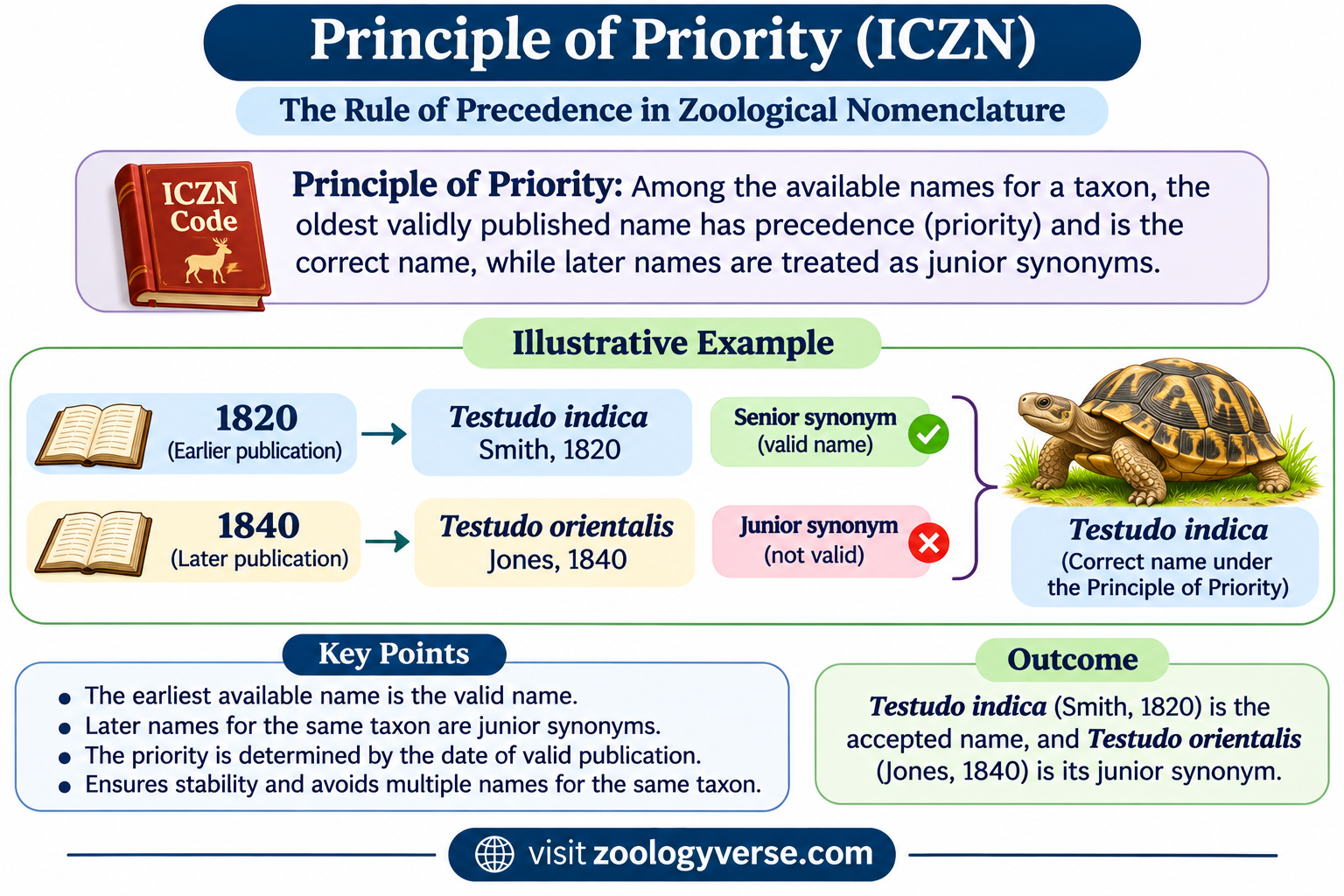
For example, if one author establishes an available name for a species in 1820 and another author independently establishes a different available name for the same species in 1840, the 1820 name will ordinarily have priority. The later name is generally treated as a junior synonym, provided both names refer to the same taxon and no special provision applies.
The Principle of Priority is not simply a rule that the oldest word must always be used. It operates within the formal framework of Zoological Nomenclature and depends on the availability and correct application of names. Taxonomic research determines whether names are considered to refer to the same taxon; the Code then provides the nomenclatural rules for selecting the name. Priority is applied only after the relevant rules of Zoological Nomenclature establish availability. Historical publication records are therefore essential when applying Zoological Nomenclature. Zoological Nomenclature uses publication dates as formal evidence when competing names are compared.
10.2 Starting Point of Priority
For most purposes, the starting point for the priority of zoological names is 1 January 1758, associated with the tenth edition of Carl Linnaeus’s Systema Naturae. The Code treats the works published on that date as the starting point for zoological nomenclature, subject to specific provisions concerning certain names and works.
This starting point creates a common historical reference for evaluating the priority of names. It also prevents researchers from having to assess an unlimited range of earlier descriptive expressions as potential scientific names under the modern system. This requirement makes original descriptions especially important in Zoological Nomenclature.
10.3 Application of the Principle of Priority
The principle is applied when taxonomists determine which available name should be used for a taxon. The process generally involves examining the original publications, checking whether the names are available under the Code, establishing their publication dates and determining whether they refer to the same taxonomic entity.
The following steps are commonly involved:
- Identify the competing scientific names that have been applied to the taxon.
- Examine the original descriptions and publications in which those names were established.
- Determine whether each name is available under the relevant provisions of the Code.
- Establish the correct dates of publication.
- Compare the available names and identify the one with priority.
- Check whether conservation, reversal of precedence or another Code provision affects the outcome.
These steps show that Zoological Nomenclature requires careful evaluation of publication history rather than selection based only on the apparent age of a name. Researchers should also distinguish nomenclatural priority from taxonomic preference: a taxonomist may revise the limits of a taxon, but the name applied to it must still be assessed under the Code. Researchers must verify the original date before deciding which name has priority in Zoological Nomenclature. An unavailable earlier expression cannot displace an available name under Zoological Nomenclature. Zoological Nomenclature distinguishes an available name from a name that is merely mentioned in literature.
10.4 Senior and Junior Synonyms
When two or more available names are considered to refer to the same taxon, they are known as synonyms. The name with priority is generally called the senior synonym, while a later name is called a junior synonym.
For example, suppose a species was described under one available name in an earlier publication and was later described again under a different name. If subsequent taxonomic study concludes that both names refer to the same species, the earlier name will normally be selected under the Principle of Priority. The later name is then treated as a junior synonym, unless an exception or formal ruling applies.
| Term | Meaning |
|---|---|
| Senior synonym | The available synonym that generally has priority |
| Junior synonym | A later available synonym that generally does not take precedence |
| Synonymy | The condition in which different names are treated as referring to the same taxon |
The distinction is important in Zoological Nomenclature because synonymy can arise as scientific knowledge improves and previously separated forms are recognized as belonging to the same species. Accurate synonymy records help researchers apply Zoological Nomenclature consistently across publications.
10.5 Exceptions and Reversal of Priority
Although priority is a fundamental rule, its application is not absolute in every case. The Code includes provisions intended to prevent the strict use of an older name from causing unnecessary instability or confusion. One important mechanism is the reversal of precedence under specified conditions.
In particular circumstances, a younger name that has been used consistently may be maintained over an older name that has not been used for a long period. The Code sets out conditions for this treatment, including requirements concerning prevailing usage and the history of the competing names. The Commission may also use its plenary power in exceptional cases to conserve a name or otherwise resolve a serious nomenclatural problem.
These exceptions demonstrate that Zoological Nomenclature seeks to balance historical priority with stability and universality. They should not be applied casually; the relevant provisions and evidence of usage must be examined carefully. Zoological Nomenclature also considers whether a name has been formally conserved or protected. Such provisions prevent priority from producing disruptive changes in widely used animal names. Zoological Nomenclature thus balances chronological precedence with the need for nomenclatural stability.
10.6 Importance of the Principle of Priority
The Principle of Priority provides an objective starting point for resolving conflicts between competing available names. It helps maintain consistency in taxonomic publications, museum catalogues, biodiversity databases and conservation records.
Without this principle, different researchers might select different names according to personal preference, leading to confusion in scientific communication. By establishing a general rule and carefully defined exceptions, Zoological Nomenclature provides a systematic way to evaluate competing names while allowing established usage to be protected when the Code permits it.
The Principle of Priority is therefore essential to the practical application of Zoological Nomenclature. It connects the historical record of scientific publication with the present-day use of animal names and supports continuity as taxonomic knowledge develops. The Principle of Priority gives Zoological Nomenclature a consistent historical reference. Careful source checking is therefore a basic task in Zoological Nomenclature. Where evidence is incomplete, researchers should explain the uncertainty rather than assume priority. The Code’s exceptions ensure that Zoological Nomenclature does not undermine established usage unnecessarily. Together, these safeguards make Zoological Nomenclature both historically grounded and practically stable. This careful approach strengthens Zoological Nomenclature in modern zoological practice.
11. Principle of Typification
The Principle of Typification is a fundamental part of Zoological Nomenclature. It establishes a permanent nomenclatural reference for the application of a scientific name by connecting that name with a designated name-bearing type. This connection helps zoologists determine which taxon a name applies to, even when interpretations of species boundaries or relationships change. Typification is therefore essential for stability and precision in Zoological Nomenclature. These rules make Zoological Nomenclature reproducible across taxonomic studies.
11.1 Meaning of Typification
Typification is the process by which a scientific name is objectively linked to a name-bearing type as specified by the International Code of Zoological Nomenclature. A type does not necessarily represent the most typical, common or average member of a species. Instead, it serves as the reference that fixes the application of the name.
For example, when a new animal species is described, the author usually designates a particular specimen as the holotype. Future researchers can examine this specimen, together with the original description and other relevant evidence, when assessing the identity and application of the name. This is an important safeguard within Zoological Nomenclature because taxonomic opinions may change while the name-bearing reference remains fixed. Zoological Nomenclature uses types to anchor names, not to define biological variation. This distinction is central to Zoological Nomenclature.
11.2 Name-Bearing Types in Different Nomenclatural Groups
The nature of a name-bearing type depends on the nomenclatural group to which the name belongs. The Code recognizes different types for the family, genus and species groups.
| Nomenclatural group | Name-bearing type | Explanation |
|---|---|---|
| Species group | A specimen or, in certain cases, another permitted type under the Code | Fixes the application of a species-group name |
| Genus group | A nominal species | Fixes the application of a genus-group name |
| Family group | A nominal genus | Provides the reference for a family-group name |
For a species-group name, the type is generally a specimen preserved in a museum or other recognized collection. For a genus-group name, the type species is the nominal species that objectively anchors the generic name. For a family-group name, the type genus provides the reference from which the family-group name is formed.
These connections are central to Zoological Nomenclature because they provide objective reference points for names at different taxonomic ranks. Such documentation protects the reliability of Zoological Nomenclature.
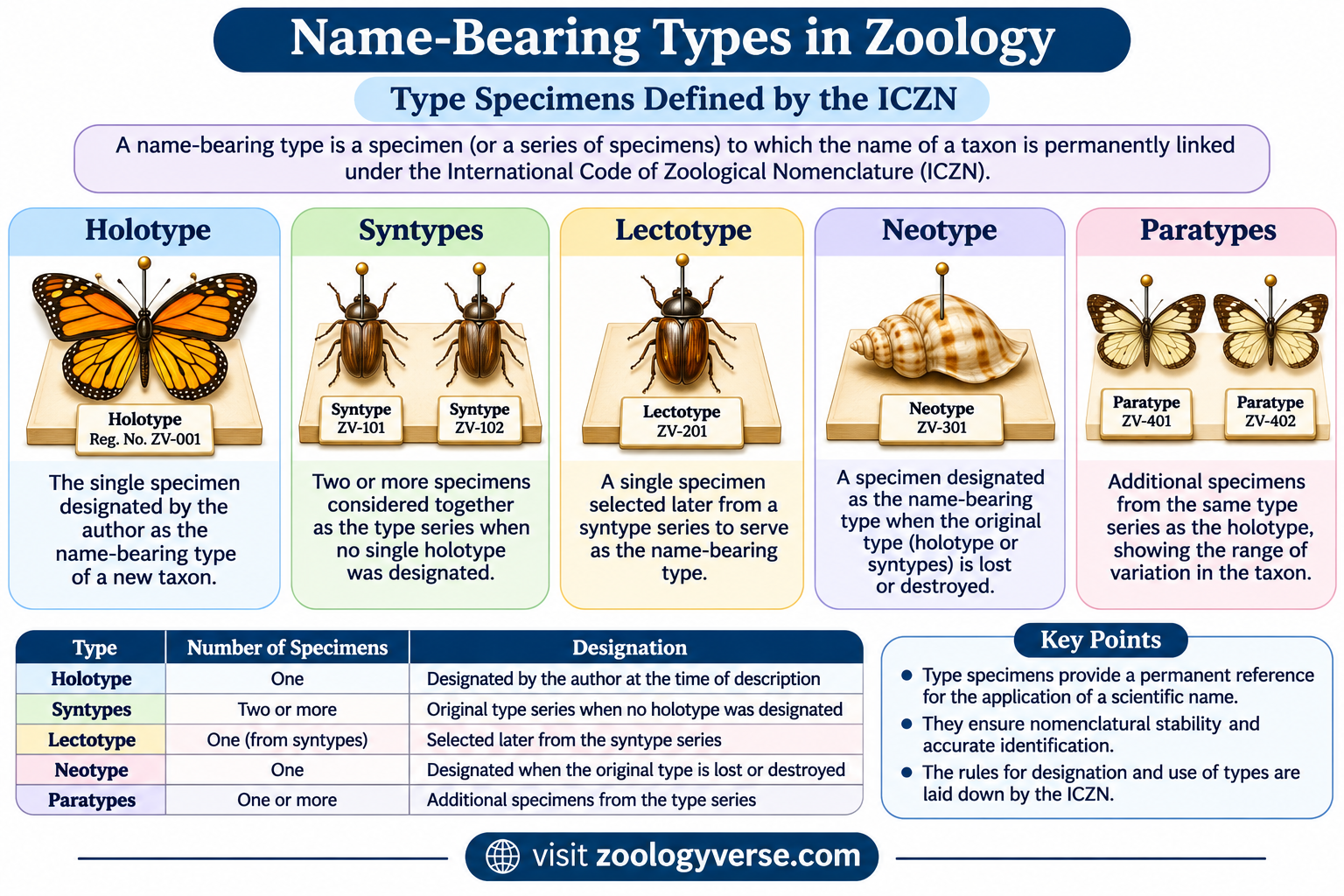
11.3 Types of Name-Bearing Specimens
The Code recognizes several categories of name-bearing types used in zoological descriptions and revisions. Their correct designation and interpretation are important when applying Zoological Nomenclature.
- Holotype: The single specimen designated as the name-bearing type when a new species-group taxon is established.
- Syntypes: Two or more specimens cited in the original description when no holotype was designated, or when the original description otherwise establishes a series of syntypes.
- Lectotype: A single specimen selected later from the syntypes to serve as the name-bearing type.
- Neotype: A specimen designated as the name-bearing type when no name-bearing type is believed to be extant and the requirements of the Code are met.
- Paratypes: Specimens included in the type series other than the holotype. Paratypes are not name-bearing types under the Code.
The distinction between these categories is important. Zoological Nomenclature applies these categories according to the Code. Correct type designation is therefore a formal requirement of Zoological Nomenclature. A paratype may provide useful information about variation within a species, but it does not have the same nomenclatural status as a holotype. Similarly, a lectotype is selected from an existing type series, whereas a neotype is designated in circumstances where the original name-bearing type is lost or destroyed and the Code’s conditions are satisfied.
11.4 Type Species and Type Genus
In Zoological Nomenclature, names of genera and families are also connected to name-bearing types. A genus-group name is fixed to a nominal species called the type species. The type species provides the objective reference for the application of the genus-group name.
Similarly, a family-group name is based on a type genus. For example, the family name Felidae is based on the genus Felis. The type genus anchors the family-group name even if taxonomists later change the limits or internal arrangement of the family.
A type species does not have to be the most common or best-known species in the genus. Its function is nomenclatural rather than a statement about biological importance. This distinction is essential to understanding how Zoological Nomenclature maintains stable names when classifications are revised. Type species provide this anchor within Zoological Nomenclature. The type genus similarly anchors family-group names in Zoological Nomenclature.
11.5 Importance of Type Specimens in Taxonomic Research
Type specimens are important reference materials in zoological museums and research institutions. They allow researchers to compare newly collected specimens with the material on which an existing name was based. This is particularly valuable when closely related species are difficult to distinguish or when a taxonomic group is revised.
Type material may be re-examined using modern techniques, including detailed microscopy, imaging and, where appropriate, molecular methods. However, destructive sampling of valuable type specimens requires careful consideration and may be restricted by institutional policies or the condition of the specimen.
The preservation, labelling and documentation of type specimens are therefore essential responsibilities of taxonomists. These practices help ensure that the reference material remains traceable and available for future study. These comparisons support accurate application of Zoological Nomenclature.
11.6 Role of Typification in Maintaining Nomenclatural Stability
Taxonomic classifications may change as new morphological, ecological or molecular evidence becomes available. A species may be divided into several species, or multiple named species may be combined into one. In such situations, name-bearing types help determine how existing names should be applied.
Typification does not decide the boundaries of a taxon or determine its evolutionary relationships. Instead, it provides a stable reference for the name while taxonomists investigate the biological evidence. This separation between nomenclatural reference and taxonomic judgment is a key feature of Zoological Nomenclature. Typification therefore provides continuity within Zoological Nomenclature. Researchers use this evidence when interpreting names under Zoological Nomenclature.
By connecting names to name-bearing types, the Code reduces uncertainty and helps researchers apply names consistently across revisions, publications and collections. The Principle of Typification is consequently indispensable to Zoological Nomenclature and to the reliable documentation of animal diversity.
12. Principle of Homonymy
The Principle of Homonymy is an important rule of Zoological Nomenclature that prevents the same scientific name from being used for different animal taxa within the same nomenclatural group. When identical names are established for different nominal taxa, they are known as homonyms. The International Code of Zoological Nomenclature provides rules for identifying and resolving these conflicts. These provisions help keep Zoological Nomenclature clear, consistent and unambiguous.
Homonymy may arise when different researchers independently propose the same name for unrelated animal groups. Without common rules, one scientific name could refer to more than one taxon, creating confusion in research publications, museum collections and biodiversity databases. Zoological Nomenclature addresses this problem through rules that distinguish earlier and later available names and determine how the conflict should be resolved. These safeguards are central to the consistent application of Zoological Nomenclature.
12.1 Meaning and Definition of Homonymy
Homonymy is the condition in which two or more identical names are established for different nominal taxa within the same nomenclatural group. Under the Code, names are assessed according to their availability, publication history and nomenclatural group. The mere similarity of two words does not automatically establish homonymy; the relevant provisions and spelling rules must be considered.
For example, if a genus name has already been established for one animal group and another author later establishes the same name for a different genus within the same group, the names may be homonyms. The earlier name is generally called the senior homonym, while the later name is called the junior homonym. Zoological Nomenclature normally gives precedence to the senior homonym, subject to the Code’s provisions and exceptions.
Homonymy is different from synonymy. Homonyms are identical names established for different nominal taxa, whereas synonyms are different names considered to refer to the same taxon. This distinction is essential in Zoological Nomenclature because each condition requires a different nomenclatural treatment. Synonymy is generally addressed through priority, while homonymy is addressed through the rules preventing duplicate names within the same group. Understanding the distinction is necessary for applying Zoological Nomenclature correctly.
12.2 Principle of Homonymy Under the ICZN Code
The Principle of Homonymy is governed by provisions of the Code dealing with homonyms in the family, genus and species groups. In general, when two available names are identical within the same nomenclatural group, the junior homonym cannot normally be used as the valid name while the senior homonym remains in force.
The senior homonym generally retains precedence, while the junior homonym must be replaced by an available synonym or, when necessary, a new replacement name. The precise treatment depends on the group concerned and the circumstances in which the names were established. Zoological Nomenclature therefore requires more than a simple visual comparison of names: researchers must establish availability, identity and the relevant nomenclatural relationship. These requirements define how Zoological Nomenclature treats competing names.
The application of this principle requires examination of original publications. Researchers must determine whether the names are identical under the Code, whether both are available and whether they belong to the same nomenclatural group. These checks establish whether a genuine homonymy problem exists under Zoological Nomenclature. Such checks protect the consistency of Zoological Nomenclature.
12.3 Types of Homonyms
Homonyms are commonly distinguished according to the circumstances in which the names were established and, for species-group names, whether the identical names were originally combined with the same genus. Each category must be interpreted according to the relevant rules of Zoological Nomenclature.
1. Primary homonymy
Primary homonyms are identical species-group names originally established in the same combination, meaning that they were originally published with the same generic name. If two different species are independently described under the same species-group name in the same genus, the later available name is generally a junior primary homonym.
For example, imagine that two authors independently describe different species in the genus Aquila and give both the specific name minor. If both names are available and meet the conditions for primary homonymy, the later name is a junior primary homonym. The Code determines the consequences and any applicable exceptions.
2. Secondary homonymy
Secondary homonymy occurs when two species-group names were originally established in different genera but become identical after the species are placed in the same genus. Their original combinations were different, but a later taxonomic change creates a homonymy conflict.
For example, two species may originally be described in separate genera. If subsequent research transfers both species to one genus and their specific names are identical, secondary homonymy may arise. The Code contains provisions for determining whether the junior name must be replaced and whether an exception applies. Zoological Nomenclature thus accommodates taxonomic changes while regulating the naming conflicts they may create. This distinction helps researchers apply Zoological Nomenclature accurately.
3. Family-group and genus-group homonymy
Homonymy can also occur among family-group and genus-group names. Identical available names established for different nominal taxa are evaluated under the relevant provisions of the Code. The treatment depends on the nomenclatural group, the dates and circumstances of publication, and any applicable exceptions.
These categories demonstrate that homonymy is not restricted to species names. It can affect several levels of Zoological Nomenclature, and each case must be assessed under the rules applicable to its group. These procedures are particularly important in practical Zoological Nomenclature.
12.4 Senior and Junior Homonyms
The distinction between senior and junior homonyms is generally based on the dates on which the competing names became available.
| Term | Meaning |
|---|---|
| Senior homonym | The earlier available name that generally retains precedence |
| Junior homonym | The later identical available name that is generally rejected |
| Homonymy | The condition in which identical names apply to different nominal taxa within the same nomenclatural group |
The Principle of Priority usually gives precedence to the senior homonym. However, the Code includes provisions and exceptions that may affect the treatment of particular names. Researchers must therefore examine the relevant articles rather than assume that every later name is automatically replaced. This careful assessment is an important part of Zoological Nomenclature. Researchers should document the evidence supporting their interpretation of Zoological Nomenclature.
12.5 Resolution of Homonymy
When homonymy is identified, taxonomists examine the original descriptions and publication records to establish the status of the competing names. The appropriate solution depends on the nomenclatural group and the circumstances of the case.
The main steps include:
- Identify the potentially identical scientific names.
- Examine their original publications and dates.
- Determine whether each name is available under the Code.
- Establish whether the names belong to the same nomenclatural group.
- Determine whether the case involves primary or secondary homonymy, where relevant.
- Identify the senior and junior homonyms, if the rules require this distinction.
- Determine whether an available synonym can replace the junior homonym.
- If no suitable synonym exists, establish a replacement name in accordance with the Code.
A replacement name is also called a nomen novum. It is established to replace an existing name that cannot be used because of a nomenclatural problem, such as homonymy. Its establishment must satisfy the relevant provisions of the Code. The replacement name has its own authorship and date, while its type is the same as that of the name it replaces, as specified by the Code. Such formal procedures allow Zoological Nomenclature to resolve duplicate names without losing the connection to the taxon concerned. Such changes must be evaluated under Zoological Nomenclature before a name is adopted.
12.6 Importance of the Principle of Homonymy
The Principle of Homonymy is essential for maintaining clarity in Zoological Nomenclature. It prevents identical scientific names from creating confusion between different animal taxa and supports accurate identification in scientific literature.
The principle is particularly important during taxonomic revisions, when species are transferred between genera and new combinations are created. Such changes can produce secondary homonymy even when no conflict existed in the original descriptions. Researchers must therefore reassess names when taxonomic combinations change.
By regulating these situations, Zoological Nomenclature provides a systematic method for resolving naming conflicts. The principle also supports consistency in museum catalogues, research databases, biodiversity inventories and conservation records. Correct application of the homonymy rules is necessary for stable scientific naming and for the reliable exchange of zoological information. In this way, Zoological Nomenclature combines clear naming rules with procedures that accommodate continuing taxonomic research. These provisions help maintain stability in Zoological Nomenclature. These rules are indispensable to Zoological Nomenclature in taxonomic revisions. Correct interpretation preserves the reliability of Zoological Nomenclature. Researchers apply these provisions whenever Zoological Nomenclature encounters duplicate names. Accurate records are essential for the continued reliability of Zoological Nomenclature.
13. Synonymy and Homonymy in Zoological Nomenclature
Synonymy and homonymy are two important nomenclatural conditions encountered when scientific names are established, compared and applied to animal taxa. Synonymy occurs when different available names are considered to refer to the same taxon, whereas homonymy occurs when identical names have been established for different nominal taxa within the same nomenclatural group. Understanding these conditions is essential for applying Zoological Nomenclature consistently and avoiding confusion in scientific communication. This distinction is a routine part of Zoological Nomenclature when historical names are reassessed. The correct interpretation of Zoological Nomenclature depends on the evidence associated with each name.
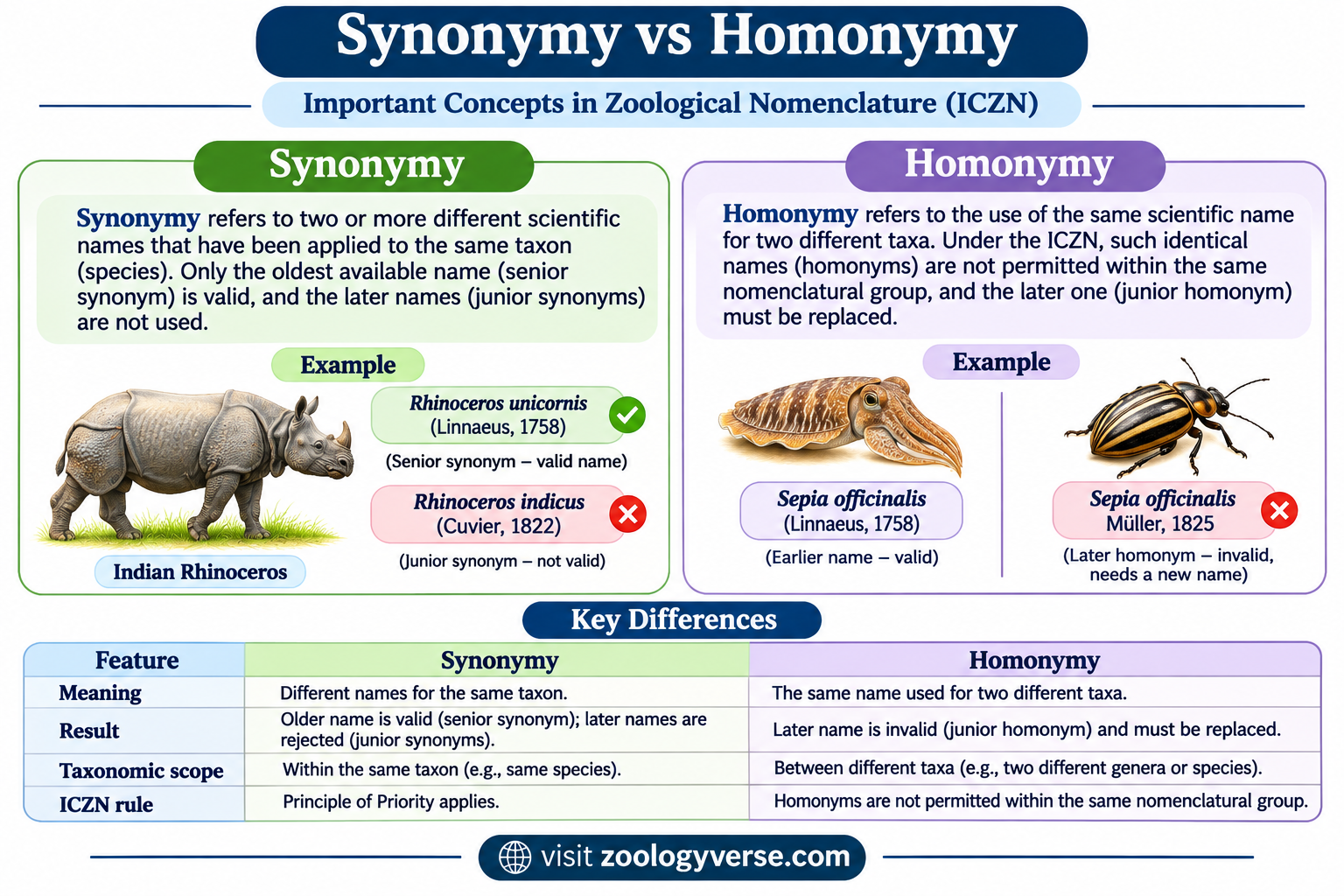
13.1 Meaning of Synonymy
Synonymy is the condition in which two or more available scientific names are considered to refer to the same taxonomic entity. It commonly arises when different researchers independently describe the same species, sometimes because they are unaware of earlier descriptions or because the organisms were collected from different geographical regions.
For example, an animal may be described under one name in an early publication and later described again under another name. If subsequent taxonomic research concludes that both descriptions refer to the same species, the names are treated as synonyms. Zoological Nomenclature provides rules for determining which name generally takes precedence.
Synonymy may also arise when taxonomic research changes the limits of a taxon. Two species previously considered distinct may later be treated as one species. Their names may then become synonyms, depending on the taxonomic conclusion and nomenclatural circumstances. The recognition of synonymy is therefore a taxonomic judgment, while the selection of the correct name is governed by the Code. Such cases show why Zoological Nomenclature distinguishes nomenclatural facts from taxonomic hypotheses.
13.2 Types of Synonyms
Synonyms are commonly distinguished as objective or subjective, according to the relationship between their name-bearing types.
1. Objective synonyms
Objective synonyms are names that have the same name-bearing type. Because the names are based on the same nomenclatural type, they refer to the same nominal taxon, even if they were originally established under different names or combinations.
For example, two genus-group names may be established with the same type species. Under the Code, those names are objective synonyms. Their relationship is fixed by the identity of their name-bearing type rather than by an assessment of general similarity. These type-based relationships are evaluated under the provisions of Zoological Nomenclature.
2. Subjective synonyms
Subjective synonyms are names whose name-bearing types are different, but which taxonomists consider to belong to the same taxon. Their synonymy depends on scientific judgment and may change when new evidence becomes available.
For example, two separately described animal species may initially be regarded as distinct. Later examination of morphology, anatomy or molecular evidence may lead researchers to conclude that they represent the same species. Their names are then treated as subjective synonyms.
The distinction is important because objective synonymy follows from the identity of name-bearing types, whereas subjective synonymy depends on taxonomic interpretation. Zoological Nomenclature provides the rules for selecting names once such relationships have been recognized. The distinction is applied consistently throughout Zoological Nomenclature.
13.3 Meaning of Homonymy
Homonymy occurs when identical scientific names are established for different nominal taxa within the same nomenclatural group. It may arise through independent naming by different researchers or through changes in taxonomic combinations.
The earlier available name is generally called the senior homonym, while the later one is called the junior homonym. Under the relevant provisions of the Code, the junior homonym is generally not retained when the senior homonym has precedence, although exceptions may apply.
Homonymy differs from synonymy because the names involved have opposite relationships: synonyms are different names for the same taxon, while homonyms are identical names for different nominal taxa. This distinction is central to Zoological Nomenclature and to the correct interpretation of animal names. This is a recurring task in Zoological Nomenclature.
13.4 Differences Between Synonymy and Homonymy
| Basis | Synonymy | Homonymy |
|---|---|---|
| Meaning | Different names referring to the same taxon | Identical names established for different nominal taxa |
| Names involved | Different scientific names | Identical scientific names |
| Main issue | Choosing the correct name among competing synonyms | Preventing one name from referring to different taxa |
| General rule | Priority usually determines the senior synonym | The senior homonym generally takes precedence |
| Example of relationship | Two descriptions later considered to represent one species | Two different genera independently given the same name |
The distinction helps researchers identify the type of nomenclatural problem before applying the relevant Code provisions. Zoological Nomenclature treats synonymy and homonymy through different rules, so confusing the two can lead to incorrect naming decisions. Zoological Nomenclature therefore separates the identity of a name from the taxonomic opinion about a group.
13.5 Resolution of Synonymy and Homonymy
The resolution of synonymy and homonymy requires examination of original descriptions, publication dates, name-bearing types and the taxonomic evidence relevant to the organisms concerned.
For synonymy, researchers first determine whether the names are available and whether they refer to the same taxon. They then examine priority and any applicable provisions that may conserve a name or protect prevailing usage. The oldest available name is generally selected, subject to the Code.
For homonymy, researchers determine whether the names are identical under the Code, whether they are available and whether they belong to the same nomenclatural group. If a junior homonym cannot be retained, an available synonym may be used or a replacement name may be established under the applicable provisions.
These procedures demonstrate how Zoological Nomenclature balances historical publication, taxonomic evidence and stability. The Code gives Zoological Nomenclature a consistent method for handling these cases. The correct outcome depends on the facts of each case and the relevant articles of the Code. Applying Zoological Nomenclature correctly requires checking both the original publication and subsequent taxonomic treatment. These comparisons are important in Zoological Nomenclature because the same-looking problem may have a different nomenclatural cause.
13.6 Importance in Taxonomic Research
Synonymy and homonymy are common considerations in taxonomic revisions, species catalogues, museum databases and biodiversity inventories. As researchers examine new specimens and apply modern analytical methods, previously accepted species boundaries may be revised, creating new synonymies or changing the combinations in which names are used.
Homonymy checks are also necessary when proposing new names. Zoological Nomenclature provides the shared rules needed to manage these naming relationships while allowing taxonomy to develop as scientific knowledge improves. Such checks are essential to the practical use of Zoological Nomenclature. Researchers should record the reasoning behind decisions made under Zoological Nomenclature. These safeguards preserve the clarity of Zoological Nomenclature. Accurate treatment of these conditions supports consistent identification and reliable exchange of biological information. Reliable documentation allows Zoological Nomenclature to be applied consistently across databases and publications. This careful approach strengthens the stability of Zoological Nomenclature.
14. Availability and Validity of Zoological Names
Availability and validity are two important concepts in Zoological Nomenclature. They are related, but they do not mean the same thing. Availability concerns whether a name has been established in accordance with the requirements of the International Code of Zoological Nomenclature (ICZN). The distinction is foundational to Zoological Nomenclature. In Zoological Nomenclature, this is the first question to examine when assessing a proposed name.
Validity concerns whether an available name is the correct name to use for a particular taxon under the Code. Zoological Nomenclature treats these as separate stages of nomenclatural assessment.
This distinction is essential in Zoological Nomenclature. A name may be available but not currently valid because an older name has priority, because it is a junior homonym, or because taxonomists regard it as a synonym of another name. Therefore, availability is a nomenclatural status, while validity is determined through the application of the Code to a taxonomic situation.
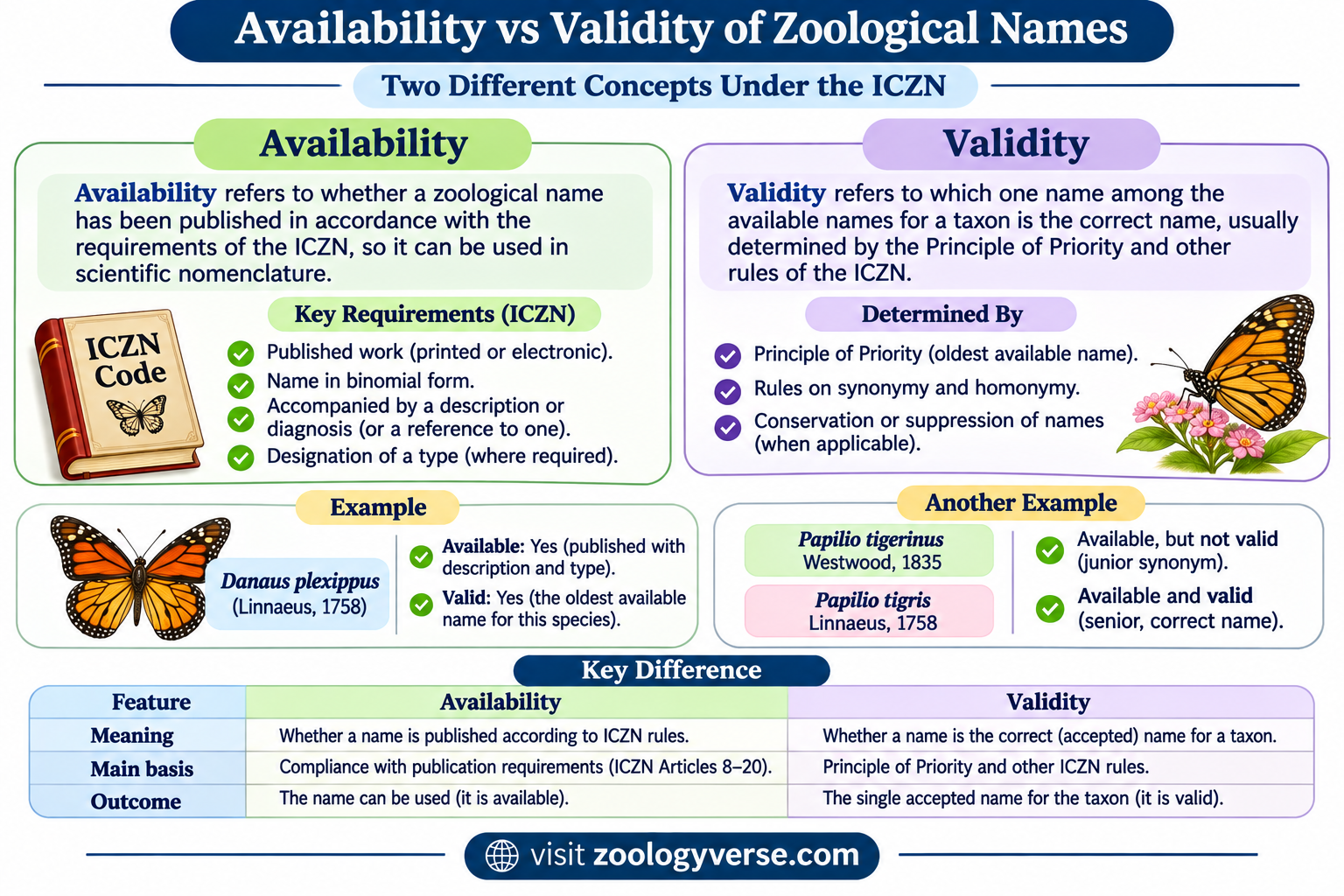
14.1 Meaning of Availability
A zoological name is available when it satisfies the relevant provisions of the Code. These requirements include matters such as the date and form of publication, the way the name is proposed, and the information or description required for the relevant group and period.
Availability gives a name formal standing under Zoological Nomenclature. This formal status allows the name to be assessed under the other rules of Zoological Nomenclature. It means that the name can participate in the rules governing priority, homonymy and synonymy.
However, an available name is not automatically the valid name of a taxon. This distinction is one of the most important practical points in Zoological Nomenclature.
For example, a researcher may publish a new species name in a work that meets the Code’s requirements. The name may be available even if later research shows that the described animal belongs to a species that already has an older name. In that case, the newer name may become a junior synonym.
14.2 Requirements for Availability
The exact requirements depend on the date of publication and the nomenclatural group. In general, researchers must check the following points:
- Publication: The name must appear in a work issued in a manner recognized by the Code.
- Date: The publication date must be established because it may affect priority.
- Name formation: The name must comply with the applicable formation and spelling provisions.
- Description or indication: The work must include the description, definition or indication required by the Code for that name and publication date.
- Type fixation: The applicable provisions for fixing a name-bearing type must be followed.
- Other formal conditions: Any additional requirements for the relevant group or type of publication must be satisfied.
For names published in electronic works, additional conditions apply. These include requirements concerning the work’s registration in ZooBank and its archiving, as specified by the Code.
Authors should consult the current Code rather than assume that an online appearance alone makes a name available. This is especially important when applying Zoological Nomenclature to electronic publications.
These requirements help make Zoological Nomenclature traceable. They also make it possible to check the history of a name using the original publication.
14.3 Meaning of Validity
A valid name is the name that should be used for a taxon under the applicable provisions of the Code. In ordinary cases, it is the oldest available name that applies to that taxon, subject to priority and the Code’s exceptions.
Validity depends on more than the date of publication. Researchers must consider whether names are available, whether they are synonyms, whether homonymy is involved, and whether a name has been conserved or otherwise protected by a formal ruling. These checks guide the application of Zoological Nomenclature.
For this reason, Zoological Nomenclature distinguishes the availability of a name from its validity. This distinction prevents publication alone from being mistaken for acceptance.
An available name may be valid in one taxonomic treatment but treated as a synonym in another if the taxonomic limits of the group differ.
14.4 Difference Between Available and Valid Names
| Basis | Available name | Valid name |
|---|---|---|
| Meaning | A name that meets the Code’s requirements for availability | The name selected for a taxon under the Code |
| Main consideration | Formal establishment | Correct application |
| Depends on | Publication and other applicable requirements | Availability, priority, synonymy, homonymy and relevant exceptions |
| Possible status | May be valid or invalid | Must be an available name, subject to the Code |
This distinction prevents a common misunderstanding. A name does not become valid simply because it has been published or appears in a database.
Zoological Nomenclature requires researchers to evaluate its formal status and its relationship to other names. This evaluation is necessary before a name is adopted in a taxonomic account.
14.5 Unavailable Names
A name is unavailable when it fails to meet the relevant requirements of the Code. Examples may include names published without the required description or indication, names appearing in works that do not qualify as published under the Code, or names excluded by specific provisions.
Unavailable names do not normally compete for priority with available names. This is a basic distinction in Zoological Nomenclature. They may still appear in historical literature and can be useful when tracing the history of a taxonomic idea, but they do not have the same nomenclatural standing.
Researchers should not assume that every scientific-looking word in an old publication is an available zoological name. The history of Zoological Nomenclature contains many names that require this careful assessment. The relevant publication date and Code provisions must be checked carefully.
14.6 Importance in Taxonomic Research
The distinction between availability and validity is essential when describing new species, revising classifications and preparing taxonomic catalogues. It helps researchers determine whether a proposed name can enter zoological nomenclature and whether it should be used for a particular taxon. This makes the distinction indispensable in practical Zoological Nomenclature.
Accurate assessment also improves museum records, biodiversity databases and scientific publications. It helps ensure that Zoological Nomenclature is applied consistently across different information systems.
When a name is revised or replaced, researchers should explain the evidence and the relevant Code provisions. By distinguishing formal availability from correct application, Zoological Nomenclature provides a consistent method for evaluating animal names.
Careful use of these concepts supports stable naming while allowing taxonomic knowledge to develop. This balance is a central aim of Zoological Nomenclature. It is also essential for reliable application of Zoological Nomenclature.
15. Authorship and Date of Publication
Authorship and date of publication are important elements of Zoological Nomenclature. They provide information about who established a scientific name and when it became available under the International Code of Zoological Nomenclature (ICZN). These details help researchers trace the history of names and apply the rules of priority correctly. Accurate records are therefore essential to Zoological Nomenclature.
In Zoological Nomenclature, the author citation is usually written after the scientific name. The year of publication may also be included. These details are not normally part of the scientific name itself, but they provide essential nomenclatural information. They make the history of Zoological Nomenclature easier to investigate.
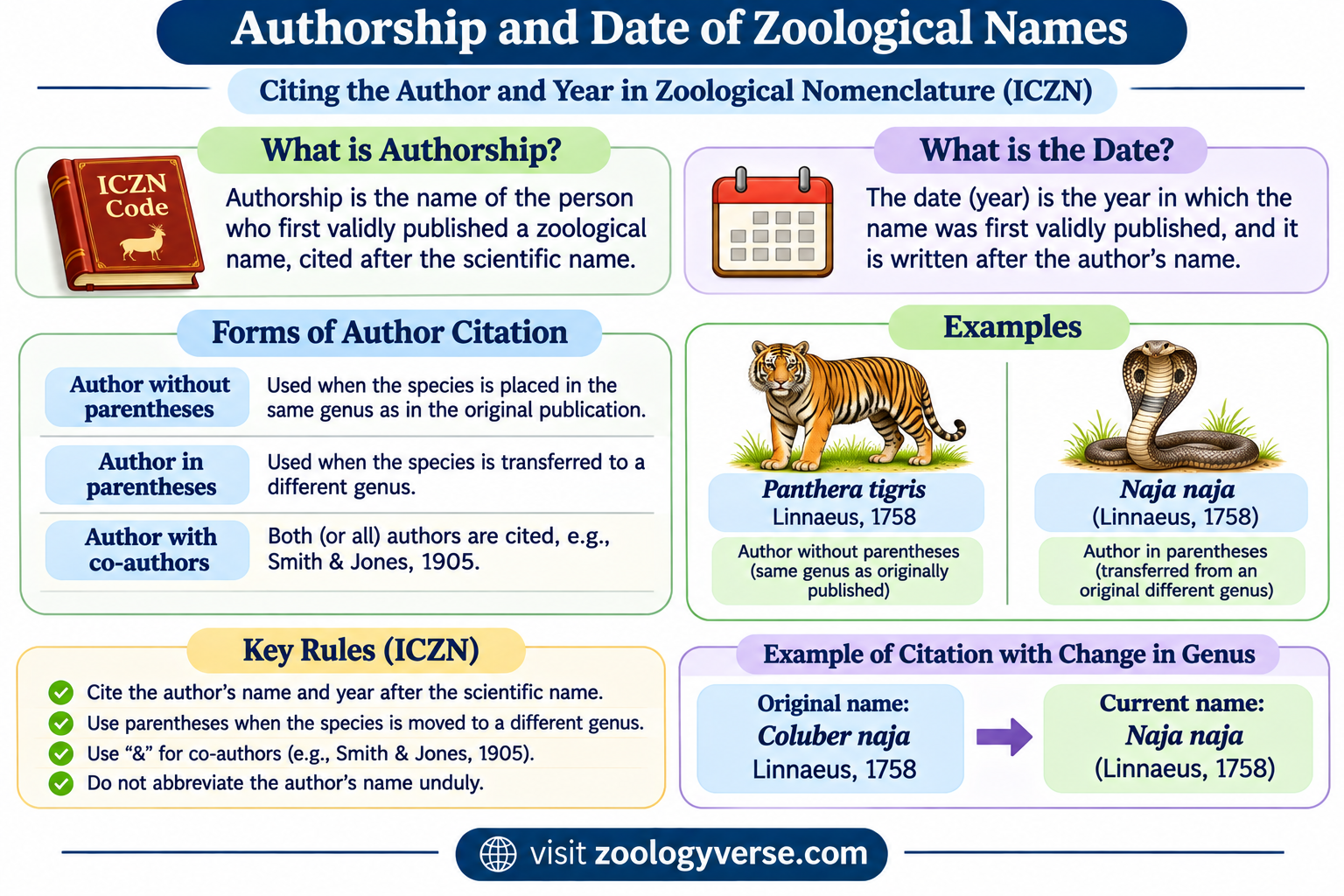
15.1 Meaning of Authorship
Authorship refers to the person or persons to whom the establishment of a zoological name is attributed under the Code. The author is generally the person responsible for making the name available, rather than necessarily the person who collected the specimen or discovered the animal.
For example, Homo sapiens Linnaeus, 1758 identifies Linnaeus as the author and 1758 as the year associated with the name’s establishment. The scientific name is Homo sapiens; the author and date are additional citation details.
Authorship is important in Zoological Nomenclature because it helps distinguish names that may have similar spellings or complicated publication histories. It also allows researchers to locate the original description and examine the evidence on which a name was established. This traceability is a key feature of Zoological Nomenclature.
15.2 How Author Names Are Written
The author’s surname is written after the scientific name and is not italicized. The publication year is usually placed after the author’s name, separated by a comma.
Examples include:
- Panthera leo Linnaeus, 1758
- Canis lupus Linnaeus, 1758
- Pavo cristatus Linnaeus, 1758
The scientific name is italicized, but the author citation and year are written in regular type. This typographical distinction is a standard convention in Zoological Nomenclature. It helps maintain consistency in Zoological Nomenclature across publications.
An author citation may be shortened in some publications, but the form should remain clear and consistent. Researchers should follow the conventions of their discipline or journal while preserving the correct nomenclatural information.
15.3 Parentheses Around Author and Date
Parentheses are used around the author and year when a species-group name is no longer combined with the genus in which it was originally established. This convention indicates that the species has been transferred to a different genus since its original description.
For example, Panthera leo (Linnaeus, 1758) is written with parentheses because Linnaeus originally described the species in a different genus combination. The parentheses signal a change in generic placement; they do not indicate a change in the identity of the author or the original publication date.
This convention helps readers follow changes in classification and is particularly useful when species are transferred between genera. It preserves important historical information in Zoological Nomenclature.
15.4 Meaning of Date of Publication
The date of publication is the date on which a work became published in the sense recognized by the Code. It is important because the Principle of Priority generally gives precedence to the oldest available name.
The date used for nomenclatural purposes is not necessarily the date on which a manuscript was submitted, accepted or first circulated privately. Researchers must establish when the work was actually issued and whether it qualifies as published under the Code.
In Zoological Nomenclature, accurate publication dates are essential when comparing competing names. They provide the chronological evidence required by Zoological Nomenclature. A difference of even a short period may affect which of two available names has priority.
15.5 Determining the Correct Publication Date
Sometimes a work is issued in parts, volumes or separate editions. In such cases, the publication date of the relevant portion must be determined according to the Code.
Researchers may need to examine:
- The original publication and its title page.
- The date printed on the work.
- Publisher records and evidence of actual distribution.
- Information about separate parts or editions.
- The Code’s provisions for works issued on different dates.
For electronic publications, additional provisions apply. The Code specifies conditions for electronic works, including requirements for registration and archiving in relevant circumstances. These provisions help ensure that names published online have a traceable publication record. This is increasingly important for modern Zoological Nomenclature.
15.6 Authorship, Date and the Principle of Priority
Authorship and publication date are closely connected with the Principle of Priority. When two or more available names are proposed for the same taxon, their dates help determine which name generally takes precedence.
The author citation also identifies the original source of a name. This makes it easier to examine the original description, type designation and other information relevant to its status.
Zoological Nomenclature relies on accurate authorship and date information to resolve historical naming questions. Incorrect citations can make it difficult to trace a name or assess its priority. Such errors can complicate the application of Zoological Nomenclature. Researchers should therefore verify author names and dates against original publications whenever possible.
15.7 Importance in Scientific Publications
Author and date citations are widely used in taxonomic revisions, species descriptions, catalogues, museum records and biodiversity databases. They provide a concise link between a scientific name and its original publication.
These details are also useful when a species is transferred to another genus, when synonyms are evaluated or when a nomenclatural problem is investigated. Correct citation supports transparent and reproducible taxonomic research. This documentation is an essential part of Zoological Nomenclature. Careful citation protects the continuity of Zoological Nomenclature.
By recording authorship and publication dates accurately, Zoological Nomenclature preserves the historical information needed to apply names consistently. These conventions strengthen the reliability of Zoological Nomenclature and support communication among zoologists worldwide.
16. Type Specimens and Name-Bearing Types
Type specimens are essential reference materials in zoological taxonomy. They provide an objective basis for applying scientific names to animal taxa. Under the International Code of Zoological Nomenclature (ICZN), name-bearing types connect names with specific references and help maintain stability when classifications change. This relationship is fundamental to Zoological Nomenclature.
A type specimen does not necessarily represent the average appearance of a species. Its primary purpose is to fix the application of a scientific name. Researchers examine type material when comparing specimens, revising species boundaries and investigating uncertain animal identities. Proper documentation is therefore essential to Zoological Nomenclature.
16.1 Meaning of Type Specimens
A type specimen is a specimen that serves as a name-bearing reference for a species-group name under the Code. It is usually designated when a new animal species or subspecies is formally described.
Scientific interpretations may change as new evidence becomes available. Taxonomists may divide one species into several species or combine previously separate species. The name-bearing type helps determine which taxon retains the original name.
This makes type specimens indispensable to Zoological Nomenclature because they provide a stable reference even when taxonomic classifications change.
16.2 Holotype
A holotype is the single specimen designated as the name-bearing type when a new species-group taxon is established.
Important characteristics include:
- It is a single name-bearing specimen.
- It is designated when the new species-group name is established.
- It serves as the primary reference for applying the name.
- It is normally deposited in a recognized scientific collection.
- Its collection details and registration information should be documented.
For example, when a zoologist describes a new frog species, one specimen may be designated as the holotype. Other researchers can examine it to verify the identity and diagnostic characteristics of the species.
16.3 Paratypes
Paratypes are specimens included in the original type series other than the holotype. They provide additional information about variation in size, colour, anatomy and other characteristics.
Paratypes help researchers understand differences between individuals, sexes and developmental stages. However, they are not name-bearing types under the Code. The holotype remains the name-bearing reference when one has been designated.
This distinction is important in Zoological Nomenclature because paratypes support species descriptions but do not independently fix the application of a name.
16.4 Syntypes
Syntypes are two or more specimens that collectively constitute the name-bearing type when no holotype was designated and the original description established a type series.
They are particularly important in older species descriptions, where authors sometimes examined several specimens without selecting a single holotype.
A lectotype may later be selected from the syntype series to become the single name-bearing type. This procedure helps clarify the application of names in Zoological Nomenclature.
16.5 Lectotype
A lectotype is a single specimen selected later from an existing syntype series to serve as the name-bearing type.
Lectotype designation may be necessary when several syntypes exist and a single reference is required to clarify the identity of a taxon.
Its main characteristics are:
- It is selected from the original syntype series.
- It becomes the single name-bearing type after valid designation.
- Its selection can clarify the application of a species name.
- Its designation must satisfy the relevant requirements of the Code.
A lectotype cannot be selected from any specimen that merely resembles the original description. It must come from the eligible original type material. This requirement protects the reliability of Zoological Nomenclature.
16.6 Neotype
A neotype is a specimen designated as the name-bearing type when no name-bearing type is believed to be extant and the requirements of the Code are satisfied.
Neotype designation is an exceptional procedure. It may be necessary when original type material has been lost or destroyed and the identity of a taxon requires clarification.
The author must explain the need for the designation and provide the evidence required by the Code. A neotype cannot be designated simply because a researcher prefers a different specimen.
16.7 Type Species and Type Genus
Name-bearing types are not restricted to physical specimens. The Code also provides type-based references for genus-group and family-group names.
- Type species: A nominal species that fixes the application of a genus-group name.
- Type genus: A nominal genus that provides the reference for a family-group name.
For example, the family Felidae is based on the genus Felis. The type genus provides the nomenclatural reference even when taxonomists revise the classification of the family.
These relationships allow Zoological Nomenclature to maintain stable names at different taxonomic ranks.
16.8 Comparison of Different Types
| Type category | Meaning | Name-bearing status |
|---|---|---|
| Holotype | Single specimen designated in the original description | Yes |
| Paratype | Additional specimen in the type series | No |
| Syntypes | Multiple specimens collectively forming the type | Yes, collectively |
| Lectotype | Specimen selected from syntypes | Yes |
| Neotype | Specimen designated when original name-bearing type is unavailable | Yes |
| Type species | Nominal species fixing a genus-group name | Yes |
| Type genus | Nominal genus fixing a family-group name | Yes |
Understanding these categories is important when examining original descriptions and conducting taxonomic revisions.
16.9 Preservation and Documentation of Type Material
Type specimens must be preserved carefully because they are valuable scientific reference materials. Zoological museums and research institutions maintain collections that allow qualified researchers to examine and compare type material.
Important practices include:
- Assigning a unique collection or registration number.
- Recording the locality, collection date and collector.
- Maintaining accurate specimen labels and records.
- Using suitable preservation methods.
- Protecting specimens from physical damage and environmental deterioration.
- Maintaining photographs and digital collection records where appropriate.
Proper documentation ensures that type specimens remain traceable and useful for future research. These practices strengthen the application of Zoological Nomenclature.
16.10 Importance of Type Material in Modern Taxonomy
Type material remains essential in modern zoological research. Researchers compare it with newly collected specimens to investigate uncertain species identities and evaluate taxonomic relationships.
Modern techniques such as microscopy, digital imaging and molecular analysis can provide additional information about type specimens. However, their use must consider the condition and scientific value of the material.
The role of a type is nomenclatural: it anchors a name rather than defining every biological feature of a species. This distinction is essential when interpreting taxonomic changes.
By connecting scientific names to name-bearing types, Zoological Nomenclature provides a stable foundation for species identification, taxonomic revisions and the documentation of animal diversity.
17. Publication Requirements and Naming New Species
The formal description of a new animal species establishes a scientific name under the International Code of Zoological Nomenclature (ICZN). Zoological Nomenclature provides the rules that determine whether the proposed name becomes available for use.
A researcher must do more than announce that an animal is new. The description, name, type information and publication must meet the applicable requirements of the Code.
17.1 Description or Definition of a New Species
A new species must be described or defined using characters that distinguish it from other known species. These diagnostic characters may include body structures, anatomy, measurements, colour patterns, behaviour, distribution or molecular evidence.
The description should explain how the proposed species differs from closely related taxa. Comparisons help readers assess the evidence and identify the organism. In Zoological Nomenclature, simply labelling an organism as a new species does not establish an available name. A diagnosis gives Zoological Nomenclature the distinguishing information needed to assess the proposed name.
17.2 Requirements for Making a Name Available
The requirements depend on the date of publication and the nomenclatural group. For a new species-group name under the current Code, the work must qualify as published, include a description or definition in words that states characters purporting to differentiate the taxon, and meet the applicable type-designation requirements.
Authors commonly indicate a new name with the expression “sp. nov.” This signals that the name is intentionally proposed as new. The name must also follow the Code’s rules for formation, spelling and grammatical treatment.
These Rules of Zoological Nomenclature help make the Scientific Naming of Animals consistent and traceable. Correct formation is an important part of Zoological Nomenclature because later authors need to recognise the same name and its original establishment. Consistent spelling also helps databases and catalogues organise names under Zoological Nomenclature.
A proposed name is not automatically available merely because it appears in a scientific-looking document. It must satisfy the relevant provisions of Zoological Nomenclature, including those governing publication and the nomenclatural act. These formal conditions distinguish a Code-compliant name from an informal label and protect consistency in Zoological Nomenclature.
17.3 Designation of a Name-Bearing Type
A new species-group name must be anchored to a name-bearing type. For a newly described species, the author normally designates a holotype and identifies the collection or institution where it is deposited.
The publication should provide details that allow the specimen to be located, such as:
- Repository or museum name.
- Catalogue or accession number.
- Collection locality and date, where known.
- Relevant specimen information and preservation details.
A holotype is not necessarily the most typical or complete individual. Its function is to provide the fixed reference to which the name is attached. Other specimens may be listed as paratypes, but paratypes do not have the name-bearing function of the holotype.
This requirement is an important part of Zoological Nomenclature. It provides an objective reference for applying a species name, even when researchers later disagree about the classification of the species. The type does not define every feature of the species; rather, it anchors the name within Zoological Nomenclature.
17.4 Publication in Print and Electronic Works
The Code recognises qualifying printed works and electronic works, but the requirements are not identical. A printed work must meet the Code’s criteria for publication, including being issued for the purpose of providing a public and permanent scientific record.
For an electronic work issued after 2011, additional conditions apply. The work must:
- State its publication date.
- Be registered in ZooBank before publication.
- Include evidence of that registration in the work.
- Be archived in a way that meets the Code’s requirements.
These provisions are important because placing a name on a website or in an online database does not, by itself, make it available. Authors should check the current Code and ICZN guidance before publication.
Meeting the applicable conditions is essential for a nomenclatural act under Zoological Nomenclature. These publication rules help ensure that Zoological Nomenclature remains dependable across print and digital research.
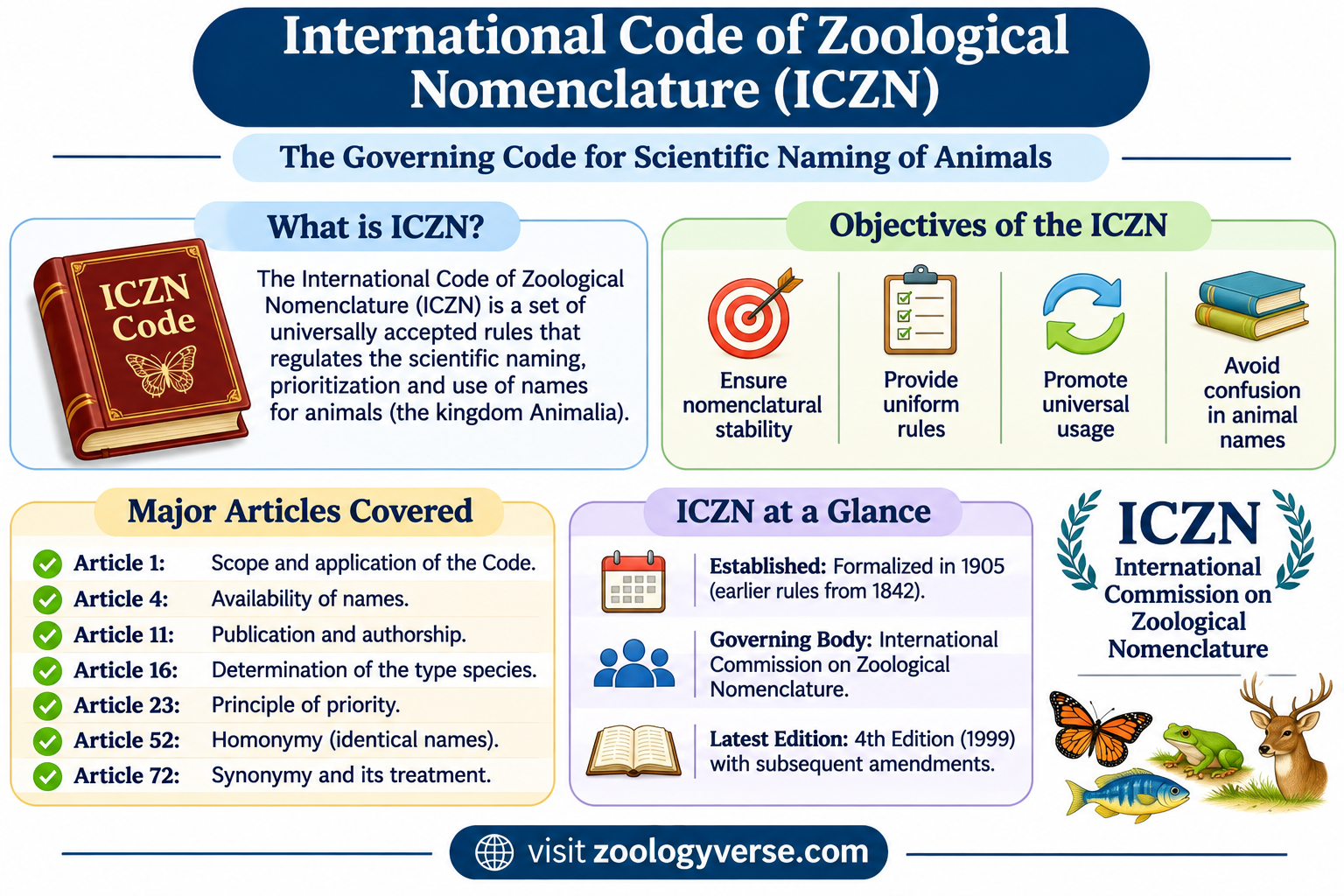
17.5 Information Included in a New Species Description
A clear description commonly contains the following elements:
| Element | Purpose |
|---|---|
| Proposed name | Identifies the new species-group name and indicates that it is new. |
| Diagnosis | States the characters that distinguish the species from related taxa. |
| Description | Records its structure, measurements and relevant variation. |
| Type information | Identifies the name-bearing type and its repository. |
| Type locality | Gives the place where the name-bearing type was collected. |
| Etymology | Explains the origin or meaning of the proposed name. |
| Comparative remarks | Explains similarities and differences from related species. |
| Illustrations | Provides photographs, drawings, maps or other supporting evidence. |
These details make the proposed species easier to evaluate and recognise under Zoological Nomenclature. They also support accurate Zoological Nomenclature by providing a traceable record for future researchers. Clear documentation allows later taxonomists to apply Zoological Nomenclature consistently when comparing specimens and published descriptions.
17.6 Why Compliance Matters
Failure to meet a mandatory requirement can affect the availability of a proposed name. For example, an electronic work that does not satisfy the applicable registration and archiving provisions may fail to establish an available name.
Researchers should therefore check the relevant requirements before submitting or publishing a new species description. Careful application of Zoological Nomenclature can prevent later confusion about the name. Such checks are a routine part of responsible Zoological Nomenclature, not an optional editorial step.
The ICZN provides the formal naming framework, while taxonomic research supplies the evidence used to recognise and distinguish species. Availability under the Code and taxonomic validity are separate questions.
Together, sound research and compliance with Zoological Nomenclature support clear and stable scientific communication. Following Zoological Nomenclature from the preparation of the description through publication helps ensure that new animal names can be used and evaluated reliably.
18. Important Rules and Recommendations of the ICZN
The International Code of Zoological Nomenclature provides internationally accepted rules for naming animals. These rules help zoologists use scientific names consistently across research, education and biological collections. Zoological Nomenclature is concerned with the availability and correct use of names, rather than deciding how animals must be classified.
The Code contains both mandatory provisions and recommendations. Mandatory provisions determine whether a name or nomenclatural act complies with the Code. Recommendations guide good practice and help authors prepare clear, useful taxonomic publications.
18.1 Use of Scientific Names
Scientific names should be written in a consistent format. Under the Rules of Zoological Nomenclature, a species name is a binomen consisting of a genus name followed by a specific name.
Authors should follow these conventions:
- Capitalise the genus name and begin the specific name with a lowercase letter.
- Italicise genus and species names when printed in ordinary scientific text.
- Write the genus name in full at its first mention; it may be abbreviated later if the meaning remains clear.
- Do not use the specific name alone as though it were the complete species name.
- Write the author and year after the scientific name when relevant; place them in parentheses if the species is no longer combined with its original genus.
These conventions make the Scientific Naming of Animals recognisable across publications. Consistent formatting also reduces confusion when several species have similar common names. These naming conventions are a practical foundation of Zoological Nomenclature.
18.2 Correct Formation and Spelling of Names
The Code regulates how names are formed and how their spelling is treated. Authors should check the original description and relevant Code provisions before changing a spelling or proposing a replacement name.
A name should not be altered simply because another spelling appears more familiar or convenient. Certain corrections are required by the Code, while other changes may be unjustified. Applying Zoological Nomenclature carefully helps preserve the correct spelling and historical identity of names. Accurate spelling is particularly important because even small differences can affect how a name is interpreted.
18.3 Priority and Stability
The Principle of Priority generally gives precedence to the oldest available name for a taxon, subject to the Code’s conditions and exceptions. This helps prevent multiple competing names from being used for the same taxon.
However, strict priority can sometimes disrupt long-established usage. The Code therefore includes provisions that allow stability to be maintained in particular circumstances. These provisions balance historical priority with consistent communication. The rules also explain how names are treated when taxonomic opinions change, keeping Zoological Nomenclature usable across revisions.
18.4 Type Specimens and Type Designations
A name-bearing type provides the objective reference for applying a species-group name. Authors describing new species should designate the required type and provide clear information about its repository and collection data.
Good practice includes:
- Depositing the type in a recognised, accessible scientific institution.
- Providing a unique catalogue or registration number.
- Recording the type locality and available collection details.
- Ensuring that the specimen is properly preserved and documented.
- Distinguishing the holotype from paratypes and other examined material.
These practices support reliable identification and future comparison. Type documentation is central to Zoological Nomenclature because it provides a permanent reference for applying a name. Clear type records also make later verification easier.
18.5 Authorship and Publication Details
The author and date associated with a scientific name help identify the publication in which the name was established. They are not normally italicised as part of the scientific name.
Authors should provide accurate publication details and avoid assigning authorship to someone who did not establish the name. When a species is transferred to a different genus, the original author and date are enclosed in parentheses. This convention records the history of the combination. Accurate authorship and dates make the history of a name traceable.
18.6 Avoiding Unnecessary New Names
Before proposing a new name, researchers should examine existing taxonomic literature, catalogues and relevant databases. This helps determine whether the organism has already been described under another name.
A proposed name may be unavailable or invalid for reasons such as earlier publication, homonymy or failure to meet the Code’s requirements. Careful literature searches reduce unnecessary naming and help authors apply the ICZN Principles responsibly. Authors should consult the Code rather than rely only on customary practices.
18.7 Recommendations for Taxonomic Authors
The Code’s recommendations encourage clarity and responsible scientific practice. Authors preparing a taxonomic publication should:
- Examine relevant literature and existing species descriptions.
- Compare the proposed taxon with closely related species.
- Provide a clear diagnosis and a sufficiently detailed description.
- Designate and document the name-bearing type as required.
- State the type locality and repository information precisely.
- Check the spelling and formation of the proposed name.
- Follow the publication requirements that apply to the work.
- Consult the current Code when a nomenclatural problem is uncertain.
Following these recommendations improves the quality of taxonomic publications. It also makes the application of Zoological Nomenclature easier for researchers, students and collection managers. These checks help ensure that a proposed act meets the formal standards of Zoological Nomenclature.
18.8 Importance of Following the Code
Consistent application of the Code allows zoologists in different countries and research fields to communicate about animal names without unnecessary ambiguity. It supports the stability of names in scientific papers, museum catalogues, biodiversity databases and educational resources.
The Code does not prevent taxonomists from revising classifications when new evidence becomes available. Instead, it provides rules for how names are to be used when taxonomic opinions change. Understanding Zoological Nomenclature is therefore essential for anyone describing, identifying or studying animal diversity.
The recommendations and mandatory provisions work together. The mandatory rules establish nomenclatural consistency, while recommendations encourage clear documentation and responsible practice. Both are important for effective Zoological Nomenclature and the scientific naming of animals. Authors should apply these requirements whenever they establish names under Zoological Nomenclature.
19. Conclusion
Zoological Nomenclature provides the internationally accepted framework for naming animals. By applying shared rules, zoologists can communicate about species clearly, even when common names differ between regions and languages. The International Code of Zoological Nomenclature (ICZN) supports consistency in the formation, publication and use of animal names.
The system has developed through centuries of taxonomic work. Its central principles include priority, typification and homonymy. Together, these principles help determine which names are available and which name should generally be used for a taxon. The Code also sets requirements for publication, authorship, type designations and the formation of scientific names.
Zoological Nomenclature does not determine how animals should be classified or how their evolutionary relationships should be interpreted. Those questions are addressed through taxonomic research and scientific evidence. Instead, Zoological Nomenclature provides rules for applying names when classifications are proposed, revised or debated.
The distinction between availability and validity is especially important. A name must first meet the Code’s conditions to be available. Its status as the valid name for a taxon then depends on the relevant nomenclatural rules and the taxonomic judgement being followed. This distinction allows Zoological Nomenclature to provide stability without preventing scientific revisions.
The ICZN also encourages careful documentation. Researchers should examine existing literature, provide clear descriptions and diagnoses, designate name-bearing types where required, and follow the publication provisions that apply to their work. These practices make scientific names traceable and help future researchers assess taxonomic decisions.
In conclusion, Zoological Nomenclature is an essential foundation of zoological taxonomy and biological communication. A sound understanding of the International Code of Zoological Nomenclature helps students and researchers interpret scientific names correctly and understand how new animal names are established. By combining formal naming rules with evidence-based taxonomy, Zoological Nomenclature supports a consistent and reliable language for studying animal diversity.
20. Frequently Asked Questions (FAQs)
What is Zoological Nomenclature?
What is the full form of ICZN?
What is the International Code of Zoological Nomenclature?
Who introduced binomial nomenclature?
What are the main principles of Zoological Nomenclature?
What is the principle of priority?
What is a type specimen?
What is the difference between synonymy and homonymy?
Does the ICZN classify animals?
Why is Zoological Nomenclature important?
Are scientific names written in italics?
What is the difference between an available name and a valid name?
Does the ICZN apply to plants and bacteria?
How can a researcher register a new animal name?
These questions cover the central ideas of Zoological Nomenclature, from scientific naming and type specimens to priority and the role of the ICZN. They can help students revise the rules and understand their application in zoological taxonomy.
21. References
- International Commission on Zoological Nomenclature (1999). International Code of Zoological Nomenclature, 4th Edition. International Trust for Zoological Nomenclature, London.
https://code.iczn.org/ - International Commission on Zoological Nomenclature. The International Code of Zoological Nomenclature. Official overview and information about previous editions.
https://www.iczn.org/the-code/the-international-code-of-zoological-nomenclature/ - International Commission on Zoological Nomenclature. About the ICZN. Information about the Commission, its responsibilities and its role in zoological naming.
https://www.iczn.org/about-the-iczn/ - International Commission on Zoological Nomenclature. Frequently Asked Questions. Explanations of the Code, its scope, electronic publication and ZooBank registration.
https://www.iczn.org/outreach/faqs - International Commission on Zoological Nomenclature. About ZooBank. Information about the official register of zoological nomenclature and the registration of publications and nomenclatural acts.
https://www.iczn.org/zoobank/ - International Commission on Zoological Nomenclature. Article 8: What Constitutes Published Work. Publication requirements under the Code, including provisions for electronic works.
https://code.iczn.org/criteria-of-publication/article-8-what-constitutes-published-work/ - International Commission on Zoological Nomenclature. Introduction to the International Code of Zoological Nomenclature. Background to the Code, its principles and its historical development.
https://code.iczn.org/introduction/ - International Commission on Zoological Nomenclature. Explanatory Note on the Code. Explanation of the structure, articles, recommendations and interpretation of the Code.
https://code.iczn.org/explanatory-note-on-the-code/
Discover more from Zoologyverse
Subscribe to get the latest posts sent to your email.