
Meiosis is a specialized type of cell division that reduces the chromosome number by half and produces genetically different haploid cells. It is essential for sexual reproduction because it allows organisms to form reproductive cells while preventing chromosome number from doubling in every generation.
Unlike mitosis, which involves one nuclear division, meiosis consists of two successive nuclear divisions—Meiosis I and Meiosis II—following a single round of DNA replication.
A diploid cell with two sets of chromosomes gives rise to haploid cells containing one set of chromosome
The major events of meiosis can be summarized as:
DNA replication → Meiosis I → reduction of chromosome number → Meiosis II → haploid meiotic products
What Is Meiosis?
Meiosis is a specialized cell division in which a diploid precursor cell undergoes one round of DNA replication followed by two nuclear divisions, producing haploid cells.
The two divisions are:
- Meiosis I: Reductional division
- Meiosis II: Equational division
During Meiosis I, homologous chromosomes separate, reducing the chromosome number from diploid to haploid.
During Meiosis II, sister chromatids separate, broadly resembling the chromosome-segregation mechanism of mitosis.
In animals, meiosis occurs during the formation of gametes in the reproductive organs. In plants, meiosis occurs in specialized cells that produce spores, which participate in the life cycle of the plant.
Meiosis and the Cell Cycle
Before meiosis begins, the cell passes through an interphase-like period during which DNA is replicated.
The important point is:
DNA is replicated only once, before Meiosis I, but the cell undergoes two successive divisions.
After DNA replication, each chromosome consists of two sister chromatids.
The sequence is:
S phase → Meiosis I → Meiosis II
There is no second round of DNA replication between Meiosis I and Meiosis II.
This arrangement allows the chromosome number to be reduced while still allowing sister chromatids to separate during the second division.
Meiosis I: Reduction Division
Meiosis I is called the reductional division because homologous chromosomes separate and the chromosome number is reduced by half.
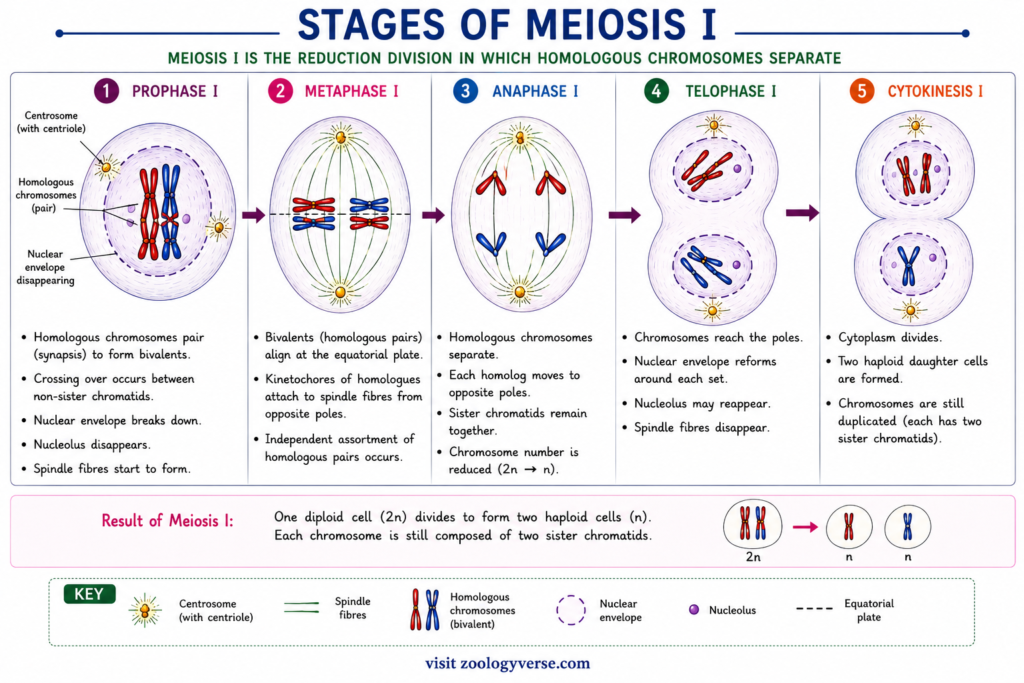
It consists of:
- Prophase I
- Metaphase I
- Anaphase I
- Telophase I
- Cytokinesis
Prophase I
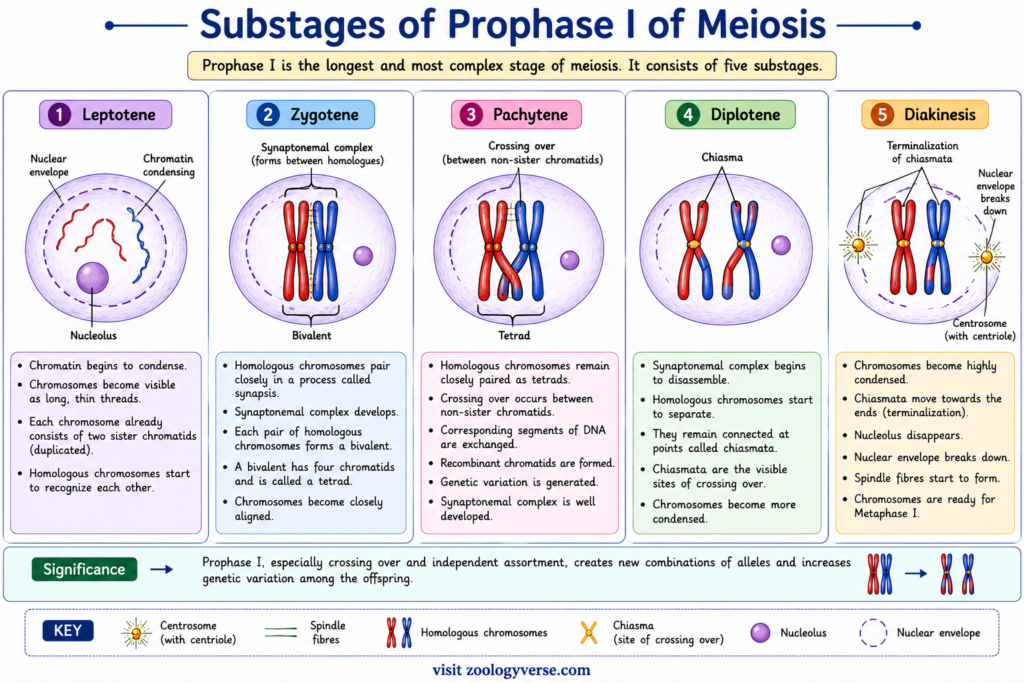
Prophase I is the longest and most complex stage of meiosis.
It is especially important because homologous chromosomes pair with each other and exchange genetic material.
Prophase I is traditionally divided into five substages:
- Leptotene
- Zygotene
- Pachytene
- Diplotene
- Diakinesis
Leptotene
During leptotene:
- Chromatin begins to condense into visible chromosomes.
- Each chromosome consists of two sister chromatids, although these may not yet be clearly distinguishable.
- Homologous chromosomes begin to recognize one another.
- Chromosomes become increasingly condensed.
- The first visible threads of the chromosomes can be observed.
- Structures associated with chromosome pairing begin to develop.
- The cell prepares for the close association of homologous chromosomes.
Zygotene
During zygotene:
- Homologous chromosomes begin to pair closely.
- This pairing is called synapsis.
- A protein structure called the synaptonemal complex develops between paired homologues.
- Each paired homologous chromosome forms a bivalent.
- Because each chromosome has two sister chromatids, a bivalent contains four chromatids and is also called a tetrad.
- Homologous chromosomes become closely aligned along their lengths.
- This pairing prepares the chromosomes for genetic recombination.
Pachytene
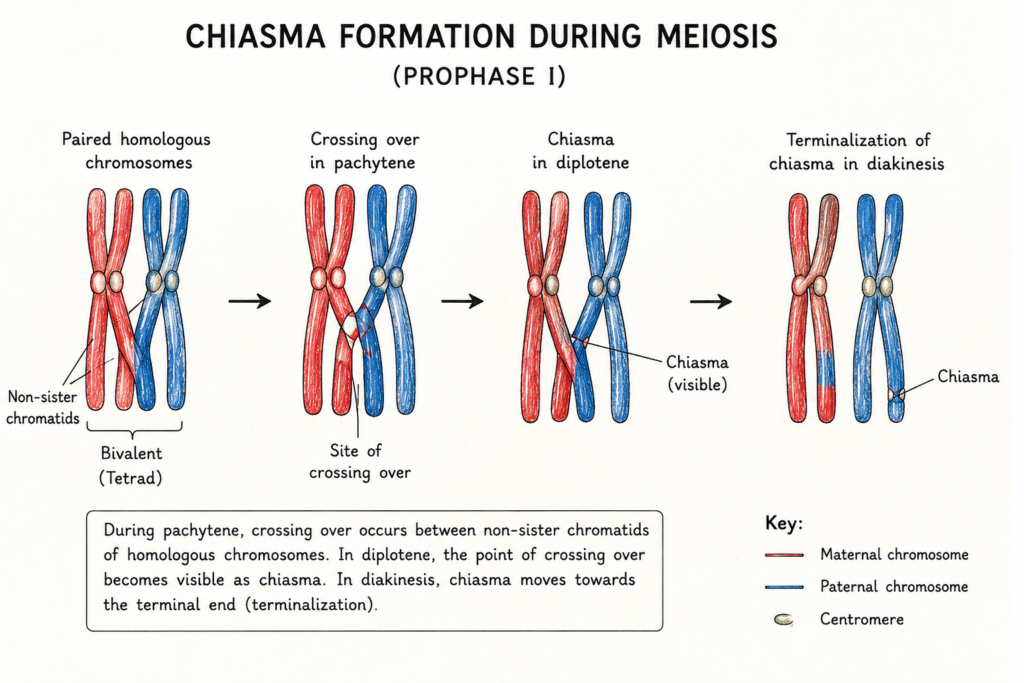
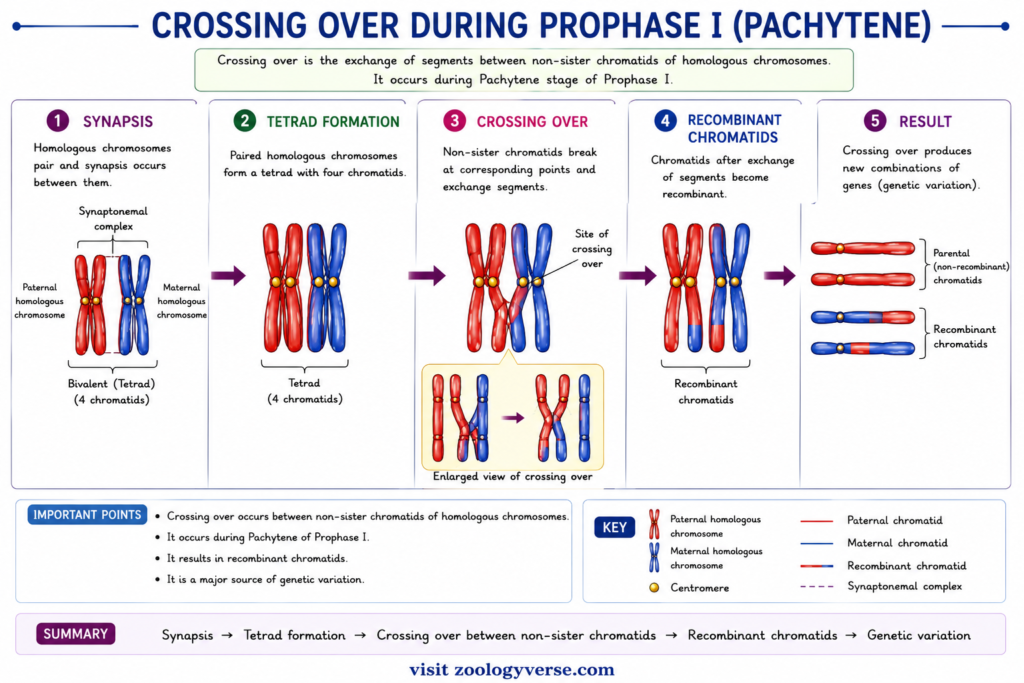
Pachytene is particularly important because crossing over occurs during this stage.
- Homologous chromosomes remain closely paired.
- The paired chromosomes form clearly recognizable tetrads.
- Crossing over occurs between non-sister chromatids of homologous chromosomes.
- Corresponding DNA segments are exchanged between homologous chromosomes.
- This produces recombinant chromatids.
- Crossing over contributes to genetic variation.
- The synaptonemal complex helps maintain the close association of homologous chromosomes during recombination.
Diplotene
During diplotene:
- The synaptonemal complex begins to disassemble.
- Homologous chromosomes begin to separate from one another.
- The homologues remain connected at visible points called chiasmata.
- Chiasmata represent the visible manifestations of sites where crossing over occurred.
- Chromosomes become more condensed.
- The number and position of chiasmata can differ between chromosome pairs.
- The chiasmata help maintain the association of homologous chromosomes until later stages.
Diakinesis
Diakinesis is the final substage of Prophase I.
- Chromosomes become highly condensed.
- Chiasmata become more clearly visible.
- Chiasmata move toward the ends of chromosomes, a process called terminalization.
- The nucleolus disappears.
- The nuclear envelope breaks down.
- The meiotic spindle develops.
- Chromosomes become ready for alignment at the metaphase plate.
Metaphase I
During Metaphase I:
- Homologous chromosome pairs align at the equatorial plate.
- Each homologous pair forms a bivalent.
- Spindle microtubules attach to the kinetochores associated with the chromosomes.
- Homologous chromosomes are oriented toward opposite spindle poles.
- The orientation of each bivalent is independent of the orientation of other bivalents.
- This independent orientation contributes to independent assortment.
- Proper chromosome attachment prepares the cell for separation of homologous chromosomes.
A key difference from mitosis is that homologous chromosomes, rather than individual duplicated chromosomes, are aligned as pairs during Metaphase I.
Anaphase I
Anaphase I is the stage in which homologous chromosomes separate.
- Homologous chromosomes move toward opposite poles.
- Sister chromatids remain joined at their centromeres.
- The chromosome number is reduced because each pole receives only one chromosome from each homologous pair.
- Chiasmata no longer hold the homologues together.
- Spindle microtubules contribute to chromosome movement.
- Each chromosome still consists of two sister chromatids.
- The separation produces two groups of chromosomes with a haploid complement.
This is the major event responsible for the reduction in chromosome number.
Telophase I
During Telophase I:
- Chromosomes reach opposite spindle poles.
- Each pole contains a haploid set of chromosomes.
- Chromosomes may partially decondense.
- Nuclear envelopes may reform around the chromosome sets in some organisms.
- The spindle apparatus is dismantled.
- Cytokinesis may occur.
- Two haploid cells are generally produced.
The exact appearance of Telophase I varies among organisms.
Cytokinesis I
Cytokinesis may follow Meiosis I.
It divides the cytoplasm and produces two cells, each containing a haploid chromosome set.
However, the chromosomes in these cells are still duplicated, meaning each chromosome consists of two sister chromatids.
Importantly, DNA replication does not occur again before Meiosis II.
Interkinesis
In some organisms, a short period called interkinesis occurs between Meiosis I and Meiosis II.
During interkinesis:
- The cells may undergo limited metabolic activity.
- The chromosomes may partially decondense.
- The spindle from Meiosis I is reorganized.
- There is no DNA replication.
Interkinesis is therefore different from the S phase of interphase.
Meiosis II: Equational Division
Meiosis II follows Meiosis I without another round of DNA replication.
It is called the equational division because sister chromatids separate.
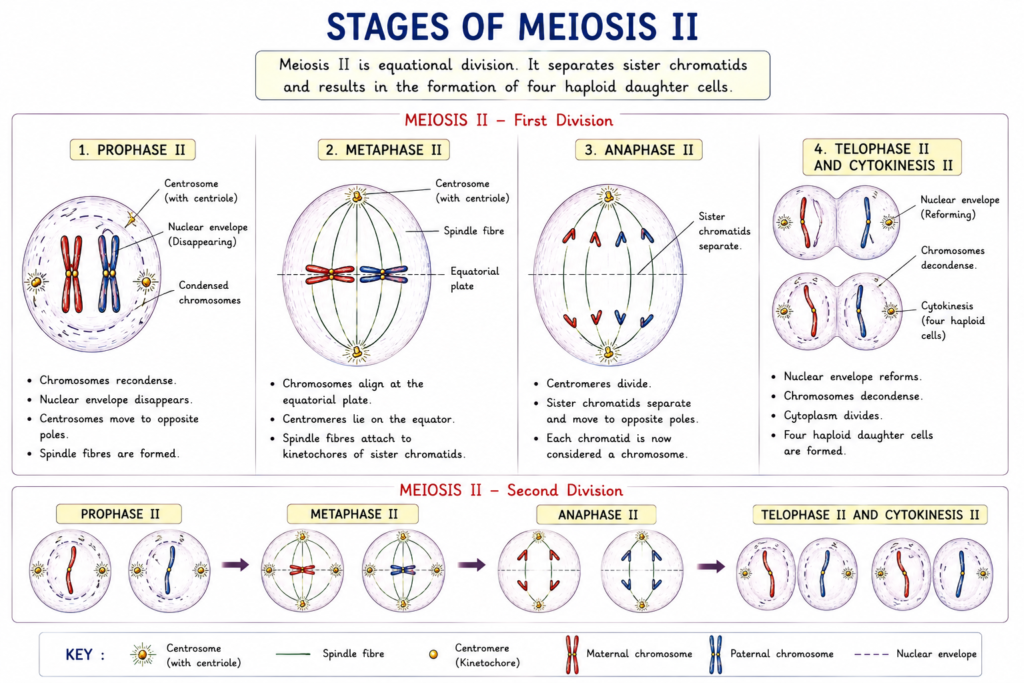
The stages are:
- Prophase II
- Metaphase II
- Anaphase II
- Telophase II
- Cytokinesis
Prophase II
During Prophase II:
- Chromosomes condense again if they had partially decondensed.
- Each chromosome still consists of two sister chromatids.
- A new spindle apparatus forms.
- Centrosomes organize spindle poles in cells where centrosomes are present.
- The nuclear envelope, if reformed after Meiosis I, breaks down.
- Spindle microtubules begin interacting with chromosomes.
- The chromosomes prepare for alignment at the equatorial plate.
Metaphase II
During Metaphase II:
- Chromosomes align individually at the equatorial plate.
- Spindle microtubules attach to the kinetochores.
- Sister chromatids become oriented toward opposite spindle poles.
- Chromosomes are positioned for accurate chromatid separation.
- The spindle assembly checkpoint helps monitor chromosome attachment.
- Each chromosome remains composed of two sister chromatids.
- Proper attachment allows the cell to proceed into Anaphase II.
Unlike Metaphase I, homologous chromosomes are no longer paired.
Anaphase II
During Anaphase II:
- Sister chromatids separate.
- Centromeric cohesion is released.
- Each separated chromatid becomes an individual daughter chromosome.
- Daughter chromosomes move toward opposite poles.
- The chromosome sets become progressively separated.
- Spindle microtubules help move the chromosomes.
- Each pole ultimately receives a haploid chromosome complement.
This process resembles the separation of sister chromatids during mitotic anaphase.
Telophase II
During Telophase II:
- Chromosomes reach the opposite poles.
- Chromosomes begin to decondense.
- Nuclear envelopes form around the chromosome sets.
- Nucleoli may reappear.
- The spindle apparatus breaks down.
- Separate haploid nuclei are established.
- Cytokinesis follows or overlaps with nuclear reformation.
Cytokinesis II
Cytokinesis II divides the cytoplasm of the cells produced by Meiosis I.
As a result:
One diploid starting cell → Four haploid meiotic products
The four products are not necessarily genetically identical because genetic variation has been introduced through crossing over and independent assortment.
Meiosis I vs Meiosis II
| Feature | Meiosis I | Meiosis II |
|---|---|---|
| Type of division | Reductional | Equational |
| Main separation | Homologous chromosomes | Sister chromatids |
| Chromosome number | Reduced | Maintained |
| Homologous pairing | Occurs in Prophase I | Does not occur |
| Crossing over | Occurs during Prophase I | Does not normally occur |
| Metaphase arrangement | Homologous pairs align | Individual chromosomes align |
| Sister chromatids | Remain together | Separate |
| Result | Two haploid cells | Four haploid products |
Crossing Over in Meiosis
Crossing over is the exchange of corresponding DNA segments between non-sister chromatids of homologous chromosomes during Prophase I.
It occurs after homologous chromosomes have paired.
The process can be summarized as:
Synapsis → Tetrad formation → Crossing over → Recombinant chromatids → Genetic variation
Crossing over is especially associated with Pachytene, while the resulting chiasmata become visibly apparent during Diplotene.
Significance of Crossing Over
Crossing over:
- Produces new combinations of alleles.
- Increases genetic variation.
- Contributes to differences among offspring.
- Helps homologous chromosomes remain associated through Prophase I.
- Provides raw material on which evolutionary processes can act.
Independent Assortment
Independent assortment is another major source of genetic variation.
During Metaphase I, each homologous chromosome pair can orient independently of other chromosome pairs.
Consequently, maternal and paternal homologues are distributed into daughter cells in many possible combinations.
For a species with n chromosome pairs, independent assortment alone can theoretically produce up to:
2ⁿ chromosome combinations
before considering crossing over and other sources of variation.
For humans, with 23 chromosome pairs:
2²³ = 8,388,608
possible chromosome combinations can arise from independent assortment alone.
Significance of Meiosis
Meiosis has several essential biological functions.
1. Production of Haploid Cells
Meiosis reduces the chromosome number from diploid to haploid.
This is essential for sexual reproduction because the fusion of two haploid gametes restores the diploid chromosome number.
2. Maintenance of Chromosome Number
Meiosis prevents chromosome number from doubling in every generation.
For example:
Diploid parent cell → Haploid gametes → Fertilization → Diploid zygote
This maintains the characteristic chromosome number of a species across generations.
3. Genetic Variation
Meiosis generates genetic variation through:
- Crossing over
- Independent assortment
- Random distribution of homologous chromosomes
Variation is particularly important for populations because it contributes to differences among individuals.
4. Formation of Gametes
In animals, meiosis is involved in the formation of sperm and eggs.
These haploid cells can fuse during fertilization to form a diploid zygote.
5. Formation of Spores in Plants
In plants, meiosis produces haploid spores rather than directly producing gametes.
These spores develop into the gametophyte generation, which subsequently produces gametes.
6. Contribution to Evolution
The genetic variation generated by meiosis contributes to variation within populations.
This variation provides material upon which natural selection and other evolutionary processes can act.
Meiosis in Animals
In animals, meiosis occurs in the reproductive cell line and is associated with gamete production.
Spermatogenesis
In males, meiosis contributes to the formation of sperm cells.
A diploid precursor undergoes meiosis to produce haploid products that ultimately differentiate into sperm.
Oogenesis
In females, meiosis contributes to egg formation.
However, oogenesis differs from spermatogenesis because the cytoplasm is distributed unequally, producing one large functional egg and smaller polar bodies.
The timing and completion of oogenesis also differ among animal species.
Meiosis in Plants
Meiosis has a different role in the plant life cycle.
In flowering plants, meiosis occurs in specialized cells of the reproductive structures and produces haploid spores.
For example:
- Microspore mother cells undergo meiosis to produce microspores.
- Megaspore mother cells undergo meiosis to produce megaspores.
The spores develop into the haploid gametophyte generation, which eventually produces gametes.
Thus, saying that meiosis directly produces gametes is accurate for many animal contexts but is not generally correct for plants.
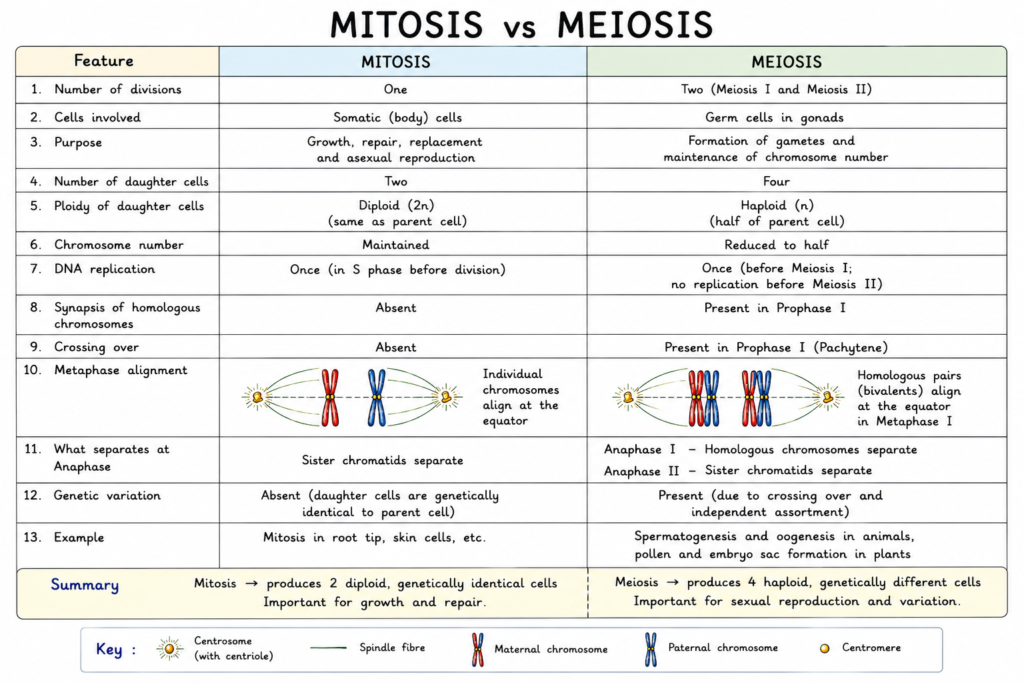
Meiosis vs Mitosis
| Feature | Meiosis | Mitosis |
|---|---|---|
| Number of divisions | Two | One |
| DNA replication | Once before Meiosis I | Once before mitosis |
| Daughter cells | Usually four meiotic products | Usually two |
| Chromosome number | Reduced by half | Generally maintained |
| Homologous pairing | Present in Prophase I | Absent |
| Synapsis | Occurs | Does not occur |
| Crossing over | Occurs during Prophase I | Normally absent |
| Genetic similarity | Products are generally genetically different | Daughter cells are generally genetically similar |
| Main role | Sexual reproduction | Growth, repair and cell replacement |
| Sister chromatids separate | Meiosis II | Mitosis |
| Homologous chromosomes separate | Meiosis I | Not applicable |
| Genetic variation | High | Usually limited |
| DNA replication between divisions | No | Not applicable |
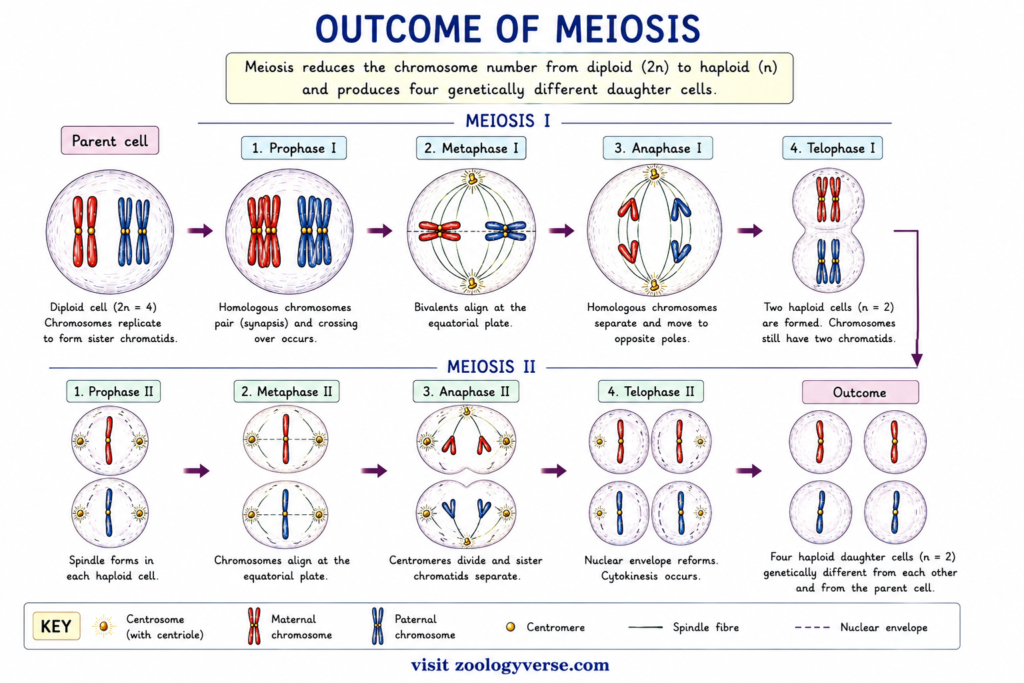
What Happens to Chromosomes During Meiosis?
The chromosome behavior of meiosis can be summarized in four major steps:
Before Meiosis
DNA replicates once, producing duplicated chromosomes.
During Meiosis I
Homologous chromosomes pair and then separate.
Diploid → Haploid
During Meiosis II
Sister chromatids separate.
Duplicated chromosomes → Individual chromosomes
Final Result
Four haploid meiotic products are generally produced.
This two-step separation is what makes meiosis fundamentally different from mitosis.
Errors in Meiosis
Meiosis requires highly accurate chromosome pairing and segregation.
Errors can result in abnormal chromosome numbers.
One important error is nondisjunction, in which chromosomes fail to separate properly.
Nondisjunction can occur during:
- Meiosis I, when homologous chromosomes fail to separate.
- Meiosis II, when sister chromatids fail to separate.
This can produce gametes with abnormal chromosome numbers.
If such a gamete participates in fertilization, the resulting zygote may have an abnormal chromosome number.
Why Is Meiosis Important for Sexual Reproduction?
Meiosis solves two major problems associated with sexual reproduction.
First: Chromosome Number
It reduces the chromosome number by half before fertilization.
Second: Genetic Variation
It creates new genetic combinations through crossing over and independent assortment.
Therefore:
Meiosis + Fertilization = Maintenance of chromosome number + Genetic diversity
Key Takeaways
- Meiosis is a specialized cell division associated with sexual reproduction.
- It involves one round of DNA replication followed by two nuclear divisions.
- Meiosis I separates homologous chromosomes.
- Meiosis II separates sister chromatids.
- Prophase I consists of leptotene, zygotene, pachytene, diplotene and diakinesis.
- Synapsis occurs during Prophase I.
- Crossing over occurs during pachytene between non-sister chromatids.
- Chiasmata become visible during diplotene.
- Meiosis generally produces four haploid meiotic products.
- It contributes to genetic variation through crossing over and independent assortment.
- In animals, meiosis contributes to gamete formation.
- In plants, meiosis produces haploid spores.
- Meiosis is essential for maintaining the chromosome number across generations.
Frequently Asked Questions
What is meiosis?
Meiosis is a specialized form of cell division in which one round of DNA replication is followed by two nuclear divisions, generally producing four haploid meiotic products.
Why is meiosis called reduction division?
Meiosis I is called reduction division because homologous chromosomes separate, reducing the chromosome number from diploid to haploid.
How many divisions occur in meiosis?
Meiosis consists of two successive divisions: Meiosis I and Meiosis II.
Does DNA replicate twice during meiosis?
No. DNA replication occurs only once, before Meiosis I. There is no DNA replication between Meiosis I and Meiosis II.
What is crossing over?
Crossing over is the exchange of corresponding DNA segments between non-sister chromatids of homologous chromosomes during Prophase I.
During which stage does crossing over occur?
Crossing over occurs during Pachytene of Prophase I.
What is a chiasma?
A chiasma is a visible point of contact between homologous chromosomes where crossing over has occurred. Chiasmata become apparent during Diplotene.
What happens during Anaphase I?
Homologous chromosomes separate and move toward opposite poles, while sister chromatids remain joined.
What happens during Anaphase II?
Sister chromatids separate and move toward opposite poles.
How many cells are produced by meiosis?
Meiosis generally produces four haploid meiotic products from one starting diploid cell, although the exact cellular outcome varies among organisms.
What is the significance of meiosis?
Meiosis is important for producing haploid reproductive cells or spores, maintaining chromosome number across generations, and generating genetic variation.
What is the difference between meiosis and mitosis?
Mitosis involves one division and generally produces two cells with the same chromosome number, whereas meiosis involves two divisions and generally produces four haploid products with genetically varied chromosome combinations.
References
- Alberts B, Johnson A, Lewis J, et al. Molecular Biology of the Cell. Garland Science.
- Lodish H, Berk A, Kaiser CA, et al. Molecular Cell Biology. W.H. Freeman.
- OpenStax. Biology 2e. Rice University.
- Cooper GM, Hausman RE. The Cell: A Molecular Approach. Sinauer Associates.
- Urry LA, Cain ML, Wasserman SA, et al. Campbell Biology. Pearson.
Recommended Study Resource
NCERT Class 11 Biology Textbook – Latest Edition
A useful textbook for understanding the cell cycle and cell division, including meiosis.
Master the NCERT Biology Class 11 – NEET & CUET
Useful for students preparing for NEET and CUET alongside the NCERT Biology syllabus, including cell division and related concepts.
As an Amazon Associate I earn from qualifying purchases.
Discover more from Zoologyverse
Subscribe to get the latest posts sent to your email.