
Chromosomes are usually thought of as compact structures that become clearly visible during cell division.
However, certain specialized cells contain exceptionally large chromosomes that remain visible during interphase. These remarkable structures are called polytene chromosomes.
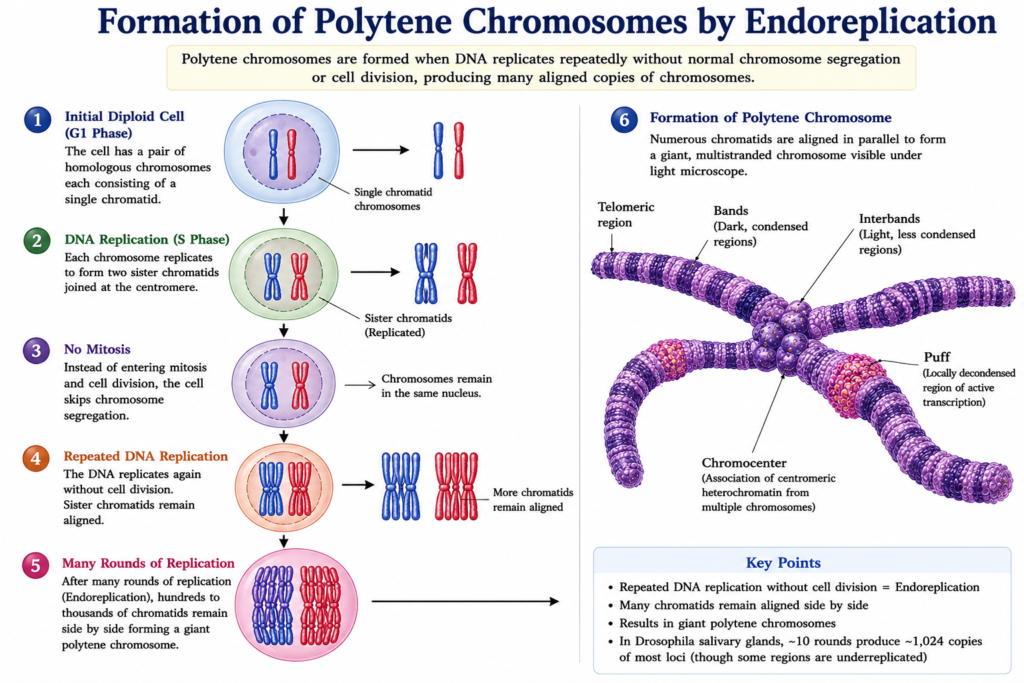
Polytene chromosomes are formed when DNA undergoes repeated rounds of replication without the normal separation of chromosomes through mitosis.
The replicated chromatids remain closely aligned with one another, producing a giant, multistranded chromosome.
They are especially well known in Diptera, particularly in the salivary gland cells of Drosophila melanogaster.
One of their most recognizable characteristics is the presence of a regular pattern of dark bands and lighter interbands. Some regions can undergo local decondensation when genes become highly active, producing visible structures known as puffs. These features make polytene chromosomes exceptionally useful for studying chromosome organization and gene activity.
Polytene chromosomes have played a major role in the development of cytogenetics and classical genetics because individual chromosome regions can be identified under a light microscope. They have been used to study gene expression, chromosome rearrangements, gene mapping, chromatin organization and DNA replication.
What Are Polytene Chromosomes?
A polytene chromosome is a giant chromosome produced by repeated rounds of DNA replication in which the newly replicated chromosome copies remain physically aligned rather than becoming separated into individual chromosomes.
The repeated replication results in numerous DNA molecules lying side by side. In Drosophila, the replicated chromatids become tightly aligned, producing a thick chromosome that can be observed using a light microscope.
The term polytene refers to the chromosome’s many-stranded organization.
The important point is that polytene chromosomes are not simply ordinary chromosomes that have become swollen. Their enormous size results primarily from repeated genome replication combined with the continued alignment of the replicated chromatids.
Where Are Polytene Chromosomes Found?
Polytene chromosomes occur in several organisms and specialized cell types, but they are particularly characteristic of Dipteran insects.
The best-known example is found in the salivary gland cells of larval Drosophila melanogaster. Polytene chromosomes are also present in other tissues of Drosophila and other dipterans, including species of Chironomus and Rhynchosciara.
Their occurrence is not restricted to insects. Polyteny has evolved in a variety of organisms and cell types, although the classic giant chromosomes used in cytogenetic studies are those of Diptera.
Formation of Polytene Chromosomes
The formation of polytene chromosomes is closely associated with a specialized cell cycle called an endocycle.
In a typical mitotic cell cycle:
DNA replication → chromosome condensation → chromosome segregation → cell division
In a polytene cell, repeated cycles instead follow approximately:
DNA replication → no normal mitosis → another round of DNA replication → repeated cycles
As this process continues, the number of DNA copies increases while the chromatids remain aligned.
Step 1: DNA Replication
The cell enters an S phase and replicates its DNA.
Step 2: Absence of Normal Cell Division
Instead of proceeding through a complete mitotic division that separates the replicated chromosomes, the cell returns to another replication cycle.
Step 3: Repeated DNA Replication
The genome is copied repeatedly.
Step 4: Alignment of Replicated Chromatids
The replicated chromatids remain closely aligned along their lengths.
Step 5: Formation of the Giant Chromosome
After many rounds of replication, thousands of aligned DNA strands can form a single giant polytene chromosome.
In the classic Drosophila salivary gland system, the euchromatic portions of the genome can reach approximately 1,024 copies after around ten rounds of endoreplication. However, this copy number is not uniform throughout the genome because some regions are underreplicated.
Endoreplication and Polyteny
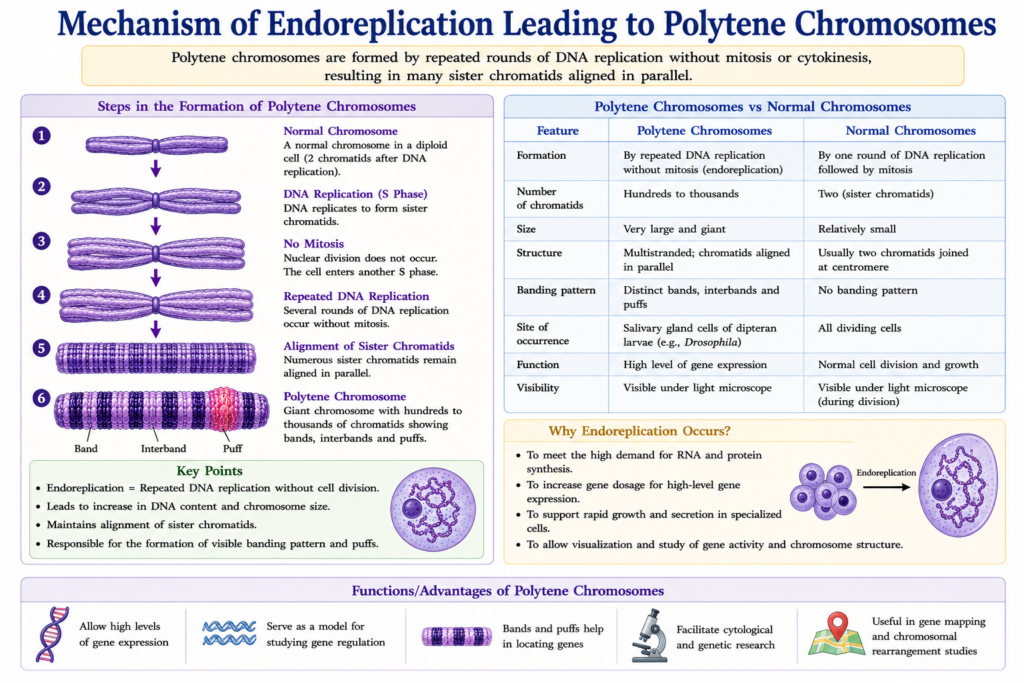
Endoreplication is repeated DNA synthesis without the complete mitotic division normally associated with chromosome segregation.
It is an important mechanism underlying polytene chromosome formation.
However, it is important to distinguish polyploidy from polyteny.
Polyploid cell
A polyploid cell contains multiple genome copies, but the replicated chromosomes do not necessarily remain physically aligned.
Polytene cell
A polytene cell contains multiple replicated chromosome copies that remain physically aligned, producing the characteristic giant chromosome.
Therefore:
All polytene chromosomes involve increased DNA content, but simply having multiple genome copies does not automatically make a chromosome polytene.
This physical alignment is one of the defining features of polytene chromosomes.
Structure of Polytene Chromosomes
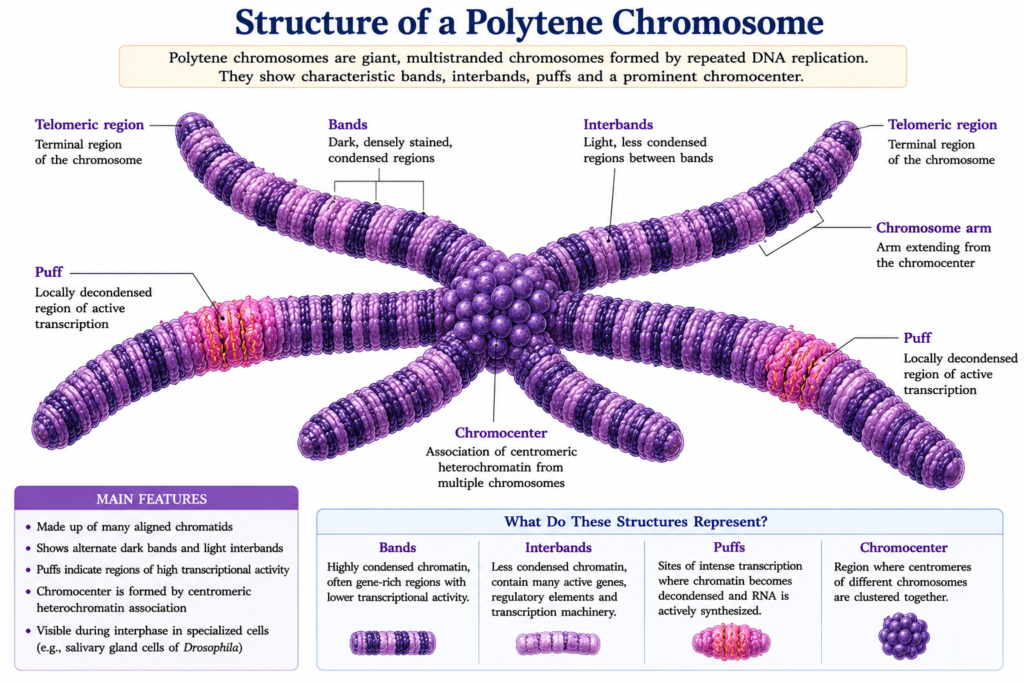
Polytene chromosomes have several recognizable structural features:
- Multiple aligned chromatids
- Bands
- Interbands
- Puffs
- Chromocenter
- Chromosome arms
- Telomeric regions
1. Multiple Aligned Chromatids
The fundamental feature of a polytene chromosome is the presence of many replicated DNA molecules arranged side by side.
During successive rounds of replication, sister chromatids remain associated instead of being separated into daughter chromosomes.
In Drosophila salivary gland chromosomes, the replicated strands are tightly aligned, producing a thick, cable-like structure.
This alignment is responsible for the enormous size of the chromosome.
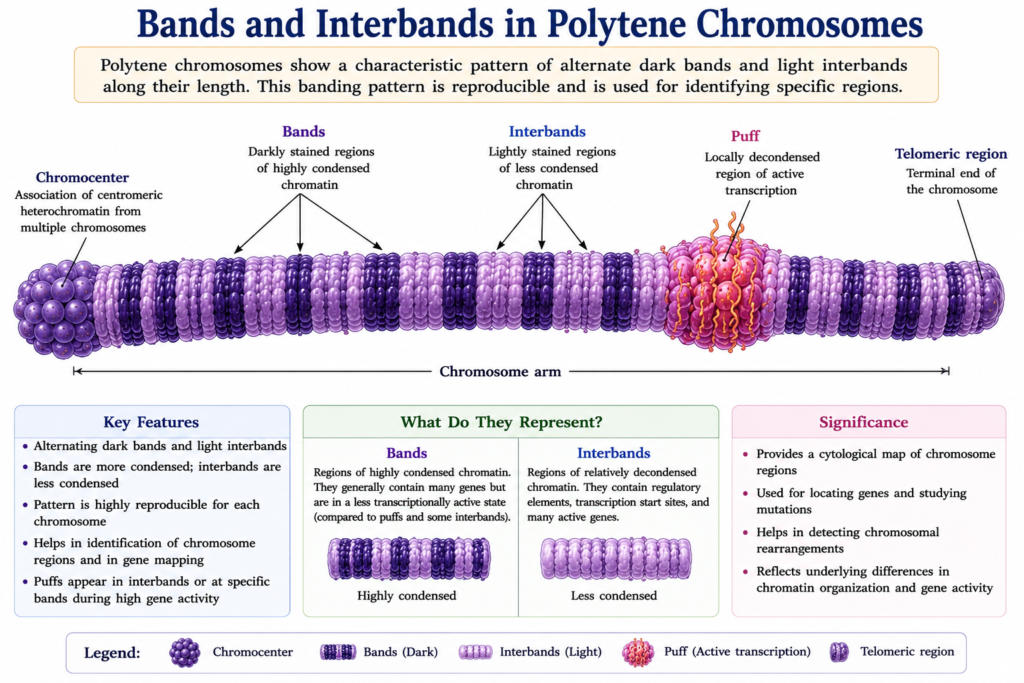
2. Bands
Bands are the prominent dark regions visible across the length of polytene chromosomes.
They arise from differences in chromatin compaction and organization.
In Drosophila, the arrangement of bands is highly reproducible and differs between chromosomes. This characteristic pattern makes it possible to identify particular chromosome regions under a microscope.
Historically, researchers used these bands to create detailed cytological chromosome maps.
Why are bands important?
They can be used to:
- Identify chromosome regions
- Locate genes cytologically
- Detect deletions
- Detect duplications
- Identify inversions
- Identify translocations
- Study chromosome organization
However, it is not scientifically correct to assume that one band always represents one gene. Modern molecular studies show that bands correspond to broader chromatin domains and can contain multiple genes and regulatory elements.
3. Interbands
The relatively lighter regions between prominent bands are called interbands.
Interbands generally contain more decondensed chromatin and are associated with several features of transcriptionally active chromatin, including RNA polymerase II and other regulatory and chromatin-remodeling factors.
However, an important correction is necessary:
Interbands should not simply be described as “active regions” while bands are described as “inactive regions.”
The organization is more complex.
Most genes in Drosophila are actually located within the larger band regions because bands contain most of the euchromatic DNA. Interbands represent smaller, highly decondensed regions that frequently contain regulatory elements, transcription initiation regions and other components associated with open chromatin.
4. Puffs
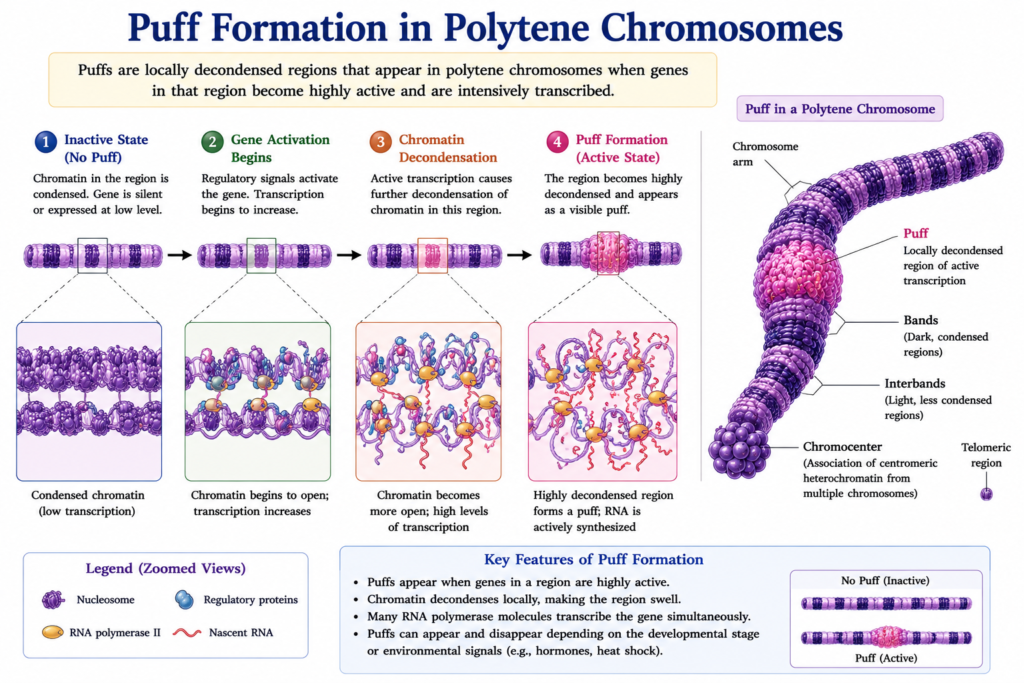
A puff is a localized region of polytene chromosome that becomes visibly expanded or decondensed.
Puffs are associated with increased transcriptional activity.
When transcriptional activity increases at a particular chromosome region, the chromatin can become more extended, producing a visible swelling.
The basic relationship can be summarized as:
Gene activation → increased transcription → local chromatin decondensation → puff formation
Puffs therefore provide a striking cytological example of the relationship between chromosome structure and gene activity.
Important clarification
A puff should not automatically be interpreted as representing exactly one gene.
A puff is a cytologically visible region of increased decondensation and transcriptional activity, and the underlying region can contain one or several transcription units.
5. Chromocenter
In Drosophila, the centromeric regions of several chromosomes become associated with one another to form a prominent structure called the chromocenter.
The chromocenter is largely associated with heterochromatic regions.
The chromosome arms extend outward from this central region.
The chromocenter is particularly easy to recognize in salivary gland polytene chromosome preparations.
6. Chromosome Arms
The chromosome arms extend from the chromocenter toward the chromosome ends.
In Drosophila melanogaster, the polytene chromosomes display recognizable chromosome arms that can be distinguished by their characteristic banding patterns.
This organization allows cytogeneticists to identify specific regions of the genome.
7. Telomeric Regions
The chromosome arms terminate in telomeric regions.
As in ordinary linear chromosomes, telomeres are specialized chromosome-end structures that contribute to the stability and maintenance of chromosome ends.
Banding Pattern of Polytene Chromosomes
The banding pattern is perhaps the most famous feature of polytene chromosomes.
Under the light microscope, a typical polytene chromosome appears as a sequence of:
dark bands → lighter interbands → dark bands → lighter interbands
The precise arrangement varies along the chromosome and between chromosomes.
In Drosophila, thousands of bands and interbands have been characterized, producing detailed cytological maps.
These maps were historically extremely important because researchers could associate mutations and chromosome rearrangements with visible chromosome regions.
Types of Chromatin Regions
The visible banding pattern reflects underlying differences in chromatin organization.
Broadly, polytene chromosome regions can include:
- Dense, highly compacted bands
- Less compacted bands
- Interbands
- Puff regions
- Heterochromatic regions
Some dense regions, particularly intercalary heterochromatin, replicate incompletely during endoreplication and therefore become underrepresented in DNA copy number.
Thus, polytene chromosomes are not simply a uniform collection of identical DNA copies.
Underreplication in Polytene Chromosomes
One of the most important details of polytene chromosome biology is underreplication.
Although repeated DNA replication can produce many copies of most genomic regions, some regions do not complete replication during every endocycle.
This is particularly important in certain heterochromatic regions of Drosophila.
As a result:
Expected DNA copy number ≠ actual copy number in every region
Some regions therefore contain considerably fewer DNA copies than the highly replicated euchromatic regions.
This is why it is inaccurate to say that every sequence in a polytene chromosome is present in exactly 1,024 copies.
Gene Amplification in Polytene Systems
Polytene tissues can also contain regions where DNA is selectively amplified.
This is different from ordinary genome-wide endoreplication.
In some specialized cells, particular genomic regions undergo additional replication to increase their copy number.
Therefore, polytene chromosome biology can involve both:
underreplication of some regions
and
amplification of particular regions
These processes contribute to the complex organization of polytene genomes.
Gene Expression in Polytene Chromosomes
Polytene chromosomes provide an unusually visible way to study gene expression.
Their large size allows researchers to associate changes in transcription with visible changes in chromosome morphology.
Less condensed regions
These regions generally provide greater accessibility for transcriptional machinery.
Highly active regions
Regions undergoing strong transcription can become more decondensed.
Puffs
Very active loci can develop visible puffs.
This makes it possible to study:
DNA → chromatin organization → transcription → visible chromosome morphology
Polytene chromosomes therefore became one of the classic systems for understanding the relationship between gene activity and chromosome structure.
Hormonal and Environmental Regulation of Puffs
Polytene chromosome puffing can change during development and in response to environmental signals.
In Drosophila, the steroid hormone ecdysone produces characteristic developmental changes in gene expression and associated puff patterns. Heat shock can also induce specific transcriptional responses visible as chromosome puffing.
This provided important early evidence that:
Changes in gene activity can be accompanied by visible changes in chromosome structure.
Polytene chromosomes therefore became an important model for studying developmental regulation of transcription.
Functions of Polytene Chromosomes
Polytene chromosomes are not simply enlarged versions of ordinary chromosomes. Their specialized structure provides several biological and experimental advantages.
1. Increased Gene Copy Number
Repeated DNA replication produces many copies of most genomic regions.
This can increase the number of templates available for transcription in highly specialized cells.
2. Supports High Cellular Activity
Many polytene cells have high biosynthetic requirements.
For example, larval salivary gland cells produce large amounts of secretory material. Increasing the copy number of many genes can support the transcriptional demands of these specialized cells.
3. Provides a Visible Model of Gene Activity
Puffs allow researchers to observe localized changes in chromosome structure associated with high transcriptional activity.
This is one of the most famous applications of polytene chromosome biology.
4. Helps in Gene Mapping
The reproducible banding pattern makes it possible to assign genes to specific cytological chromosome regions.
Before complete genome sequences were available, this was an exceptionally powerful approach to studying gene organization.
5. Helps Detect Chromosomal Rearrangements
Polytene chromosomes can reveal structural changes such as:
- Deletions
- Duplications
- Inversions
- Translocations
A change in the normal sequence of chromosome bands can provide evidence of a structural rearrangement.
6. Helps Study Chromatin Organization
Bands, interbands and puffs provide visible landmarks for investigating how chromatin is organized.
Modern molecular studies have connected these cytological structures with chromatin accessibility, protein localization, transcription and genomic organization.
Polytene Chromosomes in Drosophila melanogaster
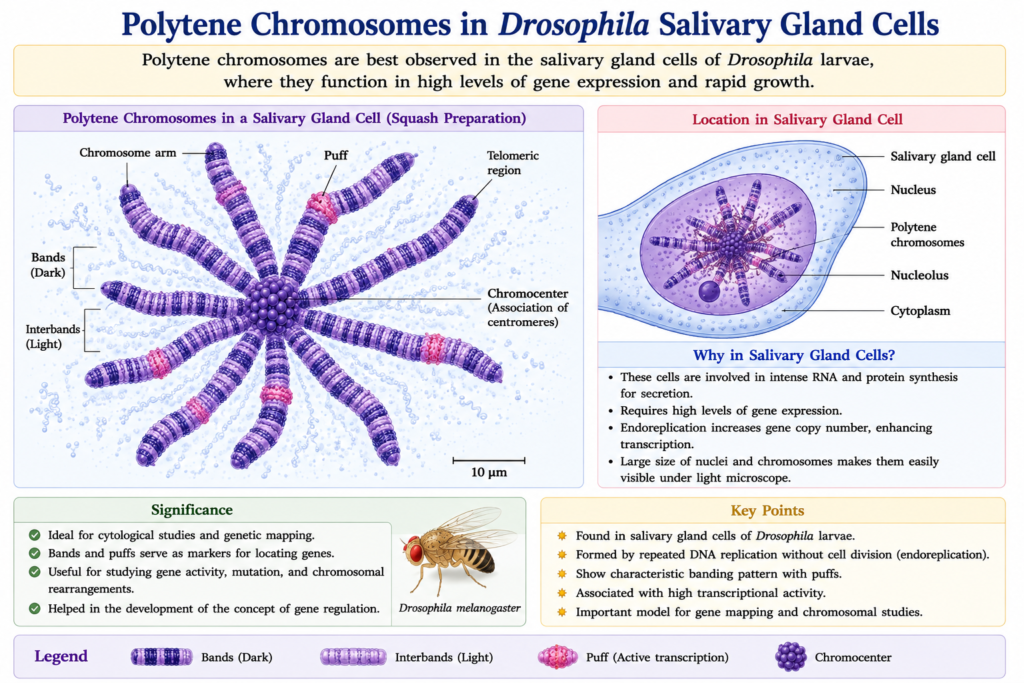
The salivary gland polytene chromosomes of Drosophila melanogaster are the classic model.
During larval development, salivary gland cells undergo repeated rounds of DNA replication without normal cell division.
The chromosomes become extremely large and display characteristic banding patterns.
In the third larval instar, the euchromatic genome can reach approximately 1,024 copies following repeated endoreplication, while some heterochromatic regions remain substantially underreplicated.
Another important characteristic of Drosophila polytene chromosomes is somatic pairing, in which homologous chromosomes remain closely associated. This contributes to the large, highly organized structure observed under the microscope.
Polytene Chromosomes and Cytological Mapping
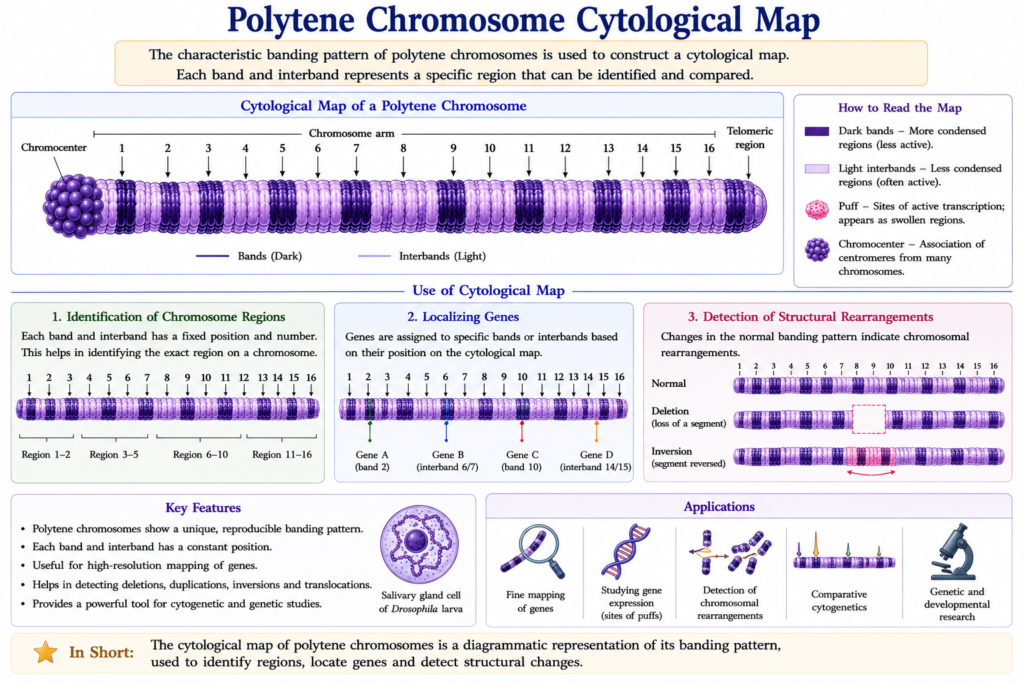
One of the most important historical applications of polytene chromosomes was the construction of cytological maps.
Because each chromosome has a characteristic banding pattern, researchers could divide it into recognizable regions.
A simplified representation might look like:
A — B — C — D — E — F
If a mutation caused a chromosome deletion, the corresponding missing region could sometimes be identified by comparing the mutant chromosome with the normal banding pattern.
Similarly, an inversion could alter the order of bands:
Normal: A — B — C — D — E
Inversion: A — D — C — B — E
This made polytene chromosomes powerful tools for classical cytogenetics.
Polytene Chromosomes and Modern Genomics
Although modern sequencing technologies have transformed genetics, polytene chromosomes remain scientifically valuable.
Researchers can now combine cytological observations with:
- DNA sequencing
- Fluorescence in situ hybridization (FISH)
- Chromatin immunostaining
- Genome-wide chromatin profiling
- Microscopy
- Transcriptomics
- Chromosome conformation studies
These methods allow researchers to connect a visible band or puff with its underlying DNA sequence, genes, regulatory elements and chromatin state.
Interestingly, research has shown that many principles of chromosome organization observed in polytene chromosomes are related to chromosome organization in non-polytene interphase cells.
Polytene Chromosome vs Ordinary Chromosome
| Feature | Polytene chromosome | Ordinary chromosome |
|---|---|---|
| Size | Extremely large | Comparatively small |
| DNA content | Many aligned copies | Usually one or two chromatids depending on cell-cycle stage |
| Formation | Repeated DNA replication without normal chromosome segregation | Normal cell cycle |
| Typical state | Specialized interphase cells | Found throughout the cell cycle |
| Chromatids | Prominent | Not normally visible as polytene bands |
| Bands | Prominent | Not normally visible as polytene bands |
| Interbands | Characteristic | Not a characteristic feature |
| Puffs | Characteristic feature | Not characteristic |
| Common example | Drosophila salivary gland | Typical somatic chromosome |
| Main research use | Cytogenetic mapping and chromosome biology | General chromosome inheritance and cell division |
Polytene Chromosome vs Lampbrush Chromosome
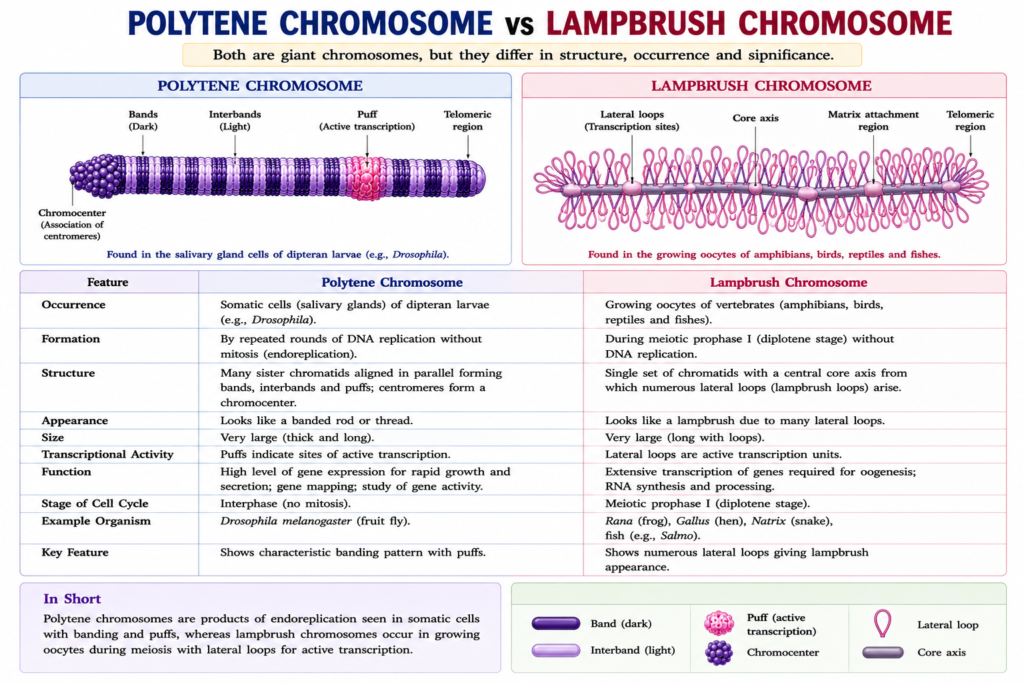
| Feature | Polytene chromosome | Lampbrush chromosome |
|---|---|---|
| Typical cell type | Specialized somatic cells | Growing oocytes |
| Common examples | Dipteran insects | Amphibians and birds |
| Formation | Repeated DNA replication without normal chromosome segregation | Extensive chromosome decondensation during meiotic prophase I |
| DNA copies | Numerous aligned copies | Not produced by repeated polytenization |
| Main visible features | Bands, interbands and puffs | Chromomeres and lateral loops |
| Major use | Gene mapping and chromosome organization | Study of transcription and RNA processing |
Polytene and lampbrush chromosomes are both unusually large chromosome structures, but they should not be confused.
For your ZoologyVerse content structure, it is better to keep the detailed explanation of lampbrush chromosomes in the separate Lampbrush Chromosome article rather than expanding this comparison too much.
Advantages of Polytene Chromosomes
Polytene chromosomes have several characteristics that make them excellent research models.
1. Very large size
Their large dimensions make them relatively easy to observe under a light microscope.
2. Distinctive banding
The reproducible banding pattern provides recognizable chromosome landmarks.
3. Visible transcriptional changes
Puff formation allows transcription-associated chromatin changes to be studied cytologically.
4. High DNA copy number
Multiple aligned DNA copies provide abundant material for some molecular and cytological analyses.
5. Easy detection of chromosome rearrangements
Changes in the banding pattern can reveal structural abnormalities.
6. Connection between structure and function
Polytene chromosomes provide a particularly clear model for investigating how chromatin organization relates to gene activity.
Limitations of Polytene Chromosomes
Despite their usefulness, polytene chromosomes have limitations.
They are highly specialized structures and therefore should not be assumed to behave exactly like chromosomes in every cell type.
Important limitations include:
- Their organization is associated with specialized cell types.
- Some genomic regions are underreplicated.
- Some regions can be selectively amplified.
- Their transcriptional organization is specialized.
- Their banding pattern should not be interpreted as a simple one-band/one-gene system.
Nevertheless, studies of polytene chromosomes have revealed many fundamental principles of interphase chromosome organization.
Biological Significance of Polytene Chromosomes
The importance of polytene chromosomes extends far beyond their unusual appearance.
They have helped scientists understand:
- Chromosome organization
- DNA replication
- Endoreplication
- Chromatin compaction
- Gene expression
- Transcriptional regulation
- Chromosome rearrangements
- Gene mapping
- Developmental regulation
- Genome organization
Their distinctive structure provides a rare opportunity to connect microscopic chromosome morphology with molecular genetic activity.
Conclusion
Polytene chromosomes are giant, multistranded chromosomes produced by repeated DNA replication without normal chromosome segregation. They are particularly prominent in specialized cells of Dipteran insects, especially the salivary gland cells of Drosophila melanogaster.
Their characteristic bands, interbands and puffs provide a remarkable cytological view of chromosome organization and gene activity. Bands and interbands represent different forms of chromatin organization, while puffs are localized regions of decondensation associated with high transcriptional activity.
Polytene chromosomes have been especially important in cytogenetics and classical genetics, where their reproducible banding patterns have been used for gene mapping and detection of chromosome rearrangements. Modern genomic studies have further shown that their organization can provide insights into chromatin structure and genome organization beyond polytene tissues.
The simplest way to remember their defining characteristics is:
Repeated DNA replication + aligned chromatids + giant size + bands, interbands and puffs = polytene chromosome.
Key Takeaways
- Polytene chromosomes are giant chromosomes containing many aligned copies of DNA.
- They are produced through repeated DNA replication without normal chromosome segregation.
- This process is commonly associated with endoreplication or endocycles.
- They are particularly prominent in specialized cells of Dipteran insects.
- The classic example is the salivary gland chromosome of Drosophila melanogaster.
- Polytene chromosomes show characteristic bands and interbands.
- Highly active regions can become locally decondensed and form puffs.
- Homologous chromosomes can remain closely paired, producing a very large chromosome structure.
- Some genomic regions can be underreplicated, while certain loci can undergo amplification.
- Their distinctive banding pattern has been used for gene mapping and identification of chromosome rearrangements.
- They provide a powerful model for studying the relationship between chromatin structure and gene expression.
- Polytene chromosomes are different from lampbrush chromosomes, despite both being unusually large chromosome structures.
Frequently Asked Questions
1. Why are polytene chromosomes called giant chromosomes?
They are called giant chromosomes because repeated DNA replication produces many aligned copies of chromosome material, making them much larger than ordinary chromosomes.
2. What is the main mechanism of polytene chromosome formation?
The main mechanism is repeated DNA replication without normal chromosome segregation, with the replicated chromatids remaining aligned.
3. What is the classic example of a polytene chromosome?
The classic example is the polytene chromosome found in the salivary gland cells of Drosophila melanogaster larvae.
4. What is the function of chromosome bands?
Bands provide recognizable structural landmarks that can be used for cytological mapping and studying chromosome organization.
5. Are chromosome bands genes?
No. A band does not necessarily correspond to a single gene. Bands represent larger chromatin regions that can contain multiple genes and regulatory sequences.
6. What causes puff formation?
Puff formation occurs when local chromatin decondensation accompanies increased transcriptional activity at a chromosome region.
7. Are puffs found in every polytene chromosome?
Puffing is a characteristic feature of many polytene chromosome systems, but the presence, appearance and regulation of specific puffs vary among organisms, tissues and developmental stages.
8. How many DNA copies can a Drosophila polytene chromosome contain?
After approximately ten rounds of endoreplication, many euchromatic regions in Drosophila salivary gland cells can reach around 1,024 copies, although some regions are underreplicated.
9. Are polytene chromosomes and polyploid chromosomes the same?
No. Polyploidy refers broadly to cells containing multiple genome copies. Polytene chromosomes specifically involve multiple replicated chromosome copies that remain physically aligned.
9. Are polytene chromosomes and polyploid chromosomes the same?
No. Polyploidy refers broadly to cells containing multiple genome copies. Polytene chromosomes specifically involve multiple replicated chromosome copies that remain physically aligned.
10. Are polytene chromosomes found only in insects?
No. Polytene chromosomes occur in a variety of organisms, although the best-known examples are found in Dipteran insects.
References
- Zhimulev IF, Demakov SA. Polytene Chromosomes – A Portrait of Functional Organization of the Drosophila Genome.
- Stormo BM, et al. Polyteny: Still a Giant Player in Chromosome Research.
- Zhimulev IF, et al. Identical Functional Organization of Nonpolytene and Polytene Chromosomes in Drosophila melanogaster.
- Zhimulev IF, et al. Genetic Organization of Interphase Chromosome Bands and Interbands in Drosophila melanogaster.
- Saumweber H, et al. A three-dimensional structural dissection of Drosophila polytene chromosomes.
- Chromatin Organization and Function in Drosophila.
Discover more from Zoologyverse
Subscribe to get the latest posts sent to your email.