
The genus Pinctada belongs to the Pteriidae family of marine bivalve mollusks, which includes saltwater oysters. Nacre, sometimes referred to as the “mother of pearl,” makes up the robust inner shell layer of these pearl oysters.Neither the freshwater pearl mussels of the Unionidae and Margaritiferidae families nor the edible oysters of the Ostreidae family are closely related to pearl oysters. Tahitian and South Sea pearls are cultivated using Pinctada maxima and Pinctada margaritifera.They are widely cultivated, mostly in the eastern and central Indo-Pacific. The back of the Philippine 1,000 peso note has a pearl oyster.
Classification of Pinctada vulgaris
| Rank | Classification | Characterization |
|---|---|---|
| Phylum | Mollusca | Soft bodied, non-metameric, shelled. |
| Class | Pelecypoda | Bivalve shell |
| Order | Pseudolamellibranchiata | Gills form vertical folds |
| Genus | Pinctada |
Habit and habitat
Pinctada lives in the Gulf of California and in West Indian sea water.
Distribution
It has wide distribution except in cold zones. It is very common in the Gulf of Kutch. Tropical and temperate seas, Pacific and Atlantic coast.
Comments on of Pinctada vulgaris
- Commonly called as pearl oyster.
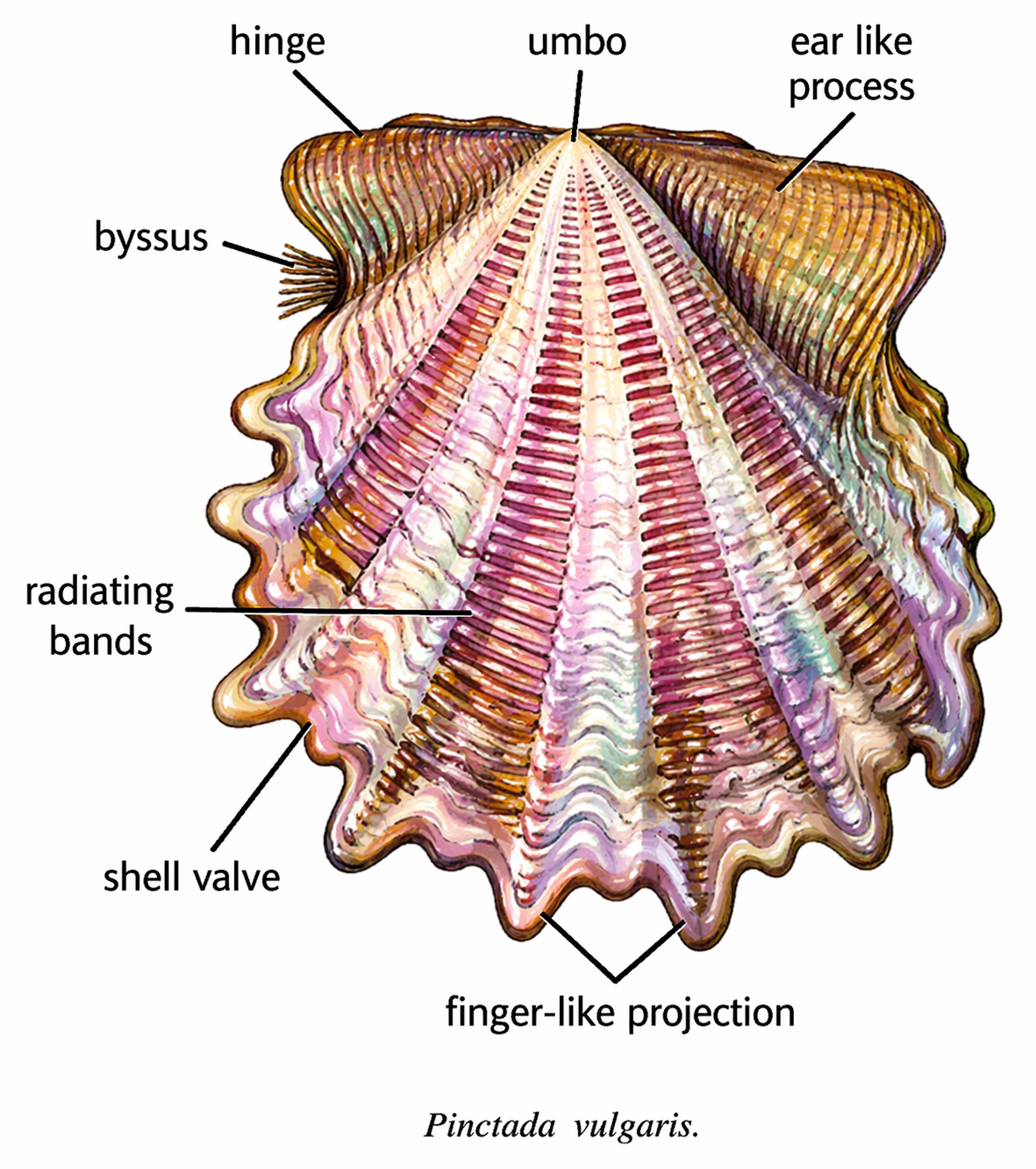
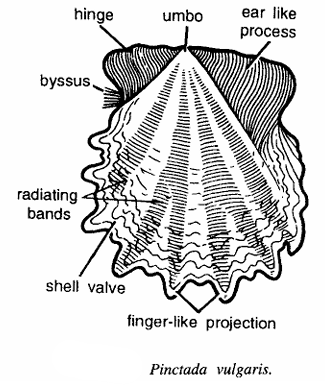
- Shell valves are unequal and the hinge line is straight, produced at each end into a short ear or wing like process.
- Left shell is large, convex and permanently attached to rocks by a strong cable of byssal threads.
- Right shell is smaller and thinner and covers viscera. Surface of the shell is coarse, irregular and ruffled and bears radiating bands terminating at the margins into finger like projections, which may disappear in order specimens.
- Like Pecten, there is a single adductor muscle.
- Right and left mantle lobes are quite free.
- Pearl oysters feed in the same manner as clams.
Economic importance
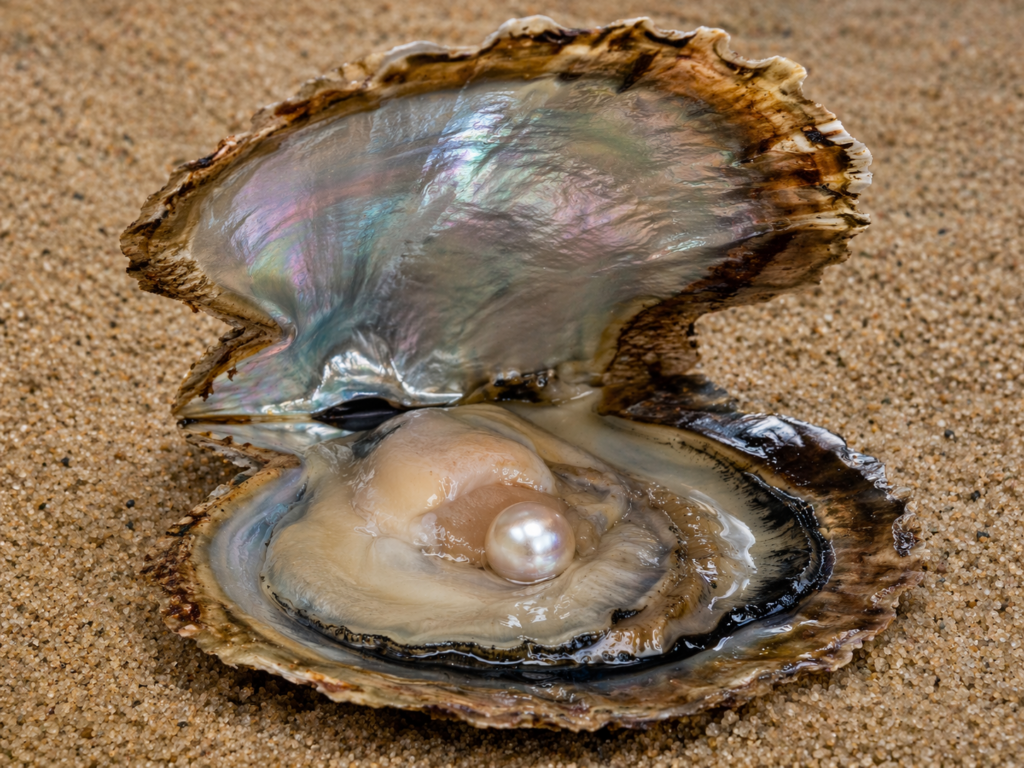
Oyster’s shell secretes pearls whenever any insect enters the shell and causes irritation. They are cultivated in pearl oyster industry. Most of our germ pearls are obtained from pearl oyster.
Identification
Since the specimen contains ear like processes and all above features, hence it is Pinctada vulgaris.
See Other Posts Also
- PRIMITIVE NERVOUS SYSTEM OF COELeNTERATES AND ECHINODERMS
- Larval forms of Mollusca
- EXCRETION IN LOWER INVERTEBRATES
- ORGANS AND MECHANISM OF RESPIRATION IN HIGHER INVERTEBRATES
- PATTERN OF FEEDING AND DIGESTION IN HIGHER INVERTEBRATES
Discover more from Zoologyverse
Subscribe to get the latest posts sent to your email.