
On this page
Introduction
Crotalus is a genus of venomous pit vipers commonly known as rattlesnakes, found mainly in North and South America. These snakes are easily recognized by the keratin-filled rattle at the tip of their tails, which they vibrate as a warning to predators. Crotalus species possess heat-sensing pits, allowing them to detect warm-blooded prey with precision. Their venom is a potent mix of hemotoxins and neurotoxins, used for both defense and immobilizing prey. Despite their reputation, rattlesnakes play a vital ecological role by controlling rodent populations and maintaining balance within their habitats.
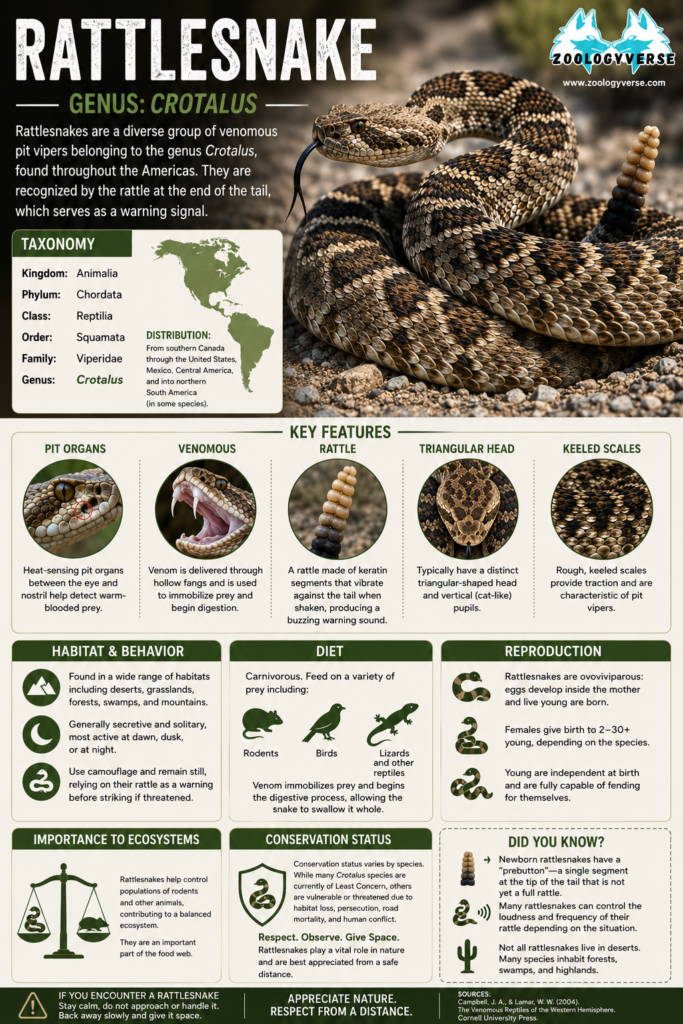
Classification of Crotalus (Rattle Snake)
- Phylum :- Chordata (Dorsal tubular nerve cord, notochord and gill-slits present.)
- Group :- Craniata (Definite head, Cranium with brain present.)
- Sub phylum :- Vertebrata (Vertebral column present.)
- Division :- Gnathostomata (Jaws and paired appendages present.)
- Super Class :- Tetrapoda (Paired limbs, lungs, cornified skin and bony skeleton.)
- Class :- Reptilia (Scaly vertebrates. Right and left aortic arches present. Single condyle. Pulmonary respiration. Embryo with amnion and allantois.)
- Sub Class :- Diapsida (Skull with two temporal openings separated by post-orbital and squamosal.)
- Order :- Squamata (Lizards and snakes with horny epidermal scales or shields. Quadrate bone movable. Vertebrae procoelous. Anal opening transverse.. Vertebrae amphicentrous.)
- Sub-order :- Ophidia (Snakes. Limbs, feet, ear openings sternum and urinary bladder absent. Mandibles jointed anteriorly by ligament. Tongue slender, bifid and protrusible. Left lung reduced.)
- Family :- Viperinae (Paired erectile fangs in front of upper jaw.)
- Genus :- Crotalus
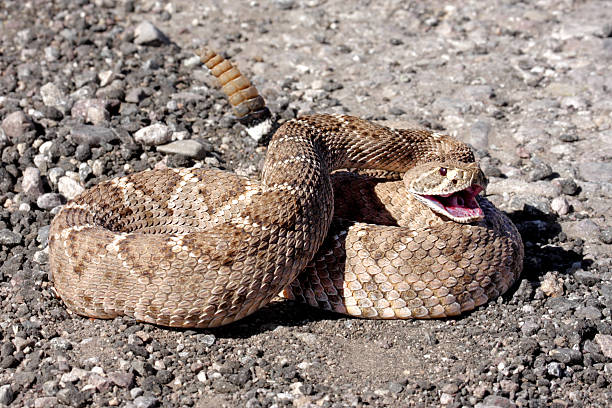
Geographical distribution
- Crotalus is found in U.S.A. and Mexico, North America and contains Crotalus horridus, a common rattle snake of U.S.A. Crotalus confluentus is found in western America. About 40 species and varieties are found in Western Hemisphere and approximately 20 in U.S.A.
Habit and habitat
- It is adapted for terrestrial life. During winter season it hibernates under the ground. The snake is carnivorous, nocturnal and feeds on small mammals.
General Characteristics of Crotalus (Rattle Snake)
- Commonly called as Rattle snake.
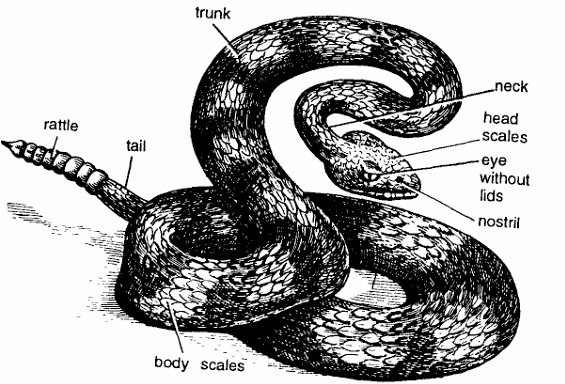
- Body is elegantly elongated, measuring 2 to 3 meters in length. Body divided into head, neck, trunk and tail. Head contains nostrils, eyes, mouth and head scales.
- General surface greyish brown with dark bands and handsome pigmentation pattern.
- Head is triangular in shape, distinct from the neck having small nostrils and ventral mouth. Upper side of head has small scales.
- Eyes are small, without eyelids, and a sensory pit is present between eye and nostril.
- There are two erectile fangs in front of jaw, one on each maxillary bone and folded backwards when not in use.
- Tongue bifid and protrusible. Two pairs of inter nasals present.
Ecological Importance of Crotalus (Rattle Snake)
- Population Control:
- Crotalus species prey on small mammals like rodents, helping to regulate populations and prevent crop damage or the spread of diseases such as hantavirus and plague.
- Food Web Dynamics:
- As both predators and prey, rattlesnakes contribute to the balance of their ecosystems. They are preyed upon by birds of prey, larger mammals, and other snakes.
- Ecosystem Engineering:
- Abandoned rattlesnake burrows provide shelter for other animals, enhancing biodiversity in their habitats.
- Indicator Species: Rattlesnakes’ presence indicates a healthy, balanced ecosystem with adequate prey and minimal human disturbance.
Conservation Status of Crotalus (Rattle Snake)
- The conservation status of Crotalus species varies. Some, like the timber rattlesnake (Crotalus horridus), are listed as Near Threatened, while others are not currently at risk.
- Threats:
- Habitat destruction due to urbanization, agriculture, and deforestation.
- Persecution and collection for the exotic pet trade.
- Climate change altering their habitats and prey availability.
- Conservation Measures:
- Protecting natural habitats and restricting land development in sensitive areas.
- Public education to reduce human-snake conflicts and discourage unnecessary killings.
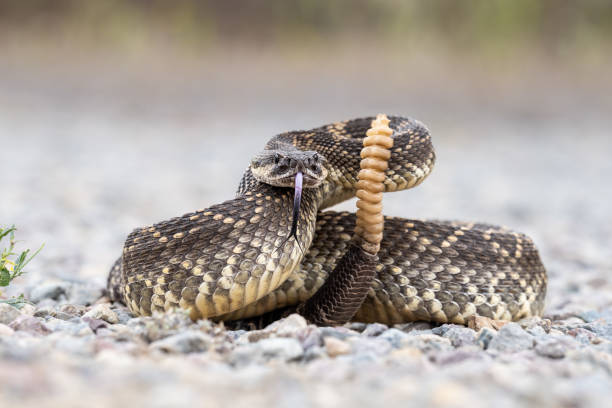
Special features
- The snake is immediately characterized by the presence of a rattle at the end of the tail. Rattle is derived from moulting epidermis consisting of 10-12 hollow segments. During fast locomotion, tail is vibrated and rattle produces characteristic rattling sound which warns the intruder.
- It is a deadly poisonous snake and is viviparous.
- Rattle Mechanism: Made of keratin segments at the tail’s end, the rattle produces a characteristic sound to warn predators or threats.
- Pit Organs: Heat-sensitive pits on their heads allow them to detect warm-blooded prey even in complete darkness.
- Venom Potency: Crotalus venom contains hemotoxins that immobilize prey and aid in digestion, while also serving as a defense mechanism.
- Camouflage: Their color patterns blend with their surroundings, offering protection against predators and facilitating ambush hunting.
- Behavioral Adaptations: They are generally shy and reclusive, using their rattle to avoid confrontations rather than engage in aggression.
Identification
- Since this snake contains rattle in tail and above features, hence it is Crotalus.
Discover more from Zoologyverse
Subscribe to get the latest posts sent to your email.