
Larval forms of Mollusca
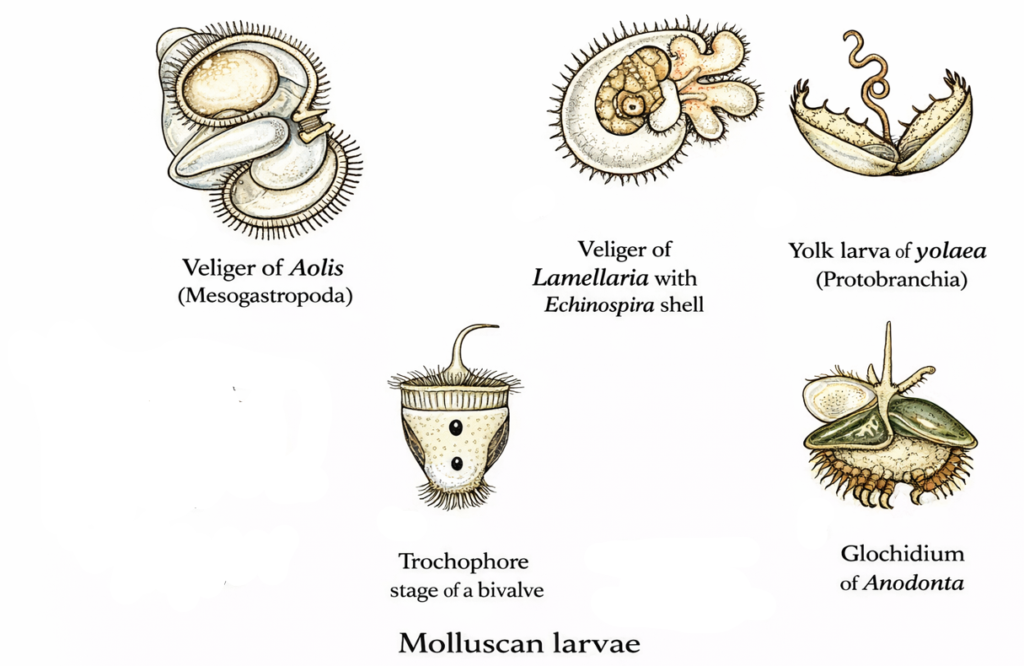
Larval forms of Mollusca may serve two purposes- finding new settling sites and gaining access to the rich food supply of phytoplankton. The earliest molluscan larva was no doubt a trochophore like that of an annelid. It was a top-shaped creature with a tuft of cilia above and a ciliated band around the middle. This is the only closest resemblance of Mollusca to the Annelida. Molluscan life histories do not perfectly correspond with taxonomy, in general it is true that the archaeogastropods and the bivalves begin life as a trochophore and rapidly pass on to a veliger.
There are different types Larval forms of Mollusca phase and according to the importance of the pelagic amount of planktonic food taken. G. Thorson (1950) recognized three ecological types of larvae in Mollusca.
Planktotrophic larvae with long larval life
Such larvae have larval life of two or three months e.g. Lamellibranch’s, Prosobranchs. They are capable of wide distribution. They are usually found in tropical, subtropical and a few in high Arctic seas. Such molluscan veligers are all ciliary feeders. The large vellar cilia collects particles which are thrown on to a tract at the base of the velum leading to a mouth. Coarse or unsuitable particles are removed by rejectory tracts upon the foot.
Planktotrophic larvae with short swimming life
Such larvae have larval life of not more than a week in the plankton e.g., Nudibranch larvae, Gibbula cineraria, Hydrobia Ulva, Turritella communis and Bela Trevelyan. The velum never elaborates. Planktonic feeding is of secondary importance. Distribution is the main object of their life. There is little growth between hatching and settling. Being less dependent on food, they are unfavorable surprisingly adaptable to conditions, and serve mainly for dispersal.
Yolk larvae
Such larvae take no food in plankton. They are lecithotrophic, as they hatch from very yolky eggs and develop into large, “yolky larvae”. They swim little and are passively carried about in the plankton. Gastropods show only few examples of yolk larvae. Yolk larvae are normally found in Amphineura, Scaphopoda and protobranchiate Lamellibranchiate. In Chiton, the yolk larvae are modified egg-shaped trochophores with a broad ciliary ring. They spend six hours to few days in the plankton. Neomenia has three such rings, Dentallium four. In protobranchs such as Yoldia and Nucula they form a large barrel-shaped ciliated test, which is thrown off when the larva settles.
See Other Posts Also
- Ostrea verginiana
- Loligo – Characteristics and Biology
- Sepia – Characteristics, Habitat, and Importance of the Cuttlefish
- Octopus
- Modern Text Book of Zoology Invertebrates (R.L. Kotpal) | PDF
Discover more from Zoologyverse
Subscribe to get the latest posts sent to your email.