
Phoenicopterus, commonly known as the flamingo, is a genus of tall, wading birds recognized for their striking pink plumage, slender legs, and uniquely curved bills.
These birds inhabit shallow lakes, lagoons, and coastal wetlands, where they feed on algae, crustaceans, and other microscopic organisms.
Their vivid coloration comes from carotenoid pigments in their diet, making them one of the most visually distinctive waterbirds.
Flamingos are highly social and form large colonies that play an important role in breeding, feeding, and protection from predators.
For Practical Study 🧪
The following notes are arranged in a practical examination format for easy study and identification.
Classification of Phoenicopterus (Flamingo)
| Rank | Classification | Characteristic |
|---|---|---|
| Kingdom | Animalia | – |
| Phylum | Chordata | Dorsal tubular nerve cord, notochord and gill-slits present |
| Group | Craniata | Definite head, Cranium with brain present |
| Sub-phylum | Vertebrata | Vertebral column present. |
| Super-Class | Tetrapoda | Paired limbs, lungs, cornified skin and bony skeleton. |
| Class | Aves | Biped and feathered vertebrates. |
| Sub-Class | Neornithes | True birds. Metacarpals fused. |
| Super-Order | Neognathae | Modern birds. no teeth. sternum keeled. |
| Order | Phoenicopteriformes | Long legged and long necked wading birds. |
| Family | Phoenicopteridae | long-legged aquatic/wading birds |
| Genus | Phoenicopterus | Large flamingos with long legs, long neck and specialized bill |
Geographical Distribution
Phoenicopterus is found in Afghanistan, India, South France, East Africa, South Spain, West Siberia, and Sri Lanka. It is tropical and sub-tropical. Eocene to Recent.
Habit and Habitat
It lives in flocks that gather on shallow jheels, tidal mudflats, ponds, and lakes. The flocks consist of many hundreds of individuals.
The birds wade into shallow water and feed with their head immersed. They feed on small molluscs, crustaceans, insect larvae, worms, seeds of marshes and organic ooze. It flies rapidly and can swim in water.
Comments
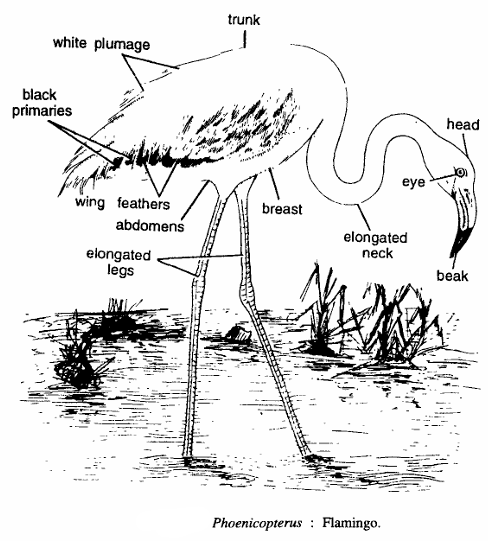
- Commonly called as Flamingo. Body divided into head, neck, back and breast.
- It is a pale, rosy-white bird, 1.25 meter tall, with elongated pink legs and long sinuous neck, which are extended during flight.
- The white plumage contrasts with scarlet wing coverts and black primaries.
- Head contains eyes and beak.
- The large pink bill is down curved.
- The fleshy tongue works like a plunger. Web present between toes.
- Wing feathers on back.
- Many nests are formed in colonies on mud flats in tropical brackish water.
- Eggs are unspotted.
Special Features
When at rest flamingos usually stand on one leg with the long neck coiled around and the head tucked away under the feathers of the back. Flamingo is famous for its beautiful, majestic and gracious walk.
Identification
Since the bird has elongated legs with webbed toes and all above features, hence it is Flamingo.
Quick Identification
| Feature | Character |
|---|---|
| Common name | Flamingo |
| Scientific name | Phoenicopterus |
| Class | Aves |
| Order | Phoenicopteriformes |
| Body | Tall, slender body with a long neck and long legs |
| Bill | Characteristically curved bill adapted for filter feeding |
| Feet | Webbed feet |
| Key identifying character | Long legs, long neck, webbed feet and specialized bill |
Physical Characteristics of Flamingo
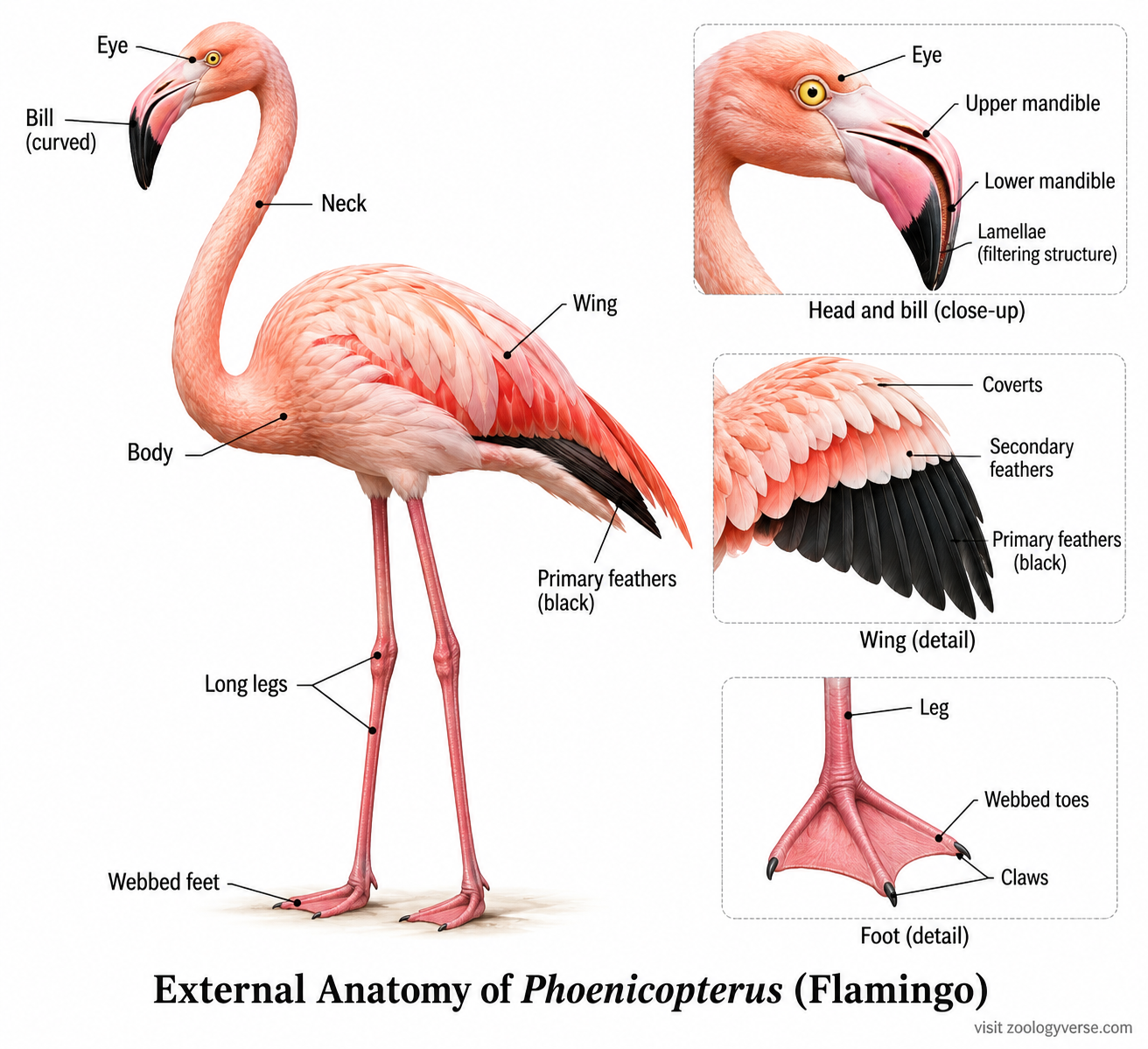
Flamingos are tall wading birds with a distinctive body shape adapted for life in shallow wetlands. They have a relatively small head, a long neck, very long legs and broad wings.
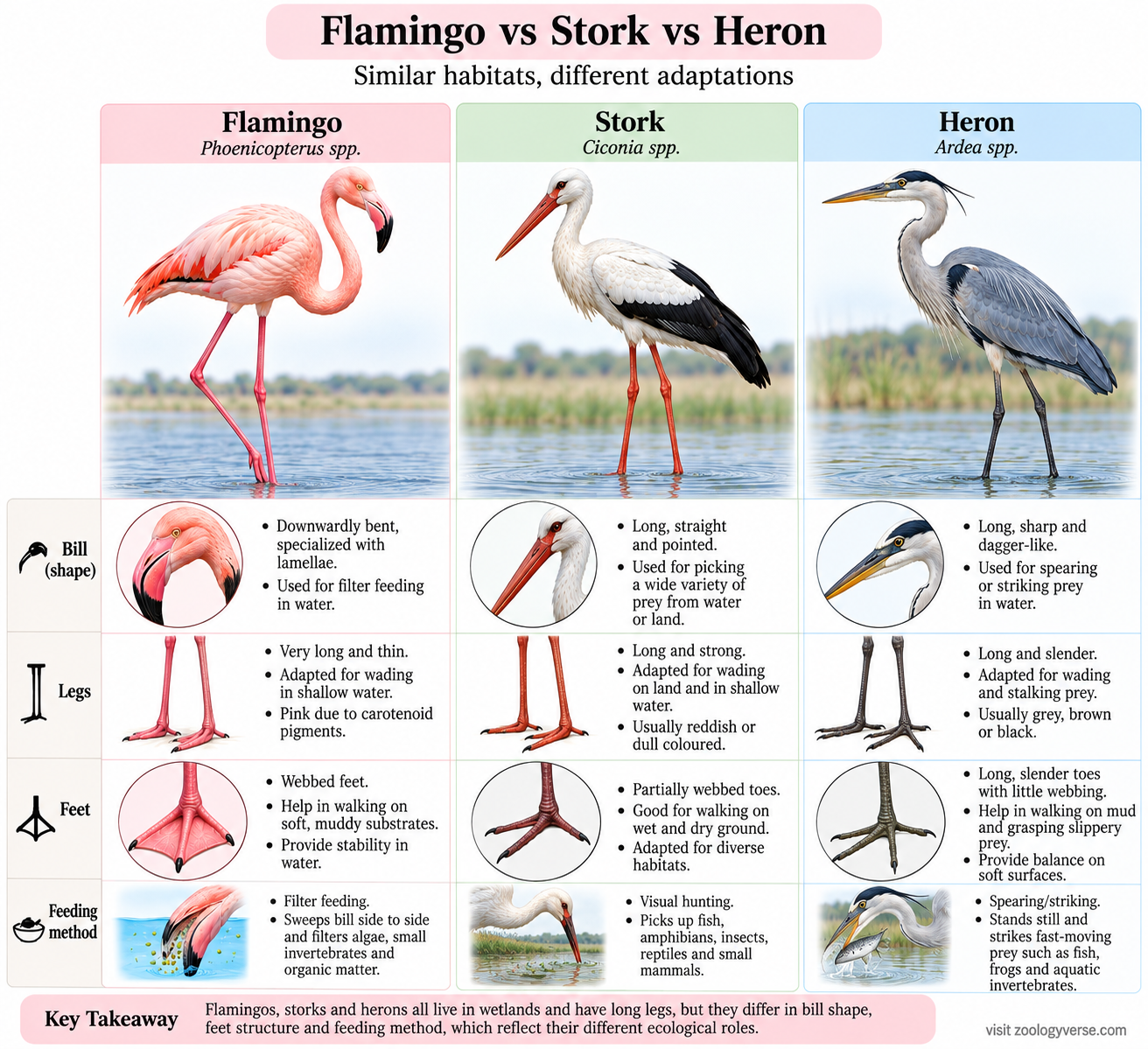
Their feet are webbed, helping them move through water and soft muddy substrates. The bill is one of their most distinctive features: it is bent downward and specialized for obtaining food from water and sediment.
Flamingo plumage ranges from pale pink to deeper rosy shades depending on the species and other factors, including diet.
The combination of long legs, elongated neck, webbed feet and a specialized bill makes the flamingo readily recognizable among aquatic and wading birds.
Flamingo Feeding and Filter-Feeding Adaptation
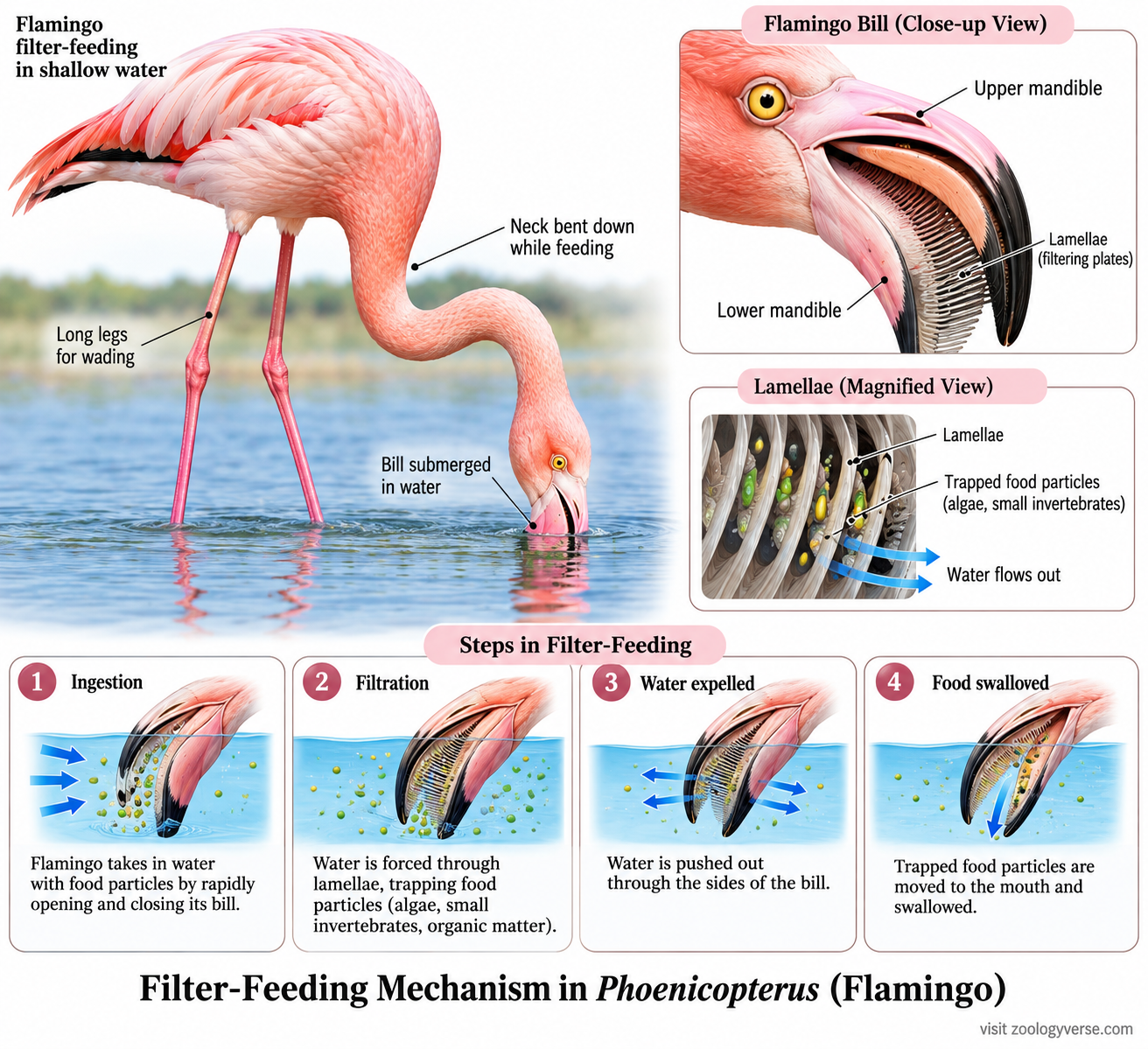
Flamingos are specialized feeders that obtain food from shallow water and wet sediments.
Their downward-curved bills are adapted for filter feeding. While feeding, a flamingo places its bill in the water and uses movements of the bill and tongue to draw water and food particles through the filtering structures inside the bill.
Their diet may include algae, small aquatic organisms and other organic particles. The specialized bill allows flamingos to separate suitable food particles from water and mud, making their feeding mechanism an important adaptation to their wetland habitat.
This specialized feeding system is closely associated with the characteristic shape of the flamingo’s bill and is one of its most distinctive biological adaptations.
Adaptations of Flamingo
| Adaptation | Function |
|---|---|
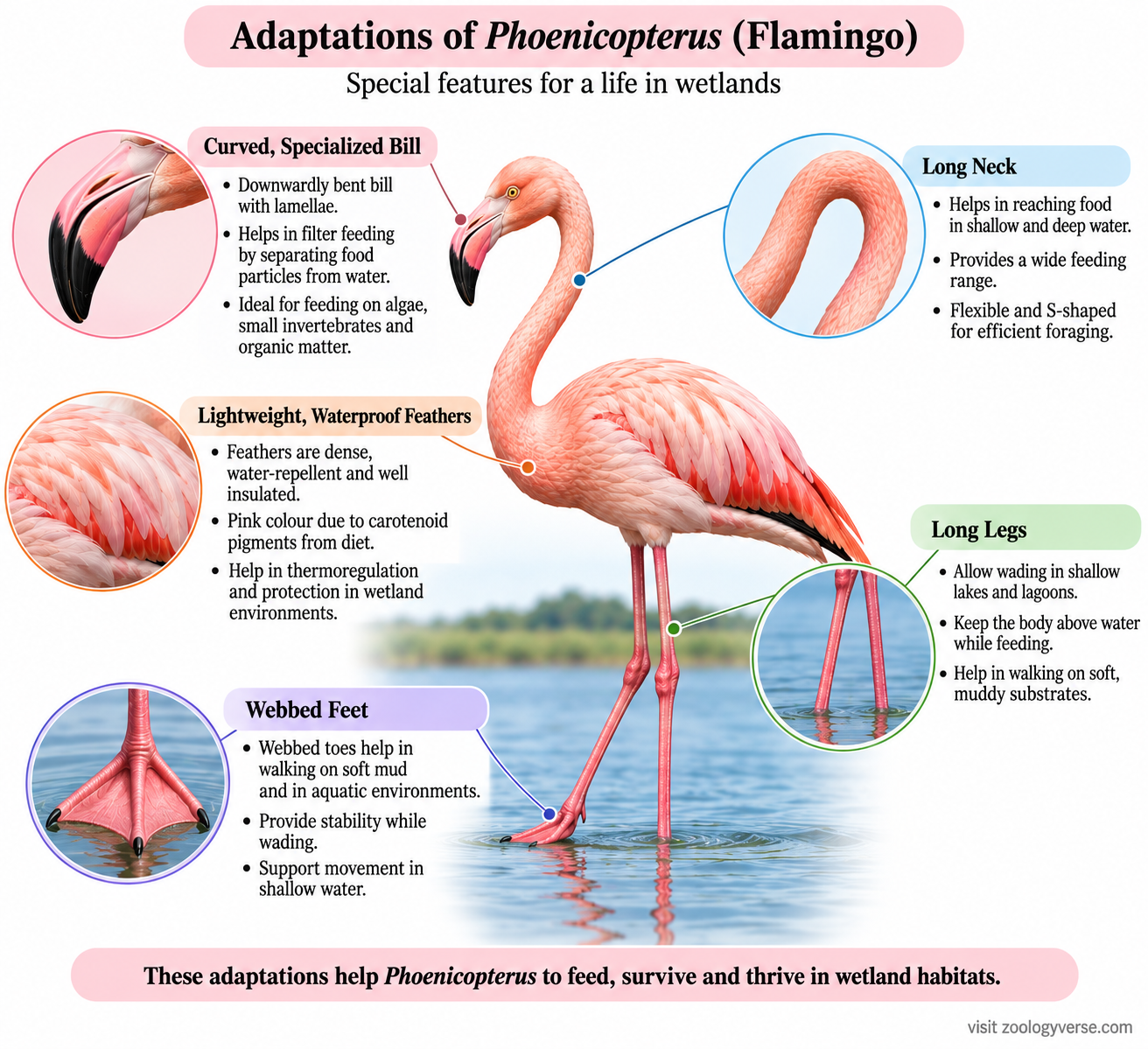
| Long legs | Help the bird wade through shallow water and wetland habitats. |
| Long neck | Helps it reach food while feeding in shallow water. |
| Downward-curved bill | Specialized for filter feeding and collecting food particles. |
| Filtering structures in the bill | Help separate food particles from water and mud. |
| Webbed feet | Help with movement in water and on soft muddy surfaces. |
| Long wings | Provide the lift and power needed for flight. |
| Pink or reddish plumage | Characteristic pigmentation associated partly with dietary carotenoids. |
| Social behaviour | Living in groups can support feeding, breeding and protection. |
These adaptations allow flamingos to exploit shallow aquatic environments efficiently. Their specialized legs, feet, neck and bill work together to support wading, feeding and movement in wetland habitats.
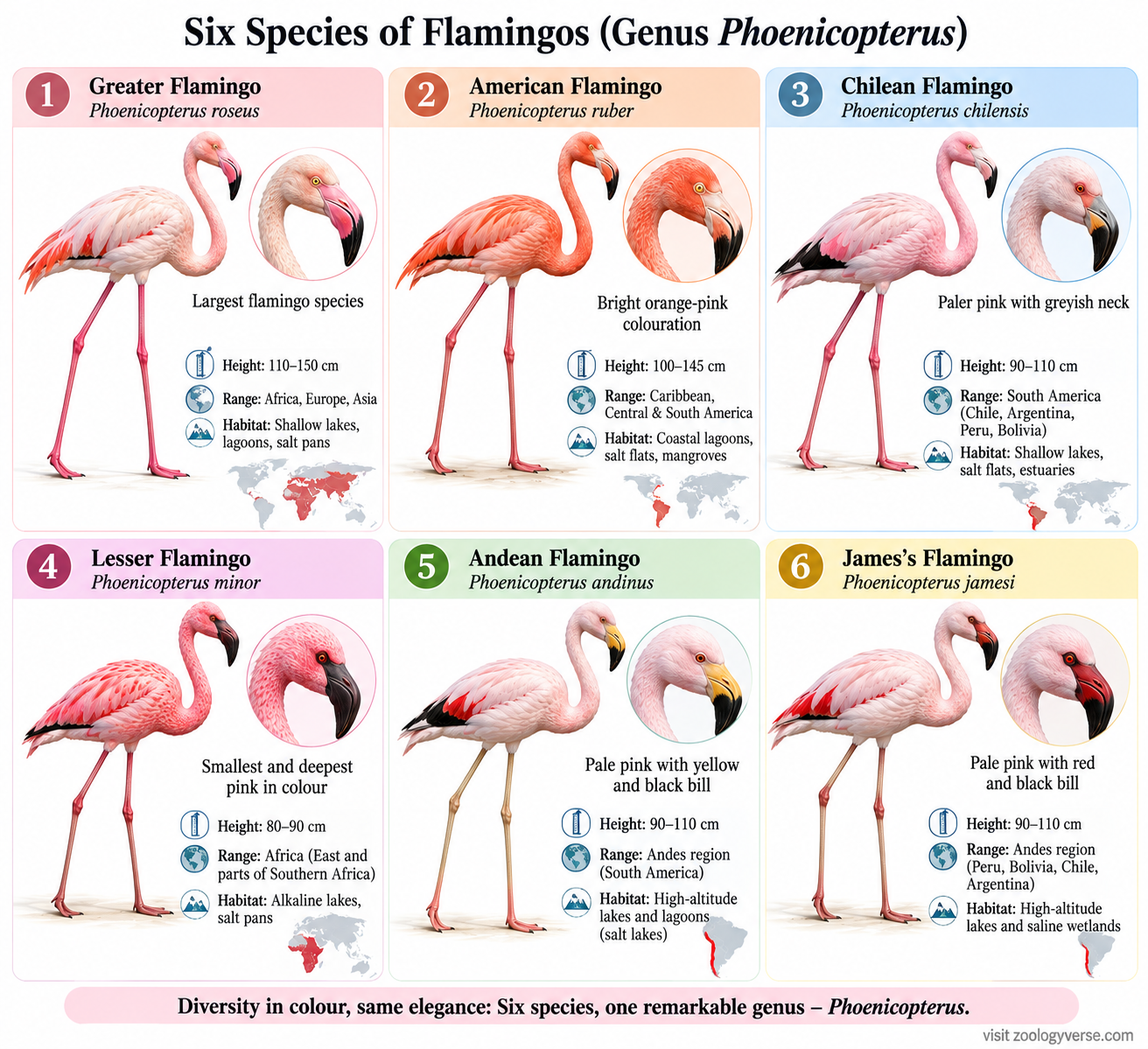
Species of Flamingos
| Scientific name | Common name |
|---|---|
| Phoenicopterus roseus | Greater flamingo |
| Phoenicopterus ruber | American flamingo |
| Phoenicopterus chilensis | Chilean flamingo |
| Phoeniconaias minor | Lesser flamingo |
| Phoenicoparrus andinus | Andean flamingo |
| Phoenicoparrus jamesi | James’s flamingo |
Where Do Flamingos Live?
Flamingos are associated mainly with shallow aquatic habitats such as lakes, lagoons, estuaries, mudflats and other wetlands. Different species occupy different geographical regions, ranging from tropical and subtropical areas to temperate regions. Some flamingo species are also adapted to high-altitude wetlands in the Andes.
These habitats provide suitable feeding grounds because shallow water and soft sediments contain algae and small aquatic organisms that form an important part of the flamingo diet. Wetland conditions also provide suitable areas for breeding and social activity.
| Habitat | Importance |
|---|---|
| Shallow lakes | Feeding and resting |
| Lagoons | Feeding and breeding |
| Mudflats | Foraging for food |
| Estuaries and coastal wetlands | Feeding and movement |
| High-altitude lakes | Important habitat for some South American species |
Flamingo Behaviour
Flamingos are highly social birds and are commonly seen in groups or large colonies. Group living is particularly important during feeding and breeding.
Flamingos communicate through a variety of vocalizations and visual displays, especially during social and reproductive activities.
They spend considerable time feeding in shallow water and may also rest while standing on one or both legs. Their social behaviour, feeding movements and characteristic postures make them distinctive among wetland birds.
- Social behaviour: Usually occurs in groups or colonies.
- Feeding behaviour: Feeds in shallow water and wet sediments.
- Communication: Uses vocal and visual signals.
- Resting: May rest while standing on one or both legs.
- Breeding behaviour: Forms breeding colonies and performs courtship displays.
Reproduction in Flamingos
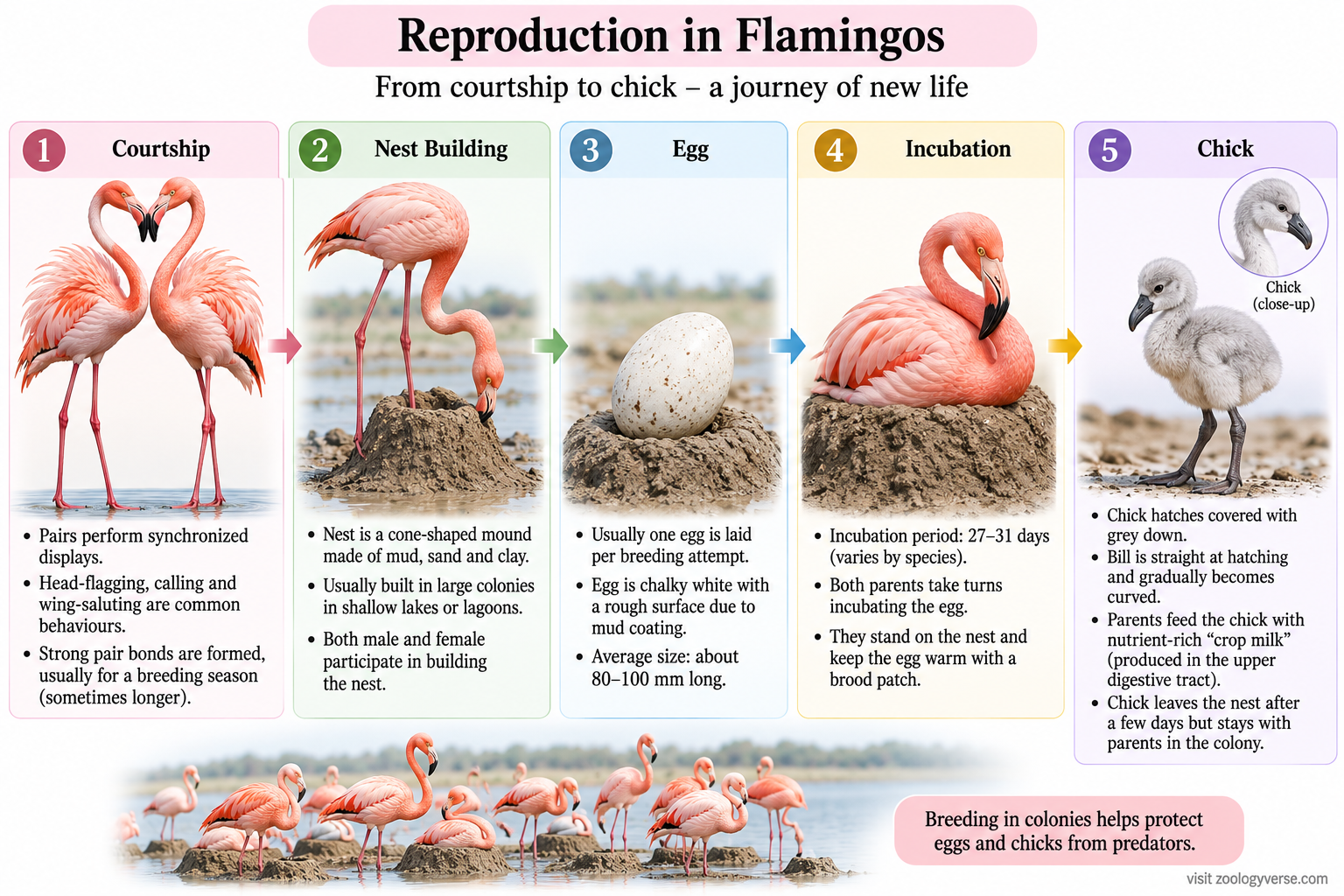
Flamingos generally breed in colonies, often in wetlands where suitable nesting sites and food are available. During the breeding season, adults perform characteristic courtship displays involving coordinated movements, postures and vocalizations.
The nest is usually a mud structure built in shallow water or on exposed wetland areas. A flamingo generally lays a single egg, and both parents participate in incubation and care of the young. The chick initially has a straight bill, which gradually develops the characteristic curved shape as it grows.
Successful reproduction depends on suitable wetland conditions, including appropriate water levels, food availability and relatively undisturbed nesting areas.
Conservation Status of Flamingos
The conservation status of flamingos varies among species. Their populations can be affected by wetland degradation, changes in water availability, pollution, disturbance of breeding sites and other environmental pressures.
Because conservation status is assessed at the species level, individual flamingo species should be considered separately rather than assigning one status to the entire genus Phoenicopterus or family Phoenicopteridae.
Protection of wetlands, maintenance of suitable water conditions and protection of important feeding and breeding areas are important for flamingo conservation.
| Flamingo species | Conservation status* |
|---|---|
| Phoenicopterus roseus | Least Concern |
| Phoenicopterus ruber | Least Concern |
| Phoenicopterus chilensis | Near Threatened |
| Phoeniconaias minor | Near Threatened |
| Phoenicoparrus andinus | Vulnerable |
| Phoenicoparrus jamesi | Near Threatened |
Conservation categories can change as assessments are updated. Check the current IUCN Red List assessment for the latest status of each species.
Frequently Asked Questions
Why are flamingos pink?
Flamingos develop their characteristic pink to reddish coloration from carotenoid pigments obtained through their diet, particularly from algae and small aquatic organisms.
What do flamingos eat?
Flamingos are filter feeders that consume algae and small aquatic organisms, including small crustaceans and other invertebrates. Their specialized bills help them filter food from water and wet sediments.
Where do flamingos live?
Flamingos occur mainly in wetlands such as shallow lakes, lagoons, mudflats and other suitable aquatic habitats. Different species occupy different geographical regions.
Why do flamingos stand on one leg?
Flamingos commonly rest while standing on one leg. Their leg and joint anatomy allows this posture with relatively little muscular effort; explanations involving energy conservation and thermoregulation have also been proposed.
Can flamingos fly?
Yes. Flamingos are capable of flight and can travel considerable distances between suitable feeding, breeding and resting areas.
How many species of flamingos are there?
There are six living flamingo species recognized within the family Phoenicopteridae, distributed among three genera: Phoenicopterus, Phoeniconaias and Phoenicoparrus.
What is the scientific name of a flamingo?
“Flamingo” refers to several species rather than one species. The genus Phoenicopterus includes the Greater, American and Chilean flamingos.
How long do flamingos live?
Flamingos can live for several decades. Reported lifespan varies according to species and whether the bird is living in the wild or under human care.
Are flamingos endangered?
Not all flamingo species have the same conservation status. Their conservation status is assessed individually, and some species are listed as threatened or near threatened while others have lower-risk classifications.
How do flamingos feed?
Flamingos use their specialized bills as filtering structures. They take in water containing food particles and use structures inside the bill to separate suitable food from the water.
Recommended Study Resource
Practical Zoology Vertebrate 12/Ed
by Ss Lal (Author)
Rastogi Publications MODERN TEXT BOOK OF ZOOLOGY: VERTEBRATES (Z-3)
by Prof. R. L. Kotpal (Author)
As an Amazon Associate I earn from qualifying purchases.
References
- Animal Diversity Web — Phoenicopteridae
- Animal Diversity Web — Phoenicopterus roseus
- Animal Diversity Web — Phoenicopterus chilensis
- IUCN SSC Flamingo Specialist Group
Discover more from Zoologyverse
Subscribe to get the latest posts sent to your email.