
The genus Salamandra comprises terrestrial salamanders found mainly in Europe, parts of North Africa, and Asia. Species like the fire salamander (Salamandra salamandra) are among the most well-known. These amphibians are notable for their striking coloration and role in their ecosystems.
Classification of Salamandra (Fire Salamander)
- Phylum :- Chordata (Dorsal tubular nerve cord, notochord and gill-slits present.)
- Group :- Craniata (Definite head, Cranium with brain present.)
- Sub phylum :- Vertebrata (Vertebral column present.)
- Division :- Gnathostomata (Jaws and paired appendages present.)
- Super Class :- Tetrapoda (Paired limbs, lungs, cornified skin and bony skeleton.)
- Class :- Amphibia (Cold blooded. Scaleless glandular skin. Can live in water and land. Two occipital condyles, Heart three chambered)
- Order :- Urodela (Scaleless Amphibia having well developed tail, generally with two limbs, with or without external gills and gill-slits in adults.)
- Family :- Salamandroidea (Adults without gills. Lungs present)
- Genus :- Salamandra
Geographical distribution
- Salamandra is distributed in Europe, Eastern Asia and North America. Eocene to Recent.
Habit and habitat
- Terrestrial Salamandra commonly found under logs, stones, cracks and crevices of the old walls.
General Characteristics of Salamandra
- Commonly known as fire salamander.
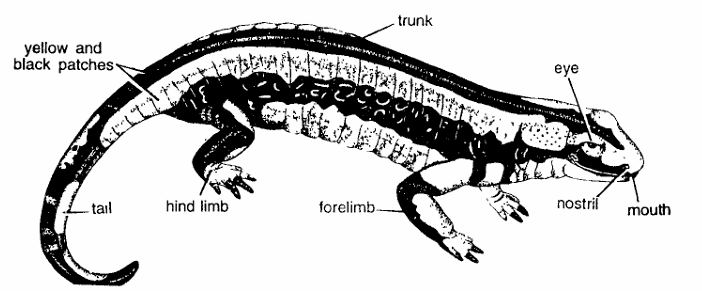
- Animal lizard like. Males measuring 12 to 15 em in length. Females longer than males.
- Body divisible into head, trunk and tail.
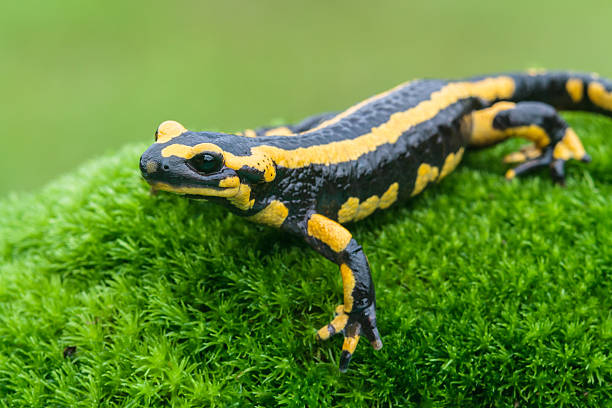
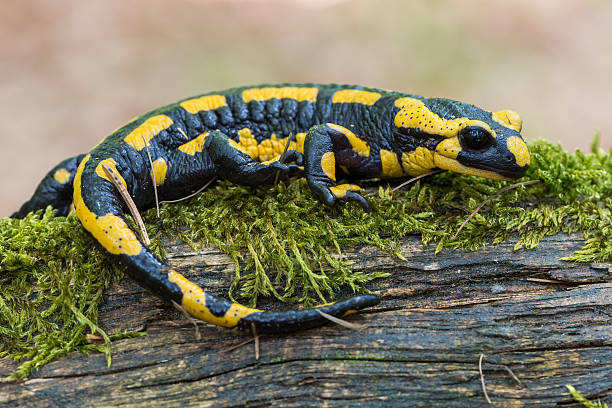
- Body coloured brilliantly black with irregular patches of yellow on back and limbs.
- Forelimbs and hind limbs well developed and lift the body well above ground.
- Head contains mouth prominent eyes and nostrils. Eyes are provided with movable eyelids.
- The large paratoid glands are present behind the head.
- Tooth-bearing extensions of prevomers along parasphenoids present.
- Lungs present. Gills and gill clefts are absent in adults.
- Vertebrae opisthocoelus. Inter-auricular septum perforated.
Ecological Importance
- Pest Control:
- Salamanders feed on a variety of invertebrates, including insects, worms, and slugs, helping control pest populations.
- Prey and Predator Role:
- They are both predators of smaller organisms and prey for birds, snakes, and mammals, contributing to the food web.
- Soil Health:
- Salamanders often burrow or hide in moist environments, contributing to soil aeration and organic matter cycling.
- Ecosystem Indicators:
- Being highly sensitive to environmental changes, salamanders are indicators of ecosystem health, particularly in forested and riparian zones.
Conservation Status of Salamandra
- General Status:
- Many Salamandra species are listed as Least Concern by the IUCN; however, specific populations face threats due to habitat loss, climate change, pollution, and disease (e.g., chytrid fungus).
- Threats:
- Habitat Loss: Urbanization, deforestation, and land-use changes reduce their habitat.
- Pollution: Agricultural runoff and chemical pollutants harm salamanders and their habitats.
- Climate Change: Altered precipitation patterns and rising temperatures affect breeding cycles and habitat suitability.
- Disease: Pathogens like Batrachochytrium salamandrivorans (Bsal) pose significant risks to salamander populations globally.
- Conservation Efforts:
- Protecting forests and riparian habitats.
- Monitoring and mitigating the spread of diseases like chytrid fungus.
- Raising awareness about their ecological role and the importance of conservation.
Special features
- Tail is without tail fin. Body is spotted all over. Some forms like S. maculosa are viviparous. The eggs develop in oviducts. Larva has gills which are sqed before hatching.
- Bright Warning Coloration:
- Salamanders, such as the fire salamander, display aposematic (warning) colors like black and yellow to signal toxicity to predators.
- Toxin Production:
- They produce skin secretions containing toxins (e.g., alkaloids) for defense against predators.
- Moisture-Dependent Skin:
- Their permeable skin requires moist environments for respiration and survival.
- Live Birth (Viviparity):
- Some species within the genus give birth to live young, an adaptation for survival in specific environments.
- Long Lifespan:
- Salamanders can live for several years, with some species reaching over 20 years in the wild.
Identification
- Since this urodele has brilliantly coloured body and above features, hence it is fire salamandra.
Discover more from Zoologyverse
Subscribe to get the latest posts sent to your email.