
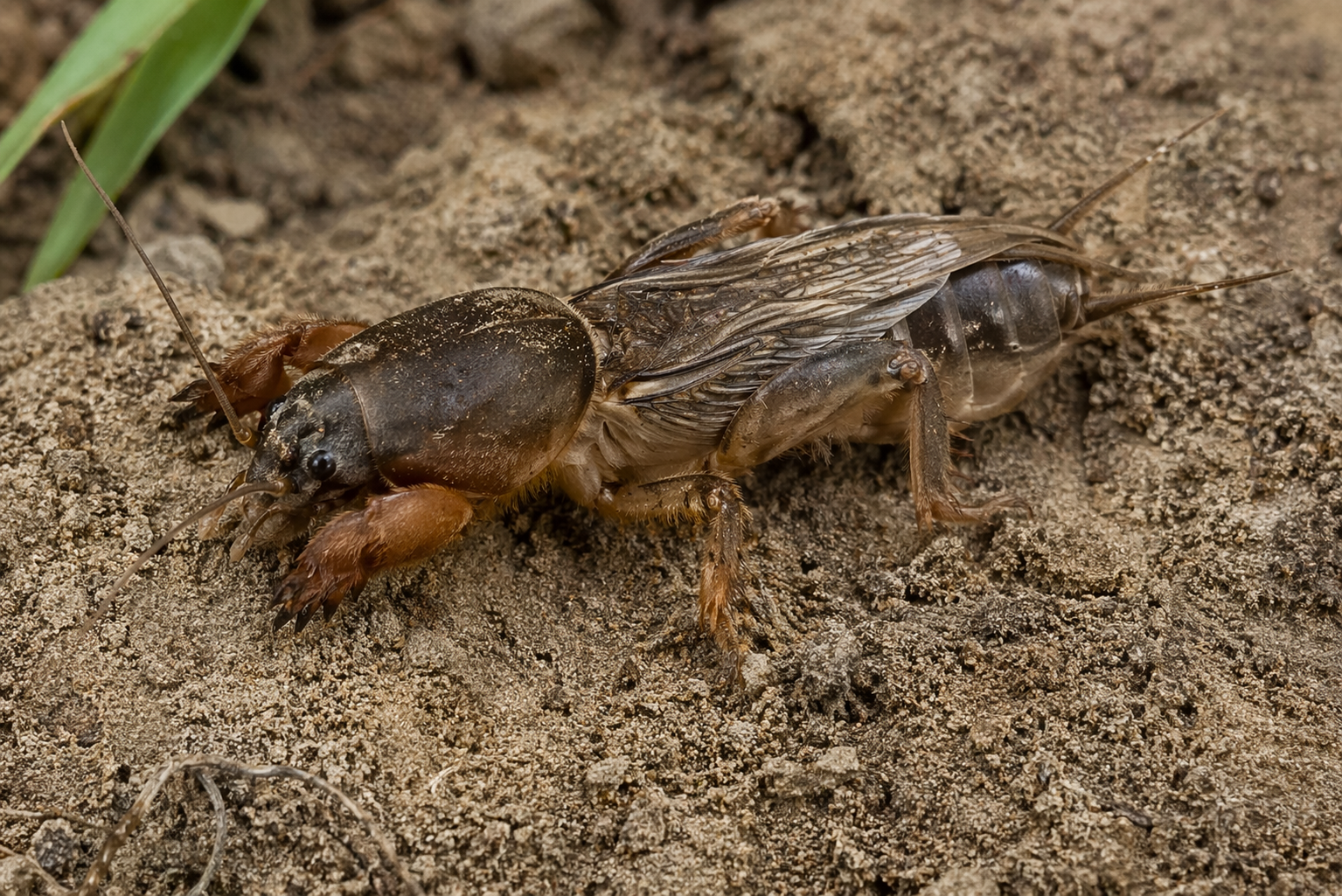
Gryllotalpa is an omnivore species. The mole cricket digs underground and feeds on insects, plant roots, and larvae. It only surfaces at night, primarily during the mating season. It can also fly when females are looking for males or when they are shifting their territory. Males use chirping to summon females. In certain areas, this cricket is regarded as a pest.
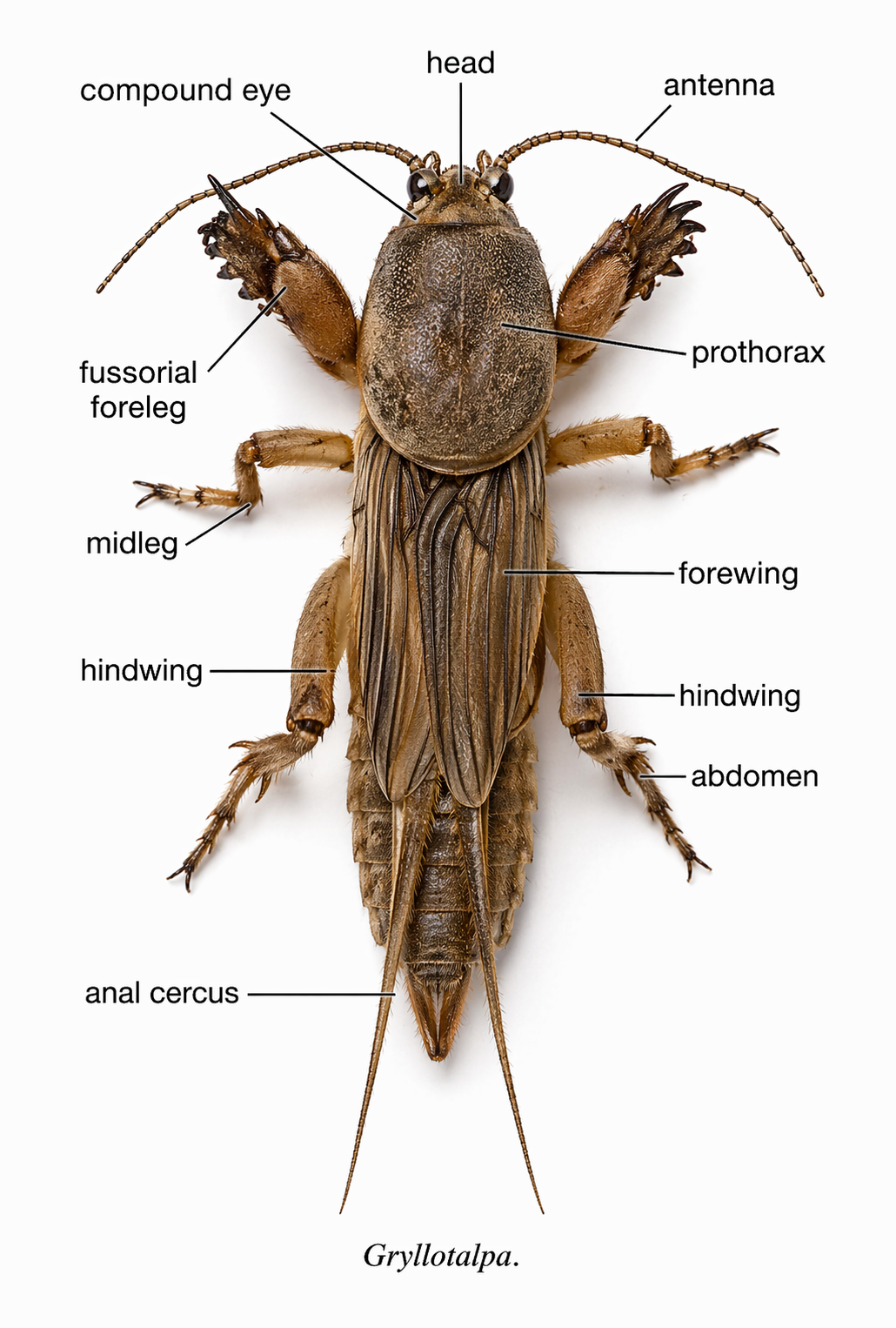
Classification of Gryllotalpa
Phylum – Arthropoda (Jointed Appendages)
Class – Insecta (3 pairs of legs.)
Sub-class – Pterygota (Winged insects.)
Division – Exopterygota (Wings develop externally.)
Order – Orthoptera (Straight wings.)
Genus – Gryllotalpa
Habit and habitat
Gryllotalpa is commonly found in fields near ponds burrowing in soil. It is subterranean. It is carnivorous feeding on small insects.
Distribution
Gryllotalpa africana is widespread over Indian plains, lower hills, warmer parts of Asia and Europe. G. vulgaris is found in Himalayas, Europe, Egypt and U.S.A.
Comments on Gryllotalpa
- Commonly called as the mole cricket.
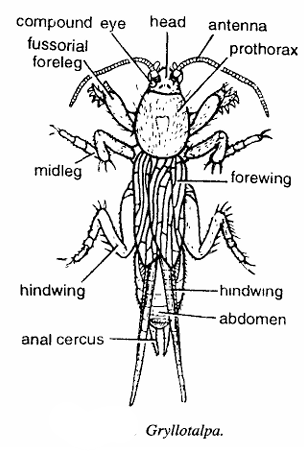
- Body is covered with short fine hairs and is differentiated into head, thorax and abdomen.
- Head contains a pair of compound eyes and a pair of antennae. Mouth parts are of biting and chewing type.
- Forelegs are modified for digging and are called as fossorial legs.
- These legs are broad and are provided with stout spines adapted for digging.
- By digging and pressing the hard head and prothorax through the soil and then the soft abdomen and weaker posterior legs follow.
- Middle legs and hind legs are elongated. There are two pairs of wings.
- Forewings are short while hind pair large and membranous and have well developed anal field.
- Hind wings extend backwards and appears as slender processes beyond the tegmina when at rest.
- A pair of unsegmented anal cerci at the end of abdomen of male and ovipositor in female well developed.
- Stridulating (sound producing) organs and auditory (hearing) organs.
Economic Status
Mole crickets are also agricultural pests causing damage to the cultivated crops. In search of food about 20 feet deep, mole cricket burrows through the soil and it destroys the roots of the plants.
Identification
Since the insect contains fussorid legs and all above characters hence it is Gryllotalpa
See other posts also
- Schistocerca (Locust)
- Pinctada vulgaris
- ORGANIZATION OF COELOM
- Larval Forms in Echinodermata
- Larval Forms of Crustaceans
Discover more from Zoologyverse
Subscribe to get the latest posts sent to your email.