
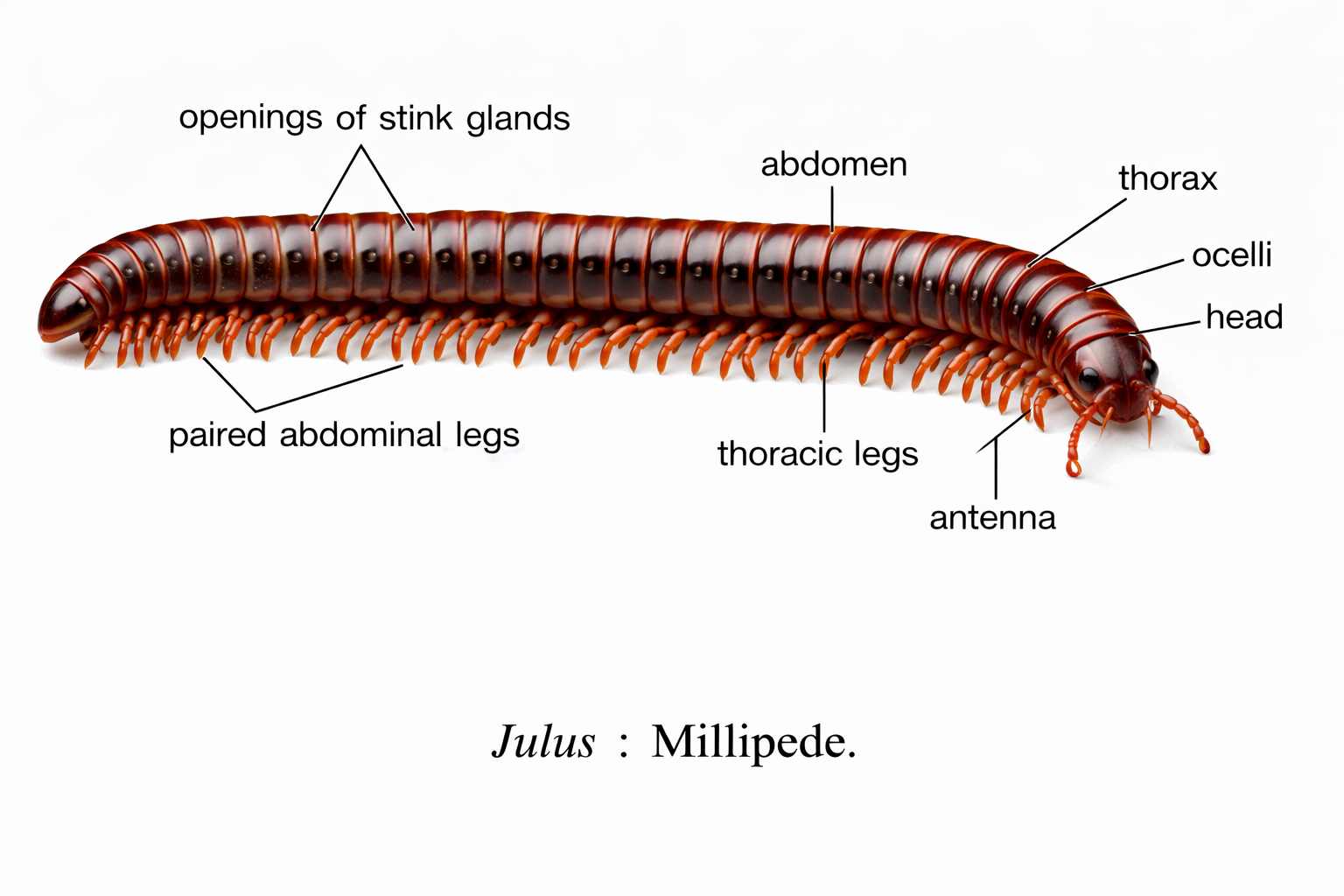
The class Diplopoda, which derives its name from the Latin mille, which means “thousand,” and pes, which means “foot,” is the formal term for the group of arthropods known as Julus (millipedes). They are distinguished by having two pairs of jointed legs on the majority of their body segments. Two single segments are fused together to form each double-legged segment. Pill millipedes are shorter and have the ability to roll into a tight ball, whereas the majority of millipedes have very long cylindrical or flattened bodies with over 20 segments. Despite the fact that the word “millipede” comes from the Latin for “thousand feet,” no species was known to have 1,000 or more until Eumillipes persephone, which can have over 1,300 legs, was discovered in 2020.
Classification of Julus (millipede)
| Phylum | Arthropoda | Jointed appendages |
| Sub-phylum | Myriapoda | containing arthropods such as millipedes and centipedes. |
| Class | Diplopoda | two pairs of jointed legs on most body segments |
| Order | Julida | small and cylindrical, typically ranging from 10–120 millimetres (0.39–4.72 in) in length. |
| Family | Julidae | containing more than 600 species in around 20 genera |
| Genus | Julus | millipede |
Habit and habitat
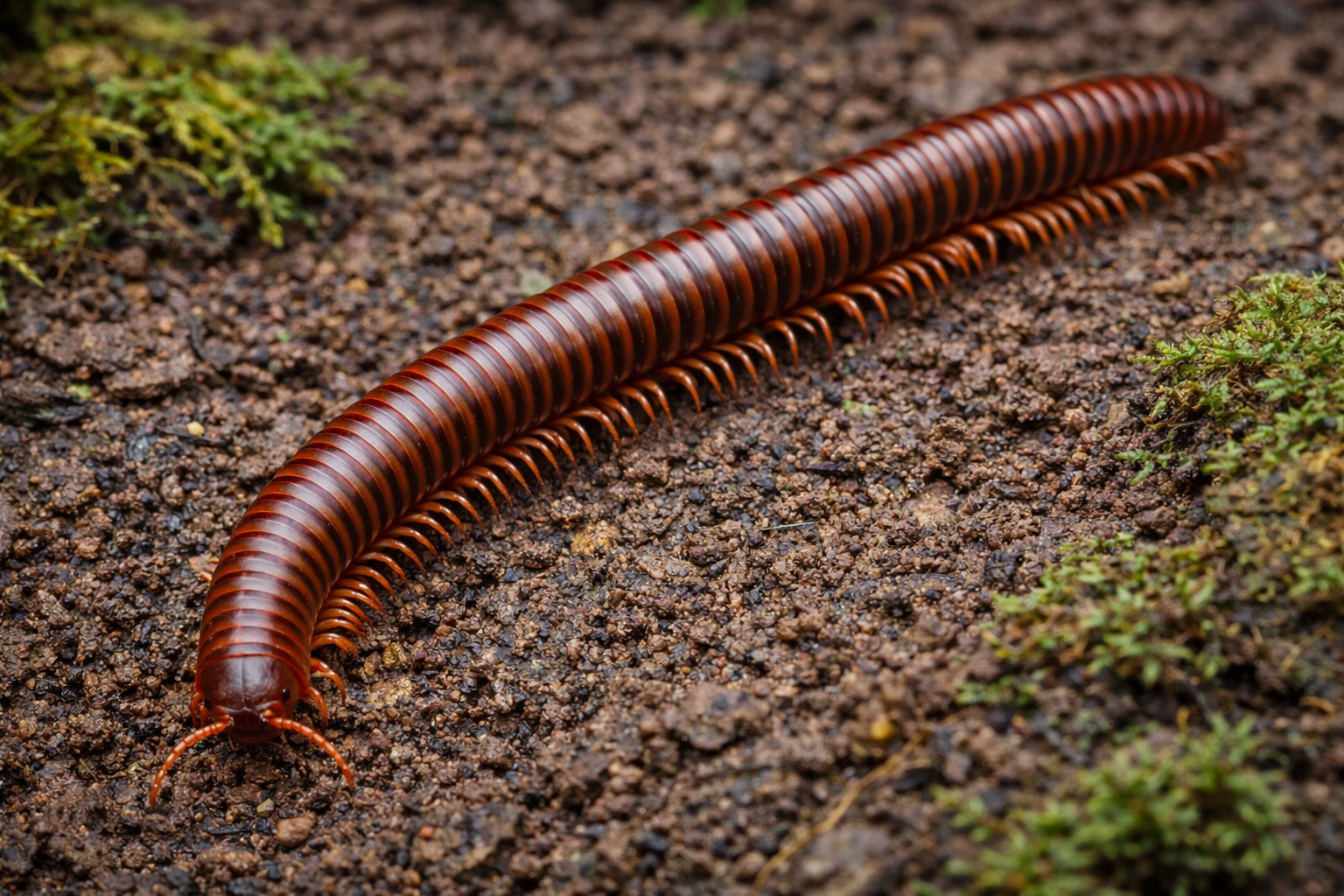
julus is also tropical, found in dark and damp places in meadows and gardens under stones and bark of dead trees. The animal is rolled up under stones. It is herbivorous. It also burrows into the soil to feed on the roots of the living plants to which it causes great damage.
Distribution
It has cosmopolitan distribution found in India, U.S.A. and Europe.
Comments on Julus (millipede)
- Commonly called as wire worm.
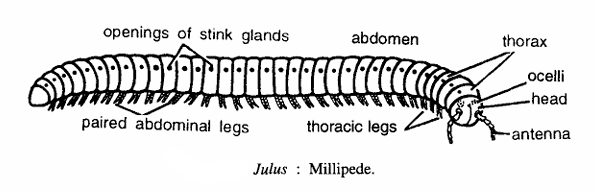
- Body of the animal is differentiated into head, thorax and abdomen. Head is covered by cephalic shields bent downwards.
- Head appendages are 7 jointed delicate antennae, groups of ocelli, mandibles, obscured by gnathochilarium.
- Antennae on the sides of the head.
- Thorax has four segments and each of the last three segments is provided with one pair of walking legs.
- Abdominal segments are double, each having one tergum, two small sterna, two pairs of walking legs and two pairs of obscure spiracles.
- Sides of most terga have dark openings of odoriferous glands, secreting noxious substance.
- Animal moves very slow in spite of its so many legs.
- The colour may be yellowish brown or reddish-chestnut.
- There is no tracheal system.
Identification
Since the specimen contains two pairs of short legs and all above features hence it is Julus.
See other posts Also
- What is Taxonomic Hierarchy?
- Crayfish vs Lobster : Differences Explained
- Palaemon malcolmsonii
- Octopus
- Doris (Sea Slugs)
Discover more from Zoologyverse
Subscribe to get the latest posts sent to your email.