
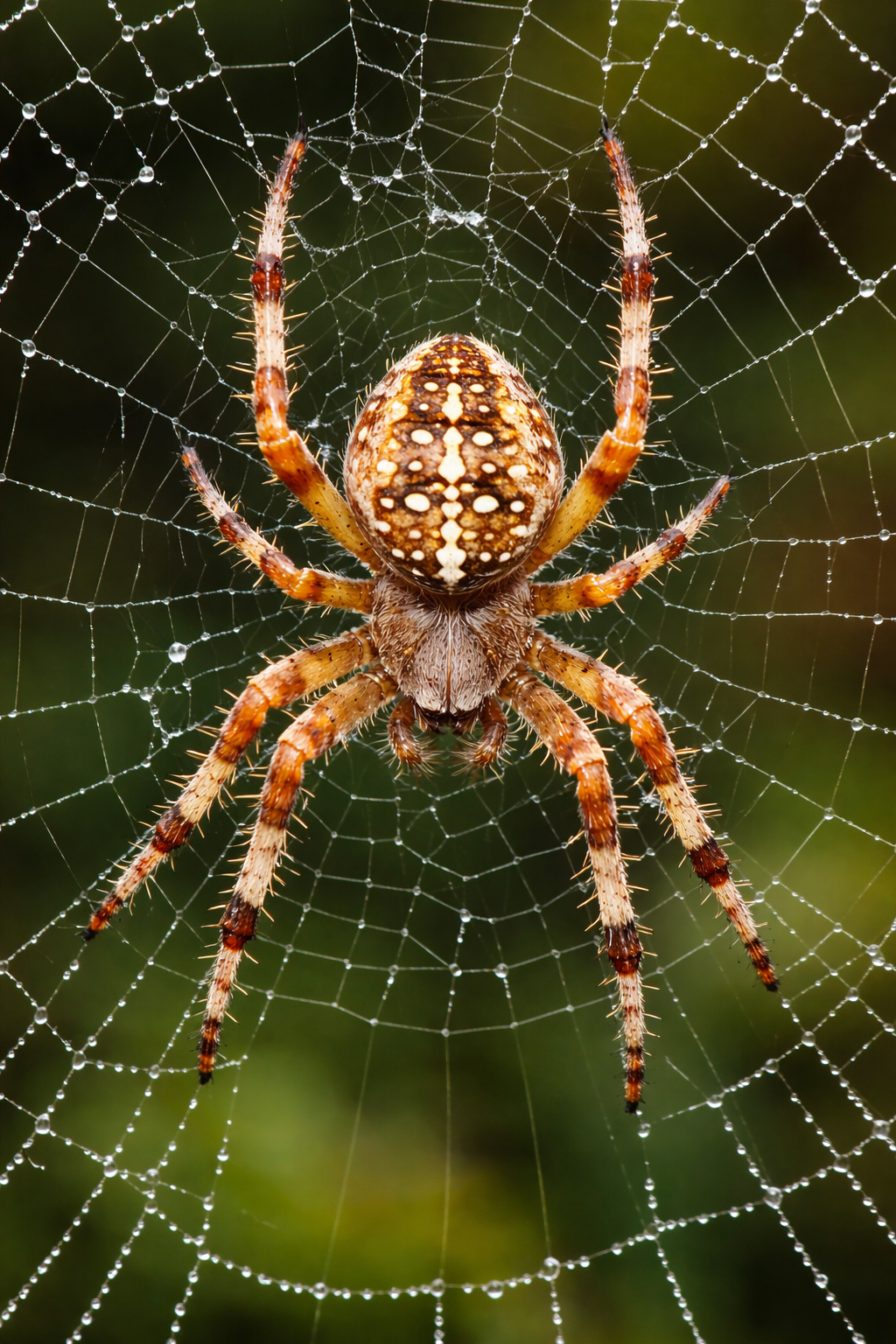
Male spiders (Araneus) in this genus are typically 1⁄3 to 1⁄4 the size of females, making them possibly the most blatant example of sexual dimorphism in the whole orb-weaver family. For instance, last-molt females in A. diadematus can develop up to 1 in (2.5 cm) in body size, whereas most males rarely grow past 0.3 in (1 cm), both discounting leg span. Longer legs, a considerably smaller and more elongated belly, and the incapacity to capture or eat animals larger than themselves are characteristics that set males apart from females.
The epigyne’s scape, or tongue-like appendage, is lengthy in females. The terminal apophysis of male pedipalps resembles a hook. There are anterolateral abdominal tubercles.
Classifciation of Araneus
| Phylum | Arthropoda | Jointed appendages. |
| Class | Arachnida | Terrestrial or aquatic arthropods with book-lungs or trachea and without antennae mandibles and jaws. |
| Order | Araneae | Embolo branchiates in which prosoma possesses 2 jointed non-chelate chelicerae and non-chelate pedipalps. |
| Genus | Araneus | orb-weaving spiders |
Habit and habitat
Aranea is commonly found in houses and gardens having cosmopolitan distribution. It is carnivorous, feeding on small insects by hunting or in ensnaring.
Distribution
It is found in India, Africa, New Zealand, Myanmar, Bangladesh and U.S.A.
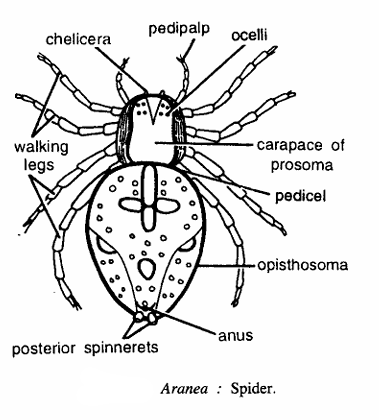
Comments on Araneus
- Commonly called as orb-weaving spiders.
- Integument is never entirely smooth and glabrous but is more or less densely covered with hairs of many varieties, there being simple, plumose, or in the shape of bristles, scales, clubs or spines.
- Body is differentiated into an anterior prosoma and a posterior opisthosoma which is superficially limbless.
- They are often brightly coloured. chelicera pedipalp posterior spinnerets
- Prosoma and opisthosoma are joined narrow pedicel. Prosoma is covered having 8 ocelli and appendages.
- Head appendages are sub-chelate small chelicerae containing poison glands and six jointed pedipalps.
- Segments 4 to 7 bear walking legs. Opisthosoma is segmented, soft, rounded and without telson.
- Last part of opisthosoma contains anus and 4 pairs of spinnerets spinning organs, which produce silken threads for the construction of spider web.
- Respiratory organs are book-lungs. Excretory organs are malpighian tubules and coxal glands.
- Sexes are separate with distinct sexual dimorphism.
Special features
The spiders construct webs of various types, reticular webs, sheet webs, funnel webs and geometric orb webs. Some spiders are vagabonds and make silk tents only for their protection while moulting or for wintering. Trap door spiders protect the mouth of their burrows with a hinged door.
Identification
Since the specimen has spinnerets spiniling organs and all above features, hence it is spider.
See other posts also
- MAMMAL SLIDES : RABBIT SLIDES
- Spotted Cuscus (Spilocuscus maculatus)
- Alligator Snapping Turtle (Macrochelys temminckii)
- ACINONYX JUBATUS (CHEETAH)
- Greater Bird-of-Paradise (Paradisaea apoda)
Discover more from Zoologyverse
Subscribe to get the latest posts sent to your email.
Pingback: Pankaj