
Larval Forms in Echinodermata
Larval Forms in Echinodermata. No other group of animals has such complicated metamorphosis in the course of development. Development may be direct or indirect. In direct one, the larval stages are missing while in indirect one, various types of free-swimming larvae are formed. In each class, a few members, are viviparous, that is, they brood their young in a sort of brood pouch on the surface of their body. The development of larva takes place in a typical deuterostomous fashion. In most cases the characteristic free-swimming larvae develop externally which significance. are of great phylogenetic
Echinoderm larva is strikingly bilaterally symmetrical in marked contrast to radially symmetrical adult. It swims about by means of a ciliated band, which may be complicated by a number of short or long slender projection or arms from the body wall. Based upon the nature and position of the arms or their absence, larvae of different classes of Echinodermata may be distinguished. After a free-swimming planktonic existence, the bilateral larva undergoes a metamorphosis, in which the radial symmetry of the adult is developed. In different classes of echinoderms, different types of larvae complete the development
Class 1. Asteroidea
Bipinnaria larva. Two types of development occur in asteroids. The direct type has large, yolky eggs and no free-swimming larval stage. The indirect type has homolecithal eggs with hitle yolk and a free-swimming larval stage. After hatching the larva develops cilia and begins a free-swimming life. The larva feeds on diatoms as an alimentary canal is formed. The presence of powerful ciliary band on the stomodaeal walls helps in feeding. Two lateral longitudinal locomotory ciliated bands develop which connect Infront of mouth, forming a preoral loop and Infront of the anus, to form a preanal loop. Preoral loop later, separates or in some cases develops Independently into an anterior ciliated ring around the body. Three lateral lobes or projections are also developed on each side of the body bordered by ciliary bands. This larva is known as bipinnaria and develops in 2 to 7 days.
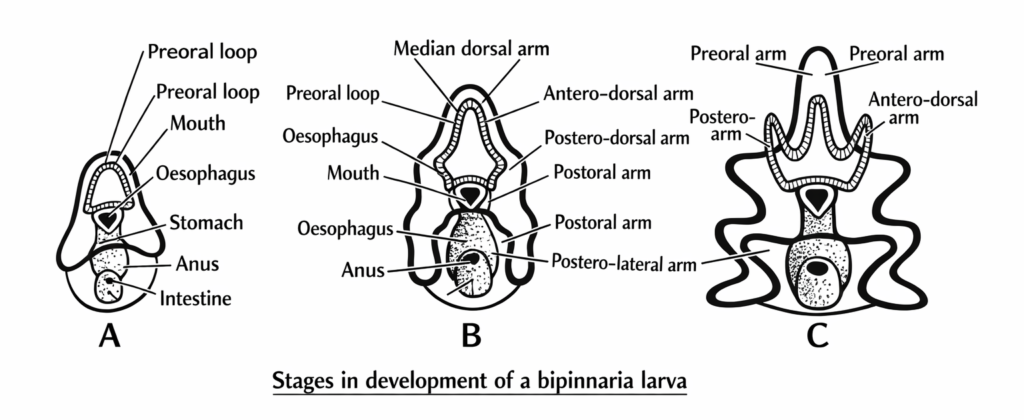
Internal development of bipinnaria. Tip of larval archenteron forms the mesenchyme and later gives rise to two lateral pouches which connect anteriorly to form a U-shaped coelom. Posterior ends of the lateral pouches pinch off to form right and left somateocoels. Remaining Interior portion represents the hydrocoel and axocoel, but they never separate. Left hydrocoel connects with the dorsal surface to form the hydropore, without ectodermal invagination. Ventrally an ectodermal invagination meets the archenteron and the larval gut is differentiated into mouth, oesophagus, stomach and intestine. Blastopore remains as larval anus. Right stomatocoel and axohydrocoel get reduced in metamorphosis, while left axohydrocoel gives rise water ring and radial canals. Axocoel separates from hydrocoel and contributes to stonecanal. Madreporite or dorsal sac originates either from rearrangement of mesenchyme cells or from ectodermal invagination or from right axohydrocoel. Bipinnaria larva, after free-swimming existence for a few weeks, changes to next larval stage, called brachiolaria larva.
Brachiolaria larva. Bipinnaria transforms to brachiolaria larva which develops three short arms at preoral lobe, known as brachiolar (one median and two lateral arms). They contain coelomic extensions and adhesive cells at their tips. An adhesive glandular area at their base acts as a sucker. Appearance of the sucker marks the beginning of metamorphosis.
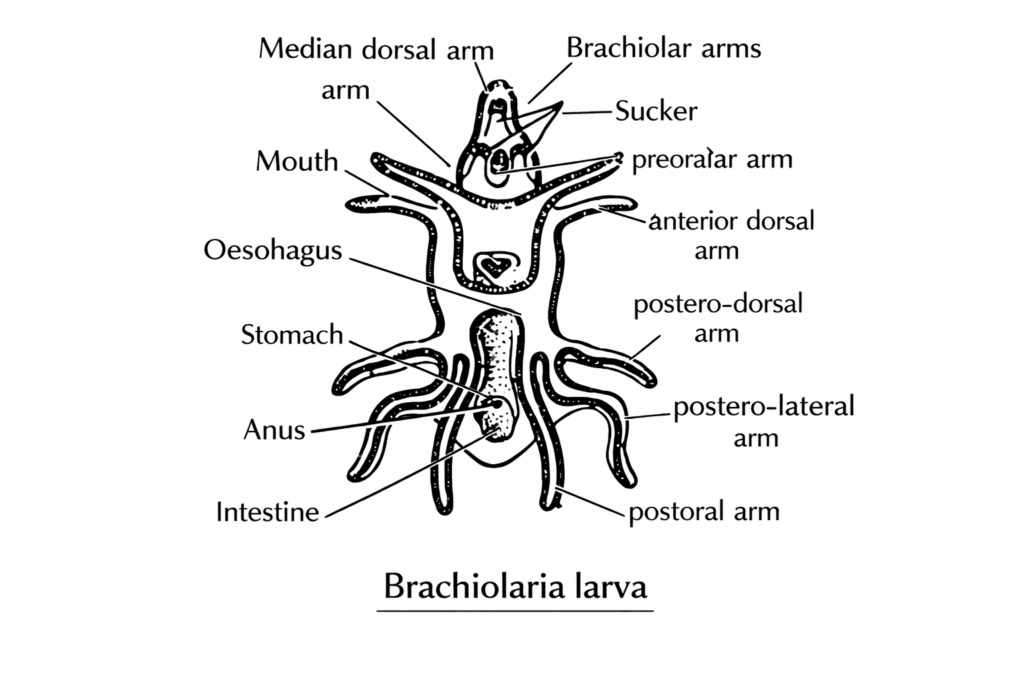
Metamorphosis of brachiolaria. With the help of adhesive structures, it attaches to some object. Anterior region acts as stalk for some time, while posterior part, having gut and coelomic chambers, converts into a young star. This star detaches itself and starts leading a free life.
Some species cut short the development as a result of deletion of some larval stages. In Astro-pecten, the brachiolaria stage is missed with the result bipinnaria directly metamorphosis into adult within 2-3 months. In Asterina gibbosa, bipinnaria stage is omitted, larva develops an adhesive apparatus, as brachiolar arms and sucker, and undergoes metamorphosis. Still in Luidia, a giant and peculiar is formed which is called as bipinnaria asterigeara.
Class II. Ophiuroidea
Ophiopluteus larva. Pluteus is the free-swimming larva in brittle stars which is known as ophiopluteus. It is similar to echinopluteus of echinoids with the only difference that the former has fewer arms than the later. The posterolateral arms are the longest and directed forward. After gastrulation the arms develop gradually. Posterolateral arms are formed first. After 4, 10 and 18 days, anterolateral, postoral and posterodorsal arms develop, respectively. Ciliated bands accompany the arms edges. Internally the larva contains coelomic chambers and archenteron. Internal development proceeds in the same way as in other classes. While free swimming metamorphosis of the larva starts, there being no attachment stage. Tiny serpent star sinks to the bottom to begin its adult existence.
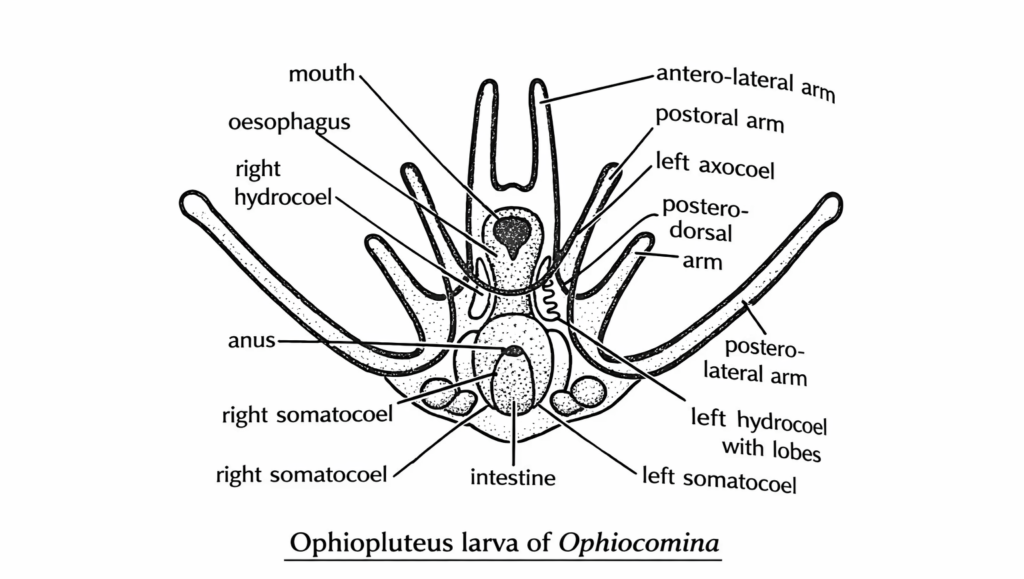
Amphiura vivipara, a viviparous form, omits pluteus stage. development takes place in ovary and the Ophionotus hexactis, aborted pluteus larva is devoid of arms and anus.
Class III. Echinoidea
Echinopluteus larva. Larva is formed after gastrulation. Gastrula becomes conical, one side of which flattens to form the oral surface. Stomodaeal invagination communicates with archenteron and the gut is differentiated into mouth, oesophagus, stomach and intestine. Blastopore remains as larval anus. Larva begins to form projections which develop into arms. There are six arms namely, preoral, anterolateral, anterodorsal, postoral, postero-dorsal posterolateral. Posterolateral arms are very short and directed outwards or backwards. In some cases, anterodorsal arms may also not develop. Thus, a fully developed echinopluteus may have 5 or even 4 pairs of arms instead of usual six. Tips of the arms are pigmented and are supported by calcarcous skeletal Locomotion is by ciliated bands, which in some case become thickened and known as epaulettes. In Arbacia and Cidaris, larva develops special ciliated lobes, between the arm bases known as vibratile lobes, auricular lobes or auricles.
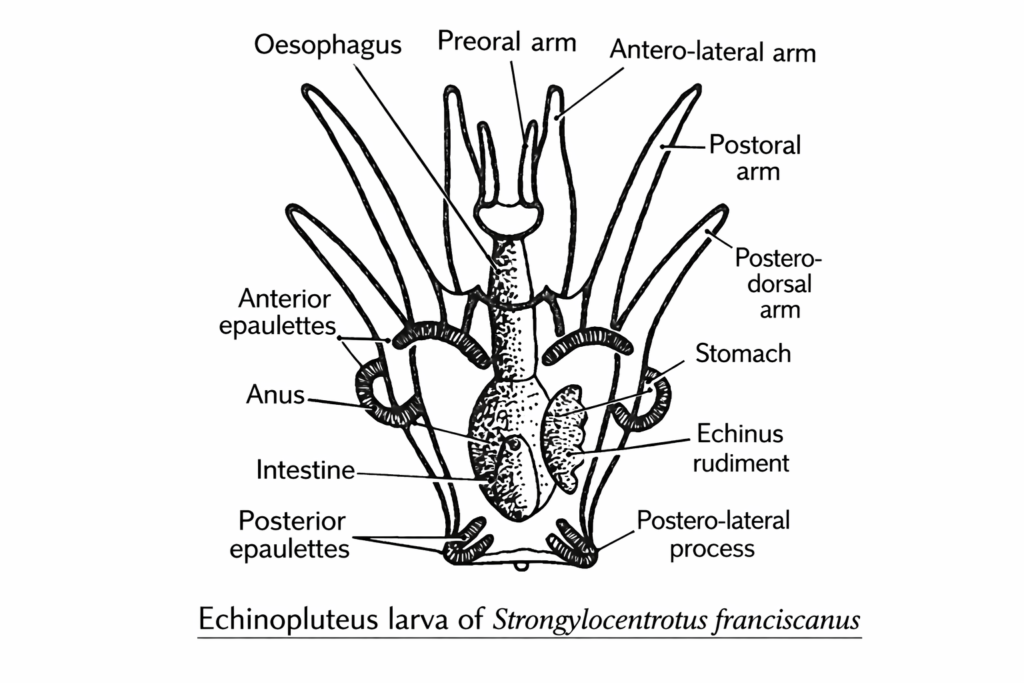
Internal development. Archenteron gives off intero-enteroceols which contribute to axocoels, drocoels and somatocoels. A vestibule is armed by the enlargement of an ectodermal vagination on the left side. Hydrocool and vestibule form the oral side of the adult. Five dial arms and five primary podia are given off the hydrocoel. Lantern is formed from left somatocoel, Echinopluteus is microscopic, free swimming in water and it develops within 7 to 30.
Class IV. Holothuroidea
Auricularia larva. After gastrulation and formation of coelomic sacs and gut, the embryo becomes a free-swimming larva called auricularia larva, within 3 days. It is transparent, pelagic about 0.5 to 1 mm in length. It swims about by a ciliated band which forms preoral loop and oral loop.
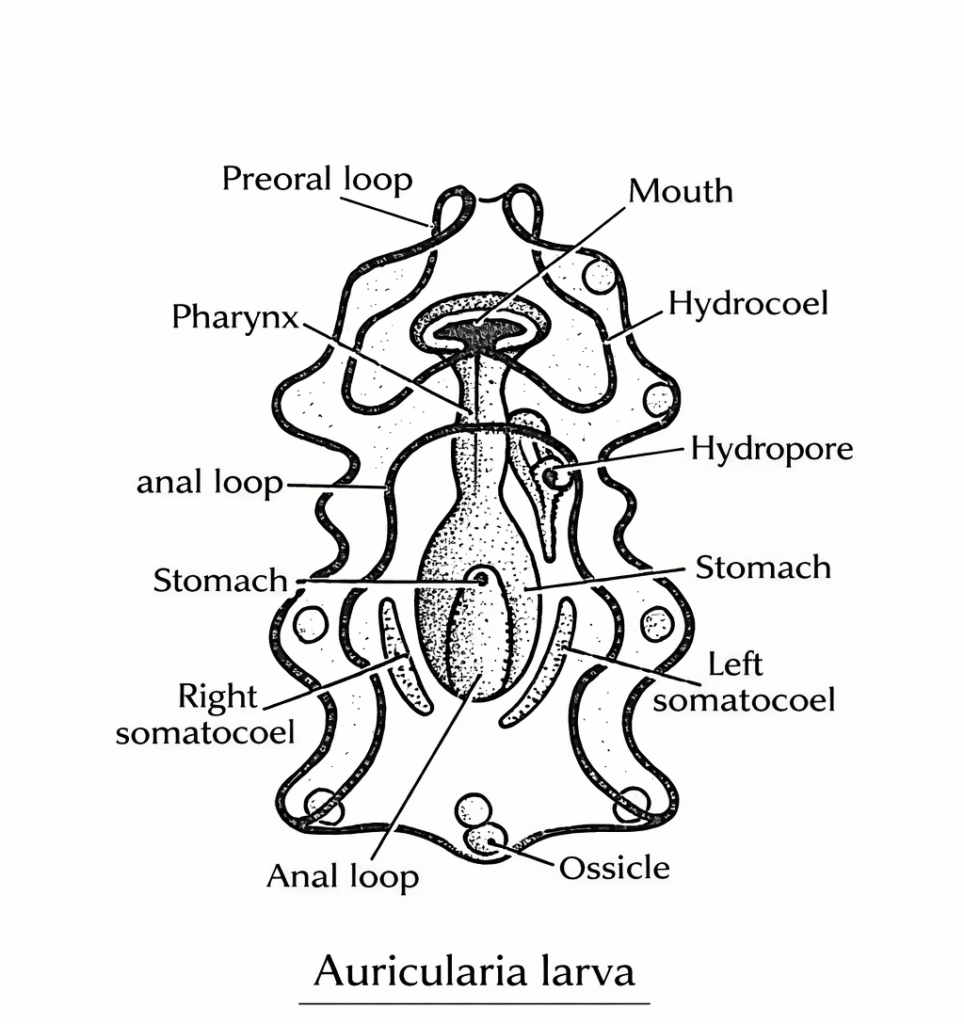
Internally, larva has a curved gut with form stomach, hydrocoel and right and left somatocoels.
Some giant auricularians of unknown adults reported from Bermuda, Japan and Canary Islands measure about 15 mm in length and possess a frilly flagellated band.
Doliolaria larva. It is a transitional stage from auricularia and appeares barrel-shaped and alike doliolaria of crinoids. Continuous ciliated band breaks in 3 to 5 flagellated rings. Mouth is shifted to anterior and anus to posterior pole.
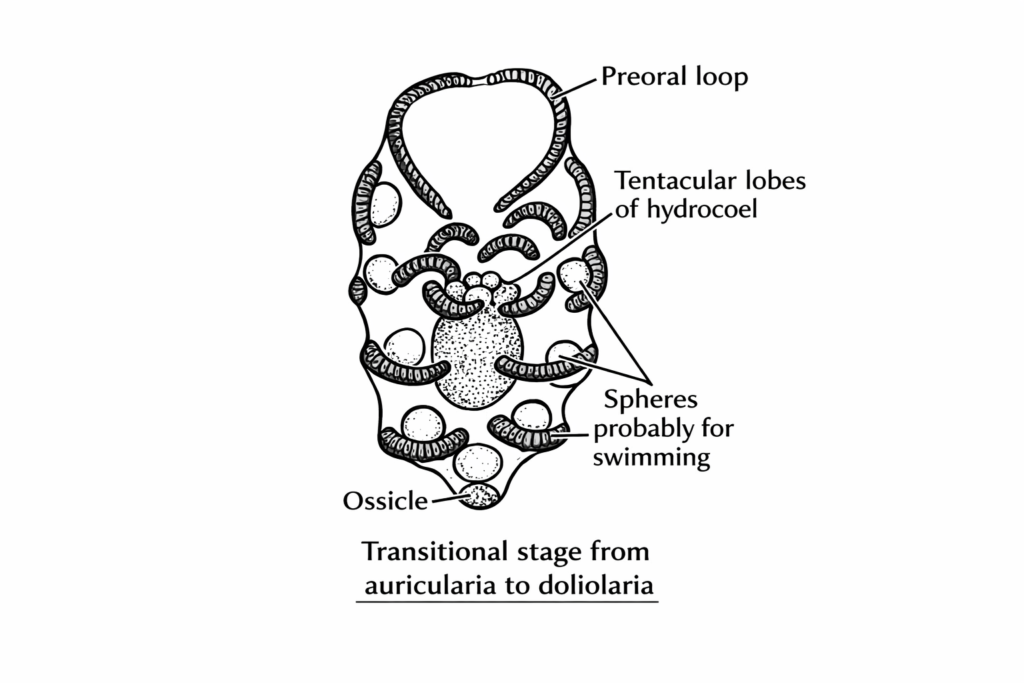
Metamorphosis is gradual during which it requires 5 tentacles and 1 to 2 functional podia. As such it is sometimes known as pentactula. after appearance of more podia and tentacles, sea cucumber settles to the sea bottom and leads in adult mode of life.
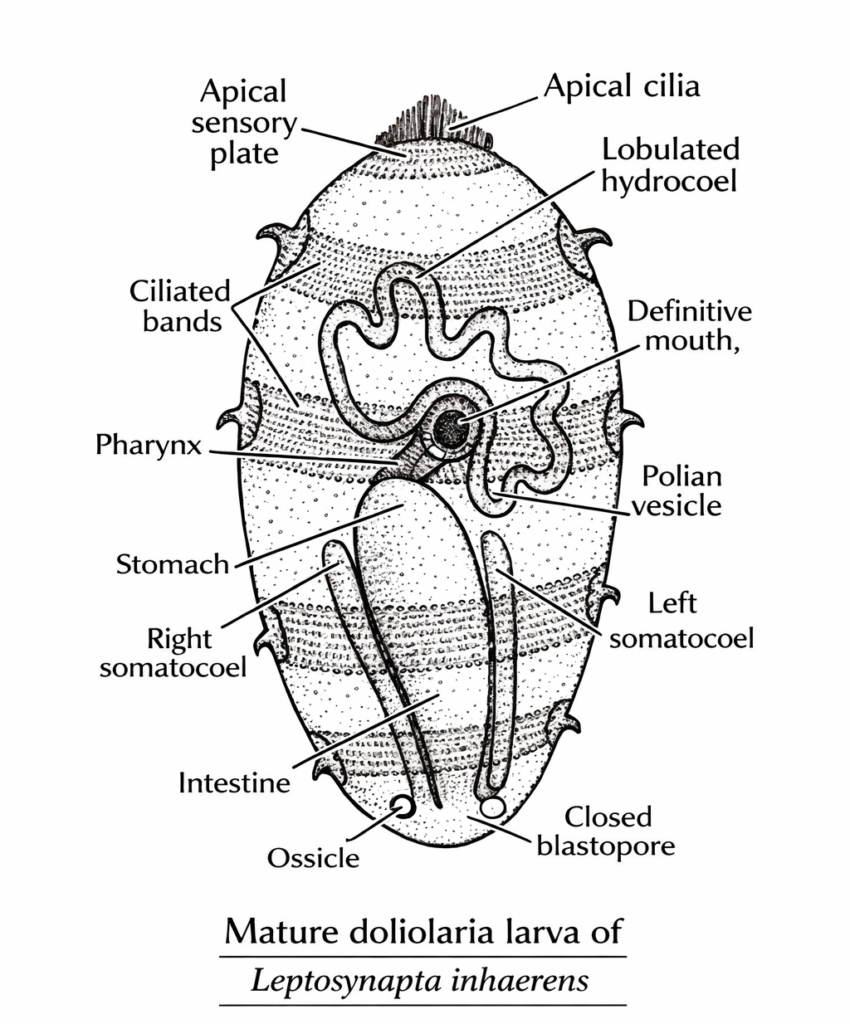
Other forms of this class show marked peculiarities in larval development. In cucumaria planci and C. quinquesemita, etc, there is no auricularia stage and embryo directly develops into dollaria larva. In others like C. saxiola, C. frondosa, both of these larval stages are committed and the larva only swims about having oval ciliated shape. In Holothuria floridana, embryo hatches directly into young.
Class V. Crinoidea
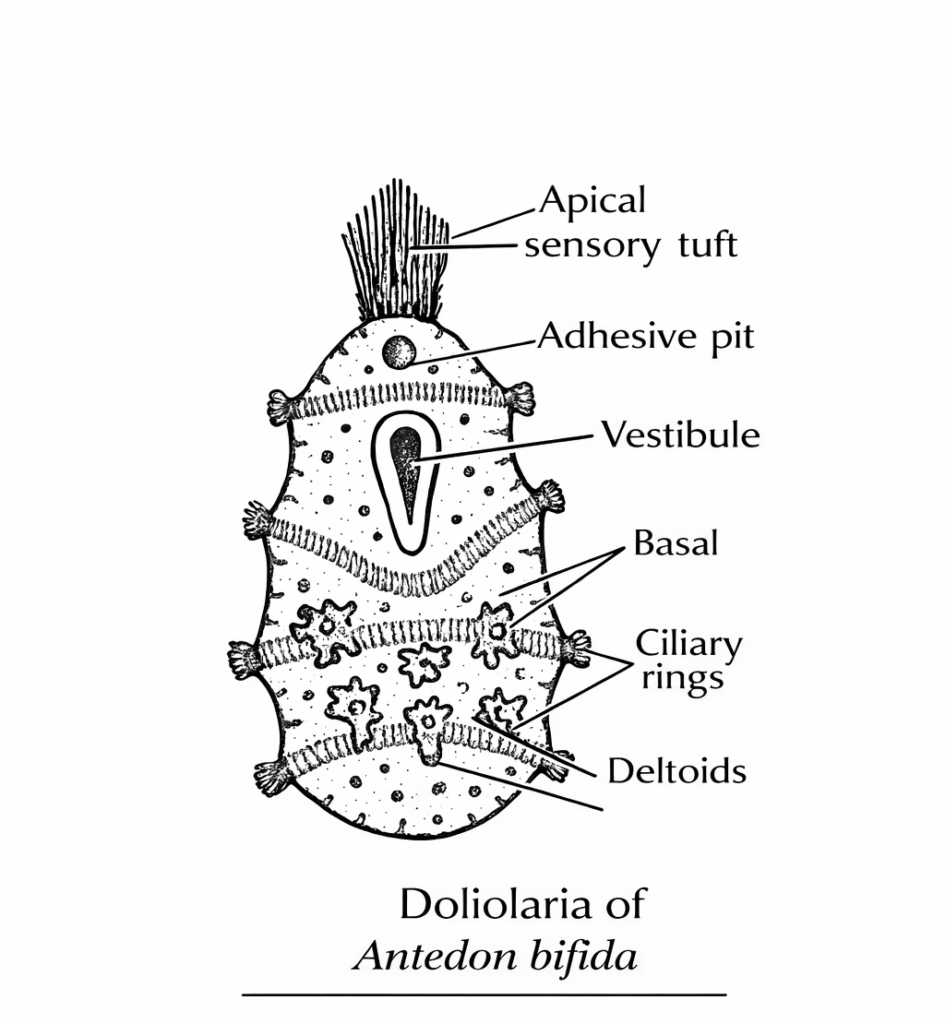
Doliolaria larva. It hatches as a free-swimming larva. Body has 4 to 5 ciliated bands with an apical sensory plate at the anterior end provided with a bunch of cilia. There is an adhesive pit over the first ciliated band, near the apical plate in the mid ventral line. Between second and third ciliated band lics the stomodaeum or vestibule. Skeleton also develops at this larval stage. After the differentiation into prospective organs, larva attaches itself and internal organs rotate at an angle of 90 degrees from ventral posterior position. Larva forms a stalk and is now referred as cystidean or pentacrinoid larva which, after sometime metamorphoses into adult.
Significance of Larval Forms in Echinodermata
Larval Forms in Echinodermata is seen that different classes of echinoderms have somewhat different larvae which differently named. After their study, following significant points can be drawn.
1. Common origin of classes. Except the larva of crinoidea which becomes sedentary, the larvae of rest of the classes have some fundamental resemblances. They are constructed on the same general fundamental plan with bilateral symmetry. They have somewhat flattened body, longitudinally looped ciliated bands, gut and enterococlic coelom. With so many common characters, one may conclude the origin of their respective classes (groups) from a common ancestor which was a coelomate, bilateral and free-swimming. Dipleurula and pentactula larva are two such hypothetic ancestors suggested by zoologists. It is believed that all modern echinoderms have originated from them.
2. Taxonomic affinities. Closely looking at the larval similarities do not indicate taxonomic affinities. Among Eleutherozoa, two well market larval forms occur-(i) Pluteus group is common 10 ophiuroids and echinoids, bilaterally symmetrical with long arms. (ii) Auricularia group, is common to asteroids and holothurians has a winding ciliated band which may be produced into lobes. On the basis of larval similarities ophiuroids should be placed near to and echinoids and asteroids near to holothurians But this is not in agreement with the morphological result palacontological according to which asteroids and Ophiuroids are closely related to cach other while echinoids seem to have followed an entirely independen evolution:
3. Phylogenetic affinities. A survey of larval types throughout echinoderms indicates several examples of close larval resemblances e.g. ophio pluteus and echinopluteus. This must be due to convergent larval evolution. Occurrence of convergence in development is seen among unrelated groups such as Asteroidea, Holothurioidea and Crinoidea. Similarly, larva of closely related forms such as asteroids and ophiuroid, exhibit major differences, which must be due to divergent larval evolution. Occurrence of divergent type of development is seen within related groups (ophiuroidea). Therefore, the larval structures in echinoderms, cannot seen the purpose of determining the phytogenetic affinities in the phylum.
4. Relationship with Chordates. Auricularia larva of Echinodermata and Tornaria larva of some enteropneusts (e.g., Balanoglossus) shows very close and striking similarities. Moreover, cleavage is indeterminate and mesoderm and coelom (enterocoel) have similar origin in echinoderms and lower chordates. Serology also indicates a relationship between the two groups in view of all this and other evidences echinoderms and chordates have been regarded as phylogenetically related groups.
5. Aid in dispersal and feeding. Since the adult echinoderms are somewhat sluggish, their larvae are the main dispersive phase for them. They remain in plankton for sufficient time to he swept from the place of their birth to new areas, or to restock the original areas. In addition to their dispersive function, larvae will aid the species in feeding from a different source from their adults, and thus when food is short larvae and adult will not compete.
See Other Posts Also
- Modern Text Book of Zoology Invertebrates (R.L. Kotpal) | PDF
- Cucumaria (Sea cucumber)
- Echinocardium (Sea potatoes)
- Astropecten
- PHYLUM ECHINODERMATA
Discover more from Zoologyverse
Subscribe to get the latest posts sent to your email.
It’s a very helpful for me .
Thank you so much.
Thank you for your comment😄