
Introduction
The genus Ciona contains sea squirts, which are marine invertebrates that are members of the phylum Chordata’s subphylum Tunicata (Urochordata). Often referred to as “sea vase” because of their resemblance to a vase, members in this genus are sessile filter feeders that flourish in marine habitats worldwide. They are distinguished by their translucent, soft-bodied tunics, which are composed of tunicin, a material that resembles cellulose.
Ciona is a notable model organism in evolutionary and developmental biology because it displays essential characteristics of chordates, such as a notochord and dorsal nerve cord during its larval stage. One of the most researched species, Ciona intestinalis, has a fully sequenced genome that provides priceless insights into the genetics and evolution of chordates.
Classification of Ciona
- Phylum :- Chordata (Dorsal tubular nerve cord, notochord and gill-slits present.)
- Group :- Acraniata (No head, cranium or brain)
- Sub phylum :- Urochordata (Marine. Body covered by a thick test. Notochord present only in larval tail.)
- Class :- Ascidiacea (Test with scattered muscles. Many pharyngeal gill-slits. Bottom-dwelling.)
- Order :- Phlebobranchia (Neural gland ventral to nerve ganglion. Gonad one.)
- Family :- Cionidae
- Genus :- Ciona
Geographical distribution
Ciona is a common mono-ascidian found in shallow waters
Habit and habitat
Solitary and sedentary animal found in shallow waters attached with rocks
General Characteristics of Ciona
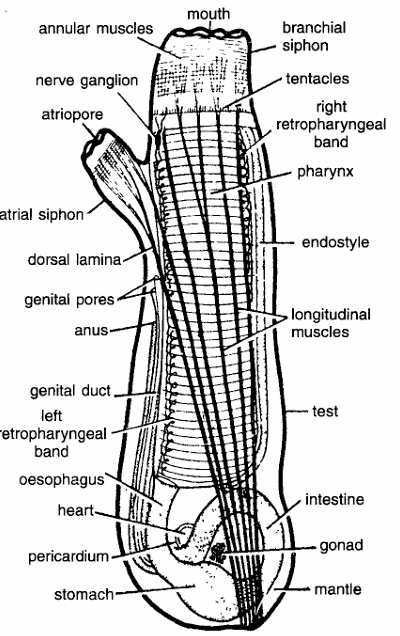
- Ciona resembles with Herdmania and measures 9 to 12 cm in length.
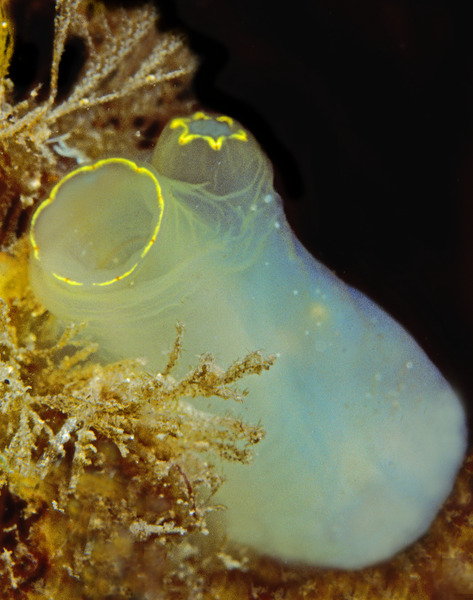
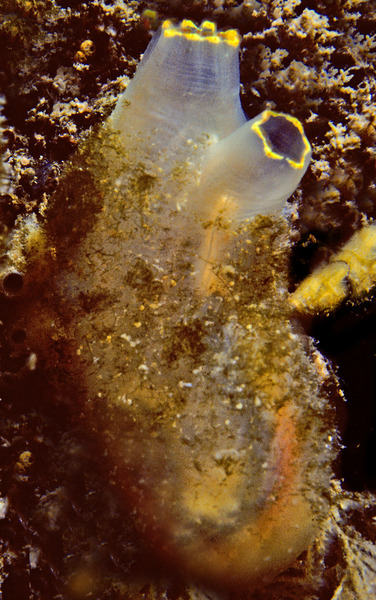
- Body of the animal cylindrical, tubular, transparent and longer than broad.
- It contains 8-lobed branchial siphon and 6-lobed atrial siphon anteriorly.
- Branchial and atrial siphons contain mouth and atriopore respectively. Tentacles present at the base of branchial siphon. One left side nerve ganglia present.
- Body covered by a transparent test and through the test, prominent thick longitudinal muscle bands can be seen. Below test is mantle.
- Alimentary canal is complete, V-shaped and consists of pharynx, oesophagus, stomach and intestine and it lies in the epicardial cavity. Heart is surrounded by pericardium.
- Different parts of gut occupy the same topographical parts as that in Herdmania. The gill-slits are rectangular. The dorsal lamina present. Intestine contains typhlosole. Running parallel with the endostyle are right and left ciliated bands which continue posteriorly as retropharyngeal bands.
- Gonads lie in the loop of intestine. Gonads open by genital pore through the genital duct. Longitudinal muscle bands are clearly seen.
- Fertilization external and the floating egg develops into an Oikopleura-like larva which settles and undergoes metamorphosis to change into adult
Special features
Ciona is hermaphroditic and protogynous. The blood of Ciona is rich in a green pigment, called as haemovanadin, containing vanadium produced by vanadocytes. The pigment probably does not take part in oxygen transport. Ciona intestinalis is the common species.
Identification
- Since the animal contains thick longitudinal muscle bands and above features hence, it is Ciona.
References
- NCBI – Ciona Research
- Encyclopedia of Life – Ciona
- World Register of Marine Species (WoRMS)
- Nature – Ciona intestinalis Genome Project
- Marine Species Identification Portal
- Zoology Practical Vertebrate
Discover more from Zoologyverse
Subscribe to get the latest posts sent to your email.