
The majority of terebella, which may grow up to 150 millimeters in length and 15 millimeters in breadth, reside in burrows or cracks. Finding and gathering food particles from the sediment surface is accomplished by the many, extremely long tentacles that extend from close to the mouth. Unlike ampharetids, the tentacles cannot be retracted. In contrast to ampharetids, which have more compact bodies, they feature plump anterior bodies and many segments in their long, tapered posterior bodies. Up to three anterior chaetigers have laterally branching gills, but the subfamily The gills of the Thelepodinae are made up of many basic filaments. The subfamily Terebellinae contains multiple rows of mid-body chaetigers. The prostomium is enlarged and the gills are absent in the subfamily Polycirrinae.
Classification of Terebella
Kingdom :- Animalia (Multicellular eukaryotic organisms)
Phylum :- Annelida (Segmented worms with true coelom and metamerism)
Class :- Polychaeta (Marine bristle worms with parapodia)
Order :- Terebellida (Tubicolous, sedentary and proboscis not-protrusible, without jaws or teeth)
Genus :- Terebella
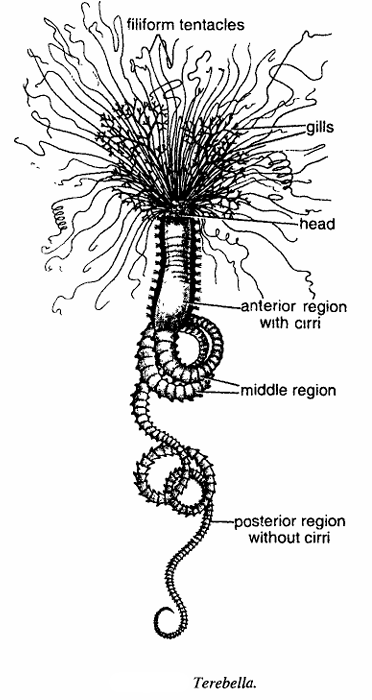
Habit and habitat of Terebella
Terebella is a marine, burrowing, sedentary annelid. The animal burrows in tubes in sand. Some species live 10 to 230 fathoms deep.
Distribution
It is found in Europe, U.S.A., Woods Hole region and Vineyard Sound to Bay of Fundy.
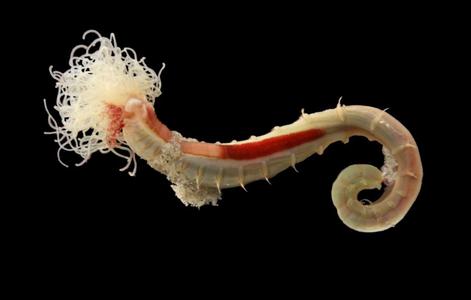
Comments on Terebella
- Body is elongated, cylindrical and divided into head and trunk.
- Head is horseshoe-shaped, made up of prostomium and peristomium.
- Prostomium contains number of long filliform bushy tentacles.
- Trunk contains about 60 segments reddish in colour and divided into anterior region or cirri, middle region with cirri and posterior region without cirri.
- Gills or branchiae are found on the dorsal surface of few anterior segments and they form 4 wide comb like branches on a single peduncle.
- Anterior 113 body is thickened while major part of the posterior body tapers narrowly.
- Setae of anterior segments are well developed while reduced in posterior segments.
Identification
Since the head contains bushy tentacles and all above characters and hence it is Terebella.
See other posts also
- PATTERN OF FEEDING AND DIGESTION IN HIGHER INVERTEBRATES
- ENTOPROCTA -STRUCTURE, LIFE HISTORY, AFFNITIES
- EXCRETION IN HIGHER AQUATIC INVERTEBRATES
- Amphitrite
- Arenicola
Discover more from Zoologyverse
Subscribe to get the latest posts sent to your email.