
The genus Pecten contains big scallops, sometimes known as saltwater clams, which are marine bivalve molluscs belonging to the Pectinidae family. This is the family’s type genus. The Latin term for a comb or rake is where the name Pecten originates.The Shell Energy Company’s emblem has been based on a Pecten shell since 1904.
Classification of Pecten
| Phylum | Mollusca | Soft bodied, non-metameric, shelled. |
| Class | Pelecypoda | Bivalve shell |
| Order | Pseudolamellibranchiata | Gills form vertical folds |
| Genus | Pecten |
Habit and habitat
Pecten lives gregariously on the sea bottom of approximately 10 fathoms deep. It feeds on microorganisms caught during respiratory water current. It is abundant among eel grass and over mud flats
Distribution
It is found in India and U.S.A. (Santa Barbara to Cape Sam Lucas, Monterary to the Gulf of California and New Jersey to Labrador).
Comments on of Pecten
- Commonly called as scallop.
- Animal is enclosed by unequal bivalved shell.
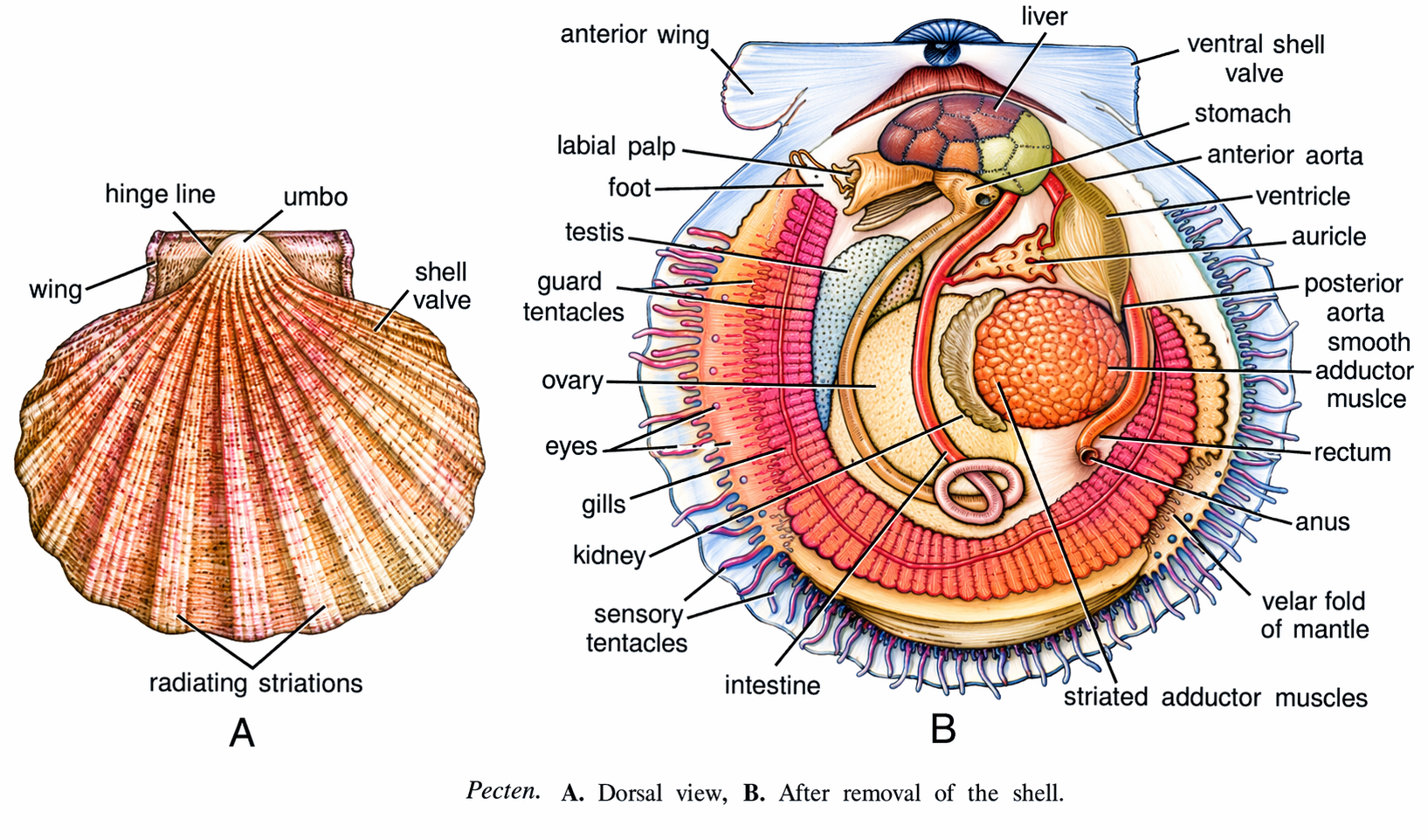
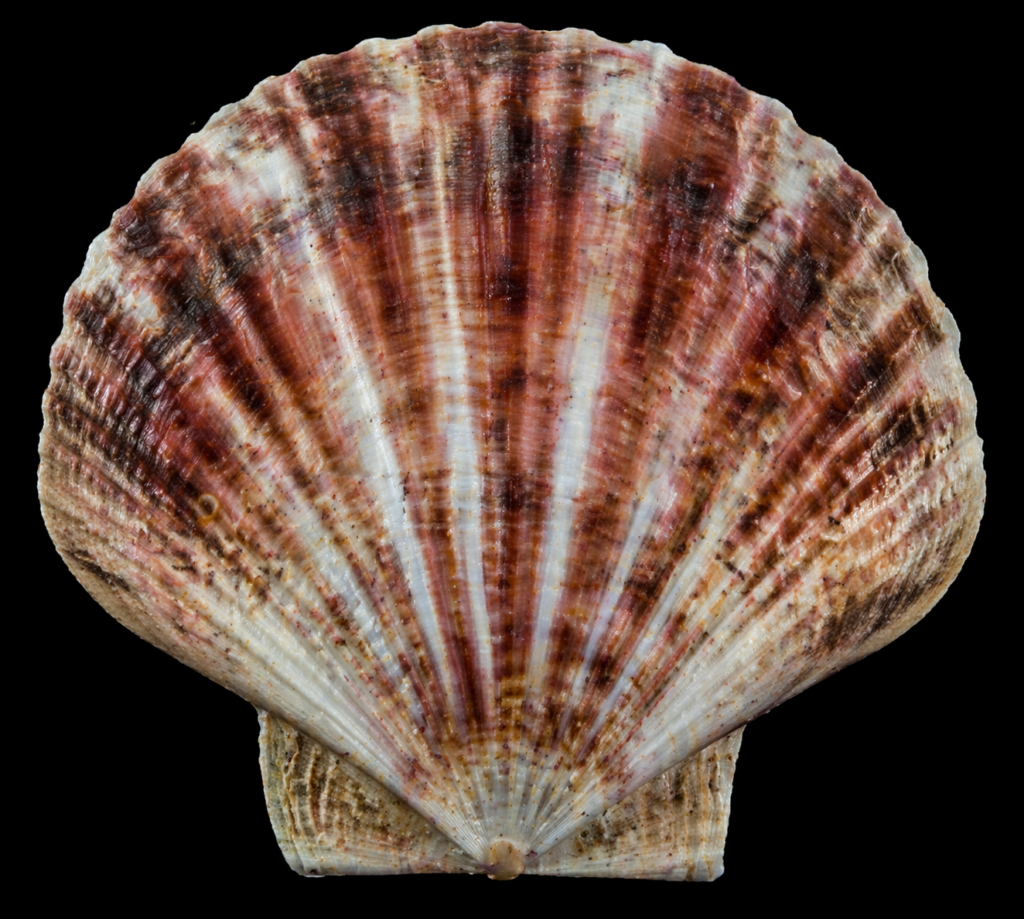
- Shells are easily recognised by their radiating striations with broad base and two winged ears above.
- Shell is beautifully sculptured. Hinge line straight and toothless.
- Animal rests on the right shell, which is white, clean and convex which has a prominent notch, where the anterior wing joins the body of the shell.
- The left shell is flat dark in colour.
- Shell valves are thin, light and raised into ridges and grooves, joined by straight, toothless hinge and possess growth lines.
- The concentric lines follow the curvature of the wavy margins. Umbo is found near hinge.
- Mantle is tentaculiferous and it enclosed viscera.
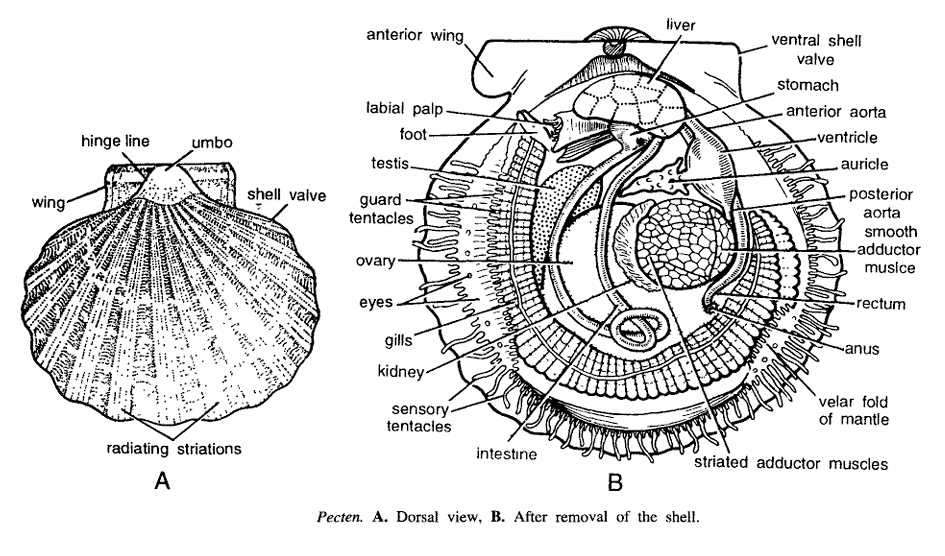
- After removing the shell liver, stomach, anterior aorta, ventricle, auricle, posterior aorta, smooth adductor muscle, rectum, anus, velar fold of mantle, striated adductor muscle, intestine, kidney, gills, ovary, guard, tentacles, foot, labial palps, anterior wings, ocelli and testes are seen.
- Margin of mantle produces velar folds with numerous sensory tentacles and stalked eyes at regular intervals. Hermaphroditic.
Special features of Pecten
Scallops leap and swim by snapping the shell valves together, giving them a zigzag course.
Economic importance
The adductor muscle of scallop is very delicious and scallop-fishing is very important industry. The scallop’s adductor muscles soak water and are unfit for preservation. They swell as they absorb moisture and this process is called as ‘plumping’.
Identification
Since the specimen contains radiating striations over the shell and all above features, hence it is Pecten.
See Other Posts Also
- PRIMITIVE NERVOUS SYSTEM OF COELeNTERATES AND ECHINODERMS
- Larval forms of Mollusca
- EXCRETION IN LOWER INVERTEBRATES
- ORGANS AND MECHANISM OF RESPIRATION IN HIGHER INVERTEBRATES
- PATTERN OF FEEDING AND DIGESTION IN HIGHER INVERTEBRATES
Discover more from Zoologyverse
Subscribe to get the latest posts sent to your email.