
DEFINITION
- The rotifera are wheel animalcules. They are microscopic, bilaterally symmetrical, free living aquatic animals and pseudocoelomate animals.
HISTORY
- An early microscopist, LEEUWENHOEK, discovered the rotifers in 1703.
- The basis of the modern classification of rotifers was laid by HUDSON and GOSSAE (1886), HARRING(1913), REMANE(1933) and MYERS.
CLASSIFICATION OF ROTIFERA
The phylum Rotifera includes nearly 2,000 species grouped under 3 orders, as follows -:
ORDER 1. SEISONOIDA
- Epizoic marine rotifers.
- Elongated body with reduced corona.
- Lateral antennae and toes absent.
- Males fully developed, no sexual dimorphism.
- Ovaries two without vitellaria.
- EXAMPLE : Seison, commensal on crustaceans.
ORDER 2. BDELLOIDA
- Swimming or creeping freshwater rotifers.
- Corona retractile with two trochal discs.
- Lateral antennae absent; toes 0 to 4.
- Mastax adapted for grinding.
- Males absent. Ovaries two, with vitellaria.
- EXAMPLES : Philodina, Rotifer, Embata etc.
ORDER 3. MONOGONONTIDA
- Swimming or sessile freshwater rotifers.
- Two lateral antennae ; toes 0 to 2.
- Mastax most often of grinding type.
- Males degenerate ; sexual dimorphism well marked.
- Ovary single, with vitellarium.
- Reproduction heterogonous.
- EXAMPLES : Epiphanes, Brachionus, notommata etc.
CHARACTERS OF ROTIFERA
- Body divisible into 3 parts :- head, trunk and tail.
- Body –wall syncytial, covered with a cuticular exoskeleton forming lorica, that is often ringed, especially over the foot.
- Digestive system completed.
- Special respiratory and circulatory systems are absent.
- Excretory and Nervous systems are present.
- Sexes separate and sexually dimorphic .
- Males usually smaller than females and degenerate.
- Females oviparous or viviparous ;parthenogenesis or sexual reproduction .
- Development direct without a larva.
- Body cavity is pseudocoelomate.
STRUCTURE OF ROTIFERA
EXTERNAL FEATURES
- HEAD -:
- Corona with cilia
- Mouth
- Sensory organs
- Brain
- TRUNK
- Largest part, sac-like
- Contains organs : mastax, salivary glands, pseudocoelom, protonephridia, stomach, intestine, anus
- FOOT
- Locomotion, attachment
- Pedal glands, one to two toes
INTERNAL FEATURES
DIGESTIVE SYSTEM
- The food, consisting of PROTOZOA, other minute organism and organic debris, is swept by ciliary action into the mouth.
- The mouth leads into a buccal tube. It leads into a muscular pharynx or mastax.
- The pharynx is provided internally with hard chitious jaws called TROPHI or INTERNAL JAWS .
- The trophi is used to grind the food materials.
- Two to seven salivary glands are present in the mastax wall.
- The mastax leads into an oesophagus. It opens into a stomach.
- A pair of gastric glands occurs inbetween the oesophagus and stomach.
- Stomach is followed by an intestine which opens into the cloaca. Cloaca opens out by a cloaca aperture.
- Execept pharynx, the digestive tract is lined by cilia.
- Digestive takes place in the stomach and absorption in the stomach and intestine.
EXCRETORY SYSTEM
- A pair of coiled nephridial tubes occurs on either side of the alimentary canal.
- They extend and open behind into a urinary bladder.
- Each tube is with lateral processes ending in flame cells.
Anteriorly the nephridial canals are connected by a transverse renal commissure called AUXLE’S ANASTOMOSE above the mouth. - Posteriorly, they open into a common pulsating or urinary bladder, which contracts periodically to expel it’s fluid contents to the outside through the cloaca.
- Water enters through the mouth by swallowing rather than penetration of the body wall.
NERVOUS SYSTEM
- The brain consists of a bilobed suprapharyngeal ganglion, situated above the mastax in head.
- Various nerves radiate from the brain to various organs and sensory centres of the body .
- The great activity of rotifers indicates that the nervous system is well-coordinated with the musculature.
SENSE ORGANS
- Cerebral eye with red pigments is present.
- Papillae with sensory hairs called antennae or palps are present. They are tactile in function.
- There are 3 antennae, one is dorsal and median situated at the anterior end of the trunk and the other two are lateral in the posterior part of the trunk.
REPRODUCTIVE SYSTEM
- They exhibit sexual dimorphism.
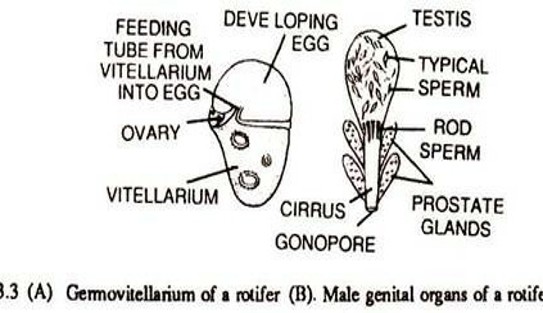
- The body cavity is filled with a large testis. A spermduct leads from the testis and it opens to the exterior by the genital pore situated on a penis.
- The female reproductive system consists of a single germovitellarium. It consists of an ovary and a large yolk gland or vitellarium. An oviduct leads from germovitellarium to the cloaca.
LIFE HISTORY OF ROTIFERA
- Fertilization is internal, cleavage is spiral and determinate.
- The embryos develop into the adult stage without metamorphosis.
- The life cycle in rotifers is related to seasons.
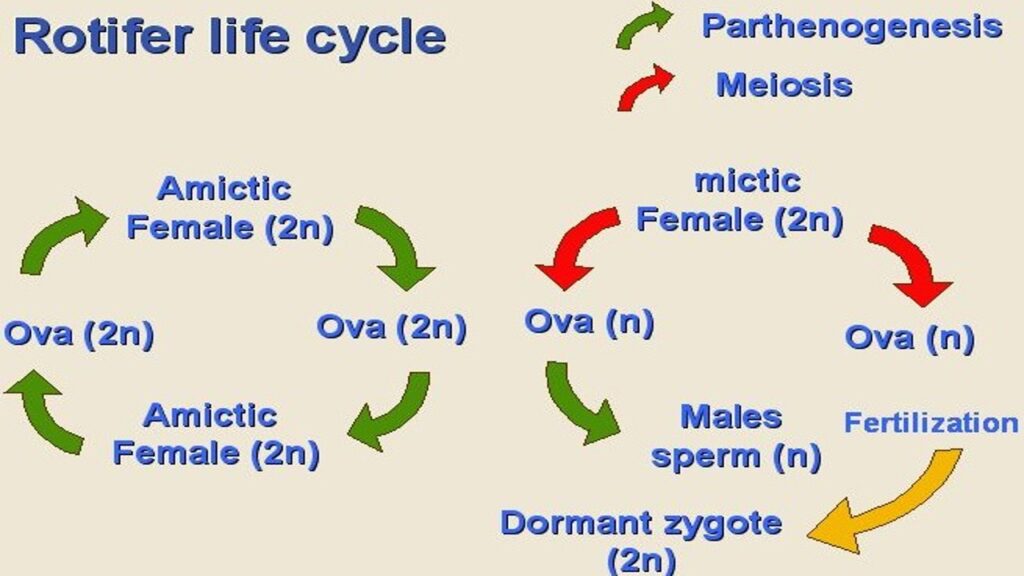
In the order Seisonida, all eggs require to be fertilized and hatch as either male or female. - In the order Bdelloida the males are unknown, and the eggs develop parthenogenetically into females.
- In the order Monogonontida, two kinds of females occur without external distinction :
AMICTIC FEMALES
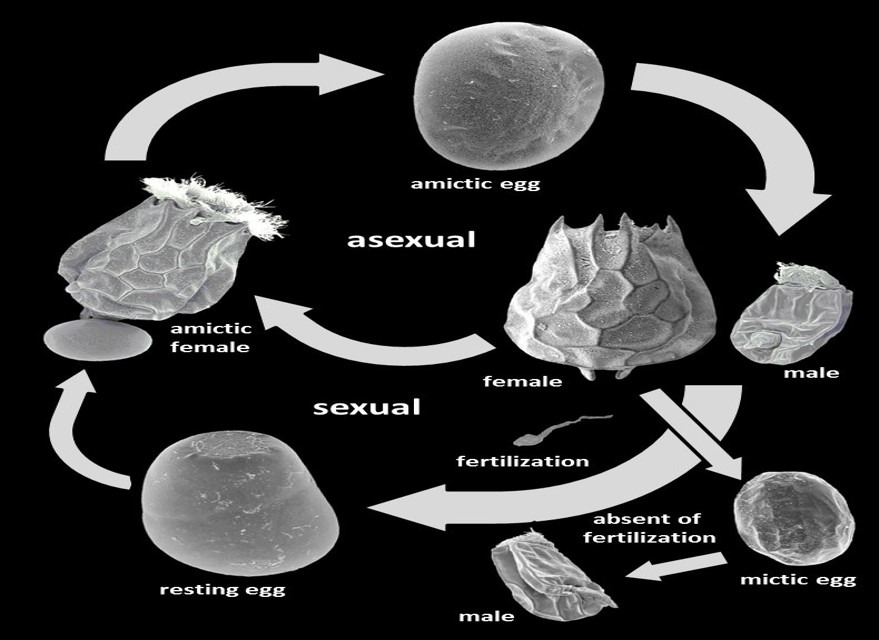
During most of the year the amictic females produce large, thin-walled and diploid eggs, referred to as amictic, parthenogenetic or summer eggs. They are incapable of being fertilized and develop into females. Many such generations of females are produced.
MICTIC FEMALES
Later in the year, as the sexual season approaches, some of the females lay mictic eggs which are small, thin-walled, haploid and capable of being fertilized.
If the eggs are not fertilized, they develop parthenogenetically into males.
If fertilized, the eggs are thick walled and called dormant or winter eggs. They can withstand unfavourable conditions. After a dormant period they develop into females which produce summer eggsand the cycle is repeated.
AFFINITIES OF ROTIFERA
The relationships of rotifers are quite obscure. They have been allied with almost every invertebrate group in the past.
AFFINITIES WITH ARTHROPODA
- Body covered by a cuticle.
- Superficial metamerism.
- Presence of two jaws (trophi).
- The moving bristle-hearing arms of Pedalia suggest the appendages of a crustacean larva
AFFINITIES WITH ANNELIDA
- Some rotifers show a close resemblance with the swimming trochophore larva. This resemblance leads to the conclusion that rotifers are simple annelids that have remained in a larval state.
- At present this hypothesis is based chiefly on the peculiar rotifer Trochosphaera whose ciliary girdle, curved intestine and excretory organ resemble the similar parts of the trochophore.
- The corona resembles the ciliary circlets of trochophor.
AFFINITIES WITH NEMATODA
- Symmetry : bilateral
- Method of movement: muscular thrashing.
- Other important facts : 3 tissue layers, complete digestive tract with 2 openings, pseudocoelom (fluid-filled body cavity).
- EXAMPLES: roundworms, flatworm and segmented worm
AFFINITIES WITH PLATYHELMINTHES
The resemblance between the rotifers and turbellarians are :
- The coronal disc may be a remnant of the ventral ciliation of turbellarians.
- The protonephridial system with flame cells is identical.
- The division of female gonad into a vitellarium and germarium is similar to flatworms.
- But rotifers have anus. They are also lacking in a continuous muscular layer and an epidermal nerve plexus characteristic of the turbellarians.
IMPORTANCE OF ROTIFERA
- The rotifers have a small size and reproduce rapidly, which makes them convenient for experimental studies by Zoologists in the lab.
- They also play a useful role in cleaning up pollutional and natural wastes.
- They form a part of the food chains leading to men.
- The rotifers are a source of food for other animals, such as small crustaceans, which are eaten by small fish.
- Some adult rotifers to the trochophore larva of some higher animals, leading to the view that the early ancestors of higher animals were rotifers like in nature.
- Rotifers are said to be “cell constant” animals because the no. of cells in the adult individual remains fixed and surprisingly constant, except in the gonads.
CONCLUSION
The rotifers are very common and abundant freshwater animals, commonly designated as the “wheel animalcules”. Generally speaking ,they are the smallest animals amongst the metazoan. The transparency of their body reveals the internal organs clearly ; they can be seen functioning in living specimens.
The embryology of rotifers, without any trace of coelom or endo-mesoderm during development, suggests that they have not been derived by retrogression of higher groups. They show the greatest resemblance, among invertebrate groups, to the Turbellaria. But, they display an amazing variety in structure and do not resemble any one group of animals. Therefore, the status of an independent phylum to rotifers seems to be justified.
Discover more from Zoologyverse
Subscribe to get the latest posts sent to your email.