
A genus of velvet worms belonging to the Peripatidae family is called Peripatus (pəˈrɪpətəs/).Although this group includes many other genera besides Peripatus, the term “peripatus” (unitalicized and uncapitalized) is also used to refer to the Onychophora as a whole. The Caribbean, northern South America, and Central America are home to the genus Peripatus. Mothers in this viviparous genus use the placenta to nurture their developing embryos.
Classification of Peripatus
| Kingdom | Animalia | |
| Phylum | Onychophora | Primitive arthropods with unjointed legs and annelidan set up. |
| Family | Peripatidae | This family includes more than 90 described species distributed among 13 genera |
| Genus | Peripatus | velvet worms |
Habit and habitat
Peripatus is a nocturnal carnivorous animal, living in rock crevices, under bark of trees, stones and moist places.
Distribution
It has a discontinuous distribution. Found in damp forests of Africa, Malaysia, Australia, South America and New Zealand.
Comments on Peripatus
- It is referred as velvet worms.
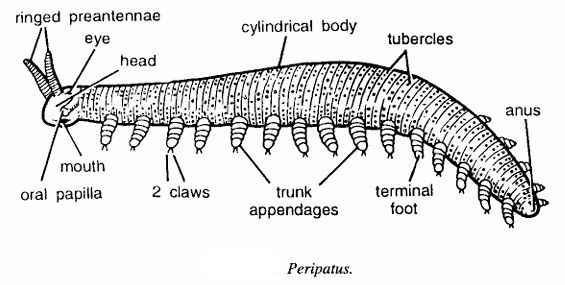
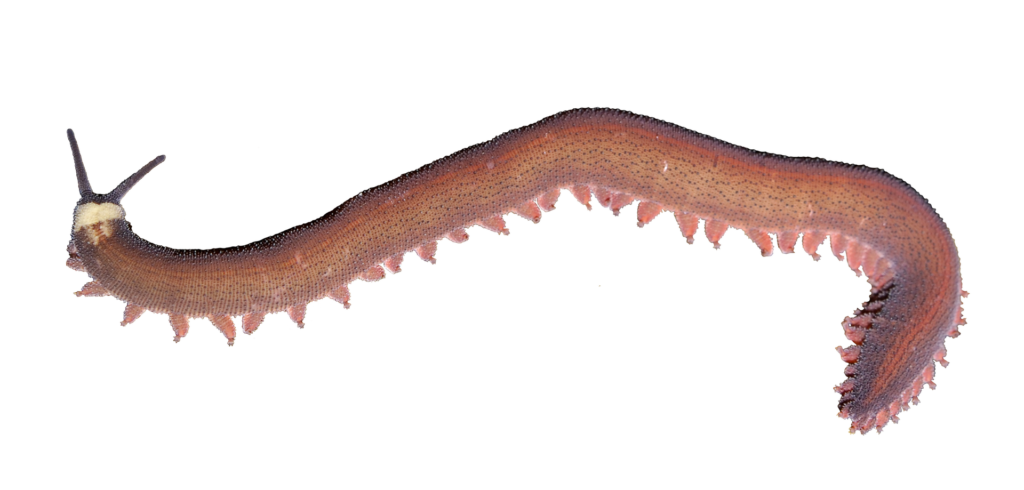
- Body of the animal is cylindrical and elongated caterpillar like and measuring 4 to 6 cm in length.
- Outer covering of the body is thin velvety, chitinous transverse wrinkles, showing numerous small papillae or tubercles.
- Anterior end is marked by preantennae and ventral mouth and posterior end by anus.
- There is a head of three segments which is not clearly separate form the body.
- Post-oral segments of the head bear pair of hooked jaws, a pair of oral papillae, a pair of simple eyes and a pair of segmented antennae.
- It feeds on insects which they catch by means of slime ejected from their oral papillae.
- There are about, fifteen pairs of walking legs. Each leg is unjointed but is ringed by ridges having tubercles and terminates in a foot, which bears two curved claws and three distinct tubercles.
- There is a tracheal system (for respiration) with spiracles scattered irregularly over the body surface.
- Excretion nephridial. Sexes separate. Crural glands are absent and genital pore is posterior.
- Mostly viviparous, but some may show oviparity.
- Peripatus is supposed to be the connecting link between Annelida and Arthropoda.
Special features of Peripatus
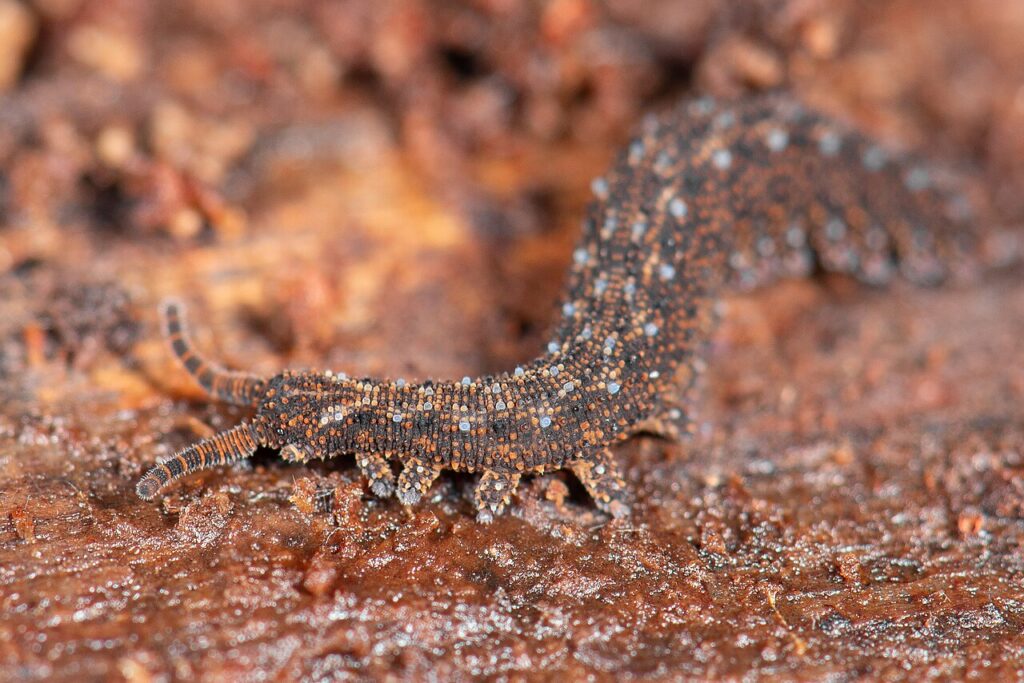
Peripatus was first described in 1825 and was classified with the molluscs due to its slug-like appearance. Grube (1874) kept it under Annelida and coined the name Onychophora. Burmeister (1856) placed the group between annelids and arthropods and Moseley (1874) finally demonstrated its relationship with arthropods by showing the presence of trachea. Peripatus is zoologically very interesting, because it exhibits both arthropod and annelid characters as under
- Annelidian characters : The vennifonn body, denno-muscular body wall, simple eyes, unjointed, hollow stumpy appendages on annelidan pattern.
- Arthropodal characters : Antennae, chitin in cuticle, haemocoel, tracheae, general structure, development and peculiar salivary glands like arthropods.
Identification
Since the specimen contains pre-antennae, 2 clawed appendages and above features, hence it is Peripatus.
See other posts also
- Carcinus (Crab)
- Glycera (Bloodworm)
- Top 10 Most Venomous Snakes in the World
- Bee Hummingbird : The World’s Smallest Bird
- Blue-Spotted Glass Frog (Cochranella mache)
Discover more from Zoologyverse
Subscribe to get the latest posts sent to your email.