
Master of Camouflage and Intelligence
The Octopus is perhaps the most famous and highly intelligent member of the class Cephalopoda, a group of marine mollusks that also includes squid and cuttlefish. Renowned for its eight highly flexible arms, sophisticated camouflage abilities, and remarkable problem-solving skills, the octopus represents the pinnacle of invertebrate evolution. Their lack of a shell, their soft body, and their complex nervous system distinguish them as one of the most successful and fascinating predators in the world’s oceans.
Classification of Octopus
The octopus belongs to the superorder Octopodiformes, which means “eight-footed.” It is the most derived (evolutionarily recent) group within the Cephalopoda.
| Taxonomic Rank | Group | Characterization |
| Kingdom | Animalia | Multicellular, eukaryotic, heterotrophic organisms. |
| Phylum | Mollusca | Soft-bodied, invertebrate animals typically possessing a mantle and a radula. |
| Class | Cephalopoda | Marine mollusks with bilateral body symmetry, a distinct head, and arms/tentacles. |
| Subclass | Coleoidea | Cephalopods lacking an external shell (or having a vestigial internal one), including octopuses, squid, and cuttlefish. |
| Superorder | Octopodiformes | Eight-limbed coleoids; includes octopods and vampire squid. |
| Order | Octopoda | Cephalopods with eight arms bearing suckers, typically lacking fins (except cirrate octopuses). |
| Family | Various (e.g., Octopodidae) | Families based on specific anatomical features, particularly arm and body structure. |
Defining Features of Octopoda
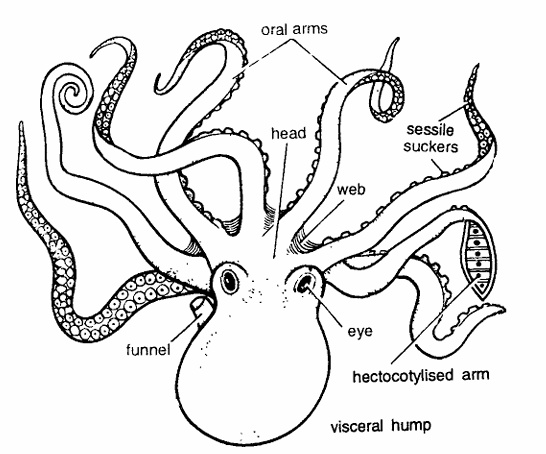
Several key anatomical features distinguish them from other cephalopods :
- Eight Arms: They possess exactly eight arms (not 10, like squid and cuttlefish) lined with suckers.
- Lack of Shell: They are entirely soft-bodied, lacking both an external shell (like the Nautilus) and a heavy internal shell (like the cuttlefish’s cuttlebone). They retain only a vestigial cartilaginous structure around the brain.
- Mantle Structure: The mantle cavity, which houses the gills and reproductive organs, is entirely enclosed, with water flow regulated by the siphon.
Habit and Habitat of Octopus
They have the broadest habitat range of all cephalopods, thriving in diverse marine environments globally.
Geographical Distribution of Octopus
- Global Presence: They are found in all the world’s oceans, from the tropics to the polar regions.
- Depth: They occupy habitats ranging from shallow intertidal zones (where they hide among rocks and reefs) to the abyssal plains of the deep ocean (where species like the Dumbo Octopus reside).
Lifestyle and Shelter
Most octopus species are benthic, meaning they live on the ocean floor. They are masters of cryptic behavior (hiding), and their existence revolves around finding and maintaining a suitable den, often called an “octopus garden.”
- Solitary Nature: They are typically solitary animals, interacting primarily for mating or territorial defense.
- Nocturnal Predators: Most species are nocturnal, emerging at dusk to hunt. Their diet consists mainly of crabs, clams, and other crustaceans and mollusks, which they crush with their beaks or drill into using their radula.
General Characteristics of Octopus
- Commonly called as devil fish.
- The round or globose body differentiates into a visceral hump and a head.
- The head contains the eyes, siphon, and eight elongated arms, each bearing two rows of sessile, cupped suckers on the inner side. In males, one arm modifies into a spoon-shaped intromittent organ, called the hectocotylized arm.
- The arms extend with webbing and appear similar. The animal crawls using its arms and also swims backward by ejecting jets of water from the funnel.
- The organism lacks both a shell and nidamental glands. The mantle encloses the visceral mass and the mantle cavity.
- The nervous system develops well and exhibits a high degree of organization.
- Octopus is dibranchiate, having 2 gills, 2 auricles and 2 kidneys.
- Colour slaty but varying through all shades from nearly white to nearly black.
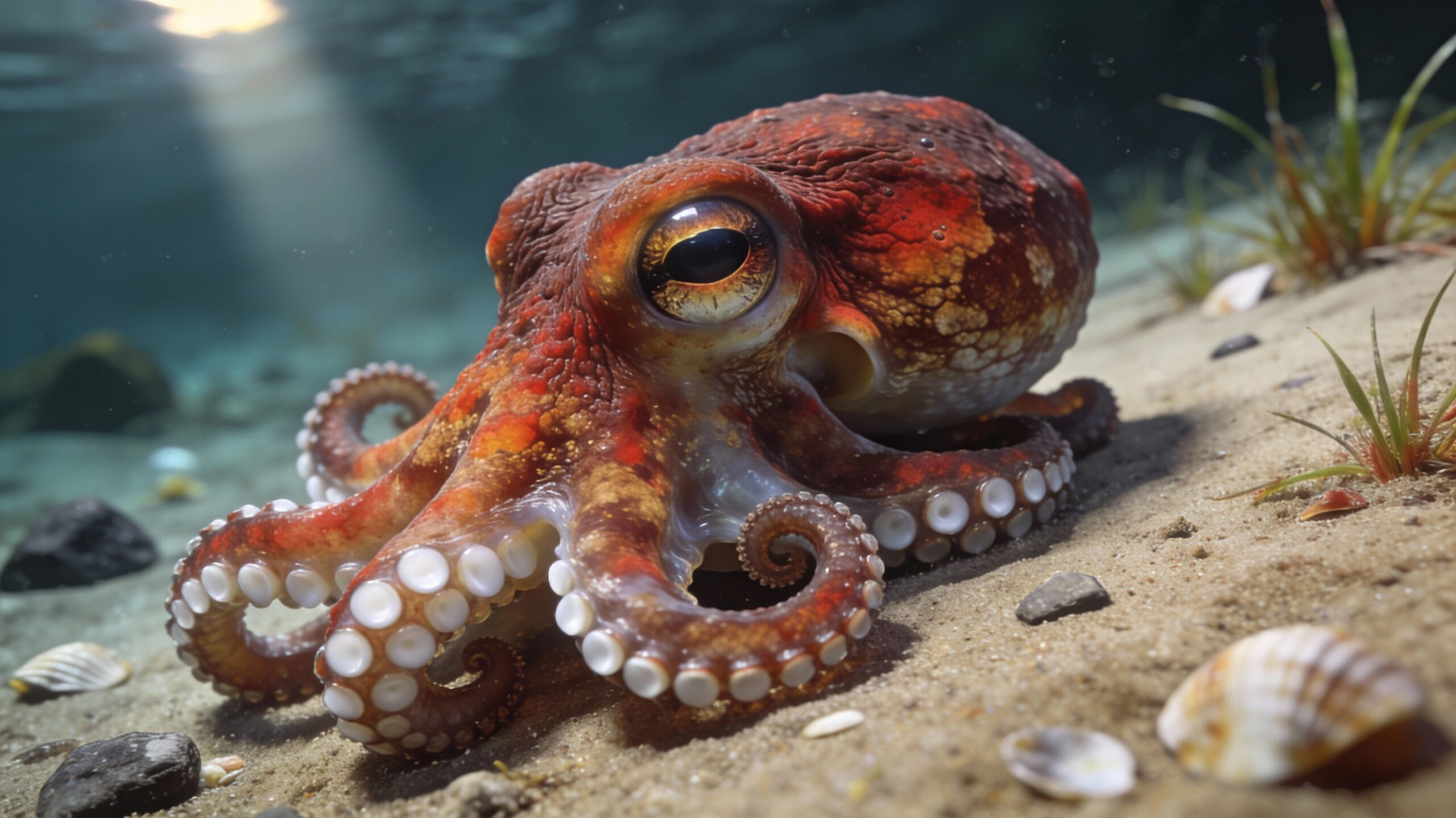
The octopus body plan optimizes flexibility, intelligence, and survival without relying on a rigid shell.
Brain and Nervous System
The octopus is considered the most intelligent of all invertebrates.
- Centralized and Decentralized Control: Its large, doughnut-shaped brain encircles the esophagus. Critically, approximately two-thirds of the octopus’s neurons are located in its arms, not its head.
- Independent Arms: The arms can literally “think for themselves,” tasting and manipulating objects even when severed from the body. The brain gives high-level commands, but the arms execute complex motor functions semi-autonomously.
Soft Body and Flexibility
The octopus is an expert at squeezing into incredibly small spaces, a capability due to its lack of bones.
- Skeletal Structure: The only rigid parts of the octopus are its beak (made of chitin) and the cartilaginous structure surrounding its brain.
- Escape Artists: This soft structure allows them to pass through any opening larger than their beak, making them notorious escape artists in aquariums.
Respiration and Circulation
They possess a unique, highly efficient circulatory system.
- Three Hearts: They have three hearts: two branchial hearts that pump blood through the gills, and one systemic heart that circulates blood to the rest of the body.
- Blue Blood: Their blood is blue because it uses a copper-rich protein called hemocyanin to transport oxygen, which is more efficient than iron-based hemoglobin in low-oxygen, cold deep-sea environments.
Special Features of Octopus: Camouflage, Ink, and Reproduction
Giant Octopus can hold a man in its arms. It ejects inky fluid in water to protect itself. The inky fluid forms a sort of smoke-screen. The ink not only helps to conceal the Octopus but also paralyses the sense of smell in the moray eel, a common predatory enemy. It is largely used for studying behavioural sciences. Very intelligent and its name devil fish seems justified as displayed by its uncanny cleverness in stocking prey and devilish and cruel capacity in tearing the victim into small pieces once captured
The unique abilities of the octopus are key to its success as a predator and survivor.
Camouflage and Skin Manipulation
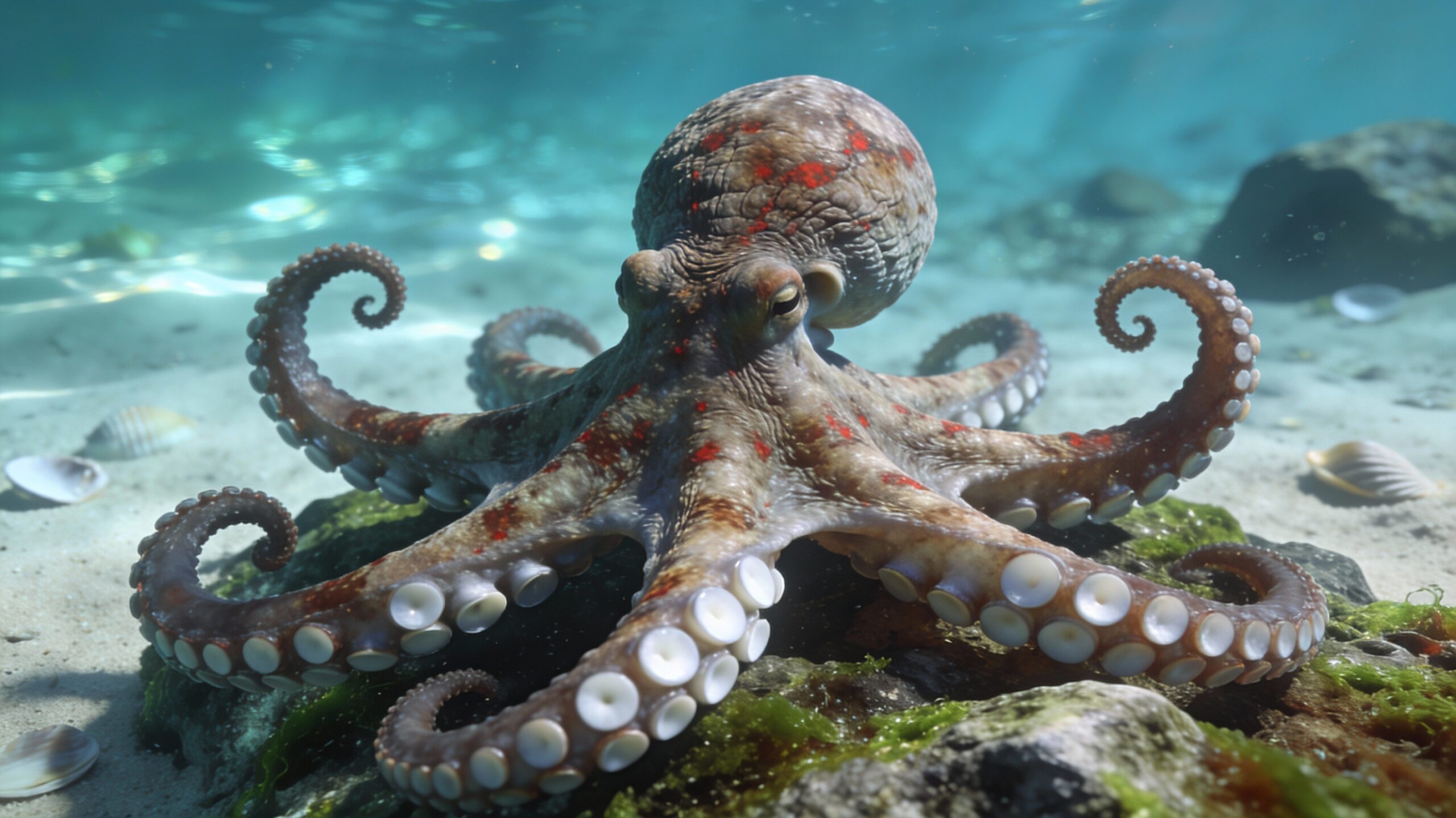
Their greatest defense is its ability to instantly change the color, texture, and pattern of its skin to perfectly match its surroundings, or to communicate.
- Chromatophores: These are tiny sacs of pigment controlled by muscles and nerves. By contracting these muscles, the octopus can expand the sacs, revealing pigment and changing its color in milliseconds.
- Iridescence and Texture: Iridophores and leucophores provide shimmering, reflective qualities, while complex muscular control allows the skin to quickly form bumps, spikes, or wrinkles, mimicking rocks or algae.
Defense Mechanism: Ink Sac
All octopuses possess an ink sac located near the anus, which releases a cloud of dark melanin and mucus.
- Function: When threatened, the octopus expels the ink through the siphon, creating a decoy cloud to confuse and distract a predator, allowing the octopus to escape using rapid jet propulsion.
Octopus Reproduction and Semelparity
They have a distinct life cycle characterized by semelparity (reproducing only once).
- Mating: Male octopuses use a specialized arm, the hectocotylus (similar to the Argonauta), to transfer sperm packets (spermatophores) into the female’s mantle cavity.
- Brooding and Sacrifice: The female then meticulously finds a den and lays thousands of eggs, often hanging them in strings. She dedicates the rest of her life—often weeks or months—to protecting, cleaning, and aerating the eggs, refusing to leave to eat. After the eggs hatch, the female usually dies shortly thereafter.
Identification and Key Species
They are generally identified by arm length, skin texture, and habitat, but several species are globally famous for their unique traits.
- Octopus vulgaris (Common Octopus): The most studied species, found worldwide in tropical and temperate waters, known for its high intelligence and successful adaptation to laboratory environments.
- Hapalochlaena maculosa (Blue-Ringed Octopus): A small, highly venomous species from the Indo-Pacific. Its bright blue rings flash as a warning when it feels threatened, possessing venom capable of paralyzing humans.
- Thaumoctopus mimicus (Mimic Octopus): An Indo-Pacific species famous for its ability to mimic the appearance and behavior of multiple other marine animals, including lionfish, sea snakes, and sole.
Conservation and Ecological Role
While many species are not currently considered endangered, they play a vital ecological role.
- Predator and Prey: They are crucial as both predators (controlling populations of shellfish and crabs) and prey (feeding seals, sharks, dolphins, and humans).
- Threats: Like all marine life, they face threats from overfishing (particularly in East Asia and the Mediterranean), plastic pollution, and the effects of ocean acidification on their prey’s calcified shells.
They are truly a marvel of natural engineering—an intelligent, flexible, and perfectly camouflaged predator that continues to captivate scientists and marine enthusiasts alike.
References (Working Links)
- World Register of Marine Species (WoRMS) – Octopoda Order Page
- Content: Provides the official taxonomic classification and valid family list for octopuses.
- Link: https://www.marinespecies.org/aphia.php?p=taxdetails&id=3247
- PLOS ONE – Octopus Brain and Nervous System
- Content: Scientific research on the distributed nervous system, detailing the concentration of neurons in the arms (decentralized control).
- Link: https://journals.plos.org/plosone/article?id=10.1371/journal.pone.0018789
- Nature – The Science of Octopus Camouflage
- Content: Detailed explanation of the mechanism of chromatophores, iridophores, and leucophores that enable rapid and sophisticated color and texture change.
- Link: https://www.nature.com/articles/d41586-020-02555-5
- Monterey Bay Aquarium Research Institute (MBARI) – Deep-Sea Octopus Reproduction
- Content: Provides insights into the unusual deep-sea brooding behavior and the long, slow reproductive cycle of octopuses (semelparity).
- Link: https://www.mbari.org/deep-sea-octopus-broods-eggs-for-record-4-5-years/
Discover more from Zoologyverse
Subscribe to get the latest posts sent to your email.