
The Nautilus, a majestic marine mollusk, is often revered as a “living fossil” for its remarkable survival through multiple mass extinctions over an evolutionary history spanning nearly 500 million years. It is the sole living genus of the subclass Nautiloidea, a lineage that once dominated the ancient oceans. Unlike its more modern relatives—the squids, octopuses, and cuttlefish—the Nautilus has retained a magnificent, coiled external shell, which is central to its survival and fame. The conservation of this ancient creature is increasingly critical due to high demand for its unique shell.
Classification of Nautilus
They belongs to the class Cephalopoda (meaning “head-foot”), yet its deep evolutionary split from all other extant cephalopods (the Coleoidea) places it in its own subclass, highlighting its ancient, primitive features.
| Rank | Classification | Characterization |
|---|---|---|
| Kingdom | Animalia | Multicellular, eukaryotic, heterotrophic organisms. |
| Phylum | Mollusca | Invertebrate animals with soft bodies; features a mantle and radula. |
| Class | Cephalopoda | Marine mollusks with bilateral symmetry, distinct head, and arms/tentacles. |
| Subclass | Nautiloidea | The most ancient extant cephalopods; characterized by a coiled, external, chambered shell. |
| Order | Nautilida | The only living order of the Nautiloidea. |
| Family | Nautilidae | Contains the genera Nautilus and Allonautilus. |
| Genus | Nautilus | The true chambered nautilus, famed for its perfect logarithmic spiral shell. |
The “Living Fossil” Status
They has remained morphologically (in physical form) virtually unchanged for hundreds of millions of years, earning it the “living fossil” moniker. This remarkable stability contrasts sharply with the dramatic evolution seen in other cephalopods, which internalized or lost their shells entirely. The presence of the external shell, pinhole camera-like eyes (lacking a lens), and numerous suckerless tentacles are all considered plesiomorphic (ancestral) traits within the Cephalopoda. The ancient ancestors, such as straight-shelled orthocones, were among the largest and most formidable predators of the Paleozoic Era.
Habit and Habitat
The Nautilus is a pelagic (open water) deep-sea dweller, restricted to the tropical and subtropical waters of the Indo-Pacific Ocean.
Geographical Distribution of Nautilus
- Range: Found primarily near the deep slopes of coral reefs and atolls, stretching from the Philippines and Indonesia to Australia and the South Pacific islands (like Fiji, Palau, and Samoa). Different species (e.g., Nautilus pompilius and Nautilus macromphalus) have slightly distinct, though overlapping, ranges.
- Preferred Environment: They are typically found in the waters adjacent to island shelves and coral reefs, particularly where the water temperature is consistently cool.
Vertical Migration and Depth
Exhibits a strong vertical migration pattern, which is crucial for its feeding and safety.
- Daytime: It typically spends the daylight hours in the safety of deeper, cooler waters, often between 100 to 400 meters (330 to 1,300 feet), to avoid visual predators.
- Nighttime: At night, it ascends to shallower waters (around 70 to 150 meters) to hunt for prey.
- Depth Limit: The intricate, pressure-resistant shell of the Nautilus pompilius has a mechanical limit. Its shell is known to implode at depths greater than approximately 800 meters due to the immense hydrostatic pressure, effectively limiting its deep-sea range.
Characteristics of Nautilus
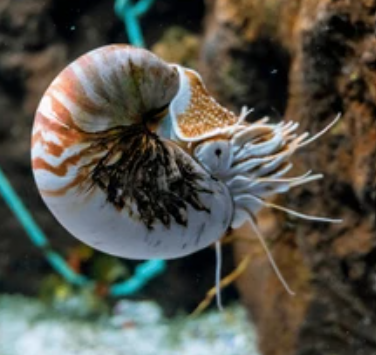
- Commonly known as pearly Nautilus.
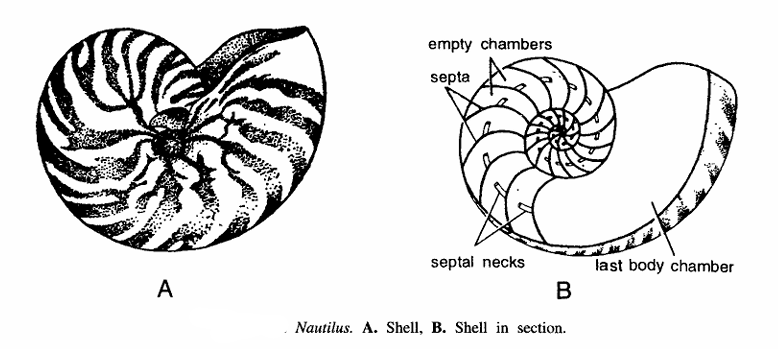
- Body of the animal lies in the flat and spirally coiled shell in one plane and internally divided into various chambers by septa having septal necks.
- Shell measures approximately 25 cm.
- Shell is differentiated into body chamber containing head, tentacles and several coiled chambers with extension of visceral mass called siphundes.
- Periostracum dark brown or black, porcellaneous layer with undulating transverse bands of white and yellowish brown alternately and inner layer pearly.
- Body proper is lodged in the largest chamber and the other chambers remain either empty of filled up with gas which helps in floatations. Internal septa are perforated.
- It is tetrabranchiate having 4 ctenidia, 4 kidneys and 4 auricles. Ink gland is absent. Sexes are separate.
- About 60 to 90 prehensile tentacles are radially arranged around the mouth.
- Siphonal funnel is formed of two separate folds.
- Eyes are open vesicles without cornea or lens. Ink gland and chromatophores absent.
- Nautilus is the only cephalopod having external shell.
- It has about 2,000 fossil species which date back to the Cambrian and reaching their maximum in the Silurian and Devonian ages.
- The body is used for food and the shell is extensively employed for ornamental and useful purposes.
- Oliver Wendell Holmes in his famous poem, “Chambered Nautilus”, calls it as “The ship of pearl”.
The True Shell
The most defining feature is the beautiful, coiled, planispiral external shell.
- Composition and Appearance: Made of aragonite (a form of calcium carbonate) with a stunning inner layer of nacre (mother-of-pearl), giving it its iridescent sheen. The outer shell is usually creamy white with reddish-brown stripes, serving as cryptic coloration in the dim light of the deep.
- The shell divides internally into numerous gas-filled chambers called camerae (or the phragmocone), and the animal occupies only the newest and largest one, known as the living chamber..
- Siphuncle: A critical structure, the siphuncle, is a thin cord of tissue that runs through a hole in the center of each dividing wall (septum). It is the mechanism by which the Nautilus controls its buoyancy.
Special Feature of Nautilus
The Nautilus achieves neutral buoyancy (weightlessness in the water) by an intricate osmotic process, making it a perfectly engineered natural submarine.
- Siphuncle Function: The siphuncle regulates the balance of seawater and gas (mostly nitrogen) within the sealed chambers.
- Density Adjustment: To change depth, the animal actively pumps salts into or out of the chambers via the siphuncle. Water follows this movement due to osmosis, changing the shell’s overall density without expending energy on continuous swimming.
- Logarithmic Spiral: The shell follows a precise logarithmic spiral (or golden spiral), a mathematically perfect growth pattern that ensures the animal’s center of gravity remains directly below its center of buoyancy as it grows, providing inherent stability.
Tentacles and Sensory Organs
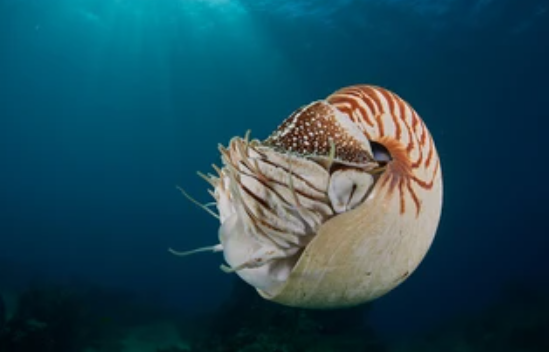
- Tentacles: Unlike the 8 or 10 arms found in other cephalopods, a Nautilus possesses 90 or more suckerless tentacles (sometimes called cirri). In addition, these tentacles have sticky, ridged surfaces that use an adhesive secretion to grasp food.
- Eyes: Moreover, the eyes of the Nautilus are highly unique and primitive. They lack a lens and are instead structured like a pinhole camera, allowing them to detect light, dark, and movement, although they cannot form sharp images.
- Chemoreception: Because of its poor eyesight, the Nautilus relies heavily on its well-developed sense of smell. Through specialized sensory organs, it uses chemoreception to locate food efficiently.
Locomotion, Diet, and Life Cycle
This is a carnivorous predator and opportunistic scavenger of the deep.
- Locomotion: It moves using jet propulsion, rapidly expelling a jet of water from its hyponome (or siphon), a muscular funnel below its head. This allows for controlled movement and maneuverability.
- Diet: Using its powerful, parrot-like beak and radula, it crushes the shells of crustaceans and consumes small fish and scavenged animal remains it finds on the reef slopes.
- Life Cycle and Longevity: The life history of the Nautilus is exceptionally slow, a major factor in its conservation vulnerability.
- Maturity: They do not reach sexual maturity until 10 to 15 years of age.
- Lifespan: They are one of the longest-lived cephalopods, potentially reaching 20 years or more.
- Reproduction: Females lay a small number of large, leathery eggs, usually one at a time, which can take up to a year to hatch. This slow, low-output reproductive strategy cannot cope with modern fishing pressures.
Identification of Nautilus
Identification is unambiguous due to its external shell.
- Shell Features: The shell is large, perfectly coiled, and features the aperture (opening) through which the animal extends its tentacles. A leathery hood (a modified pair of tentacles) can seal the aperture when the animal retracts for protection.
- Key Species:
- Nautilus pompilius (Emperor or Chambered Nautilus): The most widespread and commonly recognized species, often showing a complete filling of the central umbilical region of the shell with a protective callus.
- Nautilus macromphalus (Bellybutton Nautilus): Distinguished by a large, open umbilicus (the central coil) in the shell, found predominantly near New Caledonia.
- Allonautilus scrobiculatus (Fuzzy Nautilus): Distinguished by a periostracum, a fuzzy or scaly outer layer on its shell.
Conservation Status and Trade
The beauty of the Nautilus shell has made it a target of the curio trade, leading to severe population declines across its range.
- Threats: Destructive fishing practices, targeted harvesting for the shell trade, and habitat degradation.
- Protection: All species of Nautilus (and Allonautilus) are listed under CITES Appendix II. This listing regulates their international trade to ensure that the harvesting of the animals is sustainable and does not threaten their survival in the wild.
The Nautilus stands as a magnificent, enduring relic of the deep past, a testament to enduring biological design, and a critical symbol of marine conservation efforts.
References (Working Links)
- World Register of Marine Species (WoRMS) – Nautilus Genus Page
- Content: Provides the official, accepted taxonomic classification and valid species list.
- Link: https://www.marinespecies.org/aphia.php?p=taxdetails&id=137788
- U.S. Fish & Wildlife Service – Chambered Nautilus (Nautilus pompilius)
- Content: Detailed information on the species’ conservation status, including its listing as Threatened under the U.S. Endangered Species Act, and its biology.
- Link: https://ecos.fws.gov/ecp/species/9672
- Proceedings of the Royal Society B: Buoyancy Mechanisms in Nautilus
- Content: Scientific paper abstract detailing the physical and biological mechanisms, including the role of the siphuncle, used by the Nautilus for buoyancy control.
- Link: https://royalsocietypublishing.org/doi/10.1098/rspb.1969.0066
- CITES (Convention on International Trade in Endangered Species) – Nautilus Listing
- Content: Official information regarding the listing of all Nautilus species under CITES Appendix II, regulating their international trade.
- Link: https://cites.org/eng/news/pr/cites_lists_chambered_nautilus_to_regulate_trade
- The Cephalopod Page – The Chambered Nautilus
- Content: Comprehensive general biology, including details on its primitive eye, suckerless tentacles, and slow life cycle.
- Link: http://www.thecephalopodpage.org/Nautilus.php
Discover more from Zoologyverse
Subscribe to get the latest posts sent to your email.