
Unio includes medium-sized freshwater mussels belonging to the family Unionidae, commonly known as river mussels. These bivalve mollusks occupy rivers and lakes across Europe, Africa, and the Middle East, and humans have introduced some species into East Asia. Researchers revere Unio species for their ecological role in filtering water and indicating water quality. Their fossil history stretches back to the Jurassic period, and scientists study them closely because many populations face endangerment from habitat destruction, water pollution, and overfishing
Classification of Unio
| Rank | Taxon | Diagnostic Characteristic |
|---|---|---|
| Domain | Eukaryota | Nucleated cells with membrane-bound organelles |
| Kingdom | Animalia | Multicellular, heterotrophic aquatic mollusks |
| Phylum | Mollusca | Soft-bodied, usually with a calcium carbonate shell |
| Class | Bivalvia | Two hinged shells, filter feeders |
| Order | Unionida | Freshwater mussels with complex reproductive cycles |
| Family | Unionidae | Variously shaped shells, often with ctenidia and foot adaptations |
| Genus | Unio | Rounded to elongated shells, often with thick periostracum |
Habit and Habitat
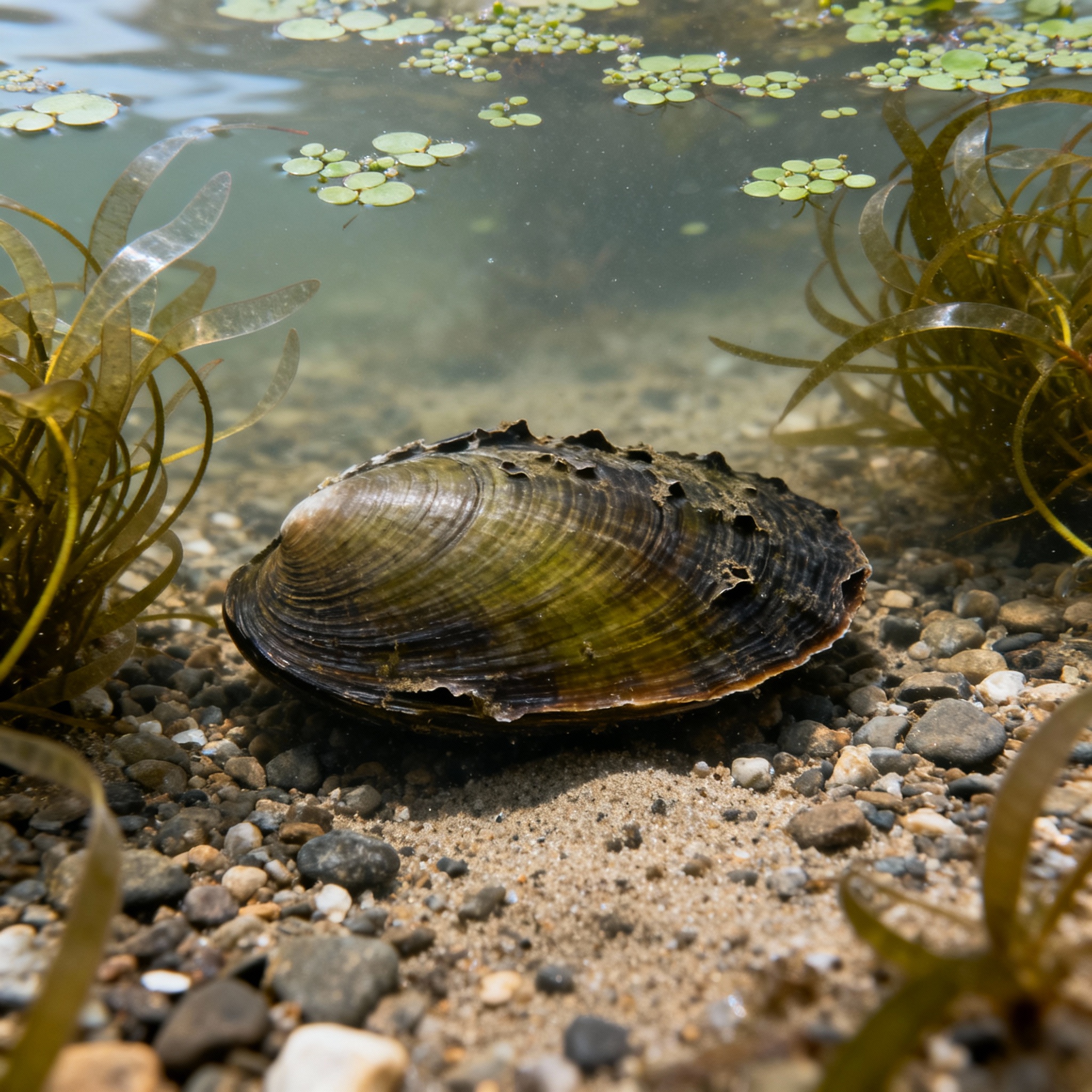
Unio species inhabit slow-moving, often silty or sandy rivers, streams, lakes, and reservoirs, preferring well-oxygenated waters with a bed of gravel, sand, or mud. They are burrowers or cemented to substrates, forming dense colonies that filter-feed on plankton, organic detritus, and bacteria. They thrive in habitats with minimal siltation, although some species adapt to more turbid and polluted waters, acting as bioindicators of ecosystem health. Many species are sedentary, with adults remaining attached to a fixed location, but juveniles may disperse via planktonic glochidia larvae.
Geographical Distribution
Unio occurs predominantly throughout Europe and parts of North Africa and the Middle East. European species such as Unio pictorum and Unio crassus occupy wide ranges and often appear on conservation priority lists. Several species are declining or have spread through introduction because habitat loss, pollution, and invasive competitors threaten them. Fossil records also show that Unio once inhabited North America, although scientists now recognize the genus primarily as an Old World group.
Characteristics of Unio
- Commonly called as fresh water mussel or clam.
- Body is dark brown, unsegmented, bilaterally symmetrical and flattened from side to side measuring 5 to 10 cm in length.
- Animal is completely enclosed in equal bivalve shells. The periostracum is generally smooth and without rays.
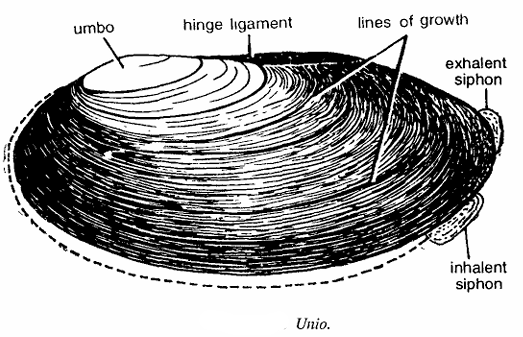
- The hinge-ligament unites the two valves along the dorsal side in a straight hinge-line
- Anteriorly, in front of the hinge, there is a whitish, knob-like swelling on each valve, called as umbo.
- Outer surface of each shell contains various lines of growth. Hinge is without teeth.
- Posteriorly, on lateral margins there are two openings; smaller one is exhalent siphon, while the larger one is inhalent siphon.
- Mantle consists of two lobes, corresponding to two valves of the shell.
- The ctenidia form a W-shape and show a eulamellibranch structure.
- The large, muscular, wedge-shaped foot enables the animal to burrow.. Adductor muscles are of same size, i.e. isomyarian.
- Sexes are separate but the male and female shells are alike.
- Development includes glochidium larva.
- The shells are used in making buttons and animals are largely dissected for understanding nervous system and invertebrate anatomy.
- Shell Morphology: Unio shells are generally rounded or elongated with a strong, usually thick periostracum. The shells are often ornamented with concentric ridges or growth lines, with some species having a pronounced umbilicus.
- Size: Shell length varies from approximately 4 to 12 centimeters depending on the species and environmental conditions.
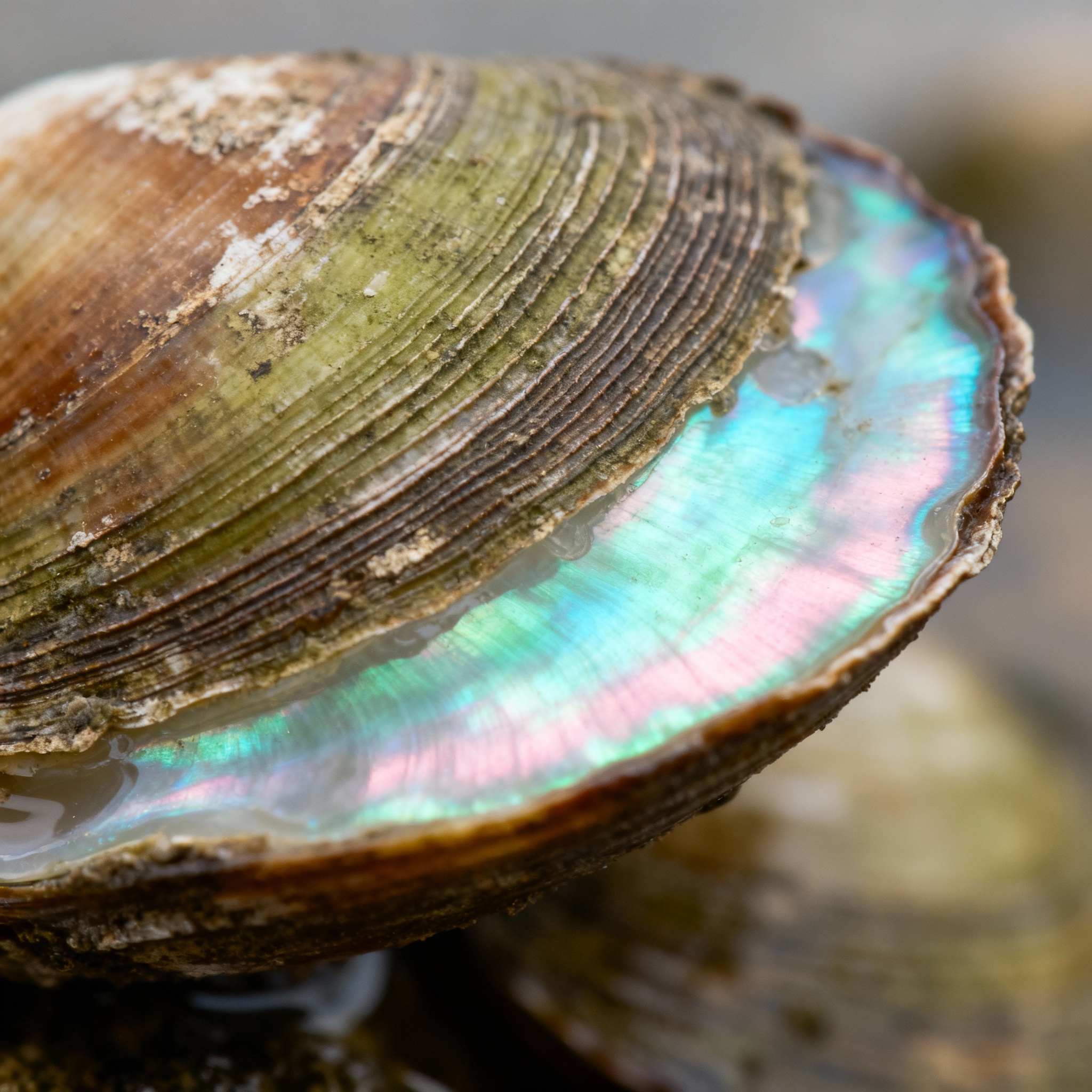
- Coloration: Shells are typically brown, olive, or yellowish with dark or light periostracum. The interior is often iridescent and pinkish or white.
- Shell Structure: The shells are inequilateral, with the hinge protected by the umbo and internal structures supporting the soft tissue.
- Soft Anatomy: The soft body is typically white to grey; the foot is large and muscular for burrowing; ctenidia are used for respiration and filter feeding.
- Reproduction: Unio species have a complex life cycle involving glochidia larvae which parasitize fish hosts, facilitating dispersal. Larvae are released into the water and attach to fish gills or fins until metamorphosis.
Ecology and Behavior
- Feeding: Filter-feeding on plankton, organic particles, and detritus, they contribute to water filtration and clarity.
- Reproduction: Unio broadcast eggs into the water, with larvae parasitizing fish hosts for weeks to months. Successful larvae release detaching from the fish and settle on the bottom to grow into adults.
- Mobility: Adults are largely sessile, attaching to substrate via byssal threads or cementation; the free-swimming larvae enable wide dispersal.
- Environmental Role: As biofilters, Unio mussels help maintain water quality. They are sensitive to pollution and declining water quality, making them key bioindicators for freshwater health assessments.
Conservation and Threats
- Habitat destruction due to dam construction, water extraction, and land use change directly impacts populations.
- Pollution from agricultural runoff, industrial wastes, and sewage decreases water quality and oxygen levels.
- Invasive species, such as zebra and quagga mussels, outcompete native Unio species.
- Climate change affects water temperatures and flow regimes, further threatening vulnerable populations.
- Some species are listed as endangered or critically endangered under various regional conservation frameworks.
Identification
- Shell shape: Rounded to elongated, with thick periostracum.
- Shell sculptures: Concentric ridges or growth lines.
- Size: Mature specimens often measure between 6-12 cm.
- Habitat: Found attached to rocks, riverbeds, or buried in sediment.
- Soft parts: White or grey body with a large foot for burrowing.
- Fish host: Larval stages parasitize freshwater fish, which can be a clue in monitoring programs.
References
- https://en.wikipedia.org/wiki/Unio_(bivalve)
- https://en.wikipedia.org/wiki/Unio_mancus
- https://www.iaszoology.com/unio/
- https://www.sciencedirect.com/science/article/pii/S0075951121000554
- https://bioone.org/journals/freshwater-mollusk-biology-and-conservation/volume-20/issue-2/fmbc.v20i2.2017.33-58/A-Revised-List-of-the-Freshwater-Mussels-Mollusca–Bivalvia/10.31931/fmbc.v20i2.2017.33-58.full
- https://pmc.ncbi.nlm.nih.gov/articles/PMC8890566/
- https://www.scribd.com/document/474260234/Type-study-Unio-Rohu
- https://www.nature.com/articles/s41598-019-48528-z
- https://www.inaturalist.org/taxa/1006290-Unio-mancus
Discover more from Zoologyverse
Subscribe to get the latest posts sent to your email.