
PTYAS (RAT SNAKE)
Ptyas is a genus of large, slender, non-venomous colubrid snakes commonly found across South Asia, Southeast Asia, and East Asia. These snakes are known for their speed, agility, and diurnal habits. They usually inhabit forests, grasslands, agricultural fields, and areas near human settlements. Ptyas species, such as the well-known rat snakes, primarily feed on rodents, frogs, lizards, and birds, making them beneficial for natural pest control. Although they may appear intimidating due to their size and defensive displays, these snakes are harmless to humans and play an essential role in maintaining ecological balance.
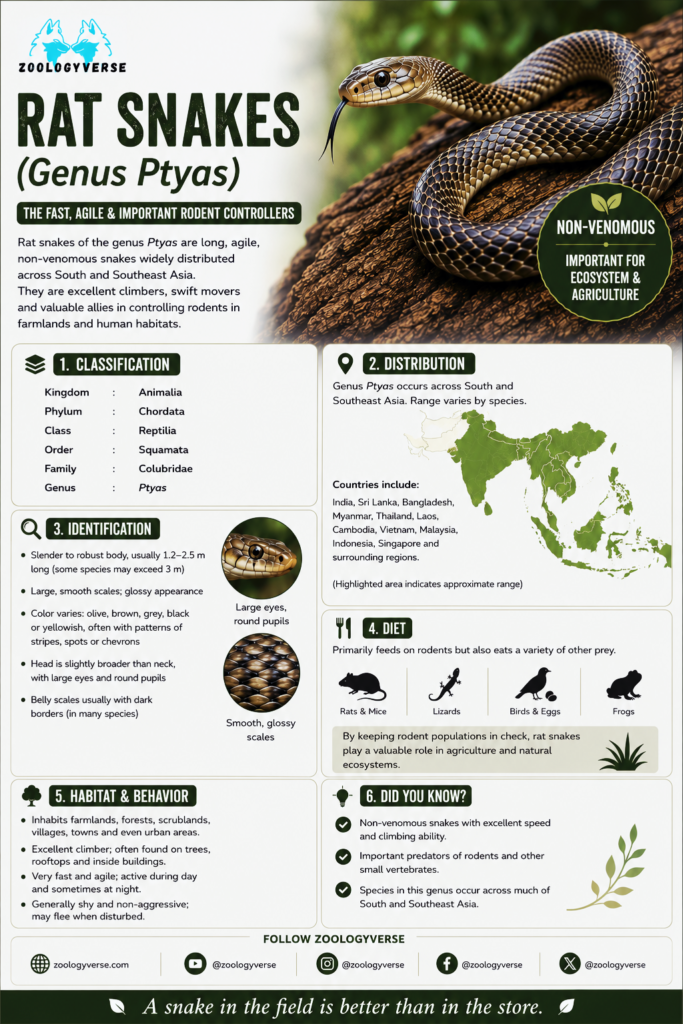
Classification of Ptyas (Rat Snake)
- Phylum :- Chordata (Dorsal tubular nerve cord, notochord and gill-slits present.)
- Group :- Craniata (Definite head, Cranium with brain present.)
- Sub phylum :- Vertebrata (Vertebral column present.)
- Division :- Gnathostomata (Jaws and paired appendages present.)
- Super Class :- Tetrapoda (Paired limbs, lungs, cornified skin and bony skeleton.)
- Class :- Reptilia (Scaly vertebrates. Right and left aortic arches present. Single condyle. Pulmonary respiration. Embryo with amnion and allantois.)
- Sub Class :- Diapsida (Skull with two temporal openings separated by post-orbital and squamosal.)
- Order :- Squamata (Lizards and snakes with horny epidermal scales or shields. Quadrate bone movable. Vertebrae procoelous. Anal opening transverse.. Vertebrae amphicentrous.)
- Sub-order :- Ophidia (Snakes. Limbs, feet, ear openings sternum and urinary bladder absent. Mandibles jointed anteriorly by ligament. Tongue slender, bifid and protrusible. Left lung reduced.)
- Family :- Colubridae (Facial bones movable. No fang.)
- Genus :- Ptyas
Geographical distribution
- They are commonly found on plains in India, Myanmar, Java, Europe, Asia, Africa, North and Central America.
Habit and habitat
- It feeds on frogs, toads, mammals, even snakes and lizards. It can climb on trees and is oviparous.
General Characteristics of Ptyas (Rat Snake)
- Commonly called as Rat snake.
- It attacks forcibly like a whip and hence it is also called as rope snake.
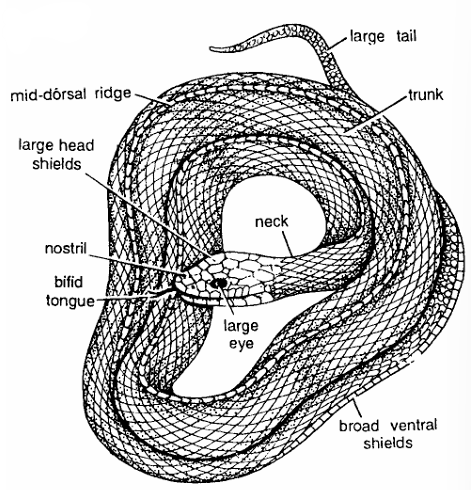
- Body is elongated with dirty, yellow colour measuring about 3 meters in length and covered with 16-17 rows of slightly keeled scales. Body divided into head, neck, trunk and tail.
- Head differentiated from neck and contains slit like mouth, eyes, nostrils and a bifid tongue.
- Loreal region is concave having pre-subocular, nasals and nostrils and supra-ocular forming a ridge on eye.
- It is non-poisonous and active snake
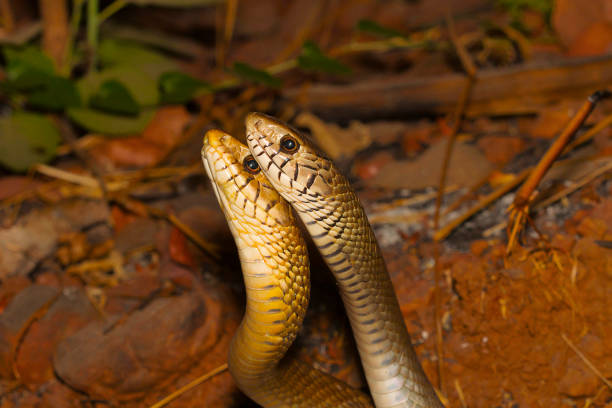
Ecological Importance
- Pest Control: They predominantly feed on rodents, helping to control populations that can otherwise harm crops and spread diseases.
- Balancing Ecosystems: By preying on various small animals, including birds, amphibians, and reptiles, Ptyas contributes to maintaining a balanced ecosystem.
- Prey for Larger Predators: They serve as prey for birds of prey, larger snakes, and carnivorous mammals, playing a crucial role in the food web.
- Indicator Species: Their presence in an area often indicates a healthy environment, as they require adequate prey and suitable habitats.
Conservation Status
- Conservation Status: Most species are listed as Least Concern by the IUCN, but localized populations may face threats.
- Global Status: Most species are listed as Least Concern by the IUCN, but localized populations may face threats.
- Threats:
- Habitat destruction due to agriculture, deforestation, and urbanization.
- Persecution due to fear and misconceptions about snakes.
- Poaching for the pet trade and traditional medicine.
- Conservation Measures:
- Public education to reduce fear and promote coexistence.
- Legal protections to prevent hunting and trading.
- Preservation of natural habitats and control of deforestation
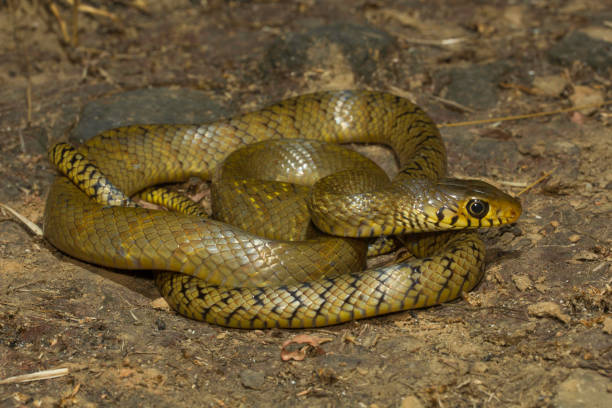
Special features
- Rat snake bites viciously and coils around the victim firmly by its prehensile tail. It emits foul odour and secretes black secretion from the anal glands.
- Impressive Speed: Rat snakes are known for their agility and speed, making them adept hunters and escape artists.
- Non-Venomous Nature: Harmless to humans, they rely on constriction or swift strikes to capture prey.
- Adaptability: These snakes can thrive in a wide range of habitats, from dense forests to urban areas.
- Behavioral Displays: When threatened, rat snakes can exhibit bluffing behavior, such as puffing up or emitting a loud hiss to deter predators.
- Length: Many Ptyas species are among the longest snakes in their respective regions, with some exceeding 3 meters in length.
Identification
- Since this snake contains ridge on eye and above features, hence it is Ptyas.
Discover more from Zoologyverse
Subscribe to get the latest posts sent to your email.